HMS Gurkha (G63)
Service
- as HMS Gurkha18 February 1941 — 17 January 1942333 days of the war
- Name
- HMS Gurkha
- Pennant / hull number
- G63
- Namesake
- Gurkha
- Builder
- Cammell Laird & Co Ltd, Birkenhead
- Ordered
- 31 March 1938
- Laid down
- 18 October 1938
- Launched
- 8 July 1940
- Commissioned
- 18 February 1941
- Fate
- Torpedoed and sunk, 17 January 1942
By torpedo (1942) - Status
- Wreck
Specifications
- Displacement, standard
- 1,920 long tons (1,951 t)
- Displacement, full load
- 2,660 long tons (2,703 t)
- Length
- 110.34 m (362 ft) OA
- Beam
- 11.28 m (37 ft)
- Draught
- 3.05 m (10 ft)
- Speed
- 36 knots (66.7 km/h, 41.4 mph)
- Range
- 5,500 nmi (10,186 km)
- Complement
- 190
- Main gun
- 20 mm (0.8 in)
HMS Gurkha was a destroyer built for the Royal Navy. She carried the pennant number G63. The ship was named after Gurkha. Cammell Laird & Co Ltd, Birkenhead laid her keel on 18 October 1938. Launched on 8 July 1940, she entered service on 18 February 1941.
She displaced 1,920 long tons standard and 2,660 long tons at full load. She measured 110.3 m (362 ft) long with a beam of 11.3 m (37 ft). Her designed speed was 36 knots, and she carried a complement of 190. Her main battery was of 20 mm (0.8 in) calibre.
Her machinery developed 48,000 shp.
She was in commission for 333 days of the Second World War.
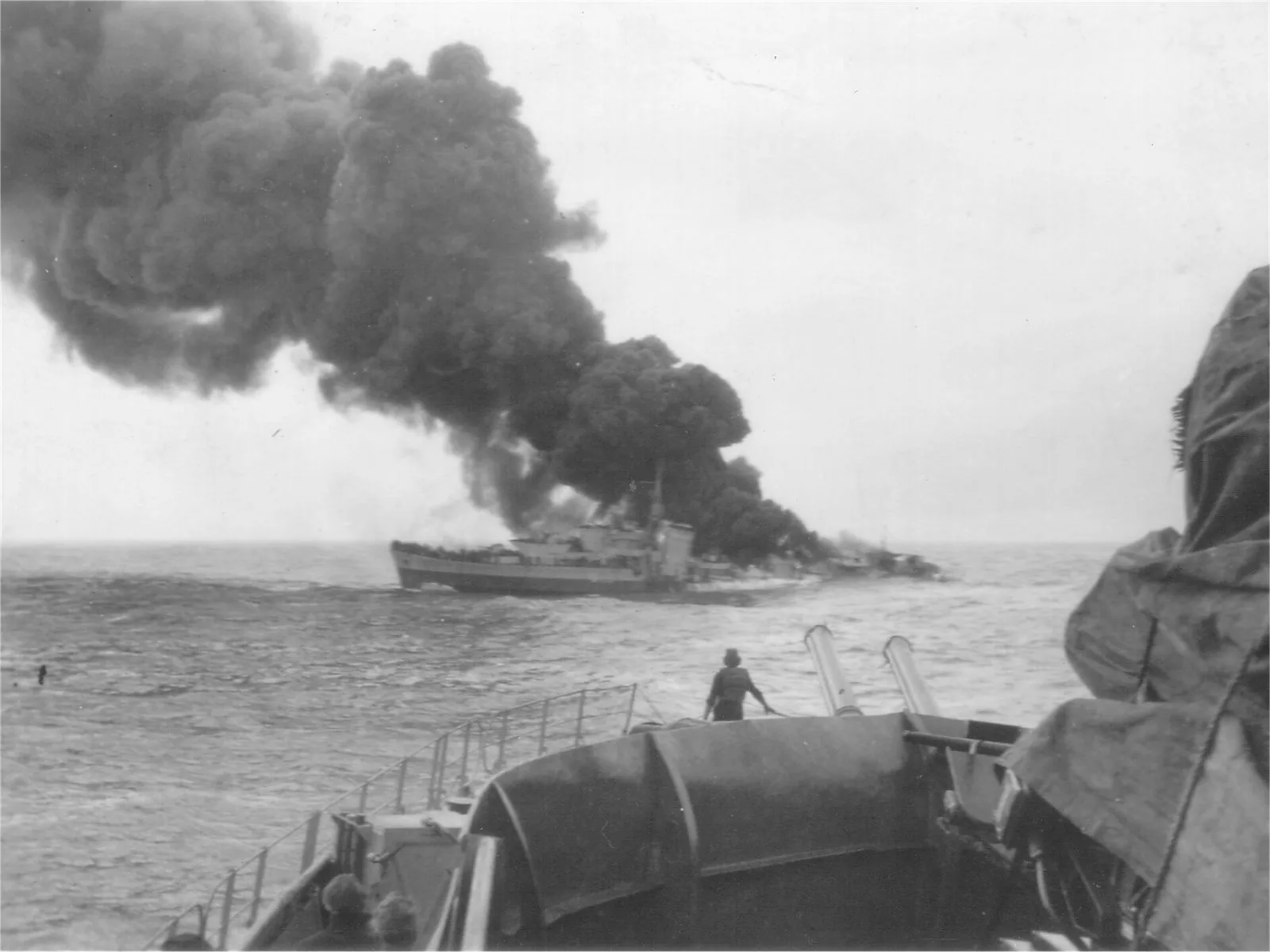
She was sunk on 17 January 1942 by torpedo, at 31°50′N 26°15′E. The wreck survives.
Written from the harvested record. Every figure above is sourced; the wording is this site's own.
Armament and machinery
Armament and machinery
- Propulsion
- 2 × shafts
- 2 × Parsons geared steam turbines
- 2 × Admiralty 3-drum boilers
- Power
- 48000 shp
- Armament
- 4 × 2 – QF 4-inch Mk XVI dual purpose guns
- 1 × 4 – QF 2-pounder Mk VIII anti-aircraft guns
- 2 × 1 – QF 20 mm Oerlikon guns
- 2 × 2 – QF .5-inch Vickers Mk III anti-aircraft machine guns
- 2 × 4 – 21 inch torpedo tubes
- 110 × depth charges, 2 rails and 8 throwers
Sources
- Facts harvested from HMS Gurkha (G63) on Wikipedia. Figures only — no wording is taken from it.
- Photograph: D.S.Hoefsloot — Own work — CC BY-SA 4.0 — Wikimedia Commons