HMS Keppel (D84)
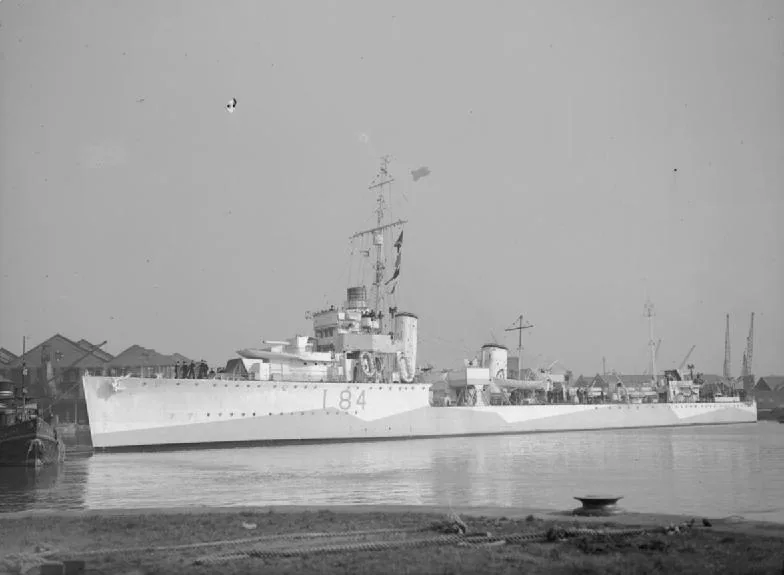
Service
- as HMS Keppel15 April 1925 — 19452,193 days of the war
- Name
- HMS Keppel
- Pennant / hull number
- D84
- Namesake
- Augustus Keppel
- Builder
- John I. Thornycroft & Company
- Ordered
- April 1918
- Laid down
- October 1918
- Launched
- 23 April 1920
- Commissioned
- 15 April 1925
- Recommissioned
- August 1939
- Fate
- Discarded 1945, Scrapped (1945)
- Status
- Scrapped
Specifications
- Displacement, standard
- 1,554 long tons (1,579 t)
- Displacement, full load
- 2,009 long tons (2,041 t)
- Length
- 100.28 m (329 ft) OA
- Beam
- 9.45 m (31 ft)
- Draught
- 3.66 m (12 ft)
- Speed
- 38 knots (70.4 km/h, 43.7 mph)
- Complement
- 164
HMS Keppel was a destroyer of the Thornycroft type destroyer leader, operated by the Royal Navy. She carried the pennant number D84. The ship was named after Augustus Keppel. John I. Thornycroft & Company laid her keel in October 1918. She entered service on 15 April 1925, having been launched on 23 April 1920.
The class followed the Admiralty V-class leader and was succeeded by the Admiralty type leader.
She displaced 1,554 long tons standard and 2,009 long tons at full load. She measured 100.3 m (329 ft) long with a beam of 9.4 m (31 ft). Her designed speed was 38 knots, and she carried a complement of 164.
Her machinery developed 40,000 shp.
She was in commission for 2,193 days of the Second World War. She recommissioned in August 1939.
She was broken up for scrap in 1945.
Written from the harvested record. Every figure above is sourced; the wording is this site's own.
Armament and machinery
Armament and machinery
- Propulsion
- 2 × Brown-Curtiss single reduction steam turbines
- 4 × Yarrow boilers
- 2 × shafts
- Power
- 40000 shp
- Armament
- 5 × BL 4.7 in Mark I dual purpose gun, 1 × QF 3 inch 20 cwt anti-aircraft gun, 6 × 21 inch (533 mm) torpedo tubes (2 × 3)
Sister ships
Sources
- Facts harvested from HMS Keppel (D84) on Wikipedia. Figures only — no wording is taken from it.
- Photograph: Russell, J E (Lt), Royal Navy official photographer — This photograph A 15039 comes from the collections of the Imperial War Museums (collection no. 4700-01) — Public domain — Wikimedia Commons