Japanese battleship Fusō
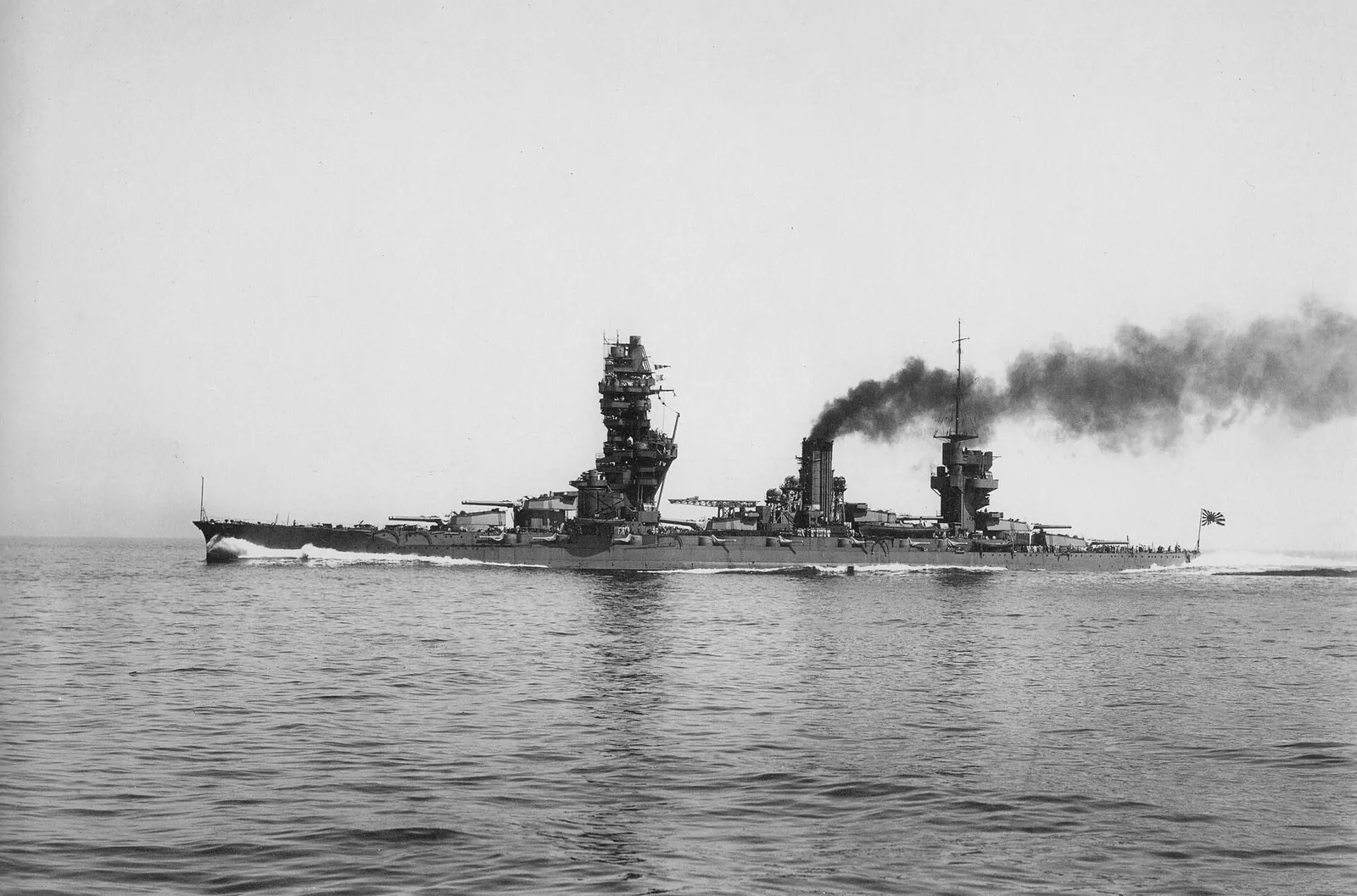
Service
- as Fusō (Japanese: 扶桑)8 November 1915 — 31 August 19452,188 days of the war
- Name
- Fusō
- Namesake
- Fusang, a classical name for Japan
- Builder
- Kure Naval Arsenal
- Laid down
- 11 March 1912
- Launched
- 28 March 1914
- Commissioned
- 8 November 1915
- Struck
- 31 August 1945
- Fate
- Sunk during the Battle of Surigao Strait, 25 October 1944 (1944)
- Status
- Wreck
Specifications — As built
- Displacement, standard
- 29,330 long tons (29,801 t)
- Displacement, full load
- 35,900 long tons (36,476 t)
- Length
- 202.7 m (665 ft) OA
- Beam
- 28.7 m (94.2 ft)
- Draught
- 8.7 m (28.5 ft)
- Speed
- 23 knots (42.6 km/h, 26.5 mph)
- Range
- 8,000 nmi (14,816 km)
- Complement
- 1,198
- Main gun
- 356 mm (14 in)
Fusō was a Fusō-class battleship built for the Imperial Japanese Navy. The ship was named after Fusang. Kure Naval Arsenal laid her keel on 11 March 1912. She entered service on 8 November 1915, having been launched on 28 March 1914.
Her class ran to two ships. The class followed the Kawachi-class battleship and was succeeded by the Ise-class battleship.
Displacement was 29,330 long tons standard and 35,900 long tons at full load. She measured 202.7 m (665 ft) long with a beam of 28.7 m (94 ft). Her designed speed was 23 knots, and she carried a complement of 1,198.
Her main battery was twelve 356 mm (14.0 in) guns in six twin mountings. Her belt armour was 305 mm (12.0 in). Her machinery developed 40,000 shp.
She was in commission for 2,188 days of the Second World War. She was struck from the register on 31 August 1945.
She was sunk on 25 October 1944. The wreck survives.
Written from the harvested record. Every figure above is sourced; the wording is this site's own.
Armament and machinery
This vessel is recorded in 2 configurations. Wartime refits changed armament and complement substantially, so each is kept separately rather than averaged into one set of figures. The figures above are as built.
As built
- Propulsion
- 4 × shafts; 2 × steam turbine sets
- Power
- 24 × Miyahara water-tube boilers
- 40000 shp
- Armament
- 6 × twin 356 mm guns
- 16 × single 152 mm guns
- 6 × 533 mm torpedo tubes
- Armour
- Waterline belt 229 - 305 mm
- Deck: 32 - 51 mm
- Gun turrets: 229 - 279 mm
- Barbettes: 203 - 305 mm
- Conning tower: 351 mm
1944
- Displacement, standard
- 34,700 long tons (35,257 t)
- Length
- 212.75 m (698 ft) OA
- Beam
- 33.1 m (108.6 ft)
- Draught
- 9.7 m (31.8 ft)
- Speed
- 24.5 knots (45.4 km/h, 28.2 mph)
- Range
- 11,800 nmi (21,854 km)
- Complement
- 1,900
- Main gun
- 356 mm (14 in)
- Propulsion
- 4 × steam turbines
- Power
- 6 × water-tube boilers
- 75000 shp
- Armament
- 6 × twin 356 mm guns
- 14 × single 152 mm guns
- 4 × twin 127 mm DP guns
- 8 × triple, 6 × twin, 23 × single 25 mm AA guns
- Armour
- Deck: 51 - 152 mm
- Aircraft
- 3 × floatplanes
Sister ships
Sources
- Facts harvested from Japanese battleship Fusō on Wikipedia. Figures only — no wording is taken from it.
- Photograph: Unknown, assumed official photographer as this a high-quality photo unlikely to be taken by an amateur and the IJN severely restricted professional photography of its ships after World War I. — Kure Maritime Museum, (edited by Kazushige Todaka), Japanese Naval Warship Photo Album: Battleships and Battle Cruisers , p. 133 — Public domain — Wikimedia Commons