USS Arkansas (BB-33)
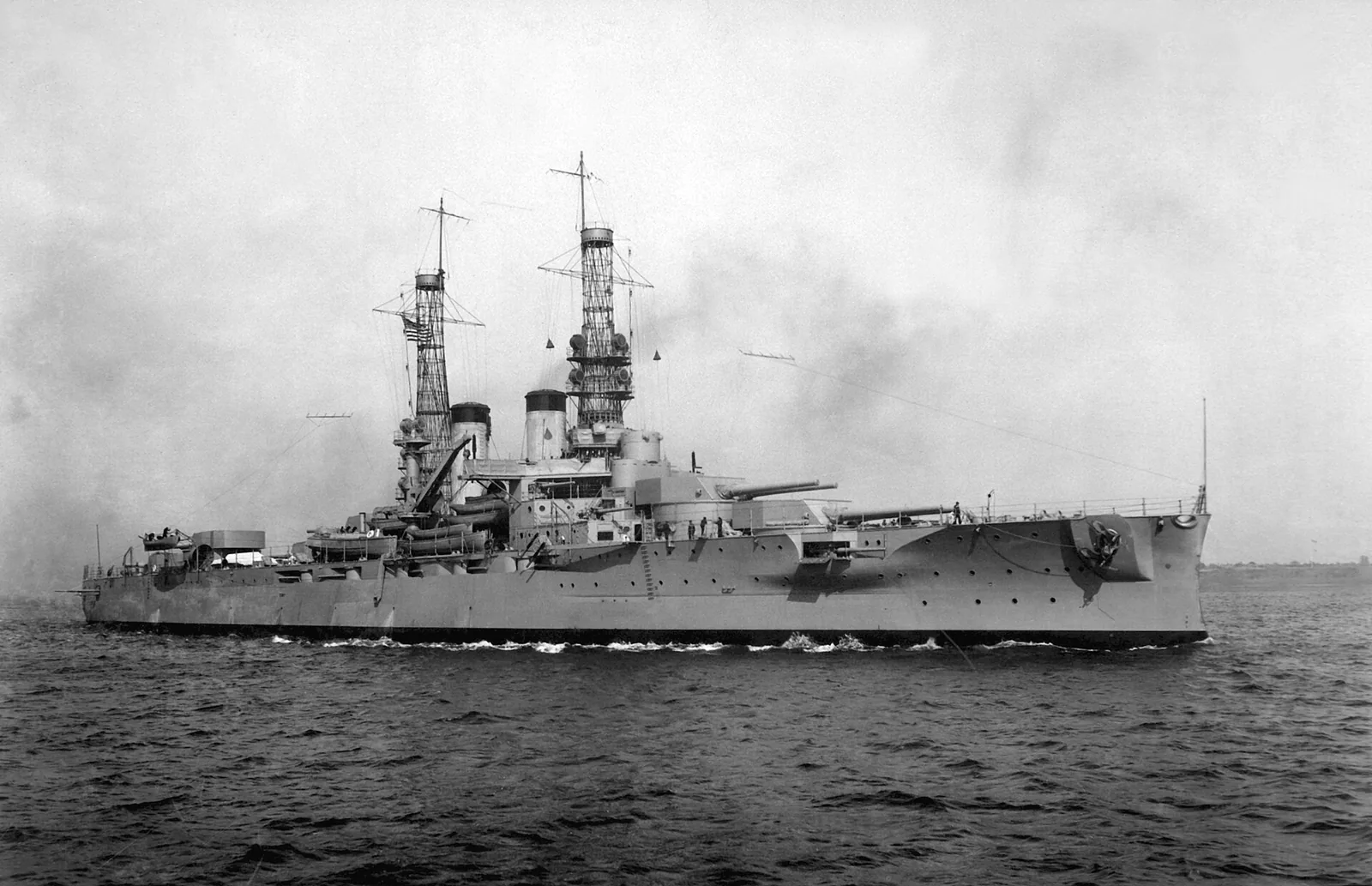
Service
- as Arkansas17 September 1912 — 29 July 19462,193 days of the war
- Name
- USS Arkansas
- Pennant / hull number
- BB-33
- Namesake
- Arkansas
- Builder
- New York Shipbuilding Corporation
- Laid down
- 25 January 1910
- Launched
- 14 January 1911
- Commissioned
- 17 September 1912
- Decommissioned
- 29 July 1946
- Struck
- 15 August 1946
- Fate
- Sunk on 25 July 1946, as part of Operation Crossroads (1946)
- Status
- Wreck
Specifications — As built
- Displacement, standard
- 26,000 long tons (26,417 t)
- Displacement, full load
- 27,243 long tons (27,680 t)
- Length
- 171.3 m (562 ft) OA
- Beam
- 28.35 m (93 ft)
- Draught
- 8.53 m (28 ft)
- Speed
- 20.5 knots (38 km/h, 23.6 mph)
- Range
- 8,000 nmi (14,816 km)
- Complement
- 1,063
- Main gun
- 305 mm (12 in)
Arkansas was admitted to the Union as the 25th state on 15 June 1836. The French Jesuit missionary and explorer Father Jacques Marquette and his confreres recorded the term Arcansas as the plural of the word they transliterated as akansa , an Algonquian name for the Quapaw Native American people.
The third Arkansas (Battleship No. 33) was laid down on 25 January 1910 at Camden, N.J., by the New York Shipbuilding Co.; launched on 14 January 1911; and sponsored by Miss Nancy L. Macon of Helena, Ark., daughter of Representative Robert B. Macon (D., Ark.). While Arkansas carried out her builder’s trials and entered Penobscot Bay, Maine, she struck a rock on 4 June 1912. The mishap occurred just as she passed Two Bush Island outside the harbor of Rockland, and the rock gashed the hull for a length of nearly 45-feet abaft the bow on the port side, under the second engine room. Sailors manned pumps to dewater the flooded compartment so that inspectors could check the damage, and she subsequently resumed her trials. Investigators exonerated Capt. Charles A. Blair of Bath, Maine, the harbor pilot, and Capt. Roy C. Smith retained command of the ship. Arkansas was commissioned at the Philadelphia [Pa.] Navy Yard on 17 September 1912, Capt. Smith in command.
The new battleship fitted out until 6 October 1912, and then (8–15 October) took part in a fleet review by President William H. Taft and Secretary of the Navy George von L. Meyer in the North [Hudson] River off New York City on the 14th, and that day the chief executive briefly bordered her. Arkansas steamed back downriver and across Long Island Sound for a torpedo outfit at Newport, R.I. (16–21 October). On the 21st the ship tested her torpedoes in Narragansett Bay, returned to Newport the following day, and completed repairs and took on stores at New York Navy Yard (23 October–24 November). Arkansas next (25–26 November) began her shakedown cruise to Hampton Roads, Va., and shifted berths there while awaiting further orders through the end of the month. She then (1–3 December) carried out gunnery trials off Tangier Island in Chesapeake Bay, and returned to Hampton Roads to prepare to again take on board the chief executive.
Continue to the full service history About 13,397 words
From the Dictionary of American Naval Fighting Ships, compiled by the Naval History and Heritage Command (Arkansas III (Battleship No. 33)). A work of the United States Government, in the public domain.
Armament and machinery
This vessel is recorded in 3 configurations. Wartime refits changed armament and complement substantially, so each is kept separately rather than averaged into one set of figures. The figures above are as built.
As built
- Propulsion
- 4 × Parsons steam turbines
- 4 × screw propellers
- Power
- 12 × Babcock & Wilcox coal-fired water-tube boilers
- 28000 shp
- Armament
- 12 × 12 in/50 caliber Mark 7 guns
- 21 × 5 in/51 cal guns
- 4 × 3-pounder 47 mm/40 cal saluting guns
- 2 × 21 in torpedo tubes (submerged)
- Armour
- Belt: 5 - 11 in
- Turret face: 12 in
- Barbettes: 11 in
- Conning tower: 11.5 in
- Decks: 1.5 - 2.5 in
1925 1927 refit
- Displacement, standard
- 26,100 long tons (26,519 t)
- Displacement, full load
- 31,000 long tons (31,497 t)
- Draught
- 9.75 m (32 ft)
- Main gun
- 305 mm (12 in)
- Power
- 4 × White-Forster oil-fired boilers
- Armament
- 12 × 12 in/50 cal Mark 7 guns
- 16 × 5 in/51 cal guns (reduced in 1919)
- 8 × 3 in/50 caliber AA guns (added in 1919)
- 4 × 3-pounder saluting guns
- Torpedo tubes removed
- Aircraft
- 3 × floatplanes
1942 refit
- Main gun
- 305 mm (12 in)
- Armament
- 12 × 12 in/50 cal Mark 7 guns
- 6 × 5 in/51 cal guns
- 10 × 3 in/50 cal AA guns
- 4 × 3-pounder saluting guns
- 9 × quad 40 mm Bofors guns
- 26 × 20 mm AA guns
Sister ships
Sources
- Facts harvested from USS Arkansas (BB-33) on Wikipedia. Figures only — no wording is taken from it.
- Service history reproduced verbatim from Arkansas III (Battleship No. 33) , Dictionary of American Naval Fighting Ships — public domain, a work of the United States Government.
- Photograph: Robert Enrique Muller — http://www.dodmedia.osd.mil/DVIC_View/Still_Details.cfm?SDAN=HDSN9902138&JPGPath=/Assets/Still/1999/DoD/HD-SN-99-02138.JPG , a public domain resource — Public domain — Wikimedia Commons