USS Henley (DD-391)
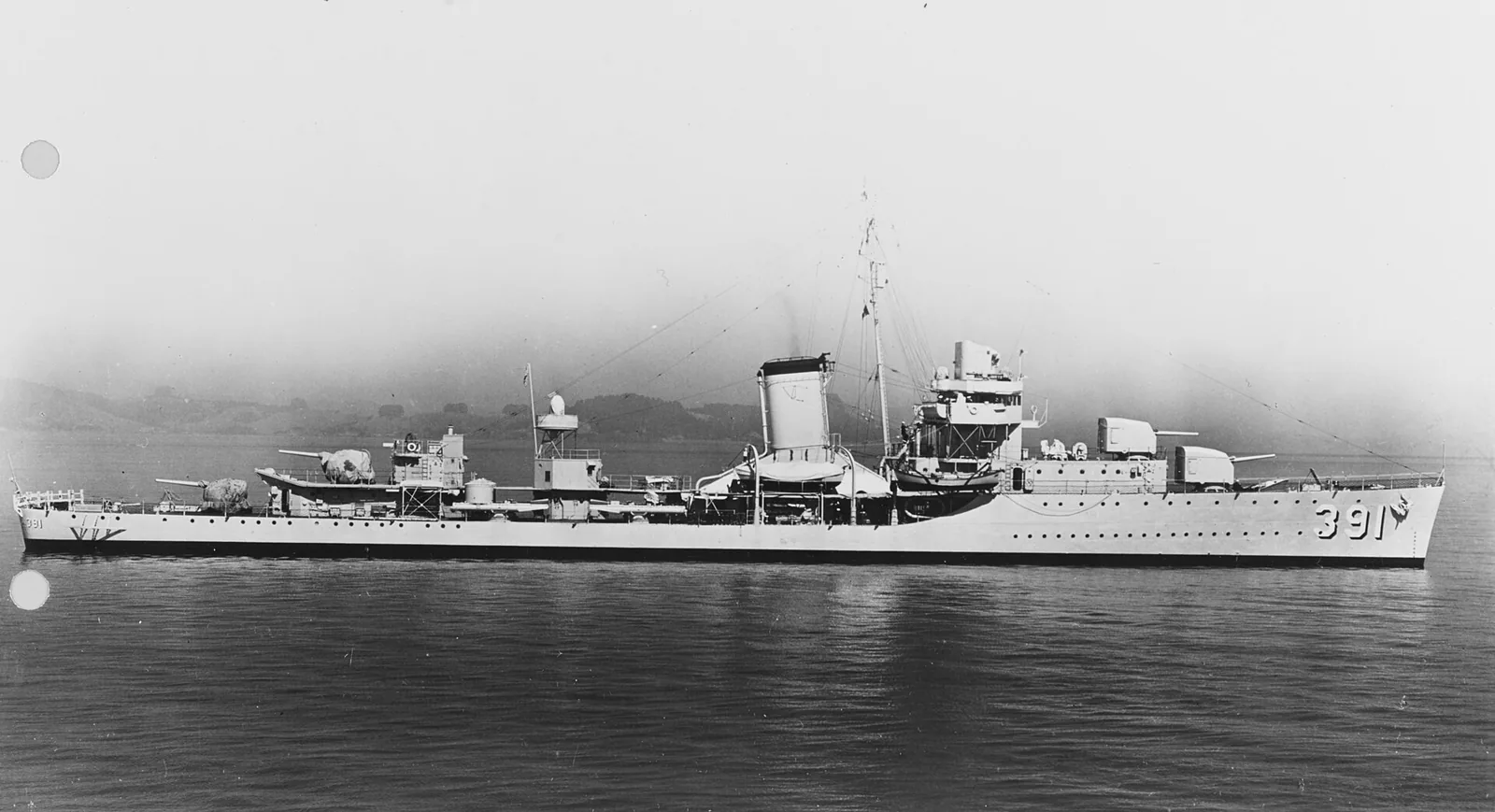
Service
- 14 August 1937 — 3 October 19431,493 days of the war
- Name
- USS Henley
- Pennant / hull number
- DD-391
- Namesake
- Robert Henley
- Builder
- Mare Island Navy Yard
- Laid down
- 28 October 1935
- Launched
- 12 January 1937
- Commissioned
- 14 August 1937
- Fate
- Sunk 3 October 1943 (1943)
- Status
- Wreck
Specifications
- Length
- 103.94 m (341 ft)
- Beam
- 10.67 m (35 ft)
- Draught
- 3.66 m (12 ft)
- Speed
- 38.5 knots (71.3 km/h, 44.3 mph)
- Range
- 6,500 nmi (12,038 km)
- Complement
- 158
The first and second Henleys were named for Robert Henley, born 5 January 1783 in Williamsburg, Va., son of Leonard and Elizabeth Dandridge Henley and nephew of Martha Dandridge Custis Washington. Appointed a midshipman 8 April 1799, Henley participated in the engagement between Constellation and La Vengeance during the Quasi-War with France 2 February 1800. After service with Preble's squadron in the Mediterranean and a cruise to the East Indies, Henley received his first command, Gunboat No. 5, at Baltimore 9 April 1808. Henley was in command of 2 divisions of 15 gunboats which drove 3 British frigates from Hampton Roads 20 June 1813. Reporting to brig Eagle, he received the thanks of Congress and a gold medal for valiant conduct in the Battle of Lake Champlain 11 September 1814. With the end of the War of 1812, Henley filled a variety of billets before commanding Hornet against pirates in the West Indies. He captured pirate schooner Moscow off Santo Domingo 29 October 1821. After serving as commandant of the Naval Rendezvous at Norfolk 1822 to 1824, he reported for similar duty at Charleston. Captain Robert Henley died at Sullivan's Island, Charleston, after a short illness 7 October 1828.
The third Henley was named for John D. Henley, brother of Captain Robert Henley, who was born in Williamsburg 25 February 1781. Commissioned midshipman 14 August 1799, Henley served in Chesapeake cruising in the West Indies until 1801. Departing Baltimore in the schooner Vixen 3 August 1803, he joined the Mediterranean Squadron for the war with Tripoli. An officer in Gunboat No. 6 under Lieutenant John Trippe, Henley participated in the attack on Tripoli 3 August 1804. Gunboat No. 6 ran alongside one of the enemy's large boats and nine men and two officers, Trippe and Henley, stormed the Tripolitan before the gunboat fell away from the enemy. Although outnumbered three to one, the Americans fought so fiercely that within a few minutes the enemy struck their colors. Fourteen of the enemy had been killed and 22 were taken prisoner. Both Trippe and Henley were highly commended for their bravery in this action. Following completion of his tour in the Mediterranean in 1805, Henley made a merchant voyage to distant ports and then in September 1807, assumed command of Gunboat No. 20. Henley then served a tour in Washington and with the outbreak of war against the British was ordered to Charleston in June 1813 to command schooner Carolina. His ship was destroyed 27 December 1814 off New Orleans during a fierce struggle in which the few small warships played a decisive role in delaying the powerful British attack and bringing victory. For his part in the victory at New Orleans 8 January 1815 Henley was highly commended by General Andrew Jackson. Promoted to Captain 5 March 1817, Henley commanded John Adams in the West Indies and Congress in the Indian Ocean before taking command of Macedonian in the struggle against West Indian pirates in 1822. Captain Henley served as commandant of the Charleston and Baltimore stations an dthe Portsmouth Navy Yard, New Hampshire, 1826 to 1832. On 16 August 1832 he was given command of the West India Squadron with Vandalia as his flagship. Captain Henley died on board Vandalia in Havana, Cuba, 23 May 1835.
The second Henley (DD-391) was launched 12 January 1937 by the Mare Island Navy Yard, Vallejo, Calif.; sponsored by Miss Beryl Henley Joslin, a collateral descendant of Captain Robert Henley; and commissioned 14 August 1937, Lt. Comdr. H. Y. McCown in command.
Continue to the full service history About 1,056 words
From the Dictionary of American Naval Fighting Ships, compiled by the Naval History and Heritage Command (Henley II (DD-391)). A work of the United States Government, in the public domain.
Armament and machinery
Armament and machinery
- Propulsion
- 49000 shp
- 2 propellers (screws)
- Armament
- 4 × 5-inch/38-caliber guns
- 4 × .50 cal (12.7 mm) machine guns
- 4 × quad 21-inch (533 mm) torpedo tubes
- 2 × depth charge tracks
Sister ships
Sources
- Facts harvested from USS Henley (DD-391) on Wikipedia. Figures only — no wording is taken from it.
- Service history reproduced verbatim from Henley II (DD-391) , Dictionary of American Naval Fighting Ships — public domain, a work of the United States Government.
- Photograph: Unknown author — This image has been extracted from another file — Public domain — Wikimedia Commons