USS Portland (CA-33)
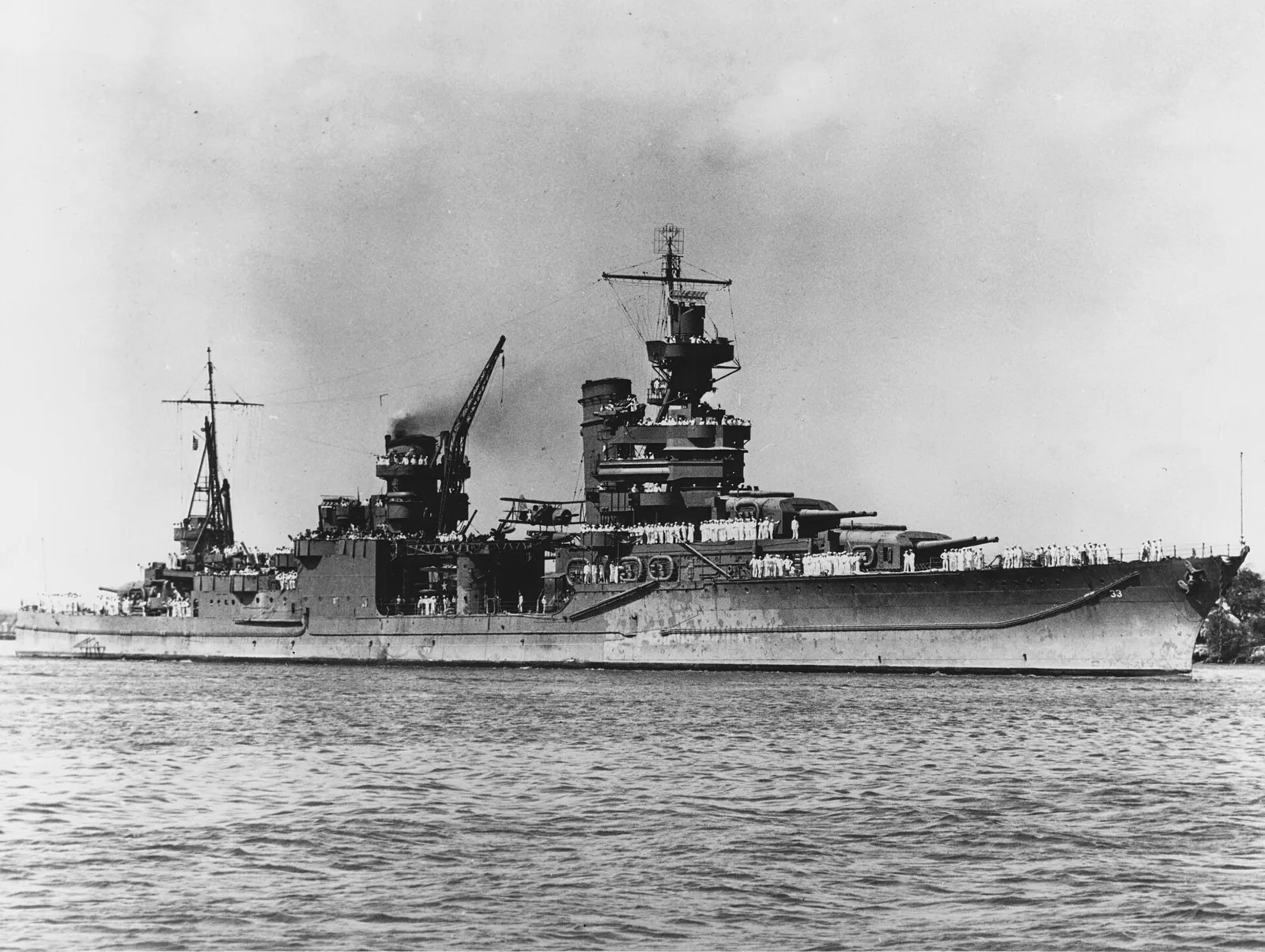
Service
- as Portland23 February 1933 — 12 July 19462,193 days of the war
- Name
- USS Portland
- Pennant / hull number
- CA-33
- Namesake
- City of Portland, Maine
- Builder
- Bethlehem Shipbuilding Corporation's Fore River Shipyard, Quincy, Massachusetts
- Ordered
- 13 February 1929
- Laid down
- 17 February 1930
- Launched
- 21 May 1932
- Commissioned
- 23 February 1933
- Decommissioned
- 12 July 1946
- Struck
- 1 March 1959
- Fate
- Sold for scrap, 6 October 1959 (1959)
- Status
- Scrapped
Specifications — As built
- Displacement, standard
- 9,800 long tons (9,957 t)
- Length
- 185.93 m (610 ft) OA
- Beam
- 20.12 m (66 ft)
- Draught
- 5.18 m (17 ft)
- Speed
- 32.7 knots (60.6 km/h, 37.6 mph)
- Range
- 10,000 nmi (18,520 km)
- Complement
- 848
- Main gun
- 203 mm (8 in)
The first Portland (CA-33) was laid down at Quincy, Mass., by Bethlehem Steel Co., Shipbuilding Div., on 17 February 1930; launched on 21 May 1932; sponsored by Mrs. Ralph D. Brooks of Portland; and commissioned on 23 February 1933, Captain H. F. Leary in command.
Departing Boston 1 April 1933, the cruiser arrived Gravesend Bay, N.Y. the evening of 3 April. The next night she received word that dirigible Akron was down at sea. Thirty six minutes after receipt of the message the ship was underway. Racing seaward, she was the first naval vessel at the scene of the disaster, and the task of search and rescue coordination was thus hers. Seventy-three lives were lost in the disaster, including that of Admiral William Moffett, Chief, Bureau of Aeronautics.
Portland steamed from San Diego, Calif. 2 October 1935 astern Houston (CA-30) which carried President Franklin D. Roosevelt. The following days the president and his party fished. After calling at Panama and several other ports, the two ships steamed to Charleston, S.C. where the president disembarked.
Continue to the full service history About 1,278 words
From the Dictionary of American Naval Fighting Ships, compiled by the Naval History and Heritage Command (Portland I (CA-33)). A work of the United States Government, in the public domain.
Armament and machinery
This vessel is recorded in 2 configurations. Wartime refits changed armament and complement substantially, so each is kept separately rather than averaged into one set of figures. The figures above are as built.
As built
- Propulsion
- 4 × Parsons reduction steam turbines
- 4 × screws
- Power
- 8 × Yarrow boilers
- 107000 shp
- Armament
- 9 × 8 in/55 caliber guns (3x3)
- 8 × 5 in/25 caliber anti-aircraft guns
- 2 × 3-pounder 47 mm saluting guns
- 8 × caliber 0.50 in machine guns
- Armour
- Belt: 3+1/4 - 5 in
- Deck: 2+1/2 in
- Barbettes: 1+1/2 in
- Turrets: 1+1/2 - 2+1/2 in
- Conning Tower: 1+1/4 in
- Aircraft
- 4 × floatplanes
1945
- Main gun
- 203 mm (8 in)
- Armament
- 9 × 8 in/55 caliber guns (3x3)
- 8 × 5 in/25 caliber anti-aircraft guns
- 2 × 3-pounder 47 mm saluting guns
- 4 × quad 40 mm Bofors anti-aircraft guns
- 4 × twin 40 mm Bofors anti-aircraft guns
- 17 × single 20 mm Oerlikon anti-aircraft cannons
Sister ships
Sources
- Facts harvested from USS Portland (CA-33) on Wikipedia. Figures only — no wording is taken from it.
- Service history reproduced verbatim from Portland I (CA-33) , Dictionary of American Naval Fighting Ships — public domain, a work of the United States Government.
- Photograph: USN — Official U.S. Navy photograph NH 97833 from the U.S. Navy Naval History and Heritage Command — Public domain — Wikimedia Commons