USS West Virginia (BB-48)
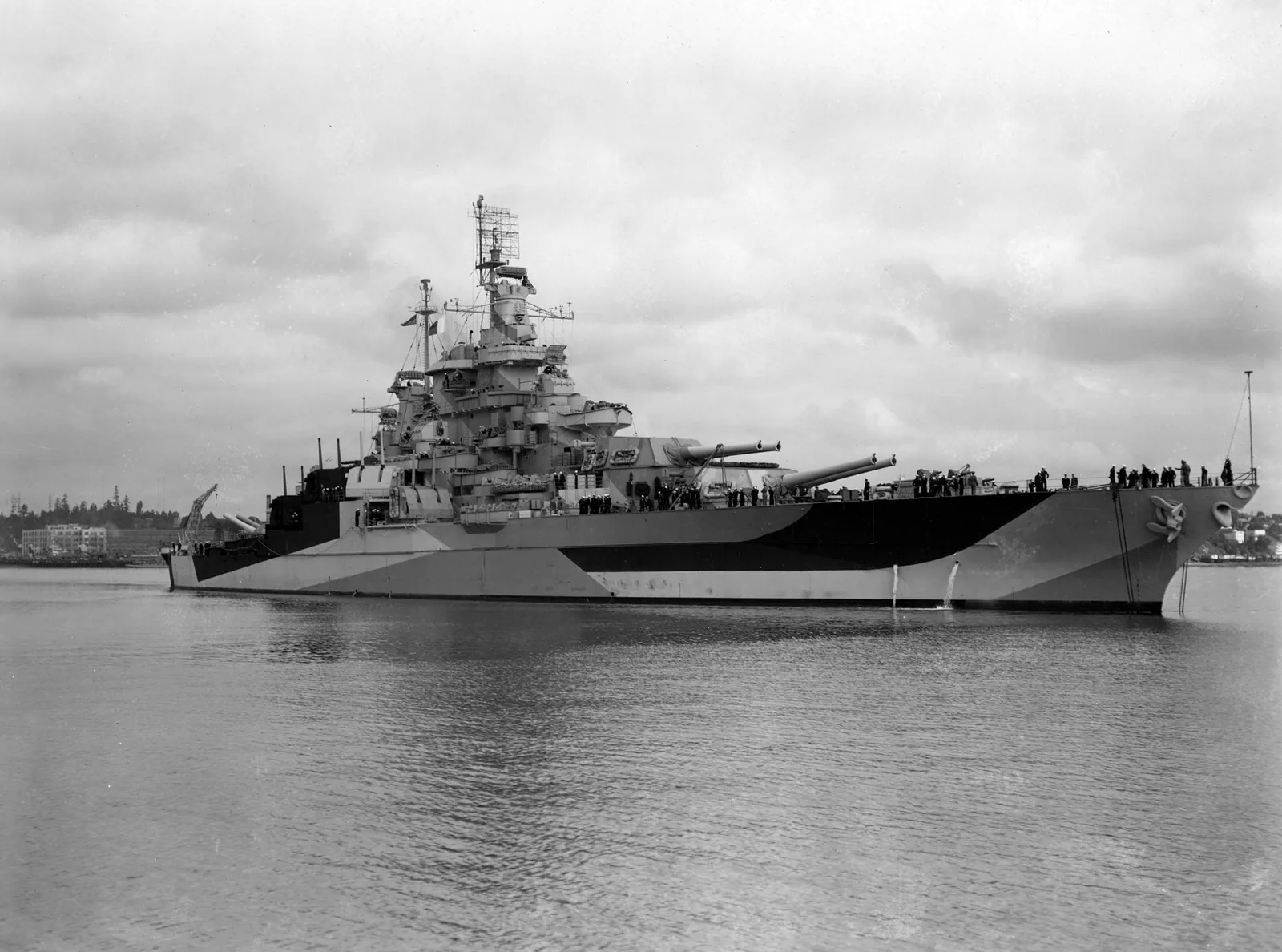
Service
- as West Virginia1 December 1923 — 9 January 19472,193 days of the war
- Name
- USS West Virginia
- Pennant / hull number
- BB-48
- Namesake
- West Virginia
- Builder
- Newport News Shipbuilding
- Ordered
- 5 December 1916
- Laid down
- 12 April 1920
- Launched
- 19 November 1921
- Commissioned
- 1 December 1923
- Decommissioned
- 9 January 1947
- Struck
- 1 March 1959
- Fate
- Sold for scrap, 24 August 1959 (1959)
- Status
- Scrapped
Specifications — Original configuration
- Displacement, standard
- 32,693 long tons (33,218 t)
- Displacement, full load
- 33,590 long tons (34,129 t)
- Length
- 190.2 m (624 ft)
- Beam
- 29.57 m (97 ft)
- Draught
- 9.14 m (30 ft)
- Speed
- 21 knots (38.9 km/h, 24.2 mph)
- Range
- 8,000 nmi (14,816 km)
- Complement
- 1,305
- Main gun
- 406 mm (16 in)
At the outbreak of the Civil War, 40 western counties of Virginia remained loyal when the rest of the state seceded. West Virginia was admitted to the Union as the 35th state on 20 June 1863
The second West Virginia (Battleship No. 48) was laid down on 12 April 1920 at Newport News, Va., by the Newport News Shipbuilding & Dry Dock Co.; reclassified to BB-48 on 17 July 1920; launched on 17 November 1921; sponsored by Miss Alice Wright Mann, daughter of Issac T. Mann, a prominent West Virginian; and commissioned on 1 December 1923, Capt. Thomas J. Senn in command.
The most recent of the "super-dreadnoughts," West Virginia embodied the latest knowledge of naval architecture; the water-tight compartmentation of her hull and her armor protection marked an advance over the design of battleships built or on the drawing boards before the Battle of Jutland.
Continue to the full service history About 5,781 words
From the Dictionary of American Naval Fighting Ships, compiled by the Naval History and Heritage Command (West Virginia II (BB-48)). A work of the United States Government, in the public domain.
Armament and machinery
This vessel is recorded in 2 configurations. Wartime refits changed armament and complement substantially, so each is kept separately rather than averaged into one set of figures. The figures above are as built.
Original configuration
- Propulsion
- 4 × General Electric turbo-electric drive
- 4 × Propellers
- Power
- 8 × Babcock & Wilcox boilers
- 28900 shp
- Armament
- 8 × 16 in/45 caliber guns
- 16 × 5 in/51 caliber guns
- 8 × 3 in/50 caliber guns
- 2 × 21 in torpedo tubes
- Armour
- Belt: 8 - 13.5 in
- Barbettes: 13 in
- Turret face: 18 in
- Conning tower: 16 in
- Decks: 3.5 in
Final configuration
- Beam
- 34.75 m (114 ft)
- Main gun
- 406 mm (16 in)
- Armament
- 8 × 16 in/45 caliber guns
- 16 × 5 in/38 cal guns
- 40 × Bofors 40 mm gun guns
- 43 × Oerlikon 20 mm cannons
Sister ships
Sources
- Facts harvested from USS West Virginia (BB-48) on Wikipedia. Figures only — no wording is taken from it.
- Service history reproduced verbatim from West Virginia II (BB-48) , Dictionary of American Naval Fighting Ships — public domain, a work of the United States Government.
- Photograph: U.S. Navy Bureau of Ships — Official U.S. Navy photo 19-N-68376 from the U.S. Navy Naval History and Heritage Command — Public domain — Wikimedia Commons