Royal Navy — Destroyer
HMCS Lincoln (G42) — service history
This is the full service history. For the vessel's particulars, photograph and specifications, see the entry.
In the words of the US Navy. The account below is reproduced verbatim from the Dictionary of American Naval Fighting Ships, compiled by the Naval History and Heritage Command — a work of the United States Government, in the public domain, and the only text on this site not written here.
Before commissioning
John Joliffe Yarnall, born in Wheeling, Va. (now W.Va.) in 1786, was appointed midshipman in the Navy on 11 January 1809. Between 1809 and 1812, Yarnall cruised the coastal waters of the United States in Chesapeake and Revenge performing duty that was tantamount to blockading his own country to enforce President Madison's embargo on trade with the European adversaries during the Napoleonic Wars. In 1813, he was transferred to Oliver Hazard Perry's command on the Great Lakes and became the first lieutenant on board Perry's flagship, Lawrence. He participated in the decisive Battle of Lake Erie on 10 September 1813, and, though wounded, refused to leave his post during the engagement. When Perry shifted his flag to Niagara during the battle, Lt. Yarnall assumed command of Lawrence. After the battle, he took the squadron's wounded on board and carried them back to Erie for medical attention. For his gallantry in the battle, Yarnall earned Perry's commendation as well as a medal expressing the gratitude of Congress and the country.
In the spring of 1815, Yarnall sailed from New York with Stephen Decatur in the frigate Guerriere for the Mediterranean Sea. On 17 June, off the Algerian coast, his ship encountered and captured Meshuda, the flagship of the Algerine "Navy." While defending his country's honor and rights during that engagement, the valiant Yarnall again suffered wounds. Probably because of his wounds, Lt. Yarnall was chosen as the bearer of dispatches from Decatur's squadron to the government in Washington. In July 1815, he embarked in the sloop-of-war Epervier for the voyage home. The warship was last seen on 14 July 1815 as she passed through the Strait of Gibraltar and into the Atlantic. Presumably, Yarnall and all others on board went down with her during the transatlantic voyage.
(Destroyer No. 143: dp. 1,154 (n.); l. 314'4- "; b. 30'11- "; dr. 9'10- " (aft) (f.); s. 35.12 k. (tl.); cpl. 122; a. 4 4", 2 3", 12 21" tt., 2 .30-cal. mg., 2 dct.; cl. Wickes )
Great War and before
1918
The first Yarnall (Destroyer No. 143) was laid down on 12 February 1918 at Philadelphia, Pa., by William Cramp & Sons Ship & Engine Building Co.; launched on 19 June 1918; sponsored by Mrs. Marie H. Bagley; and commissioned on 29 November 1918, Cmdr. William F. Halsey, Jr., in command.
Interwar 1919–1938
1920
Assigned to Division 15, Destroyer Force, Yarnall served briefly with United States naval forces in France during 1919. By 1 January 1920, her division had been reassigned to Flotilla 5, Destroyer Squadron 4, Pacific Fleet, and operated out of the San Diego destroyer base. Her division, redesignated Division 13 in February, received orders in April to proceed to the Asiatic station; but she apparently did not begin that assignment until late the following fall. Yarnall returned from the Far East to the United States late in the summer of 1921 and began repairs at Puget Sound. In December, she was reassigned to Division 11 and again operated out of San Diego until 29 May 1922 when she was decommissioned there and placed in reserve.
1930
After almost eight years of inactivity, the destroyer was recommissioned at San Diego on 19 April 1930, Cmdr. John F. McClain in command. Assigned initially to Division 11, Squadron 10, Battle Fleet Destroyer Squadrons, Yarnall operated briefly on the west coast before being transferred to the east coast sometime late in 1930. By New Year's Day, 1931, her home port had been changed to Charleston, S.C. In March, she joined the Scouting Force as a unit of Destroyer Division 3 but retained Charleston as her home port. The destroyer operated out of that base until late in the summer of 1934 when, though still a unit of Scouting Force Destroyers, she returned to the west coast. Based at San Diego, the warship remained active along the California coast until late in 1936. She then returned to the east coast and, on 30 December 1936, was placed out of commission at Philadelphia and berthed there with the reserve fleet.
Second World War 1939–1945
1939
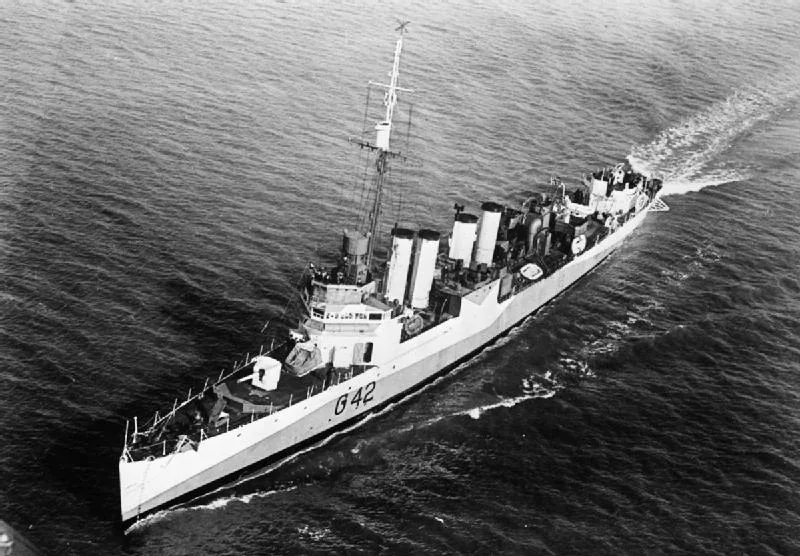
As a part of President Roosevelt's program to bolster the minuscule Atlantic Squadron after war broke out in Europe in September 1939, Yarnall ended her 21-month, second retirement on 4 October 1939 when she was recommissioned at Philadelphia, Lt. Cmdr. John G. Winn in command. She became a unit of Destroyer Squadron 11 of the Atlantic Squadron, the small fleet assigned the enormous task of keeping war out of the western hemisphere. She operated out of Norfolk in the Neutrality Patrol until the fall of 1940 when the United States concluded the destroyers-for-bases deal with the United Kingdom.
1940
Yarnall was one of the 50 overage destroyers chosen to be turned over to the Royal Navy in return for the right to establish American bases on British territory in the western hemisphere. She proceeded to St. John's, Newfoundland, where she was decommissioned by the United States Navy on 23 October 1940; and, that same day, the Royal Navy commissioned her as HMS Lincoln (G.42), Cmdr. G. B. Sayer, RN, in command.
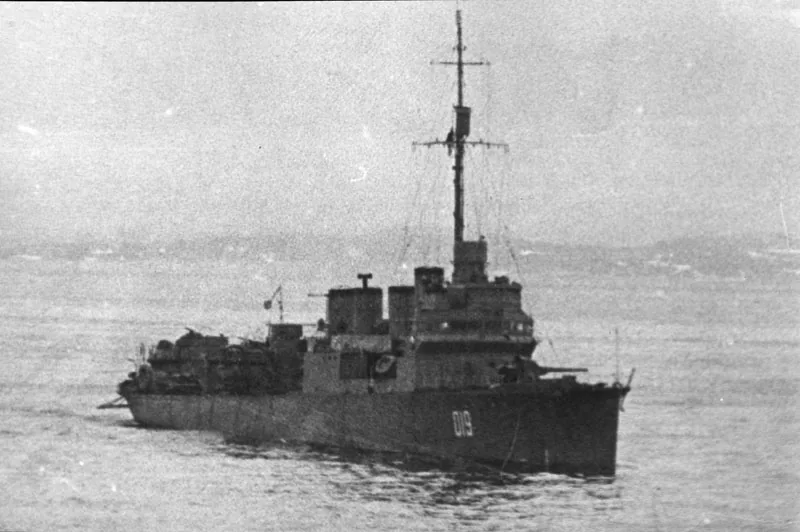
The veteran destroyer departed St. John's on 3 November 1940 and arrived in Belfast, Northern Island, on the 9th. Lincoln moved from there to Londonderry where she was assigned to the First Escort Group, Western Approaches Command. For almost a year, she met troop transport and cargo convoys in mid-ocean and escorted them into ports in the British Isles. Between September 1941 and February 1942, the destroyer was refitted at Woolwich, England. At the conclusion of that overhaul, she was turned over to an expatriate Norwegian crew and was sent back across the ocean to serve with the Western Local Escort Force, operating along the Newfoundland coast between Halifax and St. John's. In July 1942, HMS Lincoln became HMCS Lincoln when she was transferred from the Royal Navy to the Royal Canadian Navy, though still manned by Norwegians. Her duty in Canadian waters continued until the end of 1943, at which time she recrossed the Atlantic. She departed Halifax on 19 December and arrived back in Londonderry on Christmas Day. Early in 1944, the venerable warship was placed in reserve in the Tyne River. Her service to the Allied cause, however, had not quite ended. On 26 August 1944, she was transferred to the Soviet Navy to be cannibalized to provide spare parts for eight of her sisters previously given to the Russians. Her name had already been struck from the United States Navy list on 8 January 1941-soon after her transfer to the Royal Navy.
Other photographs
Held for this vessel, and not tied to any part of the account above.
References
Every work this entry draws on. There are no numbered markers in the text above: what we hold is the provenance of the page — this history, this article, these photographs.
- History Yarnall I (Destroyer No. 143) Dictionary of American Naval Fighting Ships, Naval History and Heritage Command. A work of the United States Government, in the public domain — the only text on this site reproduced verbatim.
- Facts HMCS Lincoln (G42) Structured facts only — dates, dimensions, armament and fate. No wording is taken from it. Harvested 1 August 2026.
- Photograph USS Yarnall (DD-143) Unknown author — Public domain — Wikimedia Commons
- Photograph Druzhnyy1944-1952 Igor Ageev — Image from Destroyer Photo Index DD-143 USS YARNALL — Public domain — Wikimedia Commons
- Photograph Lincoln FL3271 Royal Navy official photographer — http://media.iwm.org.uk/iwm/mediaLib//7/media-7278/large.jpg This photograph FL 3271 comes from the collections of the Imperial War Museums — Public domain — Wikimedia Commons
- Photograph US Navy cruisers and destroyers at Balboa, Panama on 23 April 1934 U.S. Navy — Official U.S. Navy photo 80-G-455906 from the U.S. Navy Naval History and Heritage Command — Public domain — Wikimedia Commons