Royal Navy — Destroyer
D14
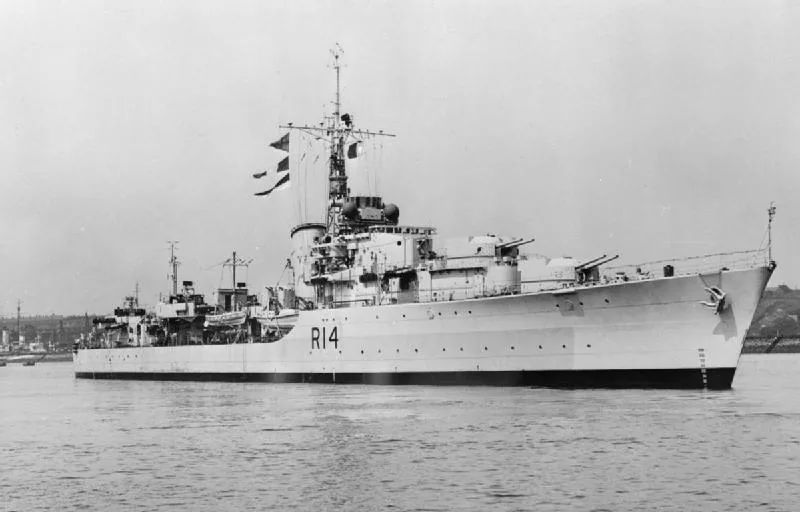
HMS Armada (D14)
Service
- as HMS Armada2 July 1945 — 196062 days of the war
Battle-class destroyer
Particulars
- Name
- HMS Armada
- Pennant / hull number
- D14
- Builder
- Hawthorn Leslie and Company
- Laid down
- 29 December 1942
- Launched
- 9 December 1943
- Commissioned
- 2 July 1945
- Decommissioned
- 1960
- Fate
- Sold for breaking up, 1965 (1965)
- Status
- Unknown
Specifications
- Displacement, standard
- 2,325 long tons (2,362 t)
- Length
- 115.52 m (379 ft)
- Beam
- 12.27 m (40.3 ft)
- Main gun
- 114 mm (4.5 in)
HMS Armada was a Battle-class destroyer in service with the Royal Navy. She carried the pennant number D14. Her keel was laid at Hawthorn Leslie and Company on 29 December 1942. Launched on 9 December 1943, she entered service on 2 July 1945.
She was one of two ships of her class. The class followed the Weapon-class destroyer and was succeeded by the Daring-class destroyer (1949).
She displaced 2,325 long tons. She measured 115.5 m (379 ft) long with a beam of 12.3 m (40 ft). Her main battery was of 114 mm (4.5 in) calibre.
She was in commission for 62 days of the Second World War. She was decommissioned in 1960.
Written from the harvested record. Every figure above is sourced; the wording is this site's own.
Armament and machinery
Armament and machinery
- Armament
- 4 × QF 4.5 in guns
- 1 × 4 in gun
- 8 × torpedo tubes
Sister ships
Sources
- Facts harvested from HMS Armada (D14) on Wikipedia. Figures only — no wording is taken from it.
- Photograph: Royal Navy official photographer — This photograph FL 1000 comes from the collections of the Imperial War Museums (collection no. 8308-29) — Public domain — Wikimedia Commons