HMS Dido (37)
Service
- as Dido30 September 1940 — October 19471,800 days of the war
- Name
- HMS Dido
- Pennant / hull number
- 37
- Namesake
- Dido
- Builder
- Cammell Laird Shipyard (Birkenhead, UK)
- Laid down
- 26 October 1937
- Launched
- 18 July 1939
- Commissioned
- 30 September 1940
- Fate
- Scrapped, 18 July 1957 (1957)
- Status
- Scrapped
Specifications
- Displacement, standard
- 5,600 long tons (5,690 t)
- Displacement, full load
- 6,850 long tons (6,960 t)
- Length
- 156.06 m (512 ft) OA
- Beam
- 15.24 m (50 ft)
- Draught
- 4.27 m (14 ft)
- Speed
- 32.3 knots (59.7 km/h, 37.1 mph)
- Range
- 1,500 nmi (2,778 km)
- Complement
- 480
- Main gun
- 133 mm (5.2 in)
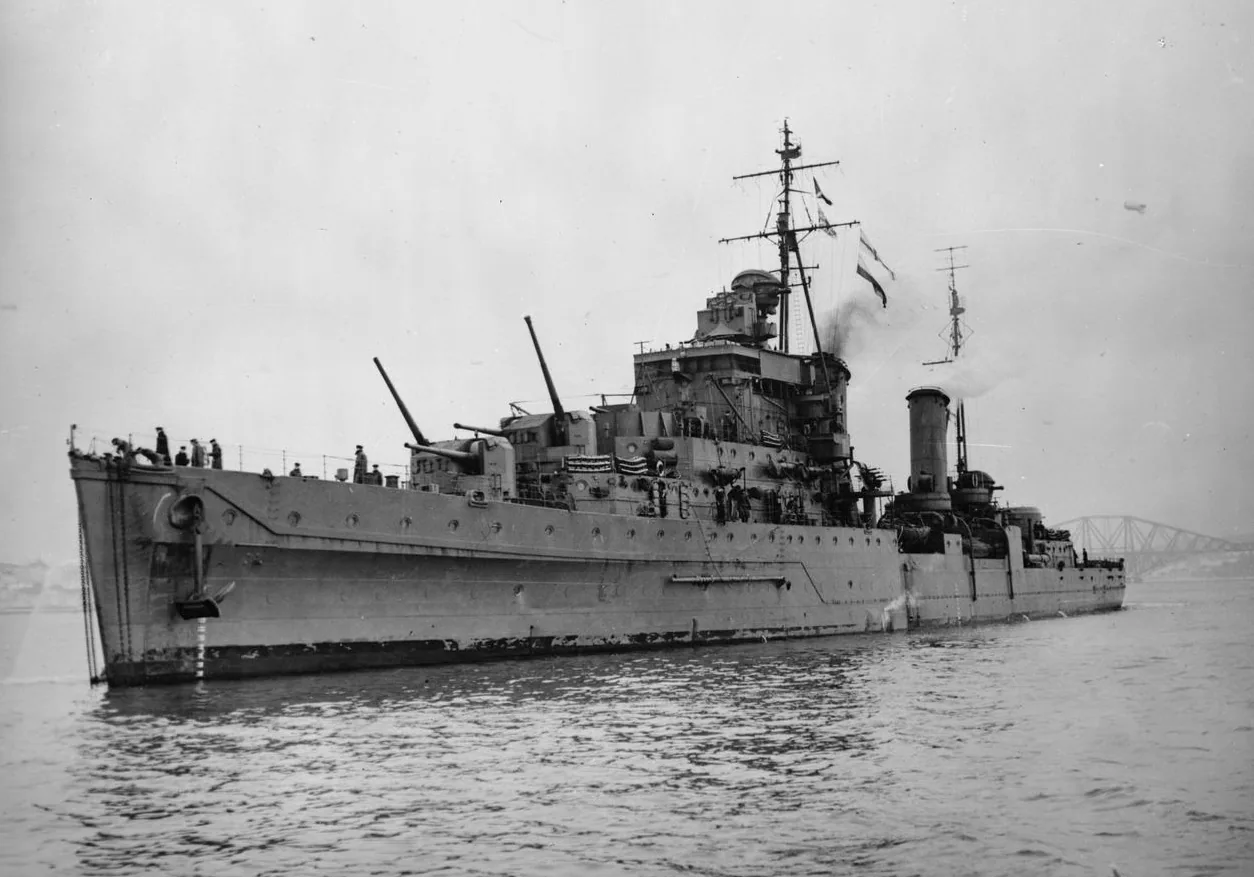
HMS Dido was a Dido-class cruiser anti-aircraft cruiser, operated by the Royal Navy. She carried the pennant number 37. She was named for Dido. Her keel was laid at Cammell Laird Shipyard (Birkenhead, UK) on 26 October 1937. Launched on 18 July 1939, she entered service on 30 September 1940.
16 ships of the class were built. The class followed the Arethusa-class cruiser and was succeeded by the Fiji-class cruiser.
Displacement was 5,600 long tons standard and 6,850 long tons at full load. She measured 156.1 m (512 ft) long with a beam of 15.2 m (50 ft). Her designed speed was 32.2 knots, and she carried a complement of 480.
Her main battery was ten 133 mm (5.2 in) guns. Her machinery developed 62,000 shp.
She was in commission for 1,800 days of the Second World War.
She was broken up for scrap on 18 July 1957.
Written from the harvested record. Every figure above is sourced; the wording is this site's own.
Armament and machinery
Armament and machinery
- Propulsion
- 4 × geared steam turbines
- 4 × Admiralty 3-drum boilers
- 4 × shafts
- Power
- 62000 shp
- Armament
- 10 × 5.25 in dual purpose guns (5 × 2)
- 1 × 4 in anti-aircraft gun
- 12 × 2-pounder pom-pom guns (3 × 4)
- 8 × .50 cal machine guns (2 × 4)
- 6 × 21 inch (533 mm) torpedo tubes (2 × 3)
- Armour
- Belt: 3 in
- Deck: 1 in
- Magazines: 2 in
- Bulkheads: 1 in
Sister ships
Sources
- Facts harvested from HMS Dido (37) on Wikipedia. Figures only — no wording is taken from it.
- Photograph: Royal Navy official photographer — This photograph FL 24425 comes from the collections of the Imperial War Museums (collection no. 8308-29) — Public domain — Wikimedia Commons