HMS Telemachus (P321)
Service
- as HMS Telemachus25 October 1943 — 1 August 1961678 days of the war
- Name
- HMS Telemachus
- Pennant / hull number
- P321
- Namesake
- Telemachus
- Builder
- Vickers-Armstrongs, Barrow
- Ordered
- 3 August 1941
- Laid down
- 25 August 1942
- Launched
- 19 June 1943
- Commissioned
- 25 October 1943
- Fate
- Scrapped 1 August 1961 (1961)
- Status
- Scrapped
Specifications
- Displacement, surfaced
- 1,290 long tons (1,311 t)
- Displacement, submerged
- 1,560 long tons (1,585 t)
- Length
- 84.12 m (276 ft)
- Beam
- 7.62 m (25 ft)
- Draught
- 3.66 m (12 ft)
- Speed
- 15.5 knots (28.7 km/h, 17.8 mph)
- Range
- 4,500 nmi (8,334 km)
- Complement
- 61
- Main gun
- 102 mm (4 in)
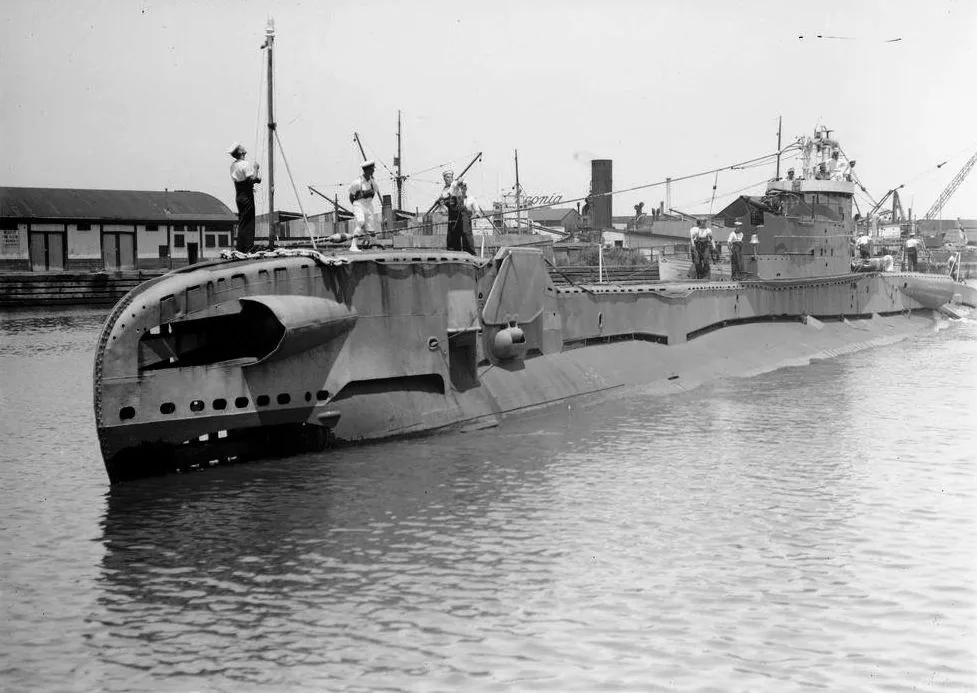
HMS Telemachus was a British T-class submarine, operated by the Royal Navy. She carried the pennant number P321. The ship was named after Telemachus. Her keel was laid at Vickers-Armstrongs, Barrow on 25 August 1942. She entered service on 25 October 1943, having been launched on 19 June 1943.
She was one of 52 ships of her class. The class followed the Grampus-class submarine and was succeeded by the U class.
The boat displaced 1,290 long tons surfaced and 1,560 long tons submerged. She measured 84.1 m (276 ft) long with a beam of 7.6 m (25 ft). Her designed speed was 15.5 knots, and she carried a complement of 61. Her main battery was of 102 mm (4.0 in) calibre.
She was in commission for 678 days of the Second World War.
She was broken up for scrap on 1 August 1961.
Written from the harvested record. Every figure above is sourced; the wording is this site's own.
Armament and machinery
Armament and machinery
- Propulsion
- Two shafts
- Twin diesel engines 2,500 hp (1.86 MW) each
- Twin electric motors 1,450 hp (1.08 MW) each
- Armament
- 6 internal forward-facing 21 inch (533 mm) torpedo tubes
- 2 external forward-facing torpedo tubes
- 2 external amidships rear-facing torpedo tubes
- 1 external rear-facing torpedo tube, aft
- 6 reload torpedoes
- QF 4 inch (100 mm) deck gun
- 3 anti aircraft machine guns
Sister ships
- HMS Tabard
- HMS Taciturn
- HMS Tactician (P314)
- HMS Taku (N38)
- HMS Talent (P322)
- HMS Talent (P337)
- HMS Talisman (N78)
- HMS Tally-Ho
- HMS Tantalus
- HMS Tantivy
- HMS Tarn (P336)
- HMS Tarpon (N17)
- HMS Taurus (P339)
- HMS Tempest (N86)
- HMS Templar
- HMS Teredo
- HMS Terrapin
- HMS Tetrarch (N77)
- HMS Thermopylae
- HMS Thetis (N25)
- HMS Thistle (N24)
- HMS Thorn (N11)
- HMS Thorough
- HMS Thrasher (N37)
Sources
- Facts harvested from HMS Telemachus (P321) on Wikipedia. Figures only — no wording is taken from it.
- Photograph: Allan C. Green — https://www.flickr.com/photos/41311545@N05/4696047800/ — Public domain — Wikimedia Commons