Japanese aircraft carrier Unryū
Service
- as Unryū (雲龍)6 August 1944 — 19 December 1944135 days of the war
- Name
- Unryū
- Namesake
- Japanese meaning "Cloud Dragon"
- Builder
- Yokosuka Naval Arsenal
- Ordered
- 1941
- Laid down
- 1 August 1942
- Launched
- 25 September 1943
- Commissioned
- 6 August 1944
- Fate
- Sunk, 19 December 1944 (1944)
- Status
- Wreck
Specifications
- Displacement, standard
- 20,127 long tons (20,450 t)
- Length
- 227.35 m (745.9 ft)
- Beam
- 22 m (72.2 ft)
- Draught
- 8.73 m (28.6 ft)
- Speed
- 34 knots (63 km/h, 39.1 mph)
- Range
- 8,000 nmi (14,816 km)
- Complement
- 1,595
- Main gun
- 127 mm (5 in)
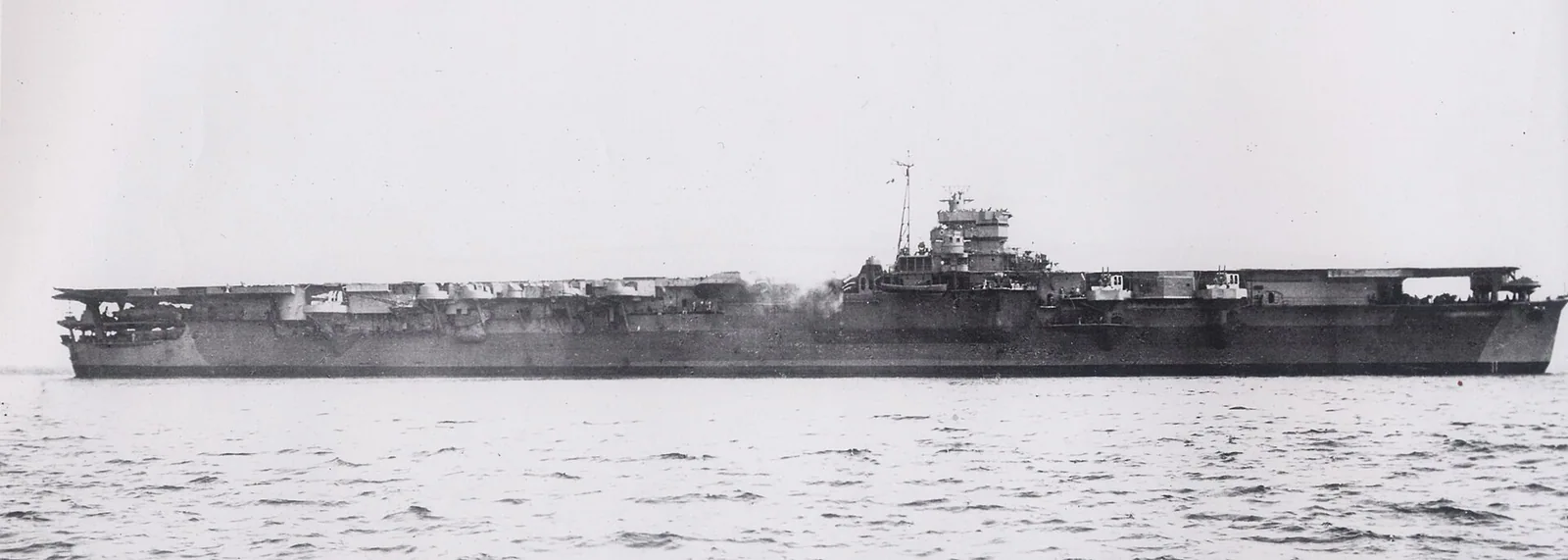
Unryū was a Unryū-class aircraft carrier built for the Imperial Japanese Navy. The ship was named after Japanese meaning "Cloud Dragon". Yokosuka Naval Arsenal laid her keel on 1 August 1942. She entered service on 6 August 1944, having been launched on 25 September 1943.
Her class ran to three ships. The class followed the Japanese aircraft carrier Taihō and was succeeded by the Japanese aircraft carrier Project Number G18.
Displacement was 20,127 long tons. She measured 227.3 m (746 ft) long with a beam of 22 m (72 ft). Her designed speed was 34 knots, and she carried a complement of 1,595.
Her main battery was twelve 127 mm (5 in) guns in six twin mountings. She carried 48 aircraft. 152,000 shp drove four shafts.
She was in commission for 135 days of the Second World War.
She was sunk on 19 December 1944, at 29°59′N 124°03′E. The wreck survives.
Written from the harvested record. Every figure above is sourced; the wording is this site's own.
Armament and machinery
Armament and machinery
- Propulsion
- 4 shafts
- 4 geared steam turbine sets
- Power
- 8 Kampon water-tube boilers
- 152000 shp
- Armament
- 6 × twin 12.7 cm (5 in) DP guns
- 16 × triple, 3 × single 25 mm (1 in) AA guns
- 6 × 28-tube 12 cm AA rocket launchers
- Armour
- Belt: 46 - 140 mm
- Deck: 25 - 56 mm
- Aircraft
- 48 (up to 65)
Sister ships
Sources
- Facts harvested from Japanese aircraft carrier Unryū on Wikipedia. Figures only — no wording is taken from it.
- Photograph: Unknown author — Yamato Museum collection — Public domain — Wikimedia Commons