Japanese battleship Ise
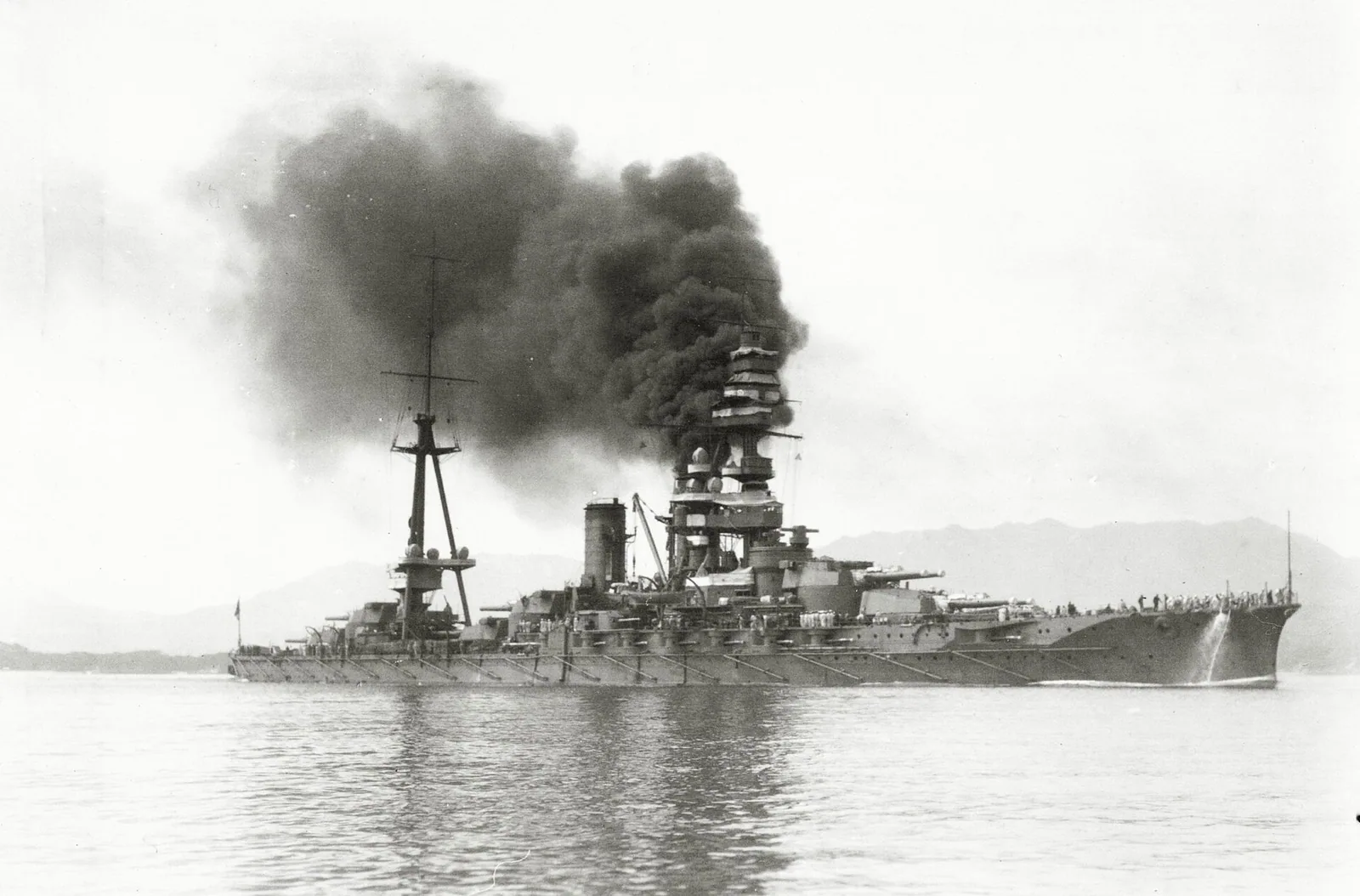
Service
- as Ise? — 20 November 19452,193 days of the war
- Name
- Ise
- Namesake
- Ise Province
- Builder
- Kawasaki, Kobe
- Ordered
- 11 April 1913
- Laid down
- 10 May 1915
- Launched
- 12 November 1916
- Struck
- 20 November 1945
- Fate
- Sunk by air attack, 28 July 1945, and subsequently scrapped (1945)
- Status
- Scrapped
Specifications — As built
- Displacement, standard
- 29,980 long tons (30,461 t)
- Displacement, full load
- 36,500 long tons (37,086 t)
- Length
- 208.18 m (683 ft)
- Beam
- 28.65 m (94 ft)
- Draught
- 8.93 m (29.3 ft)
- Speed
- 23 knots (42.6 km/h, 26.5 mph)
- Range
- 9,680 nmi (17,927 km)
- Complement
- 1,360
- Main gun
- 356 mm (14 in)
Ise was a Ise-class battleship of the Imperial Japanese Navy. She was named for Ise Province. Her keel was laid at Kawasaki, Kobe on 10 May 1915. She was launched on 12 November 1916.
She was one of two ships of her class. The class followed the Fusō-class battleship and was succeeded by the Nagato-class battleship.
She displaced 29,980 long tons standard and 36,500 long tons at full load. She measured 208.2 m (683 ft) long with a beam of 28.6 m (94 ft). Her designed speed was 23 knots, and she carried a complement of 1,360.
Her main battery was twelve 356 mm (14.0 in) guns in six twin mountings. Her belt armour was 299 mm (11.8 in) and her deck 85 mm. Her machinery developed 45,000 shp.
She was in commission for 2,193 days of the Second World War. She was struck from the register on 20 November 1945.
She was broken up for scrap on 28 July 1945.
Written from the harvested record. Every figure above is sourced; the wording is this site's own.
Armament and machinery
This vessel is recorded in 3 configurations. Wartime refits changed armament and complement substantially, so each is kept separately rather than averaged into one set of figures. The figures above are as built.
As built
- Propulsion
- 4 × shafts; 2 × steam turbine sets
- Power
- 24 × water-tube boilers
- 45000 shp
- Armament
- 6 × twin 35.6 cm guns
- 20 × single 14 cm guns
- 4 × single 7.62 cm (3 in) AA guns
- 6 × 53.3 cm torpedo tubes
- Armour
- Belt: 299 mm
- Decks: 85 mm
- Turrets: 254 mm
After first reconstruction
- Displacement, full load
- 42,001 long tons (42,675 t)
- Length
- 215.8 m (708 ft)
- Beam
- 31.75 m (104.2 ft)
- Draught
- 9.45 m (31 ft)
- Speed
- 24.5 knots (45.4 km/h, 28.2 mph)
- Range
- 7,870 nmi (14,575 km)
- Complement
- 1,376
- Main gun
- 356 mm (14 in)
- Propulsion
- 4 × steam turbine sets
- Power
- 8 × water-tube boilers
- 80000 shp
- Armament
- 6 × twin 35.6 cm guns
- 16 × single 14 cm guns
- 4 × twin 12.7 cm DP guns
- 10 × twin 2.5 cm AA guns
- Armour
- Decks: 152 mm
- Aircraft
- 3
As hybrid carrier, 1945
- Displacement, full load
- 39,805 long tons (40,444 t)
- Length
- 219.62 m (720.5 ft)
- Beam
- 31.71 m (104 ft)
- Draught
- 9.03 m (29.6 ft)
- Range
- 9,500 nmi (17,594 km)
- Complement
- 1,463
- Main gun
- 356 mm (14 in)
- Armament
- 4 × twin 35.6 cm guns
- 8 × twin 12.7 cm DP guns
- 31 × triple, 11 × single 2.5 cm AA guns
- 6 × 30-round 12.7 cm AA rocket launchers
- Aircraft
- 22–24
Sister ships
Sources
- Facts harvested from Japanese battleship Ise on Wikipedia. Figures only — no wording is taken from it.
- Photograph: Unknown author — Kure Maritime Museum, (edited by Kazushige Todaka), Japanese Naval Warship Photo Album: Battleships and Battle Cruisers, p.148 — Public domain — Wikimedia Commons