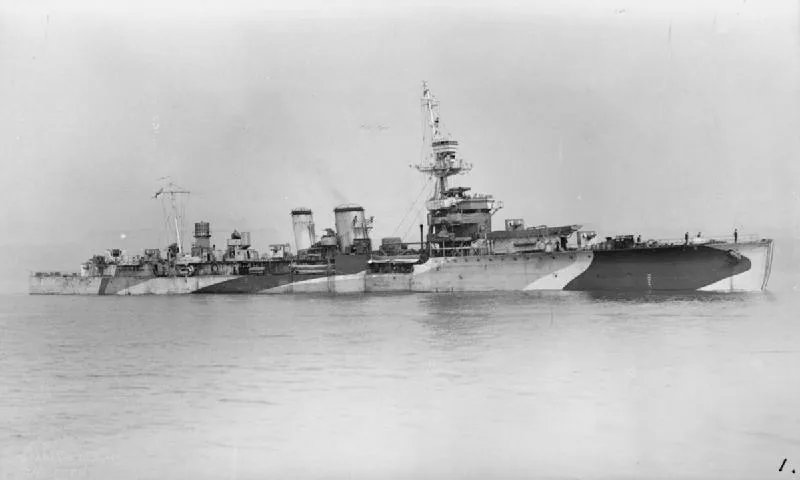
ORP Conrad
Service
- as HMS Danae22 July 1918 — 4 October 19441,860 days of the war
- as ORP Conrad4 October 1944 — 28 September 1946333 days of the war
- as HMS Danae? — 22 January 19482,193 days of the war
- Name
- ORP Conrad
- Namesake
- Danaë
- Builder
- Armstrong Whitworth
- Laid down
- 1 December 1916
- Launched
- 26 January 1918
- Commissioned
- 22 July 1918
- Decommissioned
- 4 October 1944
- Recommissioned
- 28 September 1946
- Fate
- Scrapped 27 March 1948 at Barrow (1948)
- Status
- Scrapped
Specifications
- Displacement, standard
- 4,276 long tons (4,345 t)
- Length
- 135.64 m (445 ft)
- Beam
- 14.17 m (46.5 ft)
- Draught
- 4.42 m (14.5 ft)
- Speed
- 29 knots (53.7 km/h, 33.4 mph)
- Range
- 1,480 nmi (2,741 km)
- Complement
- 462
- Main gun
- 152 mm (6 in)
ORP Conrad was a Danae-class cruiser light cruiser built for the Royal Navy. The ship was named after Danaë. Armstrong Whitworth laid her keel on 1 December 1916. She entered service on 22 July 1918, having been launched on 26 January 1918.
She was one of nine ships of her class. The class followed the C-class cruiser and was succeeded by the Emerald-class cruiser.
Displacement was 4,276 long tons. She measured 135.6 m (445 ft) long with a beam of 14.2 m (46 ft). Her designed speed was 29 knots, and she carried a complement of 462. Her main battery was of 152 mm (6.0 in) calibre.
She served with the Royal Navy as HMS Danae until 4 October 1944. She then passed to the Polish Navy, serving as ORP Conrad from 4 October 1944. She then passed to the Royal Navy, serving as HMS Danae. She was in commission for 4,386 days of the Second World War. She was decommissioned on 4 October 1944. She recommissioned on 28 September 1946.
She was broken up for scrap on 27 March 1948.
Written from the harvested record. Every figure above is sourced; the wording is this site's own.
Armament and machinery
Armament and machinery
- Propulsion
- Six Yarrow-type water-tube boilers
- Parsons geared steam turbines
- Two shafts
- 40000 shp
- Armament
- 1918: six BL 6 in L/45 Mark XII guns on single mountings CP Mark XIV
- two QF 3-inch (76.2 mm) Mk II AA guns
- two 40 mm QF 2 pdr "Pom-pom" AA guns
- twelve 21 inch (533 mm) (533 mm) torpedoes (4 triple launchers)
- 1930: six BL 6 in L/45 Mark XII guns
- three QF 4 in Mk V AA guns
- two 40 mm 2 pdr Pom-pom AA guns
- twelve 533 mm torpedo launchers
- 1942: six 6-inch (152 mm) Mk XII guns
- two 4-inch Mk V AA guns
- six 40 mm 2 pdr Pom-pom AA
- twelve 533 mm torpedo launchers
- 1943: five 6-inch (152 mm) guns
- one 4-inch (102 mm) gun
- 8 × 40 mm 2 pdr Pom-pom AA guns
- 3 × quadruple mounting Mark VII 2 pounder Mark VIII guns
- 12 × 20 mm AA guns
- depth charge launcher
- Armour
- 3 inch side (amidships)
- 2, 1¾, 1½ side (bow and stern)
- 1 inch upper decks (amidships)
- 1 inch deck over rudder
Sister ships
Sources
- Facts harvested from ORP Conrad on Wikipedia. Figures only — no wording is taken from it.
- Photograph: Royal Navy official photographer — This photograph FL 791 comes from the collections of the Imperial War Museums (collection no. 8308-29) — Public domain — Wikimedia Commons