Soviet destroyer Tbilisi
Service
- as Tbilisi11 December 1940 — 31 January 19641,726 days of the war
- Name
- Tbilisi
- Namesake
- Tbilisi
- Builder
- Shipyard No. 199, Komsomolsk-on-Amur
- Laid down
- 15 January 1935
- Launched
- 24 July 1939
- Commissioned
- 11 December 1940
- Struck
- 31 January 1964
- Fate
- Scrapped, 1964 (1964)
- Status
- Scrapped
Specifications
- Displacement, standard
- 2,350 long tons (2,388 t)
- Length
- 127.5 m (418.3 ft) OA
- Beam
- 11.7 m (38.4 ft)
- Draught
- 4.06 m (13.3 ft)
- Speed
- 40 knots (74.1 km/h, 46 mph)
- Range
- 2,100 nmi (3,889 km)
- Complement
- 250
- Main gun
- 130 mm (5.1 in)
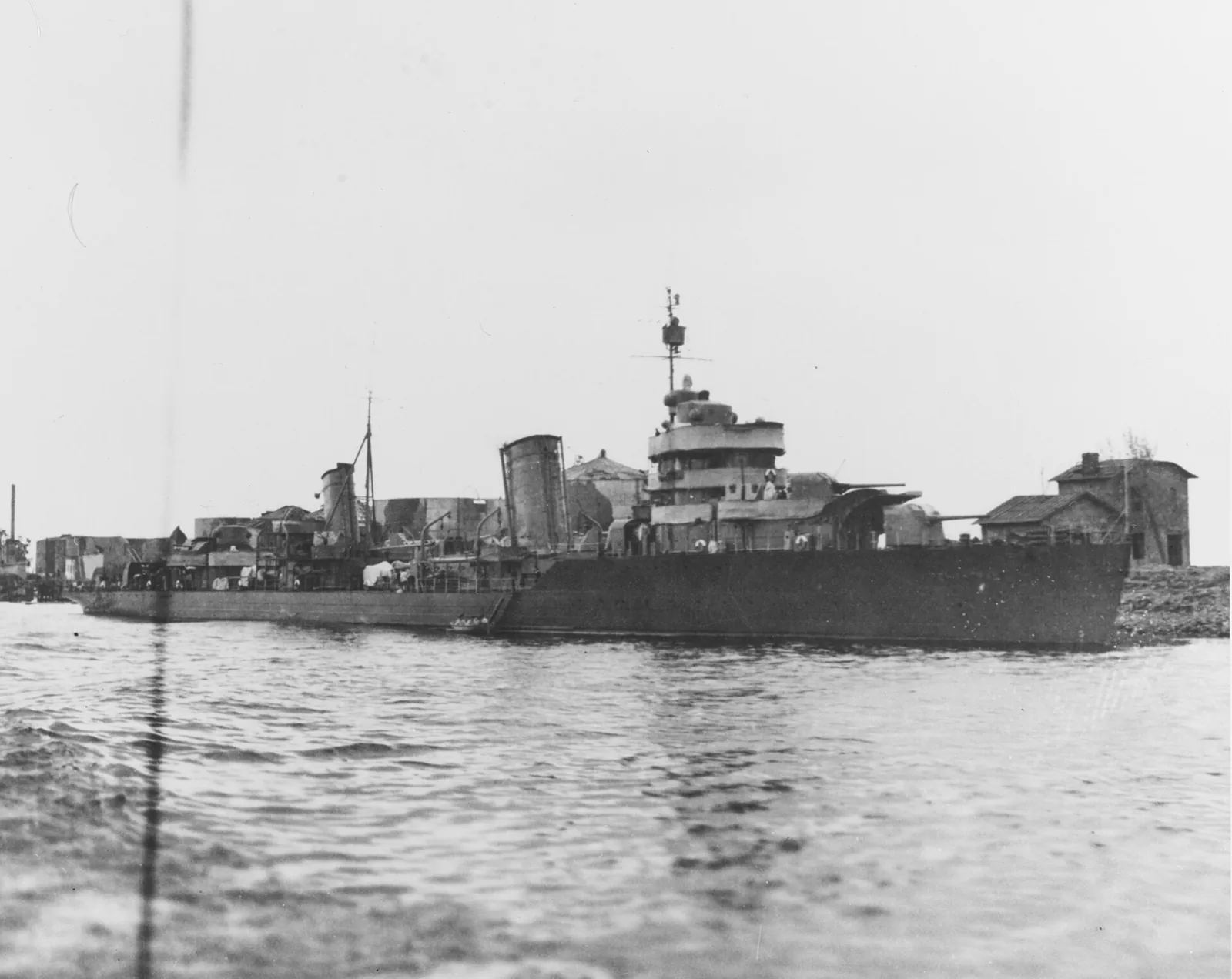
Tbilisi was a destroyer of the Leningrad-class destroyer destroyer leader built for the Soviet Navy. The ship was named after Tbilisi. Her keel was laid at Shipyard No. 199, Komsomolsk-on-Amur on 15 January 1935. Launched on 24 July 1939, she entered service on 11 December 1940.
She was one of five ships of her class. The Tashkent-class destroyer followed.
Displacement was 2,350 long tons. She measured 127.5 m (418 ft) long with a beam of 11.7 m (38 ft). Her designed speed was 40 knots, and she carried a complement of 250.
Her main battery was five 130 mm (5.1 in) guns. Her machinery developed 66,000 shp through three shafts.
She was in commission for 1,726 days of the Second World War. She was struck from the register on 31 January 1964.
She was broken up for scrap in 1964.
Written from the harvested record. Every figure above is sourced; the wording is this site's own.
Armament and machinery
Armament and machinery
- Propulsion
- 3 shafts; 3 geared steam turbines
- Power
- 3 three-drum boilers
- 66000 shp
- Armament
- 5 × single 130 mm guns
- 3 × single 76.2 mm AA guns
- 2 × single 45 mm AA guns
- 2 × quadruple 533 mm torpedo tubes
- 68–115 mines
- 52 depth charges
Sister ships
Sources
- Facts harvested from Soviet destroyer Tbilisi on Wikipedia. Figures only — no wording is taken from it.
- Photograph: Unknown naval attaché — [1] — Public domain — Wikimedia Commons