United States Navy — Frigate
Soviet frigate EK-22 — service history
This is the full service history. For the vessel's particulars, photograph and specifications, see the entry.
In the words of the US Navy. The account below is reproduced verbatim from the Dictionary of American Naval Fighting Ships, compiled by the Naval History and Heritage Command — a work of the United States Government, in the public domain, and the only text on this site not written here.
Second World War 1939–1945
1943
The first Gallup (PF-47) was launched on 17 September 1943 at Los Angeles, Calif., by the Consolidated Steel Corp.; sponsored by Ens. Helen McMahon, NNRC; and commissioned on 29 February 1944 at San Pedro, Calif., Lt. Cmdr. Clayton M. Opp, USCG, in command.
1944 Biak Island
Following conversion work at Newport Beach, Calif., and shakedown out of San Pedro and San Diego, Calif., she departed the latter port on 1 June 1944 for the Pacific war zone. Conducting antisubmarine patrol en route, she arrived at Noumea, New Caledonia, on 21 June, and continued her escort and patrol duty in the waters of New Caledonia, New Guinea, and Australia until 12 October with Escort Division 43.
On 17 August 1944, she bombarded enemy strongholds to support landings on Biak Island at Blue Beach, north of Wardo River by units of the 41st Infantry Division. She continued to fire until the troops had completed their landing and secured the beach. Again, on 25 August, Gallup lent support to the conquest of Biak by shelling the beaches between Menoerar and Cape Warari as the Army and Navy continued the successful New Guinea offensive.
Departing Hollandia 12 October 1944, Gallup was part of the screen for the vast task force which returned General MacArthur to the Philippines. On the 17th she shelled the beach area of Dinagat, and the next day she swept the channel into Leyte Gulf, P.I., as U.S. forces poised for the invasion. She then began antisubmarine and autimine patrol near Black Beach, screening vessels engaged in landing operations. Stationed most of the time off Desolation Point, she collected tide and hydro-graphic information, served as dispatch boat and as escort through the cleared channel in Leyte Gulf, guided incoming ships and convoys through the channel, and served as harbor entrance control vessel during landing operations. She performed these duties, most of the time in gusty, stormy weather, with Bisbee (PF-46), LCI(L)-343, and LCI(L)-344, before being sent on an escort mission to Humbolt Bay 28 November, touching San Pedro Bay and Kossol Roads, Manus, en route. On 3 December she left for the West Coast stopping to drop men at Seeadler Harbor, Admirality Islands, and Pearl Harbor. She arrived in San Francisco on Christmas Day 1944.
1945
Departing San Francisco 9 January 1945, Gallup steamed via Seattle to Dutch Harbor, Alaska, where she arrived on the 20th. She patrolled the North Pacific until she decommissioned at Cold Bay, Alaska 26. August. The next day she was transferred to the U.S.S.R. under lend-lease, renamed EK-19, and patrolled the Far East.
Returned by Russia at Yokosuka, Japan 14 November 1949, Gallup lay at Yokuska Navy Yard until she recommissioned 18 October 1950, Lt. Cmdr. William W. Boyd, Jr. in command. After shakedown off Sagami Wan, she got under way with Bisbee 23 November for Hungnam, Korea. There she relieved Hoquiam (PF-5) as harbor entrance control vessel, escorting ships when directed, guarding the channel against unfriendly ships, preventing friendly vessels from entering mined areas, and performing search and rescue services to the many refugees flooding through there.
On 19 December Gallup left for Pusan where she performed antisubmarine patrol on the approaches to the harbor, before leaving 31 December for Sasebo, Japan. On 29 January 1951, she returned to Korea, this time to Kansang and Kosong, for the purpose of feinting an amphibious assault to divert Communist forces and conducting a preassault bombardment on the installation at these points.
Gallup continued to operate out of Sasebo, making screening escort, patrol, and guide tours to Pusan, Wonsan, Chonjin, Korea, and Sangley Point and Subic Bay, P.I. She helped in the bombardment of Wonsan 23-25 February 1951 as U.N. forces seized the harbor islands, and then served as harbor entrance control vessel and flycatcher (anti-small-boat, anti-swimmer, anti-suicide-craft). Returning to Yokosuka 14 March, she entered drydock there for extensive hull repairs. She continued similar duty afterward until she returned to Yokosuka 6 October.
Gallup decommissioned and was transferred under M.D.A.P. to Thailand at Yokosuka, 29 October 1951 and serves the Thailand Navy as Prasae.
Other photographs
Held for this vessel, and not tied to any part of the account above.
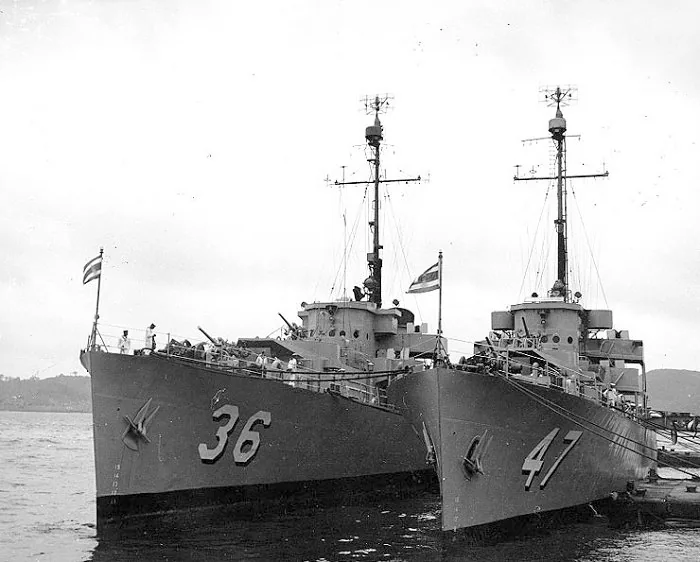
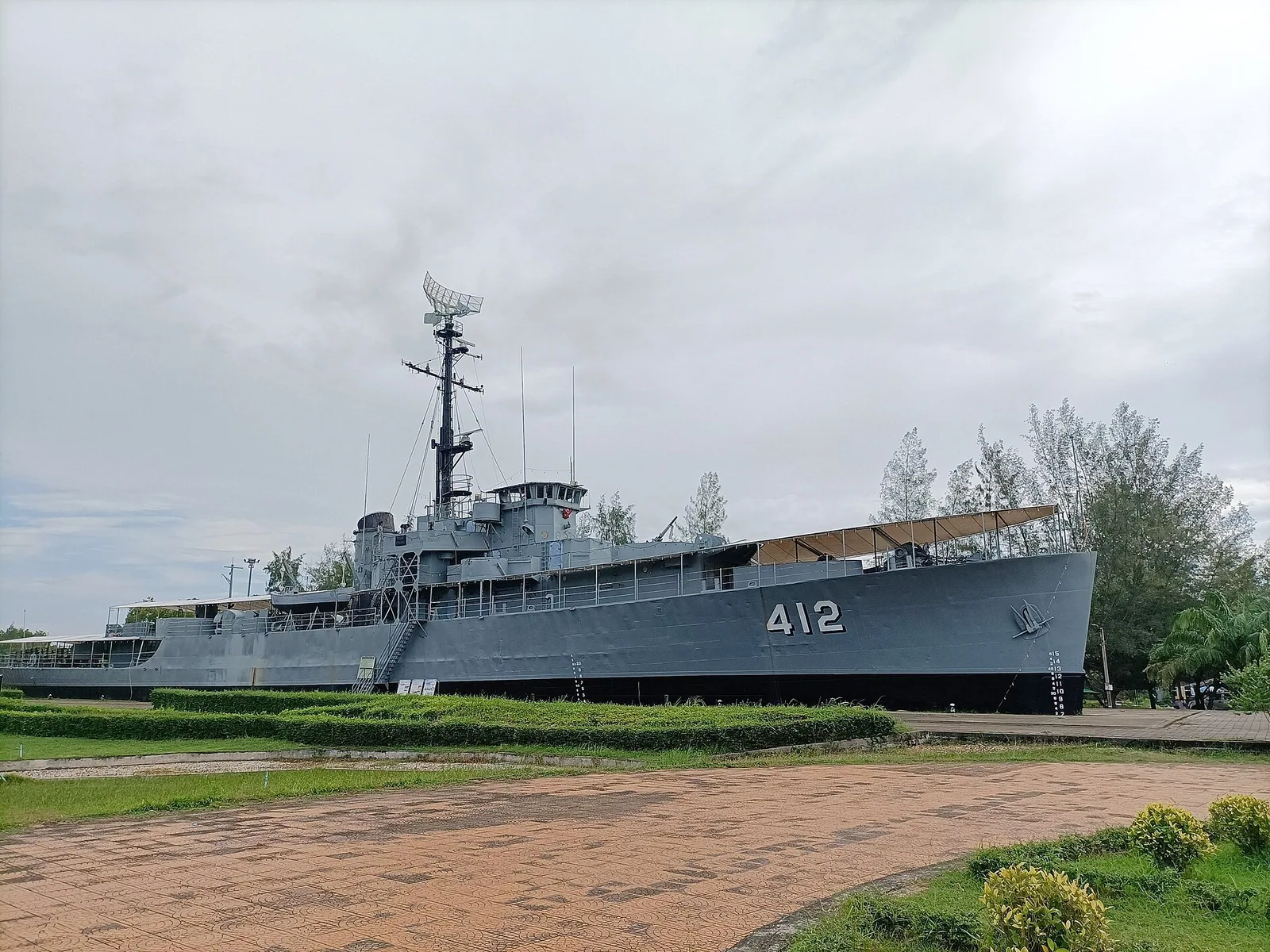
References
Every work this entry draws on. There are no numbered markers in the text above: what we hold is the provenance of the page — this history, this article, these photographs.
- History Gallup I (PF-47) Dictionary of American Naval Fighting Ships, Naval History and Heritage Command. A work of the United States Government, in the public domain — the only text on this site reproduced verbatim.
- Facts Soviet frigate EK-22 Structured facts only — dates, dimensions, armament and fate. No wording is taken from it. Harvested 1 August 2026.
- Photograph USS Gallup (PF-47) United States Navy photograph via National Archives — Scanned from Russell, Richard A., Project Hula: Secret Soviet-American Cooperation in the War Against Japan , Washington, D.C.: Naval Historical Center , 1997, ISBN 0-945274-35-1 , page 25 — Public domain — Wikimedia Commons
- Photograph USS Glendale and USS Gallup Unknown author — U.S. Navy photo NH 97102 — Public domain — Wikimedia Commons
- Photograph HTMS Prasae Memorial Z3144228 — Own work — CC BY-SA 4.0 — Wikimedia Commons