United States Navy — Destroyer
USS Aaron Ward (DD-483) — service history
This is the full service history. For the vessel's particulars, photograph and specifications, see the entry.
In the words of the US Navy. The account below is reproduced verbatim from the Dictionary of American Naval Fighting Ships, compiled by the Naval History and Heritage Command — a work of the United States Government, in the public domain, and the only text on this site not written here.
Second World War 1939–1945
1941
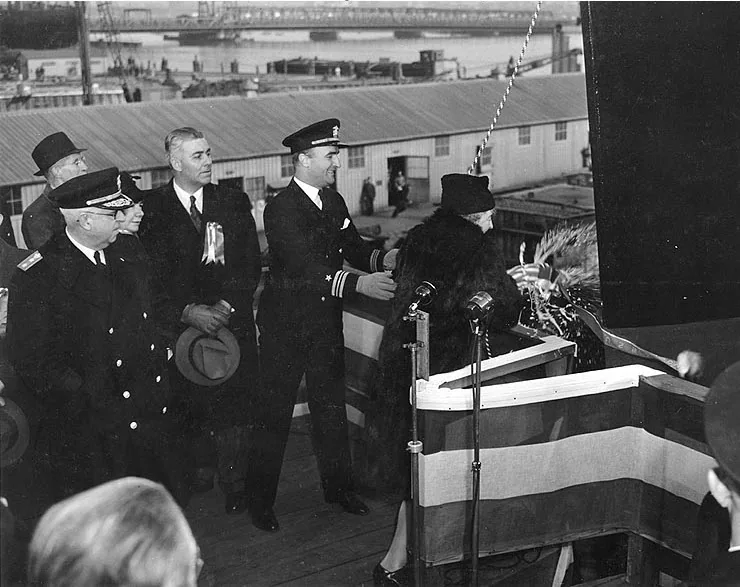
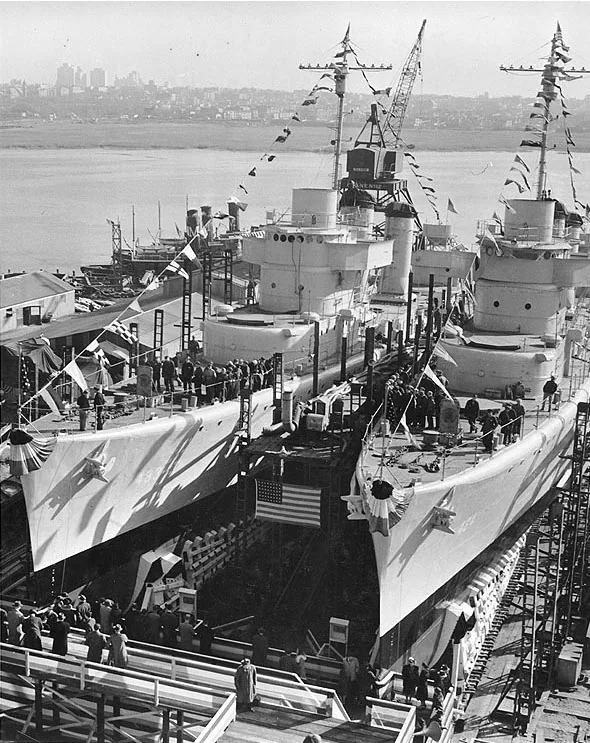
The second Aaron Ward (DD-183) was laid down on 11 February 1941 at Kearny, N.J., by the Federal Shipbuilding and Drydock Co.; launched on 22 November 1941; sponsored by Miss Hilda Ward, daughter of the late Rear Adm. Ward; and commissioned on 4 March 1942, Cmdr. Orville F. Gregor in command.
1942 Midway
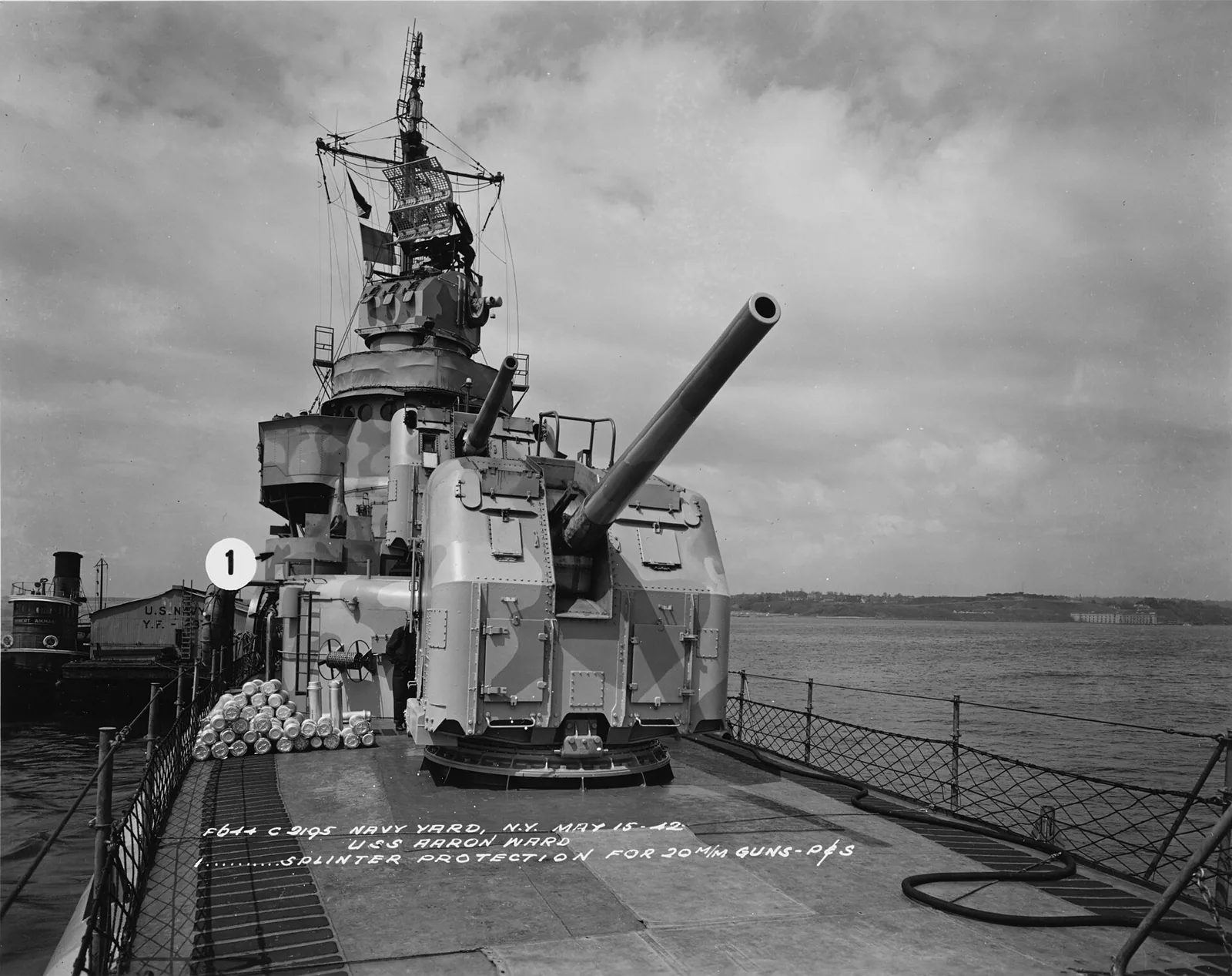
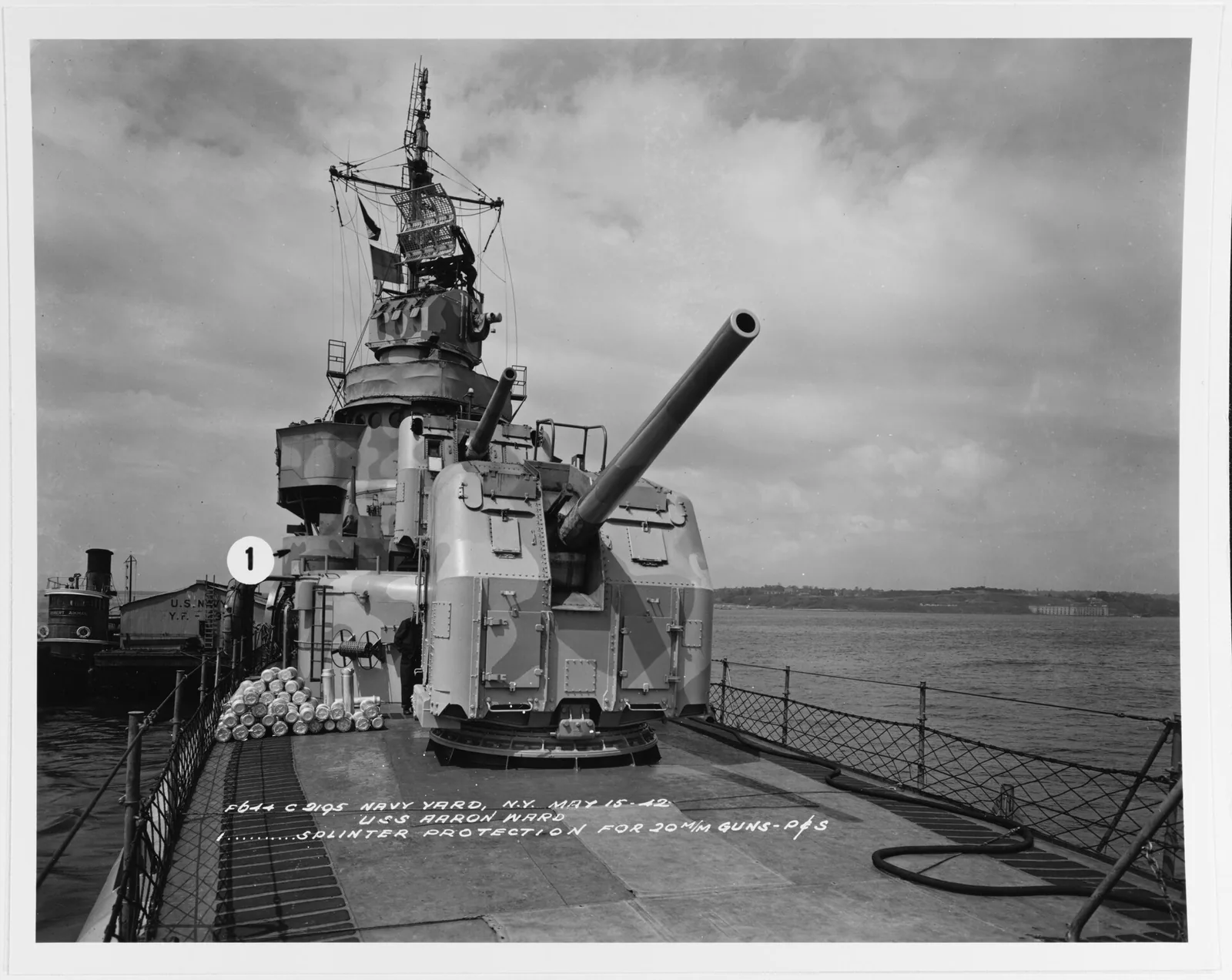
Following her shakedown out of Casco Bay, Maine, and post-shakedown availability at the New York Navy Yard, Brooklyn, N.Y., Aaron Ward sailed for the Pacific on 20 May 1942 and proceeded via the Panama Canal to San Diego, Calif. A short time later, as the Battle of Midway was developing off to the westward, the destroyer operated in the screen of Vice Adm. William S. Pye's Task Force (TF) 1, built around seven battleships and the aircraft escort vessel Long Island (AVG-1) as it steamed out into the Pacific Ocean, eventually reaching a point some 1,200 miles west of San Francisco and equally northeast of Hawaii, to "support the current operations against the enemy." With the detachment of Long Island from the task force on 17 June, Aaron Ward screened her on her voyage back to San Diego.
After local operations off the west coast, Aaron Ward sailed for Hawaii on 30 June 1942 and proceeded thence to the Tonga Islands with TF 18. Assigned to escort duties soon thereafter, she convoyed the fleet oiler Cimarron (AO-22) to Noumea, New Caledonia. During the course of the voyage she made two sound contacts, one on 5 August and the other the following day, which she developed and attacked with depth charges. Although she claimed a probable sinking in each case, neither "kill" was borne out in postwar accounting. Subsequently assigned to screening duties with forces seeking to cover and resupply Guadalcanal, Aaron Ward saw the carrier Wasp (CV-7) torpedoed by 1-19 on 15 September 1942.
Within a month's time, Aaron Ward was earmarked for a shore bombardment mission on 17 October 1942. She stood into Lunga Roads at 0717 on that day to lie to and await the arrival of a USMC liaison officer who would designate targets for the ship. Before she could embark passengers, though, she spotted five enemy bombers approaching from the west. These attacked Aaron Ward at about 0724, but ran into a heavy antiaircraft barrage from both the ship and marine guns on shore. The destroyer went ahead at flank speed when she spotted the attackers, to carry out evasive maneuvers and avoid the falling bombs, radically swinging to the right or left as the occasion demanded. Three bombs splashed 100 to 300 yards astern of the ship. The marines claimed two of the five attackers destroyed, though, while the ship and marines shared a third "kill."
Three days later, while again performing screening operations, Aaron Ward saw the heavy cruiser Chester (CA-27) take a torpedo on 20 October 1942. The destroyer went to the aid of the stricken cruiser and dropped a full depth charge pattern on Chester's assailant, I-176, but came up empty-handed. She then escorted the damaged ship to Espiritu Santo.
Ten days after her abortive hunt for I-176, Aaron Ward carried out another bombardment of Japanese positions on Guadalcanal, this time in company with the light cruiser Atlanta (CL-51), the flagship of Rear Adm. Norman Scott (Commander, Task Group (TG) 64.4), and the destroyers Benham (DD-397), Fletcher (DD-445) and Lardner (DD-487). Arriving off Lunga Point at 0520 on 30 October 1942, the task group stood in, and Atlanta embarked a liaison officer from Maj. Gen. Alexander A. Vandegrift, Commander of the First Marine Division, 20 minutes later.
Steaming to its designated area, TG 64.4 reached its destination within an hour's time, and at 0629 Rear Adm. Scott's flagship opened fire. Aaron Ward followed suit soon thereafter; eventually, before she ceased fire at 0840, she expended 711 rounds of 5-inch ammunition. Pausing briefly to investigate a reported submarine in the vicinity, Aaron Ward then cleared the area shortly before 0900, her mission completed.
Aaron Ward screened transports unloading men and materiel off Guadalcanal on 11 and 12 November 1942, claiming one enemy plane and damaging two others on the former day and two more planes off Lunga Point on the latter.
At 1830 on 12 November 1942, Aaron Ward retired with her task force in an eastward direction. Still later, the force -- five cruisers and eight destroyers, under Rear Adm. Daniel J. Callaghan -- reversed course and stood back through Lengo Channel. About 0130 on 13 November, the American ships which possessed radar picked up numerous contacts on their screens, the "Volunteer Attack Force" under Rear Adm. Abe Hiroaki, which consisted of two battleships, a light cruiser, and 14 destroyers.
Aaron Ward, leading the four destroyers bringing up the rear of Callaghan's column, ranged in on the Japanese ships with her FD radar at 0145, opening fire soon thereafter on a target she took to be a battleship. A short time later, after the ship had fired approximately 10 salvoes, she saw that the cruisers ahead of her had apparently changed course; stopping and backing both engines at 0155, Aaron Ward observed two torpedoes pass beneath her.
An instant later, Barton (DD-599), nearby, blew up (she had been torpedoed by the destroyer Amatsukaze) shortly before Aaron Ward, with the waters clear ahead of her, surged ahead once more. She prepared to fire torpedoes at a target to port, but did not because she sighted a ship which she took to be San Francisco (CA-38) 1,500 yards away. At 0204, observing what she took to be Sterett (DD-407) heading directly toward her port side, Aaron Ward went ahead, flank speed, and put her rudder over hard-a-port to avoid a collision.
A short time later, the destroyer commenced firing on an enemy ship, and hurled some 25 salvoes in her direction; her target may have been the Japanese destroyer Akatsuki, which did blow up and sink, taking all hands with her. Changing course to bear on a new target in the melee, Aaron Ward managed to get off four salvoes on director control until a Japanese shell put the director out of action and forced the destroyer's gunners to rely on local control.
In the minutes that followed, Aaron Ward received eight more direct hits; unable to identify friend from foe and certain that the enemy had surely established her American character, the destroyer then stood out to clear the area. She lost steering control at 0225, and, steering with her engines, attempted to come to the right. Seeing no more firing after 0230, when the battle apparently ended, Aaron Ward went dead in the water at 0235, her forward engine room flooded with salt water and her feed water gone.
Utilizing a gasoline pump, however, the destroyer's crew managed to pump salt water into the tanks and light the boilers off. At 0500, Aaron Ward moved slowly ahead, bound for Sea Lark Channel; ten minutes later, American motor torpedo boats closed, and the destroyer signalled them to ask Tulagi for a tug. She kept up her crawling pace for only a half hour, however, when she went dead in the water again.
Thirty minutes after she had slowed to a stop, Aaron Ward spotted an unwelcome sight: a Japanese battleship, Hiei, steaming slowly in circles between Savo and Florida Islands. Also nearby, nearer to Guadalcanal, lay Atlanta, Portland (CA-33), Cushing (DD-376) and Monssen (DD-436), all damaged, and the destroyers both burning. The Japanese destroyer Yudachi's presence in the vicinity proved to be her own undoing: Portland summarily sank her soon thereafter.
Aaron Ward, perhaps prompted to do so with more urgency due to Hiei's proximity, got underway at 0618, and two minutes later greeted the old tug (ex-minesweeper) Bobolink (ATO-131), which had arrived to take the destroyer in tow. Before the line could be rigged, though, Hiei spotted Aaron Ward and opened fire with her heavy guns. Four two-gun salvoes thundered from the battleship, the third of which straddled the crippled destroyer. Fortunately, planes sent from Henderson Field began working over Hiei and distracted her attention in the nick of time.
Losing power again at 0635, Aaron Ward was taken in tow by Bobolink, and the ships began moving toward safety. The tug turned the tow over to a district patrol boat (YP) at 0650, and the destroyer anchored in Tulagi harbor near Makambo Island at 0830. The nine direct hits she had received resulted in 15 men dead and 57 wounded. After receiving temporary repairs locally, Aaron Ward sailed for Hawaii soon thereafter, reaching Pearl Harbor on 20 December 1942 for permanent repairs.
1943
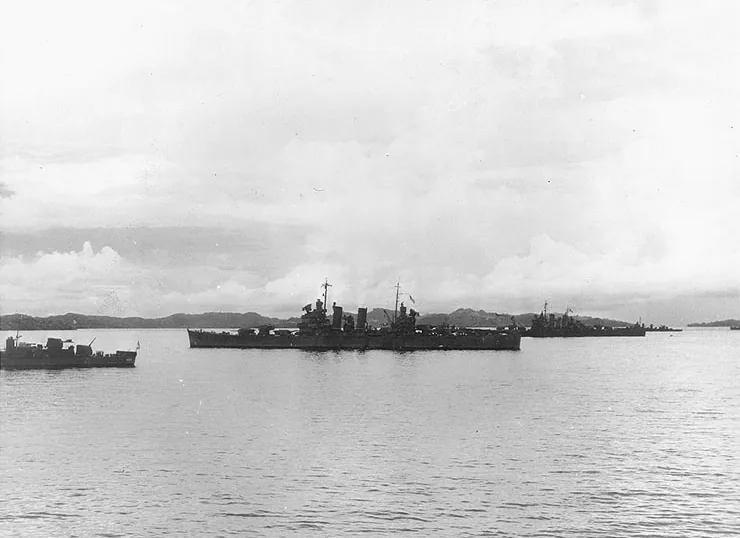
The destroyer rejoined the fleet on 6 February 1943 and soon resumed escort work. During one stint with a small convoy on 20 March, she aided in driving off attacking Japanese planes. A short time later, on 7 April, she had escorted the high speed transport Ward (APD-16) and three tank landing craft (LCT) from the Russell Islands to Savo. Not expecting to arrive until 1400, the destroyer went ahead at 25 knots to provide Ward and the three LCTs with air cover until they reached Tulagi. At about noon, however, the destroyer received notification of an impending air raid at Guadalcanal.
As the ships neared their destination, Aaron Ward received orders at about 1330 to leave her convoy to cover LST-449 off Togoma Point, Guadalcanal. Joining the tank landing ship at 1419, the destroyer directed her to follow her movements and zigzag at the approach of enemy aircraft. While the LST maneuvered to conform to Aaron Ward's movements, the latter's captain planned to retire to the eastward through Lengo Channel, as other cargo ships and escorting ships were doing upon receipt of the air raid warning from Guadalcanal.
Sighting a dogfight over Savo Island, Aaron Ward tracked a closer group of Japanese planes heading south over Tulagi; while swinging to starboard, the ship suddenly sighted three enemy planes coming out of the sun. Surging ahead to flank speed and putting her rudder over hard left, Aaron Ward opened fire with her 20-millimeter and 40-millimeter guns, followed shortly thereafter by her 5-inch battery. Bombs from the first three planes struck on or near the ship, and the mining effect of the near-misses proved devastating; the first bomb was a near miss, which tore holes in the side of the ship, allowing the forward fireroom to ship water rapidly; the second struck home in the engine room, causing a loss of all electrical power on the 5-inch and 40-millimeter mounts. Shifting to local control, however, the gunners kept up the fire. A third bomb splashed close aboard, holing her port side, near the after engine room. Having lost power to her rudder, the ship continued to swing to the left as another trio of dive bombers loosed their loads on the now-helpless destroyer. While none of these bombs hit the ship, two landed very near her port side. Twenty destroyermen had died; 59 had been wounded; seven were missing.
Despite the best efforts of her determined crew, and the assistance of the submarine rescue vessel Ortolan (ASR-5) and tug Vireo (ATO-144), however, the destroyer settled lower in the water. When it became evident that the battle to save Aaron Ward was being lost, Ortolan and Vireo attempted to beach her on a shoal near Tinete Point. At 2135, however, Aaron Ward sank, stern-first, in 40 fathoms of water, only 600 yards from shoal water.
Other photographs
Held for this vessel, and not tied to any part of the account above.


References
Every work this entry draws on. There are no numbered markers in the text above: what we hold is the provenance of the page — this history, this article, these photographs.
- History Aaron Ward II (DD-483) Dictionary of American Naval Fighting Ships, Naval History and Heritage Command. A work of the United States Government, in the public domain — the only text on this site reproduced verbatim.
- Facts USS Aaron Ward (DD-483) Structured facts only — dates, dimensions, armament and fate. No wording is taken from it. Harvested 1 August 2026.
- Photograph USS Aaron Ward (DD-483) Official U.S. Navy Photograph — Naval Historical Center Photo #: 80-G-12263 — Public domain — Wikimedia Commons
- Photograph Wrecks in the Ironbottom Sound User:W.wolny , Upload from German wikipedia by user:Vvulto — Own work — CC BY-SA 3.0 — Wikimedia Commons
- Photograph Christening of USS Aaron Ward (DD-483), 22 November 1941 U.S. Naval Historical Center Photograph — Naval Historical Center Photo #: NH 57706 — Public domain — Wikimedia Commons
- Photograph US warships at Tulagi in April 1943 Photographed from USS Fletcher (DD-445). — Official U.S. Navy photo NH 97810 from the U.S. Navy Naval History and Heritage Command — Public domain — Wikimedia Commons
- Photograph USS Aaron Ward (DD-483) - 19-N-30722 Unknown author — This image has been extracted from another file — Public domain — Wikimedia Commons
- Photograph USS Aaron Ward (DD-483) - 19-N-30722 Unknown author — 19-N-30722 — Public domain — Wikimedia Commons
- Photograph USS Aaron Ward (DD-483) and USS Buchanan (DD-484) ready for launching, 1941 U.S. Naval Historical Center Photograph — Naval Historical Center Photo #: NH 57702 — Public domain — Wikimedia Commons
- Photograph USS Aaron Ward (DD-483) in New York Harbor, 1942 Official U.S. Navy Photograph — Naval Historical Center Photo #: NH 97809 — Public domain — Wikimedia Commons