USS Adams (DM-27)
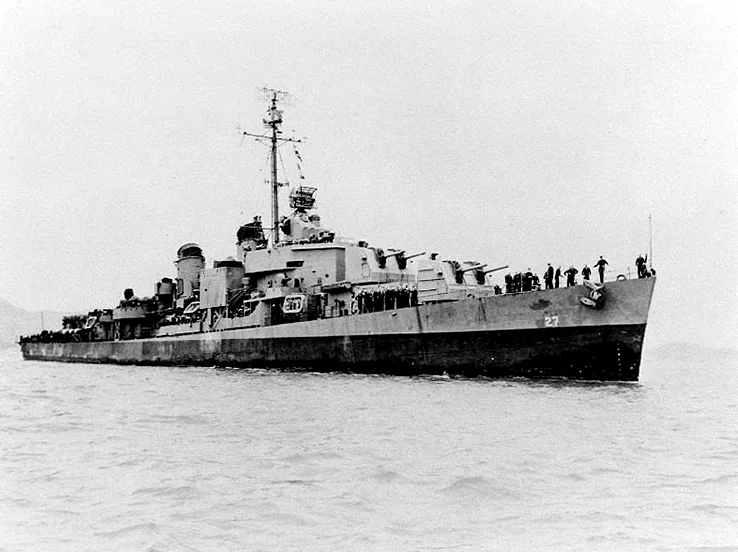
Service
- as Adams10 October 1944 — December 1946327 days of the war
- Name
- USS Adams
- Pennant / hull number
- DM-27
- Namesake
- Samuel Adams
- Builder
- Bath Iron Works
- Laid down
- 20 March 1944
- Launched
- 23 July 1944
- Commissioned
- 10 October 1944
- Decommissioned
- December 1946
- Struck
- 1 December 1970
- Fate
- Sold for scrapping, 16 December 1971 (1971)
- Status
- Scrapped
Specifications
- Displacement, standard
- 2,200 long tons (2,235 t)
- Length
- 114.6 m (376 ft)
- Beam
- 12.19 m (40 ft)
- Draught
- 5.49 m (18 ft)
- Speed
- 34 knots (63 km/h, 39.1 mph)
- Complement
- 363
- Main gun
- 127 mm (5 in)
The first and second ships named Adams honored John Adams, the second President of the United States and an ardent champion of the Navy. See John Adams (q.v.) for biography.
The third Adams (DM-27) was named in honor of Samuel Adams, born at Northampton, Mass., on 10 April 1912. Appointed to the U.S. Naval Academy from Massachusetts' 2nd Congressional District in 1931, Adams graduated in 1935. Following sea duty in the battleships West Virginia (BB-48) (28 June to 19 July 1935) and Tennessee (BB-43) (19 July 1935 to 2 January 1938), Adams underwent flight instruction at the Naval Air Station, Pensacola, Fla., and was designated a naval aviator on 17 January 1939. Promoted to lieutenant (j.g.) soon thereafter, he served a brief tour of duty in the Saratoga (CV-3) Air Group from 12 April to 12 May 1939, before he was assigned to Bombing Squadron (VB) 5, assigned to the aircraft carrier Yorktown (CV-5) on 13 May 1939.
Yorktown, to which VB-5 was attached, operated with the Pacific Fleet until the spring of 1941, when she was transferred to the Atlantic. Early in that period, VB-5 operated from Ranger (CV-4) as VB-5 and other Yorktown squadrons exchanged with units from that carrier, carried out neutrality patrols in the North Atlantic. Adams remained with the squadron through its transition at Norfolk from the Northrop BT-1 to the Douglas SBD Dauntless , and flew patrols from Yorktown when that carrier covered convoys in the North Atlantic in the fall of 1941.
Continue to the full service history About 1,743 words
From the Dictionary of American Naval Fighting Ships, compiled by the Naval History and Heritage Command (Adams III (DM-27)). A work of the United States Government, in the public domain.
Armament and machinery
Armament and machinery
- Armament
- 6 x 5 in/38 cal. guns
- 12 x 40 mm guns
- 8 x 20 mm cannons
- 2 x depth charge tracks
- 4 x depth charge projectors
- 80 mines
Sister ships
Sources
- Facts harvested from USS Adams (DM-27) on Wikipedia. Figures only — no wording is taken from it.
- Service history reproduced verbatim from Adams III (DM-27) , Dictionary of American Naval Fighting Ships — public domain, a work of the United States Government.
- Photograph: U.S. Navy — Official U.S. Navy photo NH 77371 from the U.S. Navy Naval History and Heritage Command — Public domain — Wikimedia Commons