USS Alaska (CB-1)
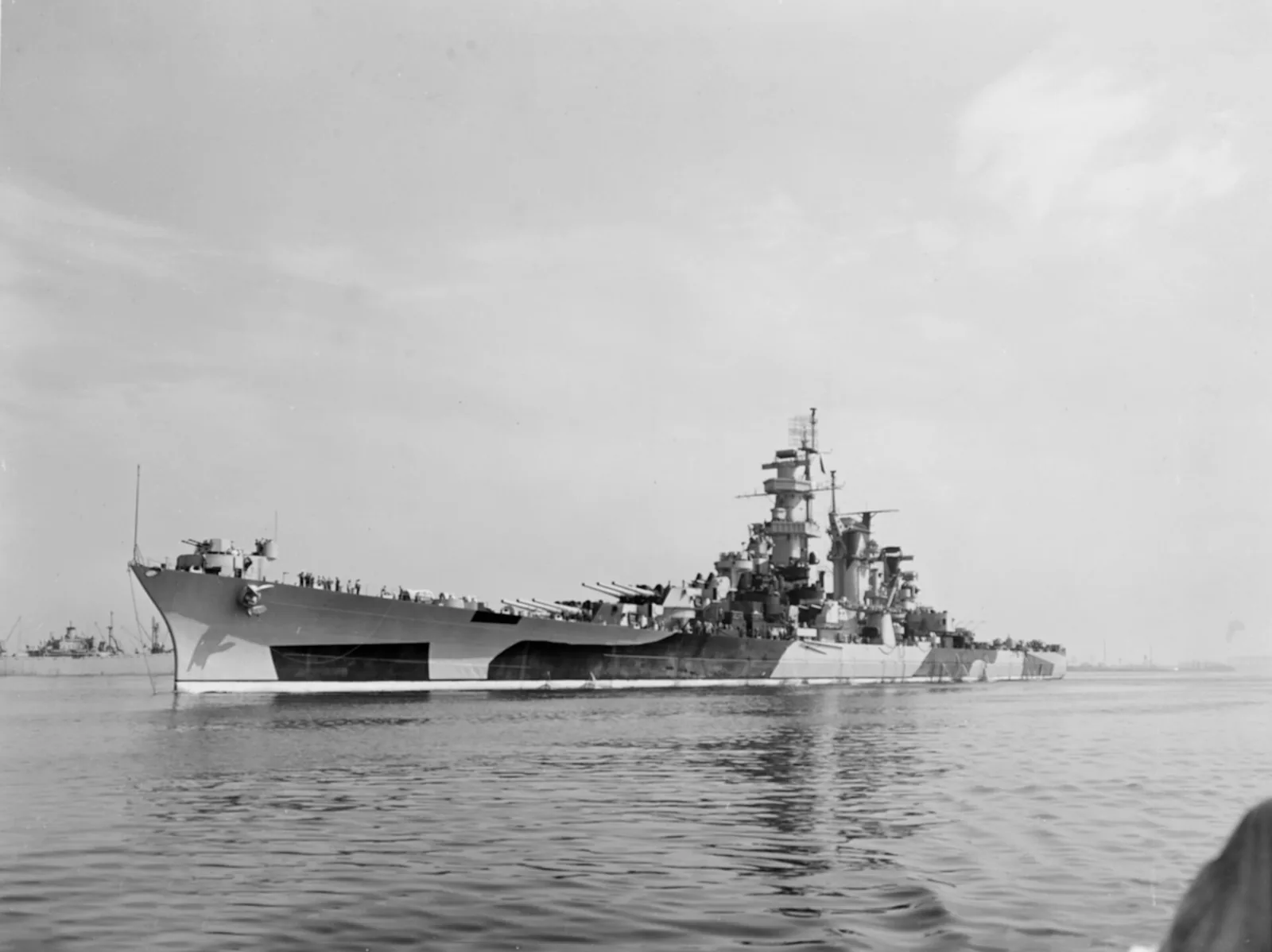
Service
- as USS Alaska17 June 1944 — 17 February 1947442 days of the war
- Name
- USS Alaska
- Pennant / hull number
- CB-1
- Namesake
- Territory of Alaska
- Builder
- New York Shipbuilding Corporation
- Ordered
- 9 September 1940
- Laid down
- 17 December 1941
- Launched
- 15 August 1943
- Commissioned
- 17 June 1944
- Decommissioned
- 17 February 1947
- Struck
- 1 June 1960
- Fate
- Scrapped in 1960 (1960)
- Status
- Scrapped
Specifications
- Displacement, standard
- 29,779 long tons (30,257 t)
- Displacement, full load
- 34,253 long tons (34,803 t)
- Length
- 246.28 m (808 ft)
- Beam
- 27.74 m (91 ft)
- Draught
- 9.45 m (31 ft)
- Speed
- 33 knots (61.1 km/h, 38 mph)
- Range
- 12,000 nmi (22,224 km)
- Main gun
- 305 mm (12 in)
A territory acquired by the United States from Russia in 1867. Alaska, located in the far northwestern corner of the North American continent and separated from the contiguous 48 states by Canada, was admitted to the Union as the 49th state in 1959.
The third Alaska (CB-1), the first of a class of "large cruisers" designed as a compromise to achieve a fast cruiser with a relatively heavy main battery, was laid down on 17 December 1941 at Camden, N.J., by the New York Shipbuilding Corp.; launched on 15 August 1943; sponsored by Mrs. Ernest Gruening, wife of the Honorable Ernest Gruening, Governor of Alaska; and commissioned at the Philadelphia Navy Yard on 17 June 1944, Capt. Peter K. Fischler in command.
Following post-commissioning fitting out at the Philadelphia Navy Yard, Alaska stood down the Delaware River on 6 August 1944, bound for Hampton Roads, escorted by Simpson (DD-221) and Broome (DD-210). She then conducted an intensive shakedown, first in Chesapeake Bay and then in the Gulf of Paria, off Trinidad, British West Indies, escorted by Bainbridge (DD-246) and Decatur (DD-341). Steaming via Annapolis, Md., and Norfolk, Alaska returned to the Philadelphia Navy Yard, where the large cruiser underwent changes and alterations to her fire control suite: the fitting of four Mk. 57 directors for her five-inch battery.
Continue to the full service history About 2,862 words
From the Dictionary of American Naval Fighting Ships, compiled by the Naval History and Heritage Command (Alaska III (CB-1)). A work of the United States Government, in the public domain.
Armament and machinery
Armament and machinery
- Propulsion
- 4 × General Electric steam turbines
- 4 × screw propellers
- Power
- 8 × Babcock & Wilcox water-tube boilers
- 153000 shp
- Armament
- 9 × 12 inch guns
- 12 × 5 in dual-purpose guns
- 56 × 40 mm guns
- 34 × 20 mm guns
- Armour
- Belt: 9 in
- Deck: 4 in
- Conning tower: 10.6 in
- Turrets: 12.8 in
- Aircraft
- 4
Sister ships
Sources
- Facts harvested from USS Alaska (CB-1) on Wikipedia. Figures only — no wording is taken from it.
- Service history reproduced verbatim from Alaska III (CB-1) , Dictionary of American Naval Fighting Ships — public domain, a work of the United States Government.
- Photograph: U.S. Navy — Official U.S. Navy photo NH 57214 from the U.S. Navy Naval History and Heritage Command — Public domain — Wikimedia Commons