USS Boston (CA-69)
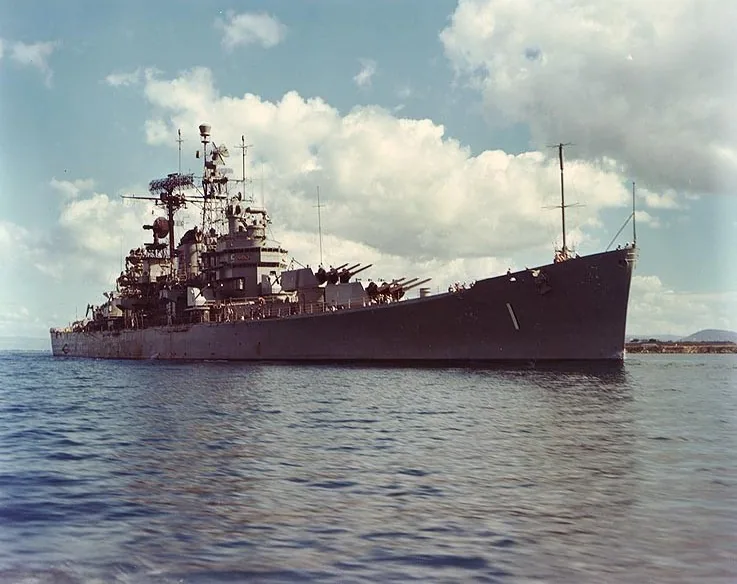
Service
- as Boston30 June 1943 — 5 May 1970797 days of the war
- Name
- USS Boston
- Pennant / hull number
- CA-69
- Namesake
- Boston
- Builder
- Bethlehem Shipbuilding Corporation
- Laid down
- 30 June 1941
- Launched
- 26 August 1942
- Commissioned
- 30 June 1943
- Decommissioned
- 29 October 1946
- Recommissioned
- 1 November 1955
- Struck
- 4 January 1974
- Fate
- Scrapped, 28 March 1975 (1975)
- Status
- Scrapped
Specifications — As built
- Displacement, standard
- 14,472 long tons (14,704 t)
- Displacement, full load
- 17,031 long tons (17,304 t)
- Length
- 205.13 m (673 ft) OA
- Beam
- 21.34 m (70 ft)
- Draught
- 6.1 m (20 ft)
- Speed
- 33 knots (61.1 km/h, 38 mph)
- Range
- 10,000 nmi (18,520 km)
- Complement
- 1,142
- Main gun
- 203 mm (8 in)
A city and seaport located in eastern Massachusetts on Massachusetts Bay at the mouths of the Charles and Mystic Rivers. It is the capital of Massachusetts and the seat of government for Suffolk County. One of the oldest cities in the United States, Boston was the site of historical events far too numerous to mention here.
The sixth Boston (CA-69) was launched 26 August 1942 by Bethlehem Steel Co., Fore River, Mass.; sponsored by Mrs. M. J. Tobin, wife of the Mayor of Boston ; and commissioned 30 June 1943, Captain J. H. Carson in command.
Boston reported to the Pacific Fleet, arriving at Pearl Harbor 6 December 1943. She joined TF 58 in January and took part in the raids on the Marshall Islands in support of the invasions of Kwajalein, Majuro, and Eniwetok (31 January-28 February 1944); Palaus and Western Carolines (30 March-1 April); Hollandia and Western New Guinea (21-24 April); Truk, including Satawan Island, bombardment (29 April-1 May); invasion of Saipan (11-24 June); 1st Bonins raid (15-16 June); Battle of the Philippine Sea (19-20 June); 2nd Bonins raid (24-26 June); 3rd Bonins raid (3-4 July); invasion of Guam (12 July-15 August); Palau-Yap-Ulithi raid (25-27 July); Morotal landings (15 September); seizure of the southern Palaus (6 September-14 October); and Philippine Islands raid (9-24 September). She served with TF 38 during the Okinawa raid (10 October); northern Luzon and Formosa raid (11-14 October); Luzon raids (15 and 24-26 October, 13-14 and 19-20 November, and 14-16 December); Battle for Leyte Gulf (24-26 October); Formosa raids (3-4, 9, 15, and 21 January 1945); Luzon raids (6-7 January); China coast raids (12 and 16 January); Nansei Shoto raid (22 January); Honshu and Nansei Shoto raids (15-16 February and 1 March), in which she bombarded Japan itself.
Boston then returned to the United States for overhaul, arriving at Long Beach, Calif., 25 March 1945. Returning to the Western Pacific, via Pearl Harbor and Eniwetok, she joined TF 38 for the raids on the Japanese home islands (20 July-15 August), including the bombardment of Kamaishi, Honshu (9 August). Following the Japanese surrender Boston remained in the Far East on occupation duty until 28 February 1946. She then returned to the United States and was placed out of commission in reserve at Puget Sound Naval Shipyard 29 October 1946.
Boston was reclassified CAG-1, 4 January 1952. In February 1952 she was towed from Bremerton, Wash., to Philadelphia for conversion to a guided missile heavy cruiser by New York Shipbuilding Corp., Camden, N. J. During conversion her after-8" turret was replaced with anti-aircraft missile launchers and she was otherwise modernized. Boston was recommissioned 1 November 1955 and operated along the east coast and in the Caribbean conducting missile evaluations and participating in fleet exercises until departing for the Mediterranean 23 November 1956. She returned in May 1957.
Boston was decommissioned in the early 1970s and struck from the Navy list on 1 November 1973. She was sold for scrapping on 1 March 1975.
From the Dictionary of American Naval Fighting Ships, compiled by the Naval History and Heritage Command (Boston VI (CA-69)). A work of the United States Government, in the public domain.
Armament and machinery
This vessel is recorded in 2 configurations. Wartime refits changed armament and complement substantially, so each is kept separately rather than averaged into one set of figures. The figures above are as built.
As built
- Propulsion
- 4 × General Electric geared turbines
- 4 × screws
- Power
- 4 × 615 psi Steam boilers
- 120000 shp
- Armament
- 3 × triple 8 in/55 caliber guns
- 6 × dual 5 in/38 caliber anti-aircraft guns
- 12 × quad 40 mm Bofors anti-aircraft guns
- 24 × single 20 mm Oerlikon anti-aircraft cannons
- Armour
- Belt: 4 - 6 in
- Deck: 2.5 in
- Barbettes: 6 - 6.3 in
- Turrets: 1.5 - 8 in
- Aircraft
- 4 × floatplanes
1955
- Main gun
- 203 mm (8 in)
- Armament
- 2 × triple 8 in/55 caliber guns
- 5 × dual 5 in/38 caliber anti-aircraft guns
- 6 × dual 3 in/50 caliber anti-aircraft guns
- 2 × twin-rail Terrier SAM launcher (144 missiles)
- Aircraft
- removed
Sister ships
Sources
- Facts harvested from USS Boston (CA-69) on Wikipedia. Figures only — no wording is taken from it.
- Service history reproduced verbatim from Boston VI (CA-69) , Dictionary of American Naval Fighting Ships — public domain, a work of the United States Government.
- Photograph: Official U.S. Navy Photograph. — https://www.history.navy.mil/content/history/nhhc/our-collections/photography/numerical-list-of-images/nara-series/kn-series/KN-10000/KN-14225.html — Public domain — Wikimedia Commons