United States Navy — Aircraft carrier
USS Cabot (CVL-28) — service history
This is the full service history. For the vessel's particulars, photograph and specifications, see the entry.
In the words of the US Navy. The account below is reproduced verbatim from the Dictionary of American Naval Fighting Ships, compiled by the Naval History and Heritage Command — a work of the United States Government, in the public domain, and the only text on this site not written here.
Before commissioning
John Cabot (1450-1498), the Venetian navigator, discovered the North American continent in 1497 while sailing under the sponsorship of King Henry VII of England.
Second World War 1939–1945
1942
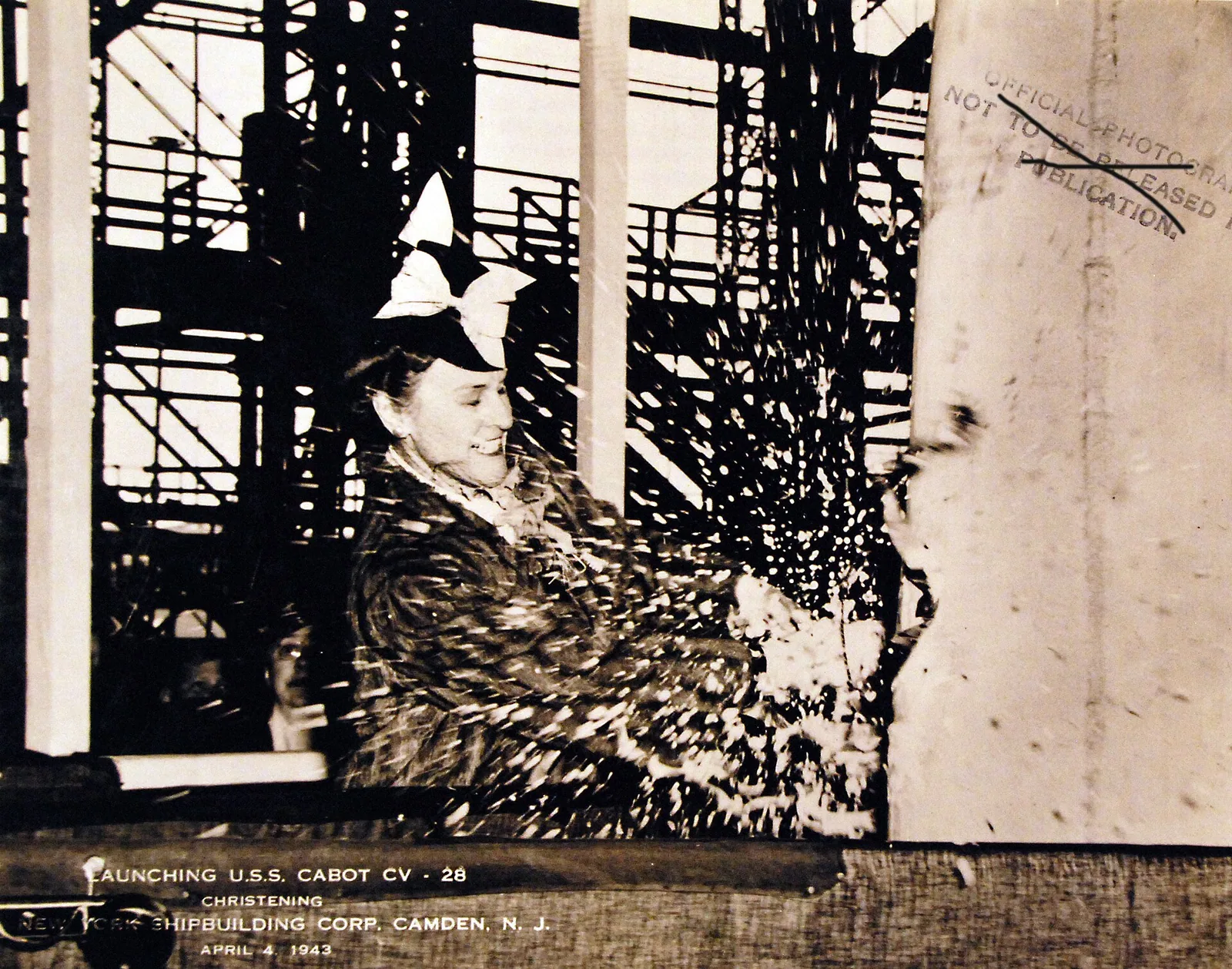
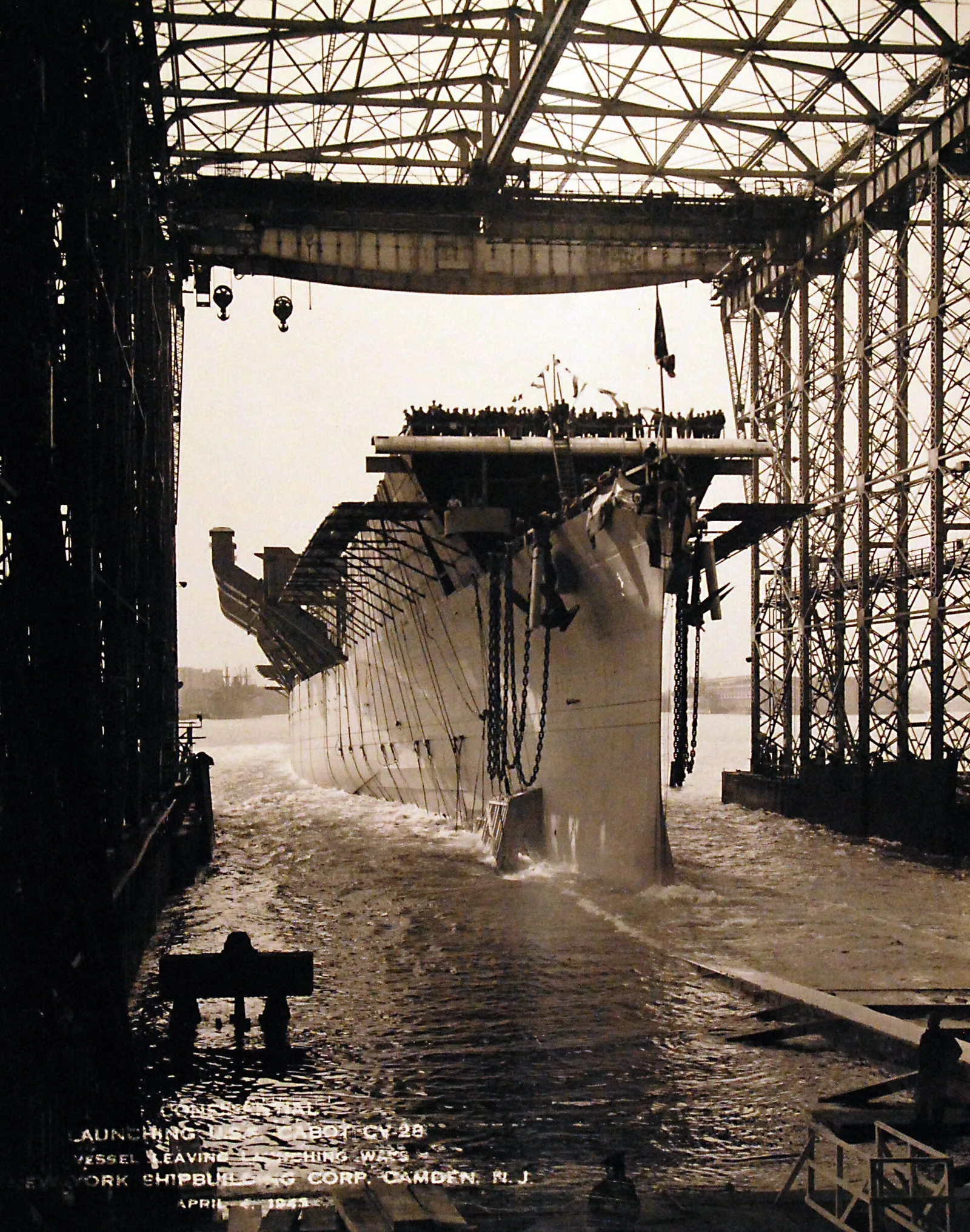
The second Cabot (CVL-28) was laid down as light cruiser Wilmington (CL-79) on 16 March 1942, by New York Shipbuilding Co., Camden, N.J.; reclassified to an aircraft carrier (CV-28) on 2 June 1942; renamed Cabot on 23 June 1942; converted while building and launched on 4 April 1943; sponsored by Mrs. A.C. Read; reclassified to a small aircraft carrier (CVL-28) on 15 July 1943; and commissioned on 24 July 1943, Capt. M.F. Shoeffel in command.
1943 Marshalls
Cabot sailed from Naval Air Station (NAS) Quonset Point, R.I., on 8 November 1943 for Pearl Harbor, T.H., where she arrived on 2 December. Clearing for Majuro in the Marshall Islands on 15 January 1944, she joined Task Force 58 to begin the consistently high quality of war service which was to win her a Presidential Unit Citation. From 4 February to 4 March 1944 she launched her planes in strikes on Roi, Namur, and the island stronghold of Truk in the Carolines, aiding in the neutralization of these Japanese bases as her part in the invasion of the Marshalls.
1944 Philippine Sea
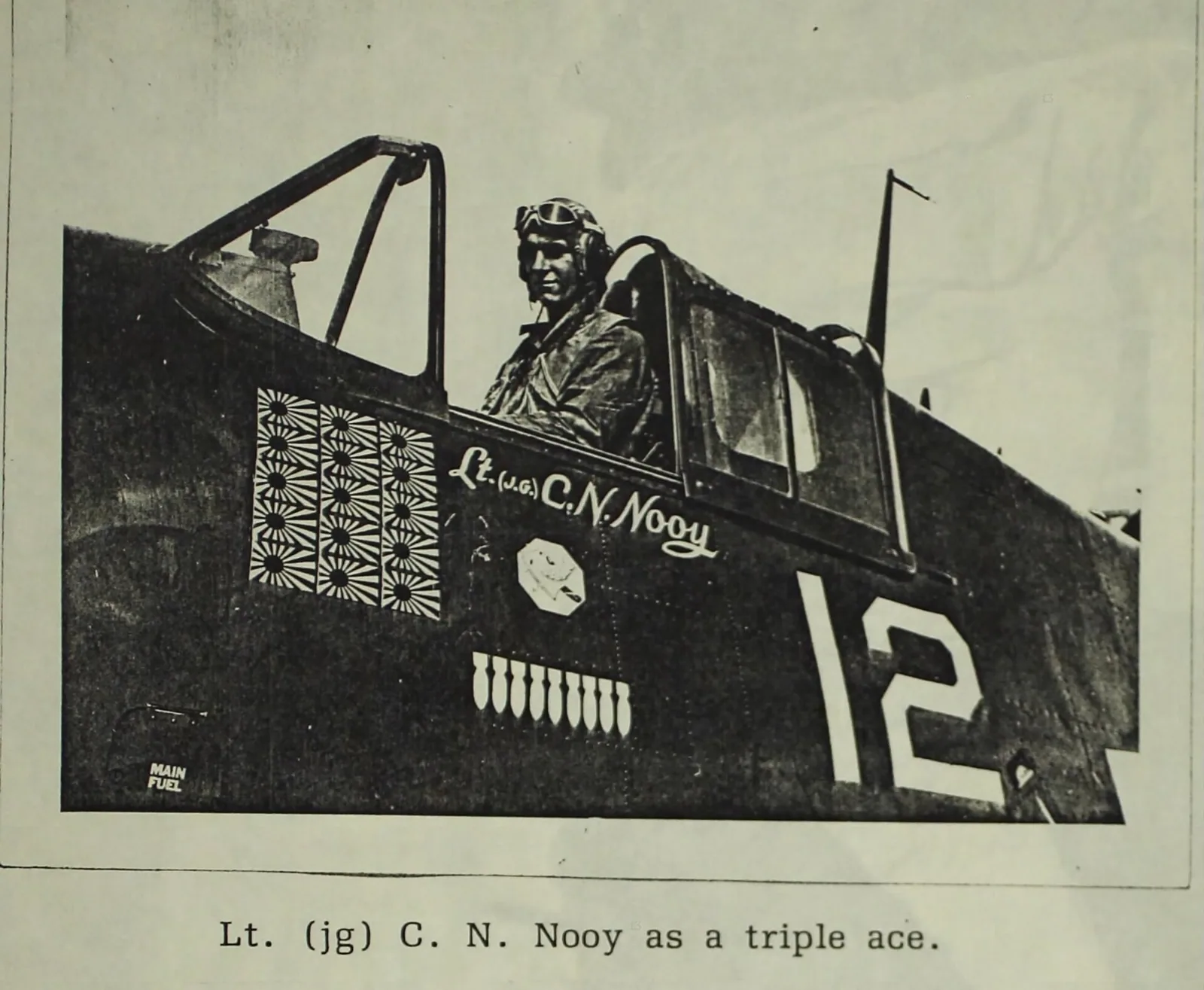
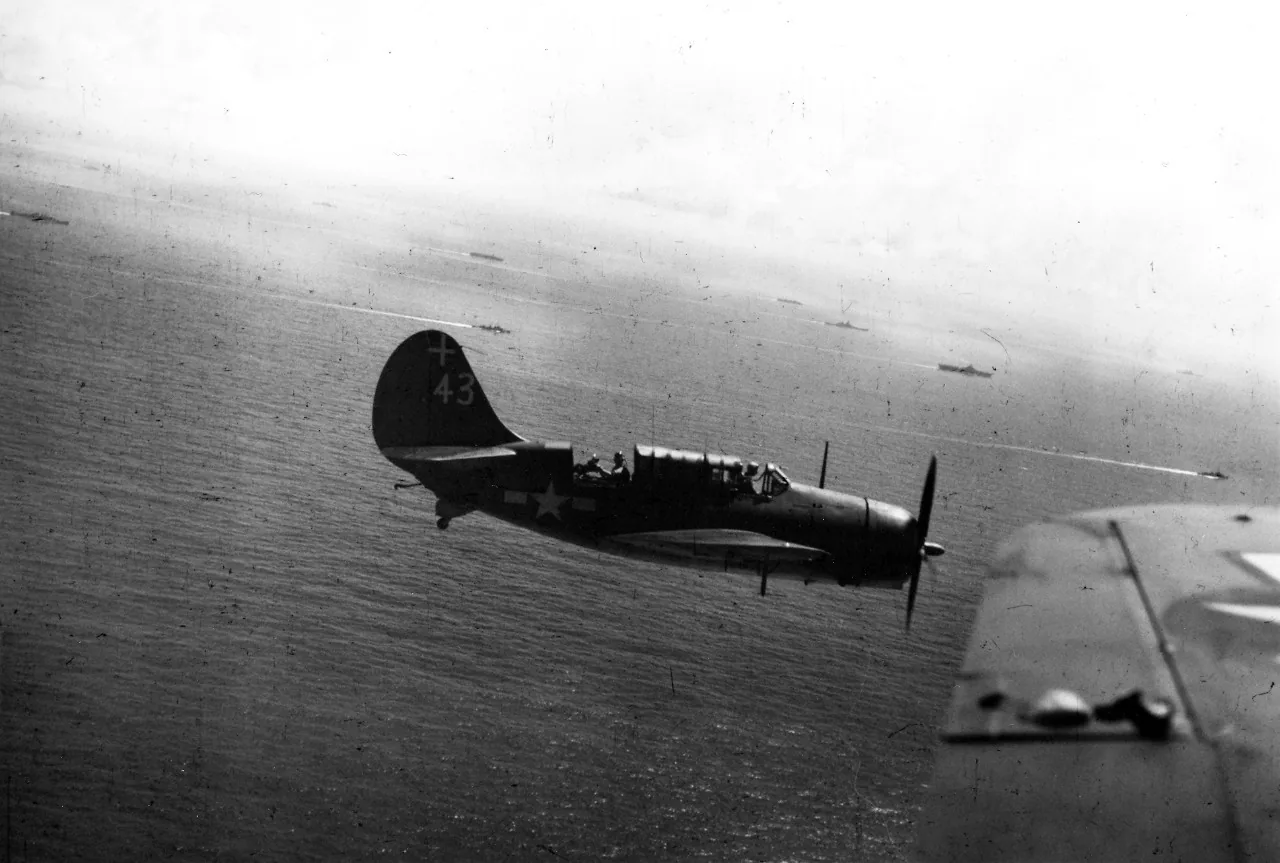
Cabot returned to Pearl Harbor for a brief repair period, but was back in action from Majuro for the pounding raids on the Palaus, Yap, Ulithi, and Woleai at the close of March 1944. She sailed to provide valuable air cover for the Hollandia operation (22–25 April), and four days later began to hurl her air power at Truk, Satawan, and Ponape. She cleared Majuro again on the 6th of June for the preinvasion air strikes in the Marianas, and on 19 and 20 June launched sorties in the key Battle of the Philippine Sea, the famous "Marianas Turkey Shoot," which hopelessly crippled Japanese naval aviation. Cabot' s aircraft pounded Japanese bases on Iwo Jima, Pagan, Rota, Guam, Yap, and Ulithi as the carrier continued her support of the Marianas operation until 9 August.
Preinvasion strikes in the Palaus in September 1944 along with air attacks on Mindanao, the Visayas, and Luzon paved the way for the long-awaited return to the Philippines. On 6 October Cabot sailed from Ulithi for raids on Okinawa, and to provide air cover for her task group during the heavy enemy attacks off Formosa [Taiwan] (12–13 October). Cabot joined the group which screened "Cripple Division 1," heavy cruiser Canberra (CA-70) and Houston (CL-81), which had been torpedoed off Formosa, to the safety of the Carolines, then rejoined her group for continued air strikes on the Visayas, and the Battle for Leyte Gulf (25–26 October).
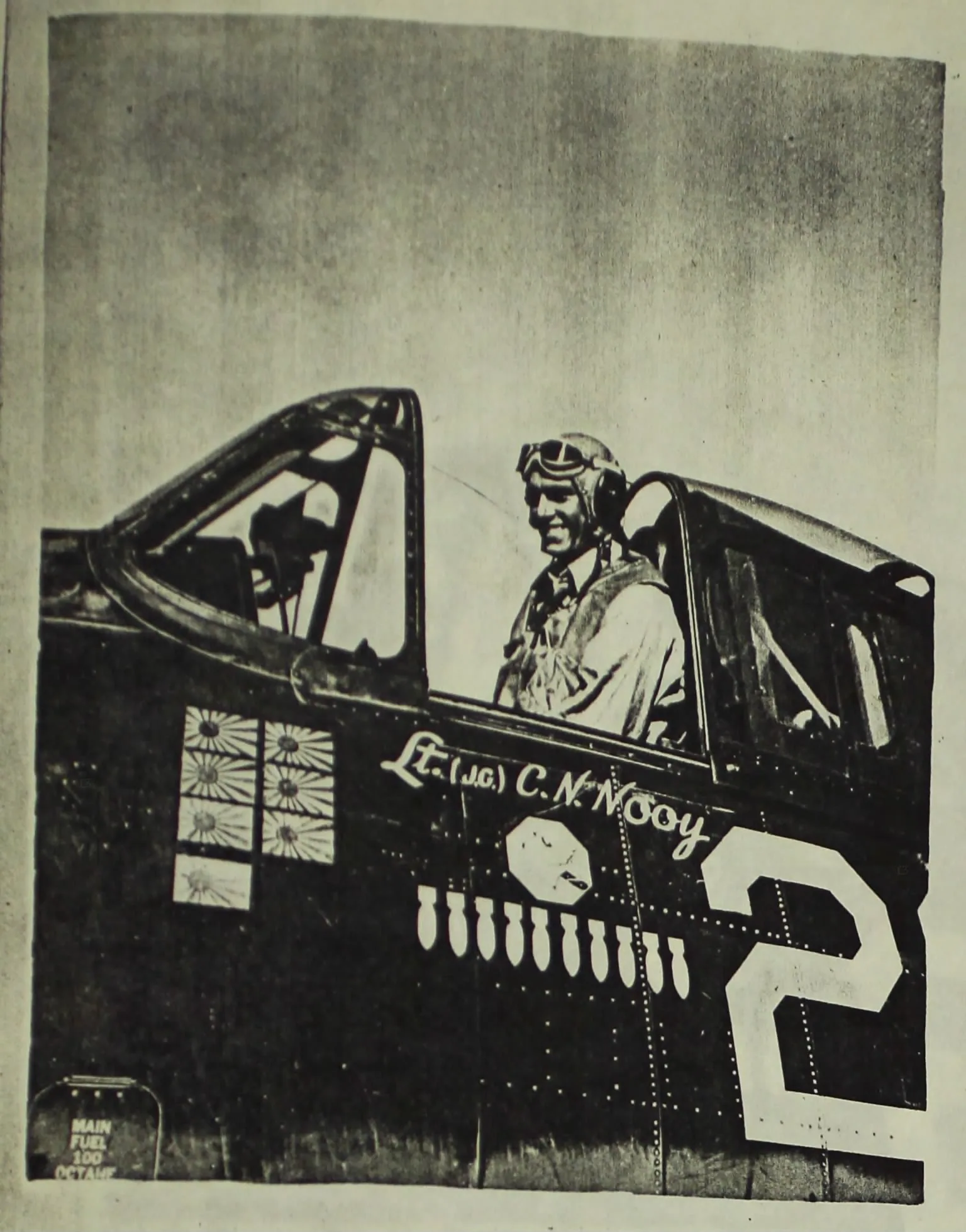
Cabot remained on patrol off Luzon, conducting strikes in support of operations ashore, and repelling desperate suicide attacks. On 25 November a particularly vicious one occurred. Cabot had fought off several kamikaze s when one, already flaming from hits, crashed the flight deck on the port side, destroying the still-firing 20-millimeter gun platform, disabling the 40-millimeter mounts and a gun director. Another of Cabot' s victims crashed close aboard and showered the port side with fragments and burning debris. Cabot lost 62 men killed and wounded, but careful training had produced a crew which handled damage control smoothly and coolly. While she continued to maintain her station in formation and operate effectively, temporary repairs were made. On 28 November she arrived at Ulithi for permanent repairs.
Cabot returned to action on 11 December 1944, steaming with the force striking Luzon, Formosa, Indochina, Hong Kong, and the Nansei Shoto in support of the Luzon operations. From 10 February to 1 March 1945, her planes pounded the Japanese homeland and the Bonins to suppress opposition to the invasion of Iwo Jima. Continued strikes against Kyushu and Okinawa in March prepared for the invasion of the latter island. After these prolonged, intensive operations, Cabot was homeward bound for San Francisco, Calif., for a much-needed overhaul completed in June.
Post-war 1946–1949
1947
After refresher training at Pearl Harbor, the carrier launched strikes on Wake Island on 1 August while en route to Eniwetok. Here she remained on training duty until the end of the war. Sailing on 21 August, she joined Task Group 38.3 to support the landings of occupation troops in the Yellow Sea area in September and October. Embarking homeward-bound men at Guam, Cabot arrived at San Diego on 9 November, then sailed for the east coast. Cabot was placed out of commission in reserve at Philadelphia, Pa., on 11 February 1947.
1948
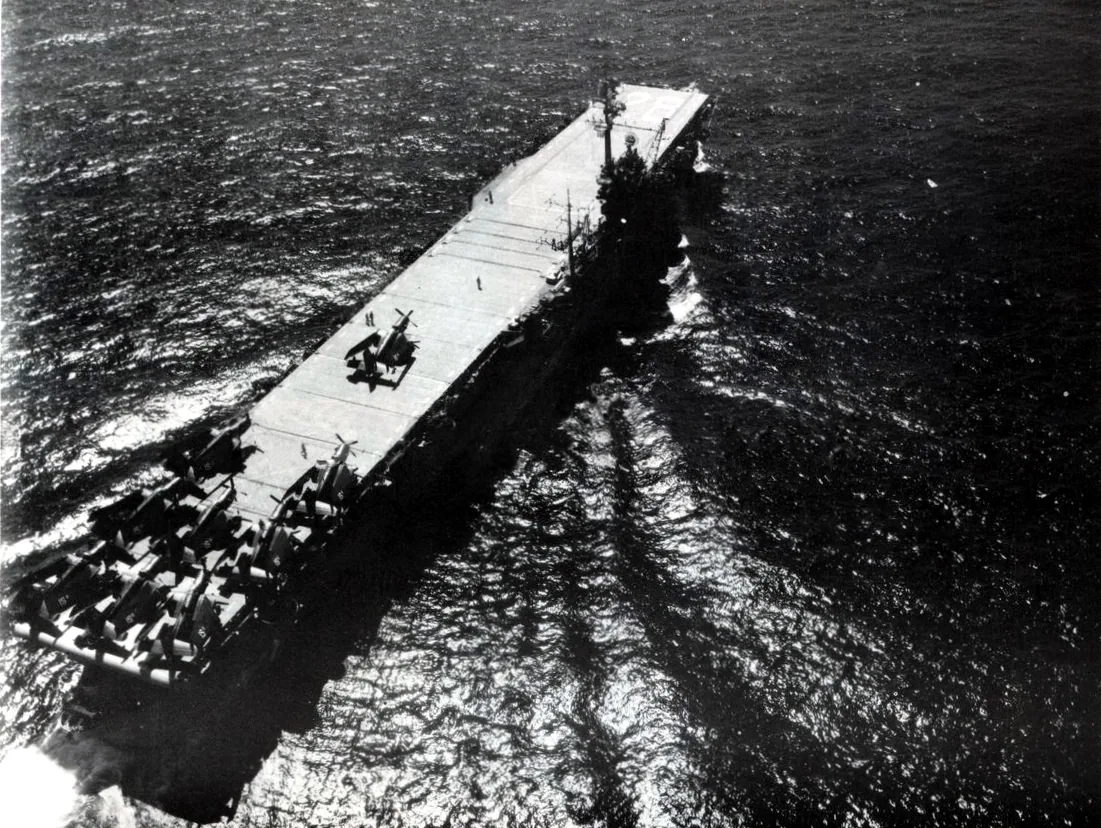
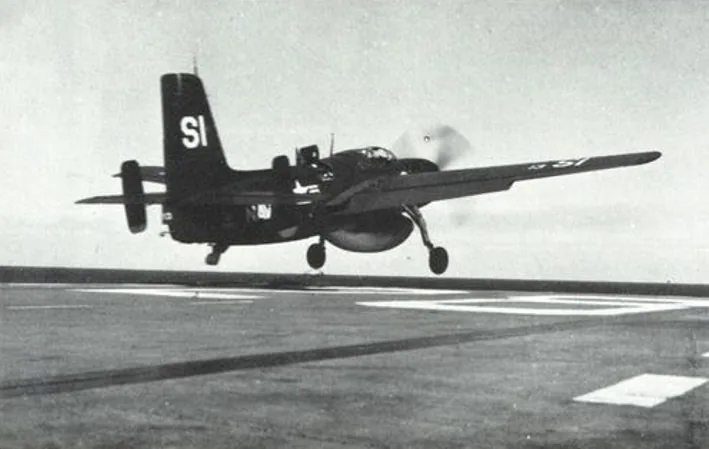
Recommissioned on 27 October 1948, Cabot was assigned to the Naval Air Reserve training program. She operated out of Pensacola, Fla., then NAS Quonset Point, on cruises to the Caribbean, and had one tour of duty in European waters (9 January–26 March 1952). Cabot was again placed out of commission in reserve on 21 January 1955, and on 15 May 1959, reclassified to an auxiliary aircraft transport (AVT-3).
Vietnam War period 1964–1975
1967

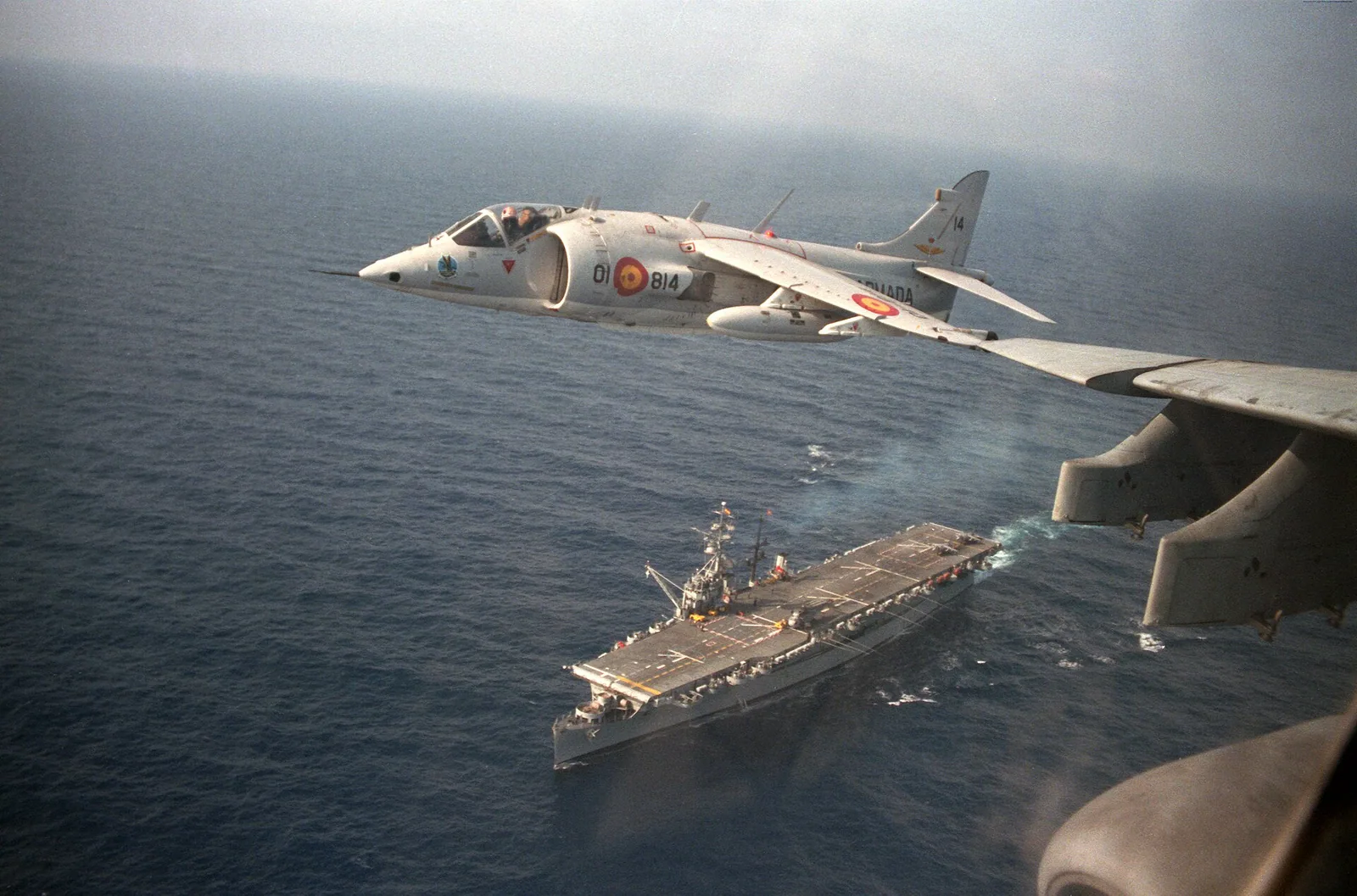
Cabot was loaned to the Spanish Navy on 30 August 1967, which renamed her Dédalo (R.01). She was thus stricken from the Naval Vessel Register on 1 August 1972, and sold to the Spaniards. She continued in service with that fleet until she was stricken a second time, in August 1989. Returned to the United States, attempts to preserve her as a floating museum and a war memorial eventually fell apart, and she was broken-up and scrapped in 2002. The National Naval Aviation Museum at NAS Penascola, Fla., built a replica of her island and part of the flight deck, using the ship's original plans.
Other photographs
Held for this vessel, and not tied to any part of the account above.


References
Every work this entry draws on. There are no numbered markers in the text above: what we hold is the provenance of the page — this history, this article, these photographs.
- History Cabot II (CVL-28) Dictionary of American Naval Fighting Ships, Naval History and Heritage Command. A work of the United States Government, in the public domain — the only text on this site reproduced verbatim.
- Facts USS Cabot (CVL-28) Structured facts only — dates, dimensions, armament and fate. No wording is taken from it. Harvested 1 August 2026.
- Photograph USS Cabot (CVL-28) Unknown author — U.S. Navy photo 80-G-262768 — Public domain — Wikimedia Commons
- Photograph USS Cabot CVL-28 off Fort Barrancas NAN11-49 USN — U.S. Navy Naval Aviation News November 1949 [1] — Public domain — Wikimedia Commons
- Photograph AV-8S over SNS Dedalo (R01) Lieutenant Commander John R. Leenhouts, U.S. Navy — Public domain — Wikimedia Commons
- Photograph USS Cabot CVL-28 NewOrleans 1996 Cobatfor — Own work — CC BY-SA 3.0 — Wikimedia Commons
- Photograph USS Cabot Sternplate Sclemmons — Own work — CC BY-SA 4.0 — Wikimedia Commons
- Photograph 40 mm Bofors twin mount on USS Cabot (CVL-28) in 1990 U.S. Navy — U.S. Navy All Hands magazine July 1990 , p. 15 — Public domain — Wikimedia Commons
- Photograph 80-G-263251 (28653505751) National Museum of the U.S. Navy — 80-G-263251 — Public domain — Wikimedia Commons
- Photograph 80-G-263270 (28698431566) National Museum of the U.S. Navy — 80-G-263270 — Public domain — Wikimedia Commons
- Photograph 80-G-263276 (28697622586) National Museum of the U.S. Navy — 80-G-263276 — Public domain — Wikimedia Commons
- Photograph 80-G-41539 (30232490216) National Museum of the U.S. Navy — 80-G-41539 — Public domain — Wikimedia Commons
- Photograph 80-G-41832 (26336831003) National Museum of the U.S. Navy — 80-G-41832 — Public domain — Wikimedia Commons
- Photograph Aerial view of USS Cabot (CVL-28) underway in early 1952 U.S. Navy — U.S. Navy photo [1] from the USS Cabot (CVL-28) 1952 cruise book available at Navysite.de — Public domain — Wikimedia Commons
- Photograph AF-2W Guardian of VS-24 is launched from USS Cabot (CVL-28), in early 1952 U.S. Navy — U.S. Navy photo [1] from the USS Cabot (CVL-28) 1952 cruise book available at Navysite.de — Public domain — Wikimedia Commons
- Photograph Cornelius N. Nooy (US Navy), circa in September 1944 United States Navy — USS Cabot Cruise Book, Navy Department Library — Public domain — Wikimedia Commons
- Photograph Cornelius N. Nooy (US Navy), in June 1944 United States Navy — USS Cabot Cruise Book, Navy Department Library — Public domain — Wikimedia Commons
- Photograph Curtiss SB2C-3 Helldiver of VB-18 in flight over U.S. Task Group 38.2 on 24 October 1944 (S-475.01) Unknown author — U.S. Navy photo S-475.01 — Public domain — Wikimedia Commons
- Photograph CVL-28 Cabot - DPLA - 1ea92a6eac2587a16747bdd792fe520f Department of Defense. Department of the Navy. Bureau of Ships. 9/18/1947-5/1/1966 — This file was contributed to Wikimedia Commons by National Archives and Records Administration as part of a cooperation project. The donation was facilitated by the Digital Public Library of America , via its partner Digital Public Library of America . Record in source catalog DPLA identifier: 1ea92a6eac2587a16747bdd792fe520f National Archives Identifier: 24741631 — Public domain — Wikimedia Commons
- Photograph CVL-28 Cabot - DPLA - a2ad1f90e3c9bf1e87046d88a30bb4ed Department of Defense. Department of the Navy. Bureau of Ships. 9/18/1947-5/1/1966 — This file was contributed to Wikimedia Commons by National Archives and Records Administration as part of a cooperation project. The donation was facilitated by the Digital Public Library of America , via its partner Digital Public Library of America . Record in source catalog DPLA identifier: a2ad1f90e3c9bf1e87046d88a30bb4ed National Archives Identifier: 24741667 — Public domain — Wikimedia Commons
- Photograph Drawing of proposed USS Cabot (CVL-28) museum at New Orleans 1990 U.S. Navy — U.S. Navy All Hands magazine July 1990 , p. 15 — Public domain — Wikimedia Commons
- Photograph F4U-1 Air Group 67 USS Cabot NAN8-49 USN — U.S. Navy Naval Aviation News August 1949 [1] — Public domain — Wikimedia Commons