United States Navy — Destroyer
USS Carmick — service history
This is the full service history. For the vessel's particulars, photograph and specifications, see the entry.
In the words of the US Navy. The account below is reproduced verbatim from the Dictionary of American Naval Fighting Ships, compiled by the Naval History and Heritage Command — a work of the United States Government, in the public domain, and the only text on this site not written here.
Before commissioning
Born in Philadelphia, Pa., in 1772, Daniel Carmick was appointed lieutenant of Marines in Ganges 5 May 1798, and entered the new Marine Corps as captain 11 July 1798. During the Quasi-War with France he commanded the Marine detachment in Constitution, and led the daring attack to spike the cannon in the fort at Puerto Plata, Santo Domingo. Major Carmick served with distinction in the Mediterranean, and commanded the Marines in the Battle of New Orleans in the War of 1812. Wounded 28 December 1814 in this engagement, Major Carmick died 6 November 1816.
Second World War 1939–1945
1942
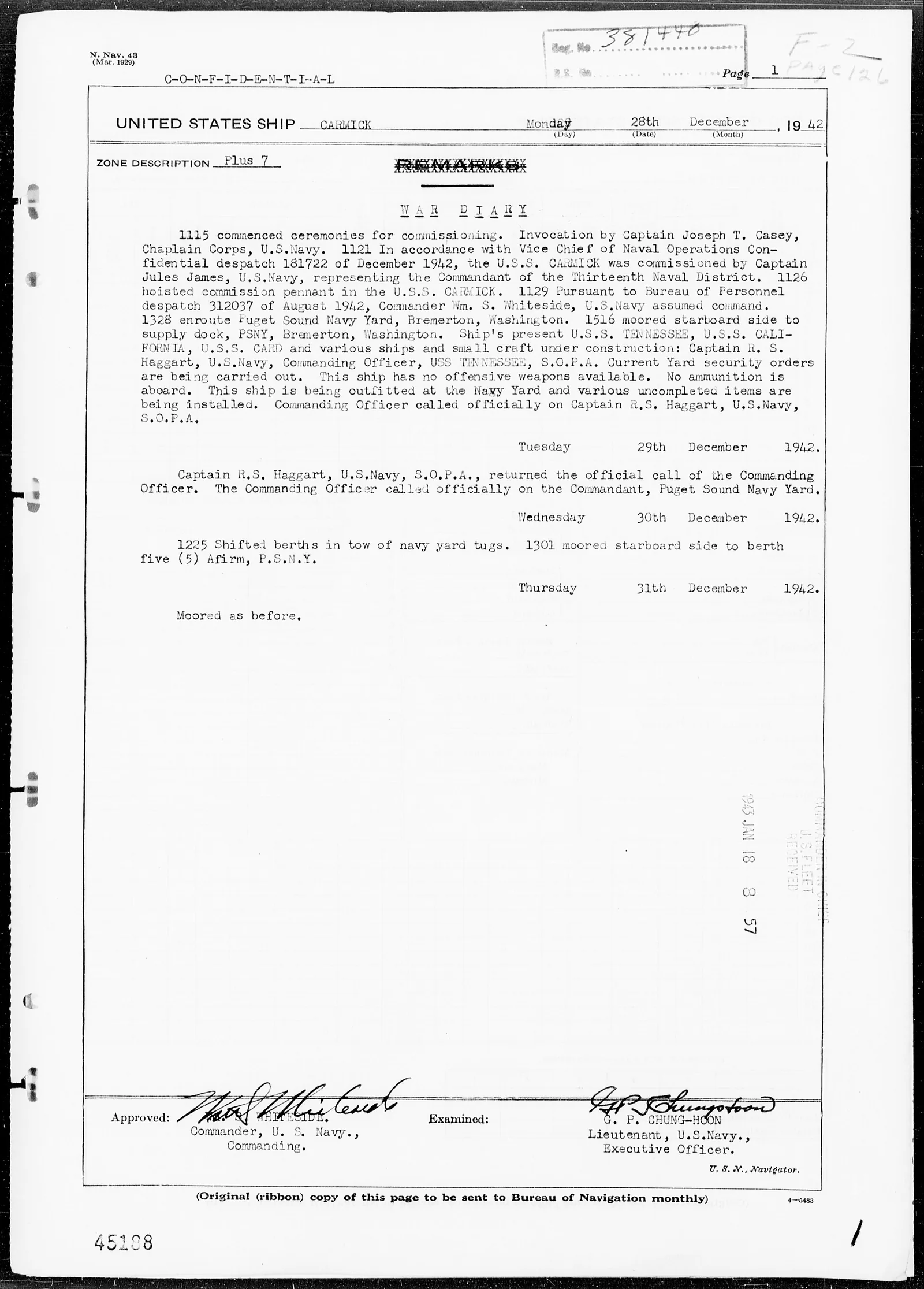
Carmick (DD-493) was launched 8 March 1942 by Seattle-Tacoma Shipbuilding Co., Seattle, Wash.; sponsored by Mrs. H. L. Merrill; and commissioned 28 December 1942, Commander W. S. Whiteside in command.
1943
Carmick cleared San Diego, Calif., 19 February 1943 for Norfolk, Va., arriving 10 March. Her varied and active career as an escort in the Atlantic began in April 1943 when she guarded a convoy to Argentia, Newfoundland, from which she returned to New York City to join the escort of a convoy bound for Casablanca. On 8 May she had her first enemy contact, delivering three depth charge attacks until being forced to break off the attack in order to rejoin the convoy. Returning to New York 1 June, Carmick stood north for training in Casco Bay. While running in a fog on 16 June, she struck a submerged object, which sent her back to Boston for 4 months of repairs.
Back in action 5 November 1943, Carmick crossed the Atlantic guarding a convoy to Londonderry, Ireland in November, escorted Chikaskia (AO-54) to Aruba in December, and in January 1944 protected Hornet (CV-12) during the carrier's shakedown training off Bermuda. In February she tested equipment for the Bureau of Ships and escorted Wasp (CV-18) to Trinidad. This phase of Carmick's contribution to the growing might of the Navy ended when the destroyer was assigned to hunter-killer operations with Destroyer Squadron 18 from 29 March.
1944 Europe
On 2 April 1944, Carmick made two depth charge attacks with inconclusive results on an enemy submarine detected by sound contact. Later the same day, she successfully dodged a torpedo. On 18 April, Carmick cleared Boston for Plymouth, England, arriving 28 April to prepare for her role in the mighty naval force mounting the invasion of Europe. On 6 June (D-Day), she took station guarding the flanks of the leading ships off Omaha Beach, acting as antisubmarine and anti-E boat screen. As the infantrymen began to move ashore, Carmick provided pin-point gunfire support, knocking out enemy strongpoints. She remained off the beachhead through 17 June, firing against enemy air attacks and guarding the great numbers of ships moving into the area to support forces ashore. On 10 June, she splashed a Heinkel bomber.
Screening duty in the English Channel preceded Carmick's departure for the Mediterranean 18 July 1944. Convoy duty in connection with the buildup for the invasion of southern France continued until 15 August, day of the preliminary attacks on the coast between Toulon and Cannes.- Once more Carmick was in the van of the invasion fleet, with duties similar to those she had at Normandy. Her constant vigilance was rewarded 18 August, when she destroyed an enemy E-boat. She supported the consolidation of the beachhead by convoy escort duty in the western Mediterranean until 23 September, when she cleared for New York City.
1945
After overhaul and training, Carmick made three convoy escort voyages to Casablanca and Oran, guarding men and supplies for the European campaign. On 10 June 1945, she entered Philadelphia Navy Yard for conversion to a high speed mine sweeper, and on 23 June 1945,- she was reclassified DMS-33.
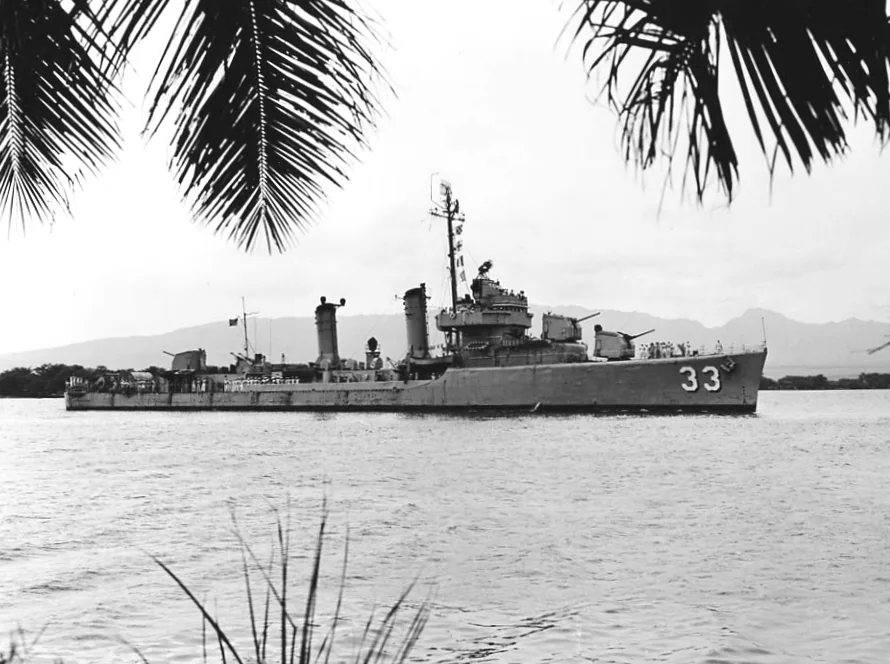
On 27 August 1945, Carmick cleared Norfolk, Va., for the Pacific, arriving at Okinawa 15 October for mine-sweeping operations in the Yellow Sea. She remained in the Far East to support the occupation until returning to San. Francisco 20 April 1946. With San Diego as her home port, Carmick made one tour to the western Pacific in the summer and fall of 1947, and conducted local operations until the outbreak of the Korean War. She cleared San Diego 4 October 1950 for duty in United Nations' efforts in Korean waters. Operating with TF 95 out of Yokosuka, Japan, she patrolled off both coasts of Korea, providing fire-support and minesweeping operations. From 29 October to 3 December, she penetrated the dangerous harbor at Chinnampo to sweep mines, and carried out this difficult assignment so well as to earn the Navy Unit Commendation. She returned to San Diego 21 November 1951 for overhaul and training.
Korean War period 1950–1953
1952
Carmick cleared San Diego 7 May 1952 for her second Korean tour, during which she patrolled off Yang Do Island, bombarded the rail center at Songjin, and provided gunfire support for minesweepers through February 1953. She returned to Long Beach, Calif., for overhaul 14 March, and in June resumed a schedule of exercises and services to the Fleet Sonar School at San Diego. After preinactivation overhaul at San Francisco, Carmick was placed out of commission in reserve 13 February 1954. She was reclassified DD-493 on 15 July 1955.
Carmick received three battle stars for World War II service, and the Navy Unit Commendation and five battle stars for Korean War service.
Other photographs
Held for this vessel, and not tied to any part of the account above.
References
Every work this entry draws on. There are no numbered markers in the text above: what we hold is the provenance of the page — this history, this article, these photographs.
- History Carmick (DD-493) Dictionary of American Naval Fighting Ships, Naval History and Heritage Command. A work of the United States Government, in the public domain — the only text on this site reproduced verbatim.
- Facts USS Carmick Structured facts only — dates, dimensions, armament and fate. No wording is taken from it. Harvested 1 August 2026.
- Photograph 493carmick 01 USN — Edited by Destroyer History Foundation from photo 19-N-39361 scanned at the National Archives and Records Administration — Public domain — Wikimedia Commons
- Photograph USS Carmick (DMS-33) at Pearl Harbor c1951 U.S. Navy — Official U.S. Navy photo NH 67110 from the U.S. Navy Naval History and Heritage Command — Public domain — Wikimedia Commons
- Photograph USS CARMICK - War Diary, 12-28-31-42 - DPLA - 005ed1e7321d4979c8b51fcd2aa74a07 Department of the Navy. Office of the Chief of Naval Operations. Intelligence Division. Office of Naval Records and Library. (1922 - 10/10/1945) — This file was contributed to Wikimedia Commons by National Archives at College Park - Textual Reference as part of a cooperation project. The donation was facilitated by the Digital Public Library of America , via its partner Digital Public Library of America . Record in source catalog DPLA identifier: 005ed1e7321d4979c8b51fcd2aa74a07 National Archives Identifier: 134043140 — Public domain — Wikimedia Commons