United States Navy — Destroyer
USS Claxton (DD-571) — service history
This is the full service history. For the vessel's particulars, photograph and specifications, see the entry.
In the words of the US Navy. The account below is reproduced verbatim from the Dictionary of American Naval Fighting Ships, compiled by the Naval History and Heritage Command — a work of the United States Government, in the public domain, and the only text on this site not written here.
Before commissioning
Thomas Claxton, born in Baltimore, Md., entered the Navy as a midshipman 17 December 1810. He was mortally wounded after gallant service in the Battle of Lake Erie 10 September 1813, dying at Erie, Pa., 17 October 1813.
Second World War 1939–1945
1942
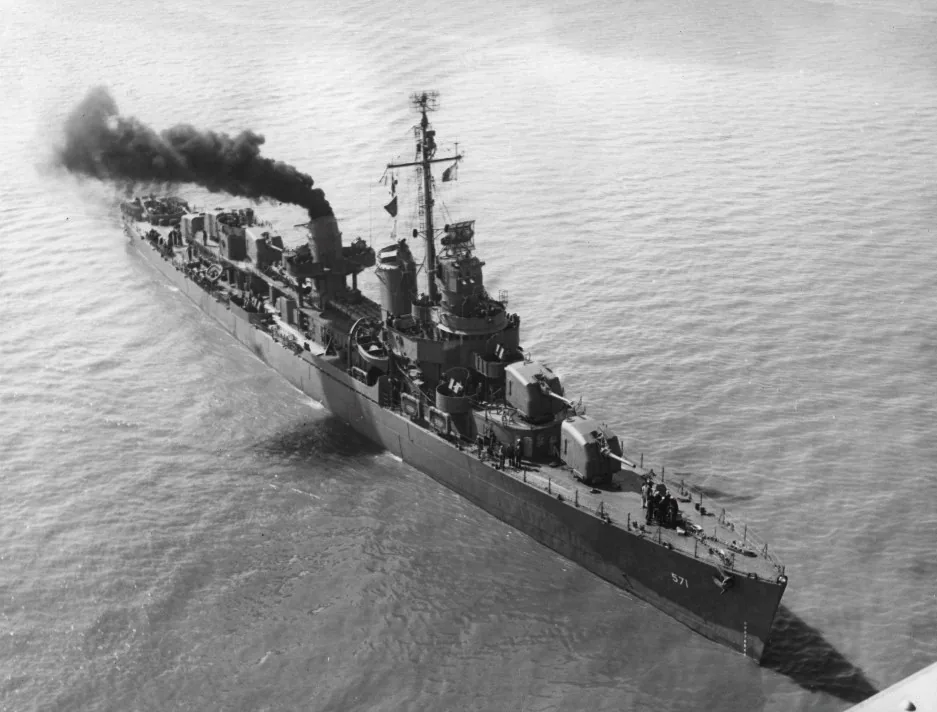
The second Claxton (DD-571) was launched 1 April 1942 by Consolidated Steel Corp., Orange, Tex.; sponsored by Mrs. A. D. Bernhard; and commissioned 8 December 1942, Commander H. F. Stout in command.
1943 Rendova
In March 1943 Claxton patrolled briefly in Casco Bay, Maine, awaiting the possible sortie of German battleship Von Tirpitz from Norwegian waters. After one convoy escort assignment to Casablanca, she sailed from Charleston, S.C., 17 May to join the Pacific Fleet.
After training at Noumea and Espiritu Santo from 12 June 1943, Claxton covered the landings at Rendova between 27 June and 25 July, then joined Destroyer Squadron 23 for a period of brilliantly executed operations which were recognized with the Presidential Unit Citation. In the struggle for the Solomons, Claxton and her squadron patrolled to intercept enemy shipping, protected the passage of American troops and shipping, bombarded enemy bases, covered landings, and engaged Japanese surface and air forces.
In the Battle of Empress Augusta Bay on the night of 1-2 November 1943, Claxton, with four cruisers and seven other destroyers, fired her torpedoes in an attack which turned back a Japanese force of four cruisers and six destroyers sailing to attack transports off Bougainville, sinking two and damaging four of the enemy ships. Afterwards, Claxton screened Thatcher (DD-514) as she towed the Foote (DD-511), one of five American ships injured that night, into Purvis Bay, arriving 4 November.
On 25 November 1943, off Cape St. George, New Ireland, Claxton and four other destroyers intercepted a force of five Japanese destroyers, as the enemy ships sailed to evacuate aviation troops to Rabaul. Once more fighting in darkness, Claxton and the others achieved complete surprise in their torpedo attack, and followed with a running gun battle. In this classic destroyer action, three Japanese ships were sunk and a fourth damaged, with no injury to the American ships.
1944 Surigao Strait
On 4 February 1944, while bombarding Sarime Plantation on Bougainville, Claxton was seriously damaged by an explosion aft, probably of two medium caliber shells. Despite her damage and 15 wounded, Claxton completed her mission with her three forward guns, then sailed for temporary aid at Purvis Bay and permanent repairs on the west coast. She returned to action in August 1944, and assigned to screen escort carriers, took part in the invasion of the Palaus in September. Sailing north for the invasion of the Philippines, the destroyer covered the operations of underwater demolition teams preparing the beaches, then gave screening and fire support during the landings on 20 October. In the phase of the Battle for Leyte Gulf known as the Battle of Surigao Strait on 24 and 25 October, Claxton screened the battle line in the surface action which virtually destroyed the Japanese southern force.
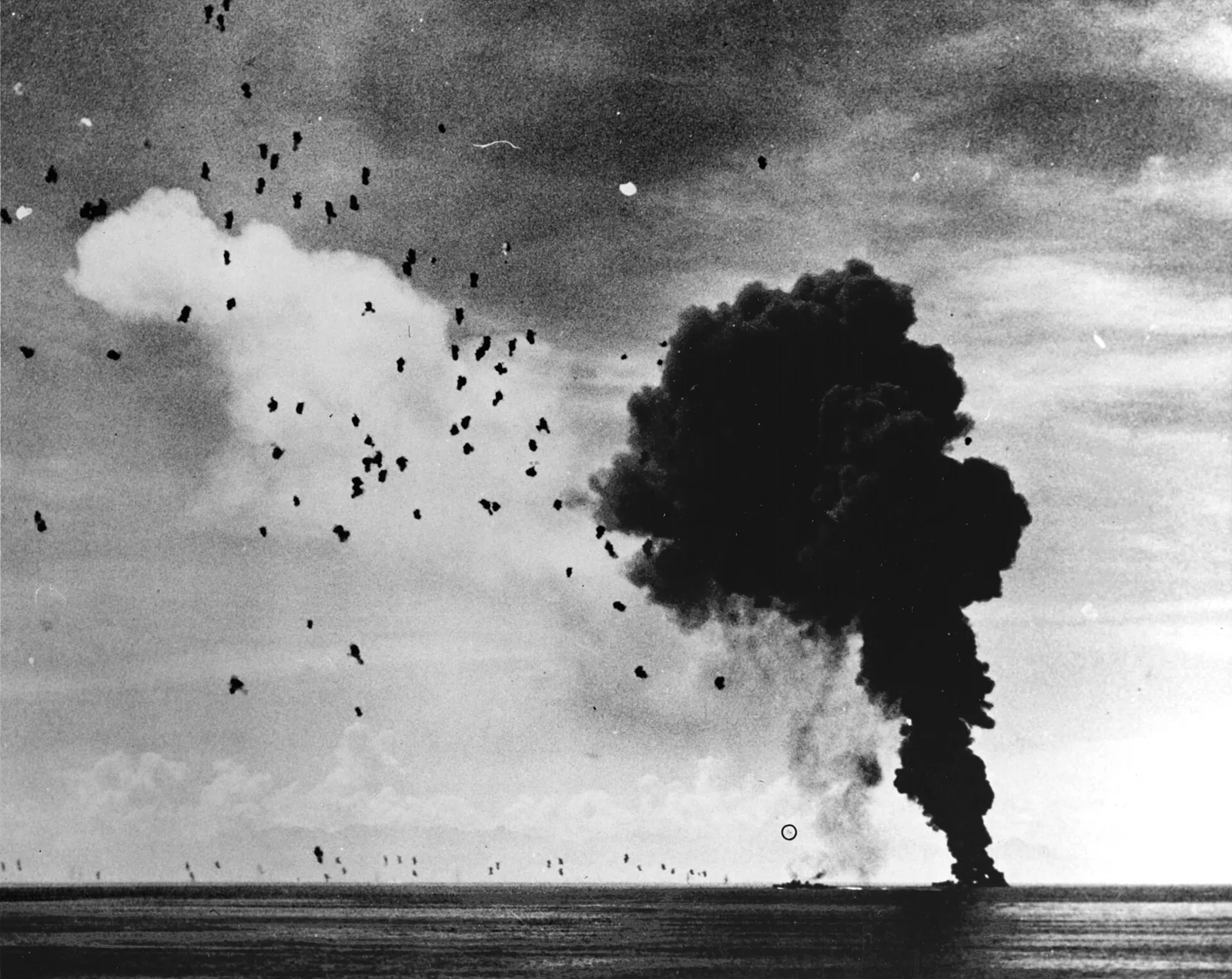
Continuing her patrol in Leyte Gulf to support the forces ashore, on 1 November 1944, Claxton suffered 5 dead, 23 wounded, and serious damage when a Japanese suicide plane crashed and exploded in the water alongside to starboard. With all her after living spaces flooded, Claxton fought her own damage as she rescued 187 survivors of Abner Read (DD-526), also a kamikaze's victim.
1945
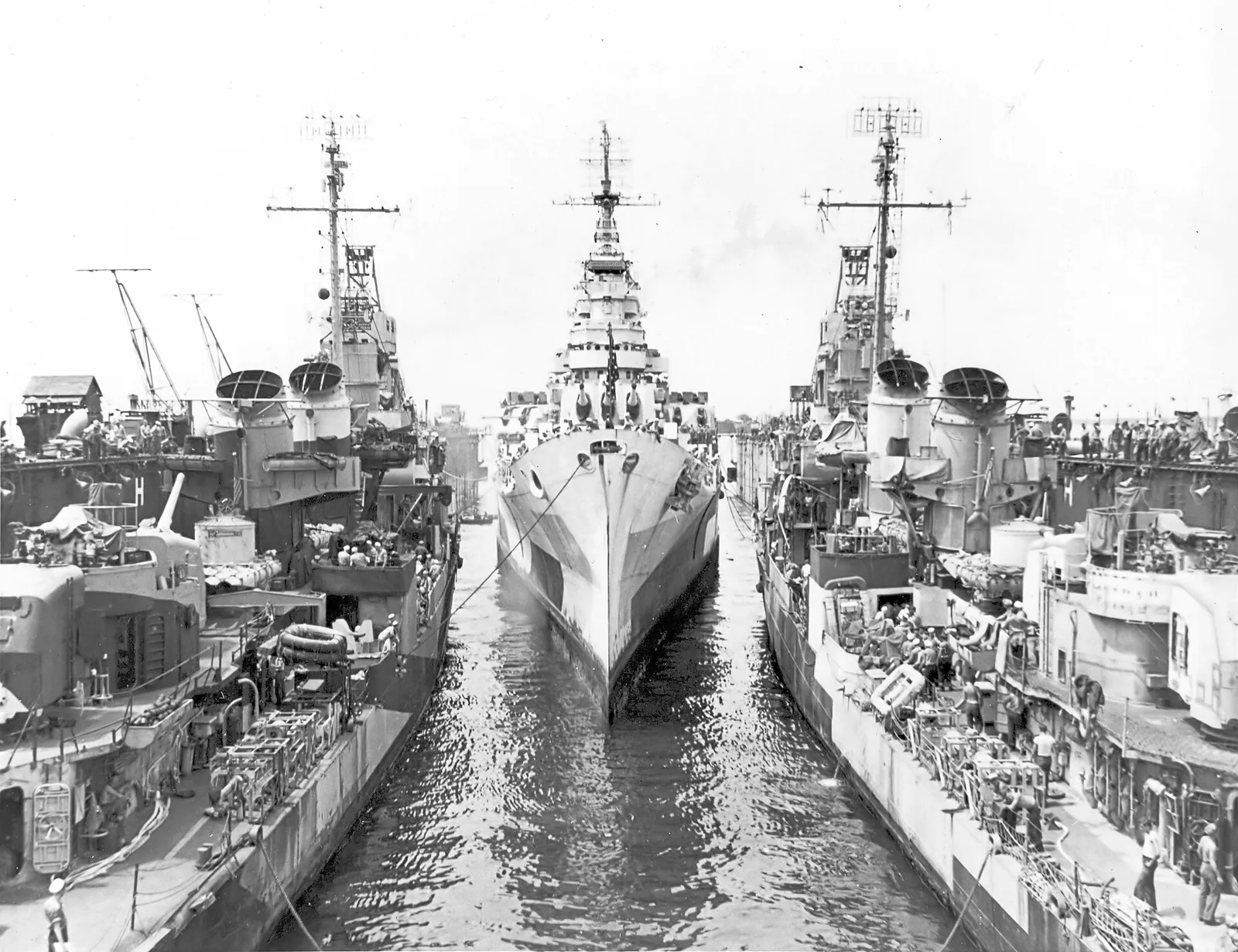
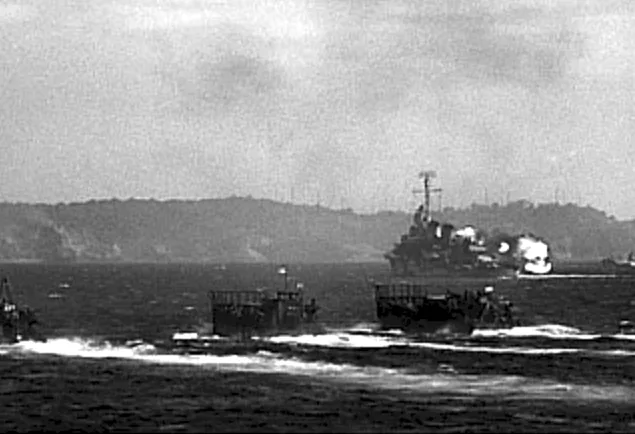
Repairs at Tacloban and Manus prepared Claxton for her return to action on fire support, patrol, and escort duty in the Lingayen Gulf landings from 9 to 18 January 1945. Continuing action in the Philippines, she conducted bombardments and covered landings, at various points on Luzon and Mindanao and in the Visayas through early May. On 16 May she arrived off Okinawa for dangerous and exacting duty as radar picket and fighter-director until the close of the war. On 6 June her guns drove off a flight of 12 would-be suiciders.
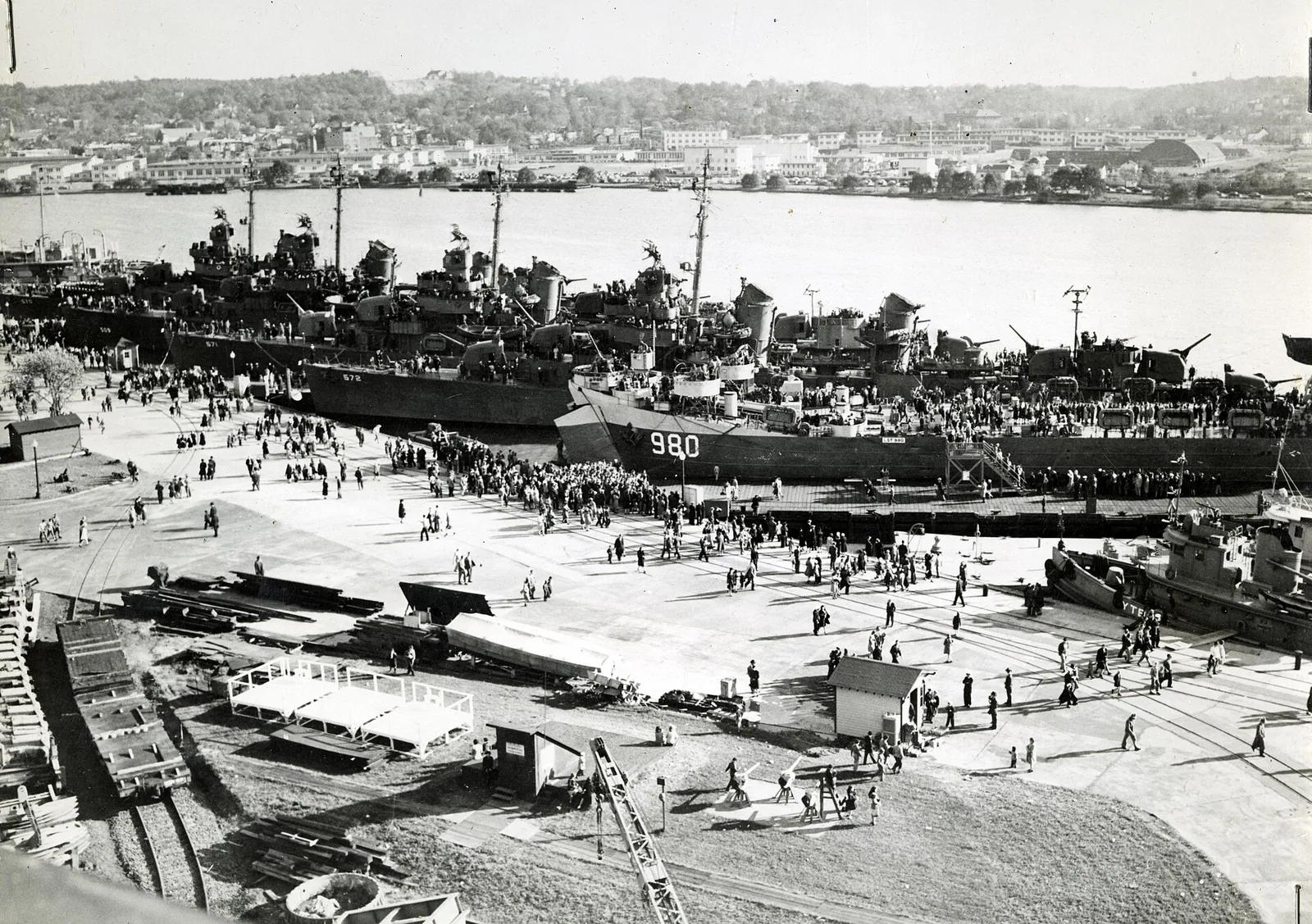
Sailing from Okinawa 10 September 1945, Claxton reached Washington, D.C., 17 October for the ceremonial presentation of the Presidential Unit Citation 2 days later. After overhaul in New York, she was decommissioned and placed in reserve at Charleston, S.C., 18 April 1946. On 15 December 1959, she was loaned under the Military Assistance Program to the Federal Republic of Germany, with whom she serves as Z-4.
Other photographs
Held for this vessel, and not tied to any part of the account above.
References
Every work this entry draws on. There are no numbered markers in the text above: what we hold is the provenance of the page — this history, this article, these photographs.
- History Claxton II (DD-571) Dictionary of American Naval Fighting Ships, Naval History and Heritage Command. A work of the United States Government, in the public domain — the only text on this site reproduced verbatim.
- Facts USS Claxton (DD-571) Structured facts only — dates, dimensions, armament and fate. No wording is taken from it. Harvested 1 August 2026.
- Photograph USS Claxton (DD-571) off the Mare Island Naval Shipyard on 13 May 1944 (19-N-66231) Unknown author — U.S. Navy photo 19-N-66231 — Public domain — Wikimedia Commons
- Photograph Ships at the U.S. Naval Gun Factory, Washington Navy Yard, Washington D.C. (USA), on Navy Day, 27 October 1945 (27663787666) U.S. Navy — U.S. Naval History and Heritage Command Photograph Navy Subject Files, WNY Box 7, Folder 1 from the National Museum of the U.S. Navy — Public domain — Wikimedia Commons
- Photograph Ships in ABSD-2 drydock 1944 (49503678937) Harley Flowers from Mobile, USA — Ships in ABSD-2 drydock 1944 — CC BY-SA 2.0 — Wikimedia Commons
- Photograph USS Abner Read (DD-526) afire and sinking in Leyte Gulf on 1 November 1944 after being hit by a kamikaze (NH 63442) Unknown author — U.S. Navy photo NH 63442 — Public domain — Wikimedia Commons
- Photograph USS Claxton (DD-571) off the Charleston Naval Shipyard, South Carolina (USA), on 16 February 1943 U.S. Navy — U.S. Navy Charleston Naval Shipyard photo 316-43 from Navsource.org — Public domain — Wikimedia Commons
- Photograph USS Claxton (DD-571) shelling Corregidor, in February 1945 USN; The original uploader was Celebrity historian at English Wikipedia ., 4 September 2006 (original upload date) — Transferred from en.wikipedia to Commons by Trần Nguyễn Minh Huy . http://www.corregidor.org/archive/army_pictorial_service/html/na_083.html — Public domain — Wikimedia Commons
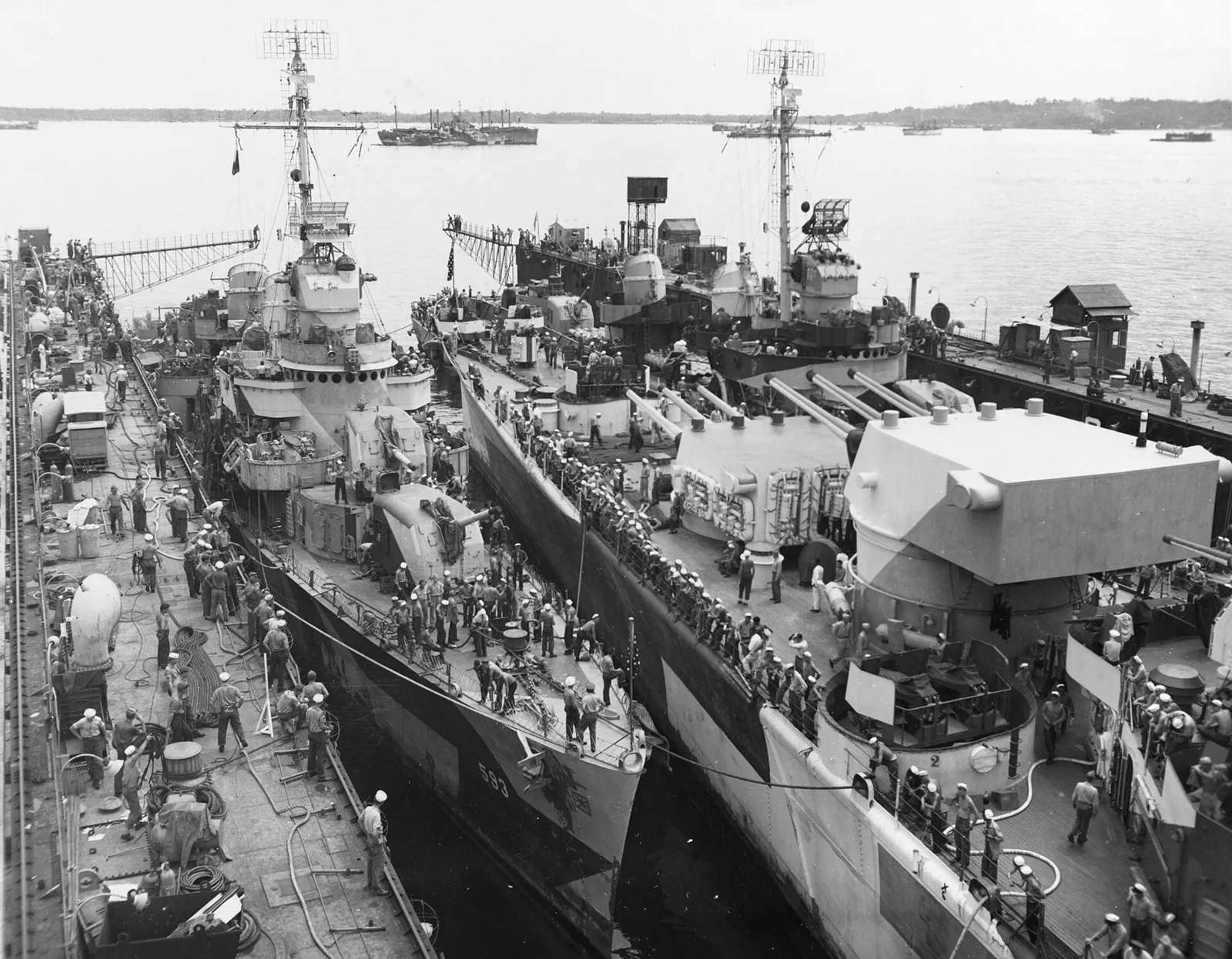
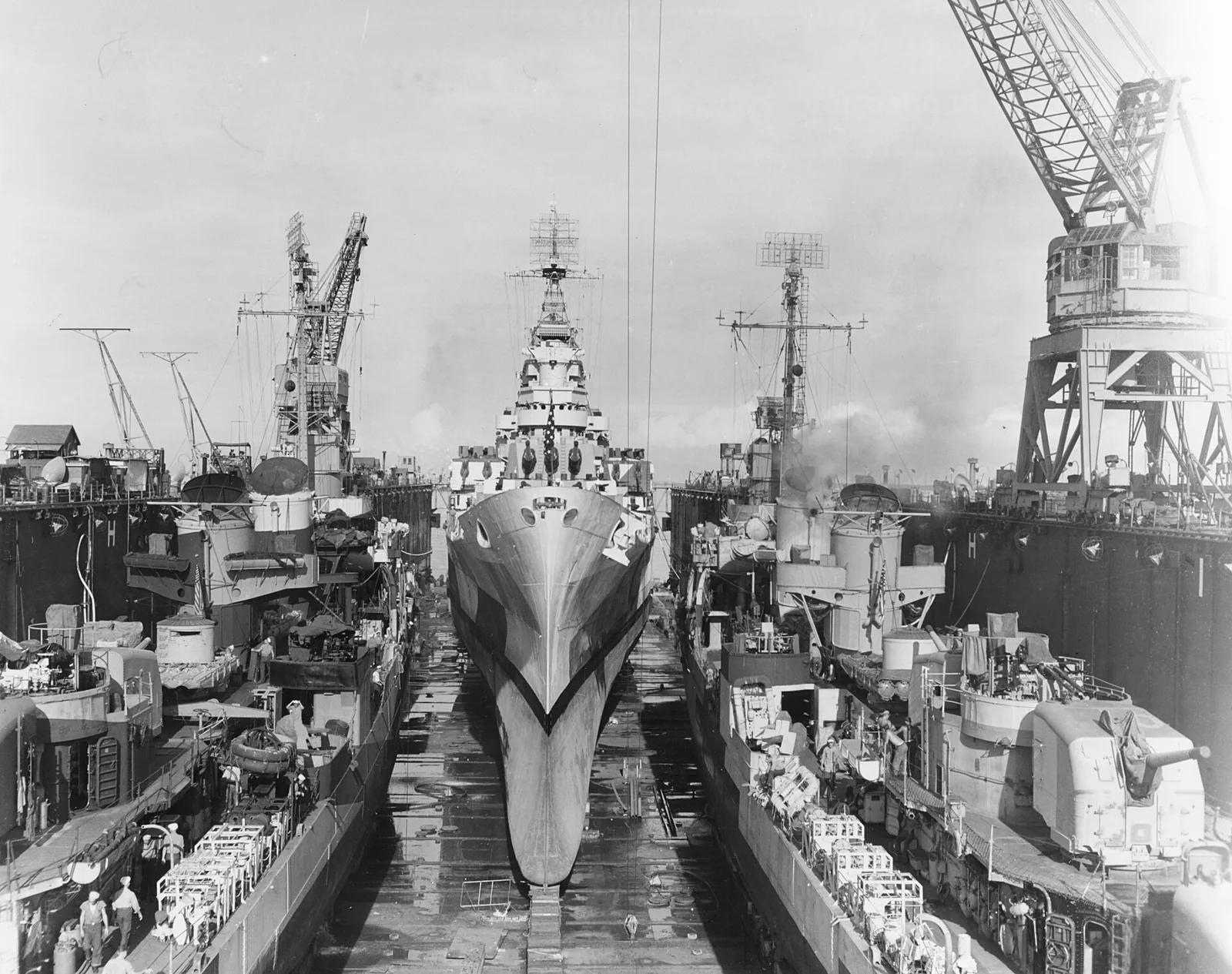
- Photograph USS Claxton (DD-571), USS Canberra (CA-70) and USS Killen (DD-593) in floating dry dock ABSD-2 at Manus, 2 December 1944 (80-G-304096) Unknown author — U.S. Navy photo 80-G-304096 — Public domain — Wikimedia Commons
- Photograph USS Claxton (DD-571), USS Canberra (CA-70) and USS Killen (DD-593) in floating dry dock ABSD-2 on 2 December 1944 (80-G-304088) Unknown author — U.S. Navy photo 80-G-304088 — Public domain — Wikimedia Commons