United States Navy — Destroyer
USS Evans (DD-552) — service history
This is the full service history. For the vessel's particulars, photograph and specifications, see the entry.
In the words of the US Navy. The account below is reproduced verbatim from the Dictionary of American Naval Fighting Ships, compiled by the Naval History and Heritage Command — a work of the United States Government, in the public domain, and the only text on this site not written here.
Before commissioning
Robley Dunglison Evans, born 18 August 1846 in Floyd County, Va., was a member of the Naval Academy class of 1864, ordered to active duty in September 1863.
In the attacks on Fort Fisher, N.C., he exhibited great gallantry under fire on 15 January 1865, when already wounded, he led his landing party through heavy fire to charge the Confederate defenses. In 1891 and 1892, commanding Yorktown on the Pacific Station, he won great acclaim for his firm and skillful handling of a tense situation with Chile. During the Spanish-American War he commanded Iowa in the Battle of Santiago. Rear Admiral Evans commanded the Great White Fleet in its passage in 1907 and 1908 from the Atlantic through the Straits of Magellan to the Pacific, where he was relieved of command because of ill health. He died in Washington, D.C., 3 January 1912. DD-78 and DD-552 were named in his honor.
Second World War 1939–1945
1942
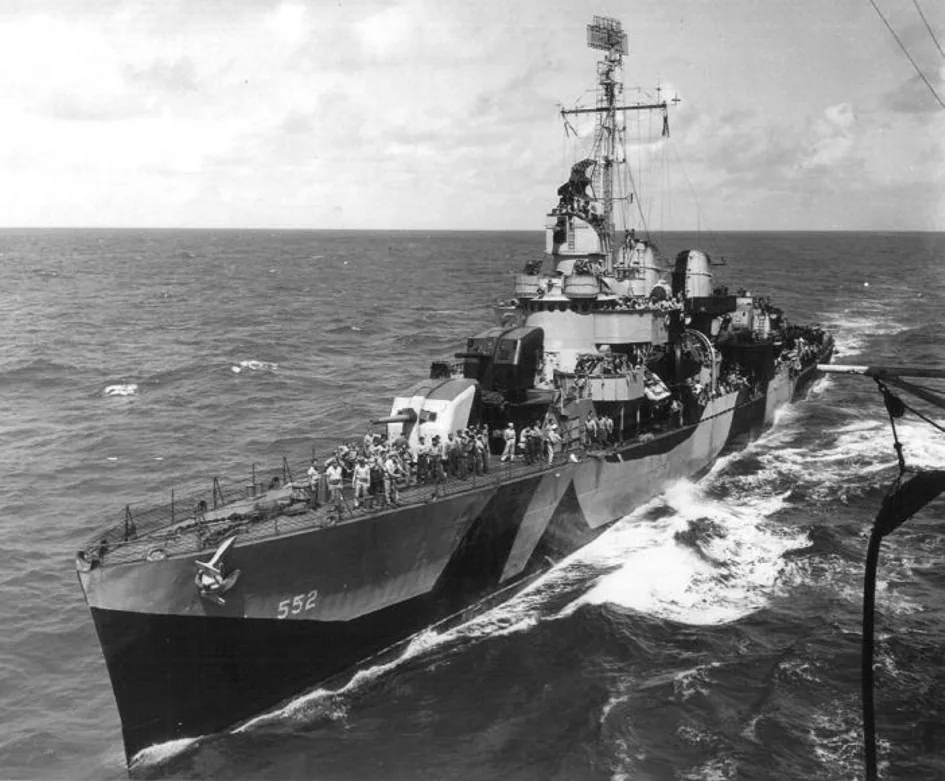
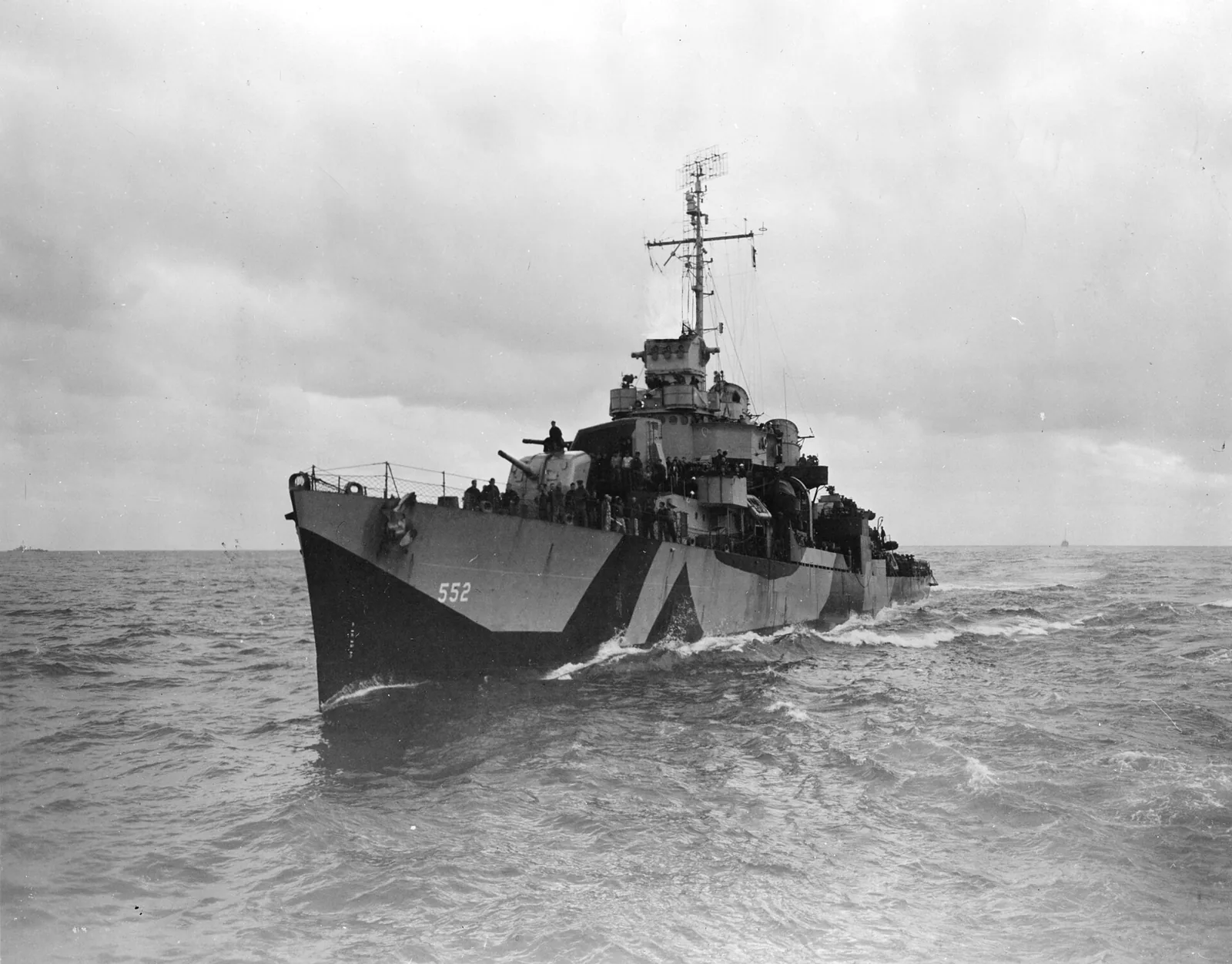
The second Evans (DD-552) was launched 4 October 1942 by Gulf Shipbuilding Co., Chickasaw, Ala.; sponsored by Mrs. C. E. Isherwood; and commissioned 11 December 1943, Commander F. C. Camp in command.
1944 Iwo Jima
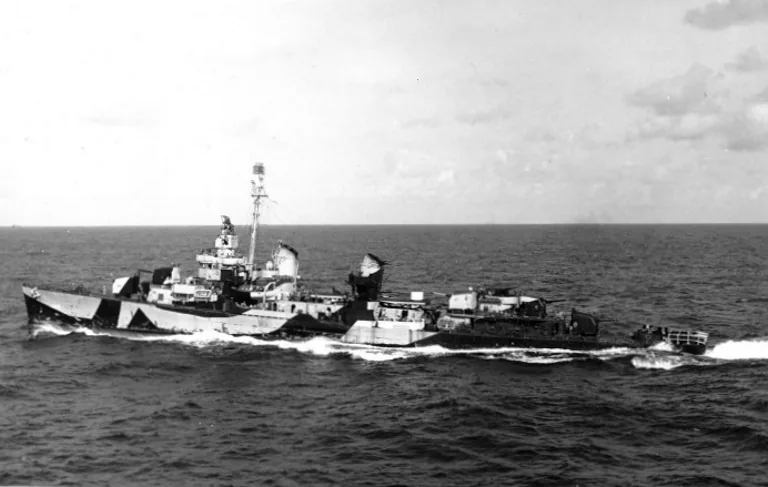
Evans reached Majuro 29 March 1944 from Pearl Harbor and the east coast, and after escorting Cimarron (AO-22) to a midocean fueling rendezvous, conducted independent antisubmarine patrols around Japanese-held atolls in the Marshalls until 13 May. After training in the Hawaiian Islands, she departed Pearl Harbor 3 June to screen the fueling and aircraft replacement group supporting both the fast carrier task force and the carrier escort force during the assault and capture of Saipan which began 15 June. She continued to screen this fueling group through the summer as the Marianas were won, returning to Eniwetok to replenish from time to time.
On 26 August 1944, Evans sailed from Eniwetok to screen the fueling and aircraft replacement group for the assault and occupation of the Palaus, and arriving at Ulithi 30 October, served on patrol and escort duty there through 11 January 1945. After a special assignment to hunt submarines near Yap and to bombard that island, from 11 to 13 January, Evans sailed to Saipan, from which she screened transports to the landings on Iwo Jima 19 February. She conducted shore bombardment and supported the troops ashore with harassing fire on Japanese positions, then screened escort carriers until 8 March, when she sailed to Ulithi.
1945
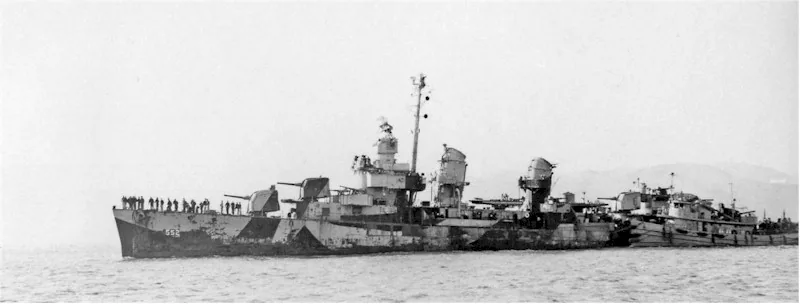
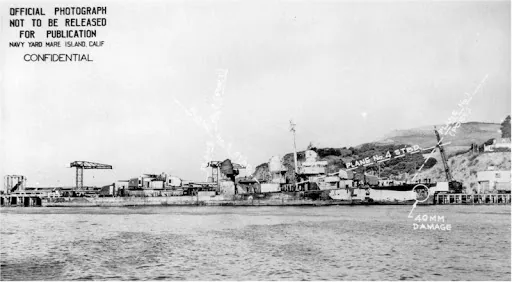
Evans cleared Ulithi 21 March 1945 to screen escort carriers in preinvasion air strikes on Okinawa and served with them through the 1 April assault and until 2 May, when she put in to Kerama Retto. Eight days later, she got underway with Hugh W. Hadley (DD-774) for a radar picket station northwest of Okinawa. During the first night on station, 10-11 May, enemy planes were constantly in evidence, more than a hundred attacked the two destroyers and the two LCSs with them. Evans fought determinedly against this overwhelming assault, splashing many of the attackers, but in quick succession, four kamikazes struck her. Evans , after engineering spaces flooded, and she lost power. With the same courage they had shown in fighting their ship, Evans' crew now strove to save her, using portable fire extinguishers and bucket brigades. They succeeded though 32 were killed and 27 wounded, and the ship was towed into Kerama Retto 14 May for repairs. She was awarded the Presidential Unit Citation for high gallantry and achievement.
After emergency repairs at Kerama Retto, Evans was towed to San Francisco, where she was decommissioned 7 November 1945. She was sold 11 February 1947.
Other photographs
Held for this vessel, and not tied to any part of the account above.

References
Every work this entry draws on. There are no numbered markers in the text above: what we hold is the provenance of the page — this history, this article, these photographs.
- History Evans II (DD-552) Dictionary of American Naval Fighting Ships, Naval History and Heritage Command. A work of the United States Government, in the public domain — the only text on this site reproduced verbatim.
- Facts USS Evans (DD-552) Structured facts only — dates, dimensions, armament and fate. No wording is taken from it. Harvested 1 August 2026.
- Photograph USS Evans (DD-552) in the Gulf of Mexico 1943 USN — Official U.S. Navy photo 80-G-204640 available at Destroyerhistory.org — Public domain — Wikimedia Commons
- Photograph USS Evans (DD 552) U.S. Navy — U.S. Navy Mare Island Naval Shipyard photo 5494-45 from Navsource.org — Public domain — Wikimedia Commons
- Photograph USS Evans (DD-552) at the Mare Island Naval Shipyard, California (USA), 28 July 1945 (5494-45) U.S. Navy — U.S. Navy Mare Island Naval Shipyard photo 5494-45 from Navsource.org — Public domain — Wikimedia Commons
- Photograph USS Evans (DD-552) at the Mare Island Naval Shipyard, California (USA), on 28 July 1945 U.S. Navy — U.S. Navy Mare Island Naval Shipyard photo 5494-45 from Navsource.org — Public domain — Wikimedia Commons
- Photograph USS Evans (DD-552) underway at sea on 5 October 1944 (80-G-263751) U.S. Navy — U.S. Navy photo 80-G-263751 from usndazzle.com — Public domain — Wikimedia Commons
- Photograph USS Evans (DD-552) underway in the Pacific Ocean on 10 June 1944 (80-G-264259) U.S. Navy — U.S. Navy photo 80-G-264259 available at usndazzle.com — Public domain — Wikimedia Commons
- Photograph USS Evans (DD-552) underway on 27 February 1945 (80-G-187725) Unknown author — U.S. Navy photo 80-G-187725 — Public domain — Wikimedia Commons