USS Gilmer (DD-233)
Variant of Clemson-class destroyer
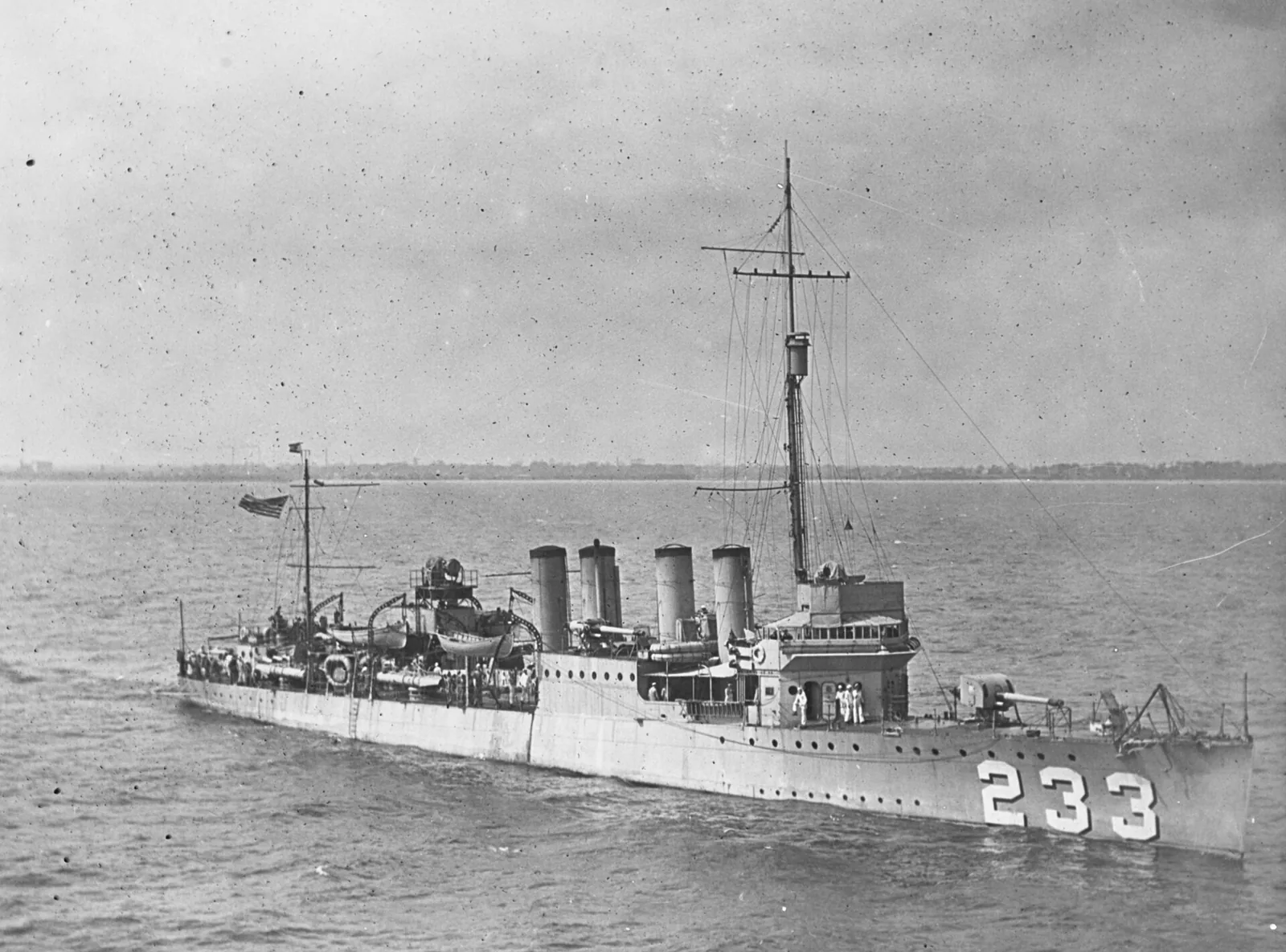
Service
- 30 April 1920 — 5 February 19462,193 days of the war
- Name
- USS Gilmer
- Pennant / hull number
- DD-233
- Namesake
- Thomas Walker Gilmer
- Builder
- New York Shipbuilding
- Laid down
- 25 June 1918
- Launched
- 24 May 1919
- Commissioned
- 30 April 1920
- Decommissioned
- 31 August 1938
- Recommissioned
- 25 September 1939
- Struck
- 25 February 1946
- Fate
- Sold for scrapping 3 December 1946 (1946)
- Status
- Scrapped
Specifications
- Displacement, standard
- 1,215 long tons (1,234 t)
- Length
- 95.71 m (314 ft)
- Beam
- 9.45 m (31 ft)
- Draught
- 2.74 m (9 ft)
- Speed
- 33.2 knots (61.5 km/h, 38.2 mph)
- Range
- 4,914 nmi (9,101 km)
- Complement
- 130
- Main gun
- 127 mm (5 in)
Thomas Walker Gilmer, born 6 April 1802 in Albemarle County, Va., served for many years in the Virginia House of Delegates, became Governor of Virginia in 1840, and was elected to Congress in 1841. He was appointed Secretary of the Navy by President Tyler 15 February 1844 but was killed 28 February 1844 by the bursting of a gun while on board USS Princeton. I The first Gilmer (Destroyer No. 233) was launched 24 May 1919 by the New York Shipbuilding Corp., Camden, N.J.; sponsored by Mrs. Elizabeth Gilmer Miles, Secretary Gilmer's granddaughter; and commissioned 30 April 1920, lit. (j.g.) Harold J. Wright commanding.
From 27 August 1920 to 11 August 1923 Gilmer made two round trip transatlantic voyages out of New York to European and Mediterranean ports. She subsequently engaged in training exercises along the Eastern seaboard, in the Caribbean, and out of West Coast ports until 1938. This varied duty was highlighted by a cruise to Nicaragua in 1926 to protect American lives and property during a civil war, an escort voyage to Havana guarding President Coolidge in battleship Texas in 1928, and disaster relief work in the Caribbean during the same year. Decommissioned at Philadelphia 31 August 1938, Gilmer recommissioned 25 September 1939 following the outbreak of World War II and was attached to the Atlantic Fleet Destroyer Division as flagship. She conducted patrols and exercises in the Atlantic and Caribbean until reaching San Diego 4 November 1940 and continued these duties along the Pacific coast until the United States entered the war.
Gilmer was at sea off Puget Sound when the Japanese attacked Pearl Harbor 7 December 1941. She immediately began antisubmarine patrol and escort duties and continued her missions until entering drydock 13 November 1942. She was redesignated APD-11 on 22 January 1943 following conversion. She sailed from Seattle 29 January via San Diego for Pearl Harbor, arriving 13 February, and subsequently escorted merchantmen to Espiritu Santo, where she moored 9 March and commenced amphibious training exercises with the 4th Marine Raider Battalion.
On 5 April Gilmer sailed from Tulagi and as flagship of Transport Division 16 engaged in antisubmarine patrols in those waters. She called at Noumea 22 April and put in at Townsville, Australia, 8 May, making two round trip escort voyages thence to Brisbane 13 May-22 June 1943. Escort and patrolling from Australia to New Guinea continued until 4 September 1943 when Gilmer participated in the Allied assault on the Huon Peninsula near Lae, New Guinea, and patrolled off Buna Island which she also bombarded. She supported American and Australian forces in the New Guinea campaign and made frequent escort voyages thence to Australia and return. On 26 December 1943 she landed troops of the famous 1st Marine Division at Cape Gloucester, New Britain, and stood by to support landings at Finschhafen 3 days later. On 2 January 1944 elements of the 126th Infantry were landed at Saidon. Gilmer engaged in patrols of Buna, Cape Sudest, and Australia and bombarded Humboldt Bay, New Guinea, 22 April 1944 when Army forces stormed ashore that D-day.
On 12 May the ship sailed from Hollandia to embark UDT teams at Pearl Harbor and debarked them 14 June 1944 at the initial assault on Saipan. Two days later she discovered and sank four Japanese cargo ships, taking 24 prisoners, and escaping serious damage. Tinian Town was bombarded 23 June and UDT operations off that island continued until 14 July when Gilmer with William C. Miller formed a hunter-killer group and sank Japanese submarine 1-6 in 18-18' N, 146-26' E. Gilmer sailed from Tinian 12 August for Pearl Harbor and until January 1945 conducted demolition and reconnaissance training with UDT teams in Hawaiian waters. She sailed 10 January as flagship for rehearsal exercises at Ulithi, and on 16 February closed Iwo Jima for the initial amphibious assaults. UDT teams were landed on the eastern and western beaches and Gilmer screened battleship Tennessee as the big ship blasted Japanese defenses on Iwo Jima. Patrolling and screening activities continued through 24 February, when Gilmer sailed for Leyte, arriving four days later. After touching Ulithi, she took parf in the Okinawa operation, closing that island 25 March 1945 as flagship of the UDT's. The next day a kamikaze took off her galley deckhouse on its way overboard, killing one and wounding three crewmen. Gilmer supported the invasion until 9 April when she sailed for repairs at Pearl Harbor, but returned to Okinawa 4 July to recommence patrolling duties.
Following antisubmarine screening assignments for convoys bound from the Philippines to Okinawa, Gilmer moored at Nagasaki 13 September after Japan's surrender to carry POW's thence to Okinawa. She sailed from that island 15 October to escort a convoy to Hong Kong, arriving 22 October, and sailed again 2 days later to escort troopships carrying the Chinese 13th Army to Chinwangtao. After further escort and patrol voyages along the China coast, Gilmer sailed from Tsingtao 26 November for the United States and finally moored in the U.S. again at Philadelphia 11 January 1946. Decommissioned 5 February 1946, her name was struck from the Navy list 25 February 1946. She was sold for scrapping 3 December 1946.
From the Dictionary of American Naval Fighting Ships, compiled by the Naval History and Heritage Command (Gilmer I (Destroyer No. 233)). A work of the United States Government, in the public domain.
Armament and machinery
Armament and machinery
- Propulsion
- 26,500 shp (20 MW)
- geared turbines
- 2 screws
- Armament
- 4 x 5 in, 1 x 3 in, 12 x 21 inch (533 mm) tt.
Sister ships
Sources
- Facts harvested from USS Gilmer (DD-233) on Wikipedia. Figures only — no wording is taken from it.
- Service history reproduced verbatim from Gilmer I (Destroyer No. 233) , Dictionary of American Naval Fighting Ships — public domain, a work of the United States Government.
- Photograph: Unknown author — U.S. Naval History and Heritage Command photo NH 53732 — Public domain — Wikimedia Commons