United States Navy — Destroyer
USS Goodrich — service history
This is the full service history. For the vessel's particulars, photograph and specifications, see the entry.
In the words of the US Navy. The account below is reproduced verbatim from the Dictionary of American Naval Fighting Ships, compiled by the Naval History and Heritage Command — a work of the United States Government, in the public domain, and the only text on this site not written here.
Before commissioning
Caspar Frederick Goodrich was born 7 January 1847 in Philadelphia. Graduating from the Naval Academy in 1864, he spent 2 years in Colorado and Frolic; 3 years in Portsmouth and Lancaster; and 3 years at the Naval Academy. Between 1874 and 1881 he had duty on board Tennessee and Kearsarge followed by a tour at the Naval Torpedo Station, Newport, R.I. After serving as executive officer of Lancaster, flagship for the European Squadron, and Inspector of Ordnance at the Washington Navy Yard, Goodrich became Officer in Charge of the Newport Torpedo Station in 1886. From 1891 until 1896, he commanded successively Jamestown, Constellation, and Concord before he spent a year as President of the Naval War College at Newport. Originating the Coast Signal Service in 1898, he then served as Director. During the Spanish-American War in 1898, he commanded St. Louis and Newark, and received the surrender of Manzanillo. Cuba, following that city's bombardment 12 August. In the years following, Goodrich commanded Iowa, Rich mond, Minneapolis, and Puritan at sea and served as Commandant of the Philadelphia Navy Yard (1900) and the Portsmouth Navy Yard (1903) on land before his promotion to the rank of Rear Admiral 17 February 1904 and his appointment for 3 years as the Commander-in-Chief of the Pacific Squadron. After duty as commandant of the New York Navy Yard 1907 to 1909, he retired 7 January 1909. Recalled to active duty in World War I, Admiral Goodrich served as officer-in-charge of the Pay Officers' Material School at Princeton until 8 November 1919 when he again stepped down from active duty, ending a 50-year naval career. He died in Princeton 26 January 1925.
Caspar Goodrich, son of the Admiral, was born in Italy. Appointed a Midshipman from Connecticut 7 September 1897, he was designated a Naval Cadet 10 June 1901 and reported to Lancaster for duty. From 1903 to 1905 Goodrich served in Maine, Cleveland, and Chicago. Assigned to Georgia on the Atlantic Station in June 1906, Goodrich was killed 15 July 1907 as the result of a turret explosion.
Second World War 1939–1945
1945

Goodrich (DD-831) was launched 25 February 1945 by the Bath Iron Works Co., Bath, Maine; sponsored by Mrs. Caspar F. Goodrich, widow of Admiral Goodrich and mother of Lt. Goodrich; and commissioned 24 April 1945, Comdr. Dale R. Frankes in command.
After shakedown training in the Caribbean, Goodrich transited the Panama Canal 12 November 1945 to support the occupation of Japan. She patrolled between principal Japanese ports until October 1946; then she based at Tsingtao, China, for patrol along the coast of Korea. The destroyer returned to San Francisco 21 December 1946 and departed 7 January 1947 to base at Newport, R.I., as a unit of the U.S. Atlantic Fleet.
Post-war 1946–1949
1948 Marines
Goodrich overhauled in the New York Naval Shipyard, then served in the Mediterranean Sea (2 February-22 May 1948). This was her first of many annual tours with the "steel gray stabilizers" of the 6th Fleet, of actively countering the repeated threats of the Soviets to overrun the defenseless nations of the Balkans and the Middle Bast and exploit them for Red Imperialism. Her service included patrol along the Israeli-Egyptian border of the Red Sea in February 1956 to help stem the Mid-East crisis that finally culminated in the nationalization of the Suez Canal. When fighting erupted, she sped back to the Mediterranean in November 1956 to protect Americans in that area and serve notice that the United States was determined to contain and terminate the conflict. The destroyer supported the landing of Marines at Beirut, Lebanon, 14 July 1958, as the Navy again met and checked a Communist thrust against the Western democracies.
Cold War 1954–1963
1959
Goodrich shifted her home port in June 1959 from Newport to Mayport, Fla. Thereafter her annual deployments to the Mediterranean included intensive training in all forms of naval welfare with NATO units and a constant readiness with the 6th Fleet to meet any threat to peace in the Mediterranean region. She interrupted her schedule in January 1960, entering the Norfolk Navy Yard for an 8-month modernization overhaul which included complete renovation and latest weapons and shipboard equipment. She was on Project Mercury recovery station 12 February 1962 as Lieutenant Colonel John H. Glenn, USMC, made his successful orbital space flight.
1962
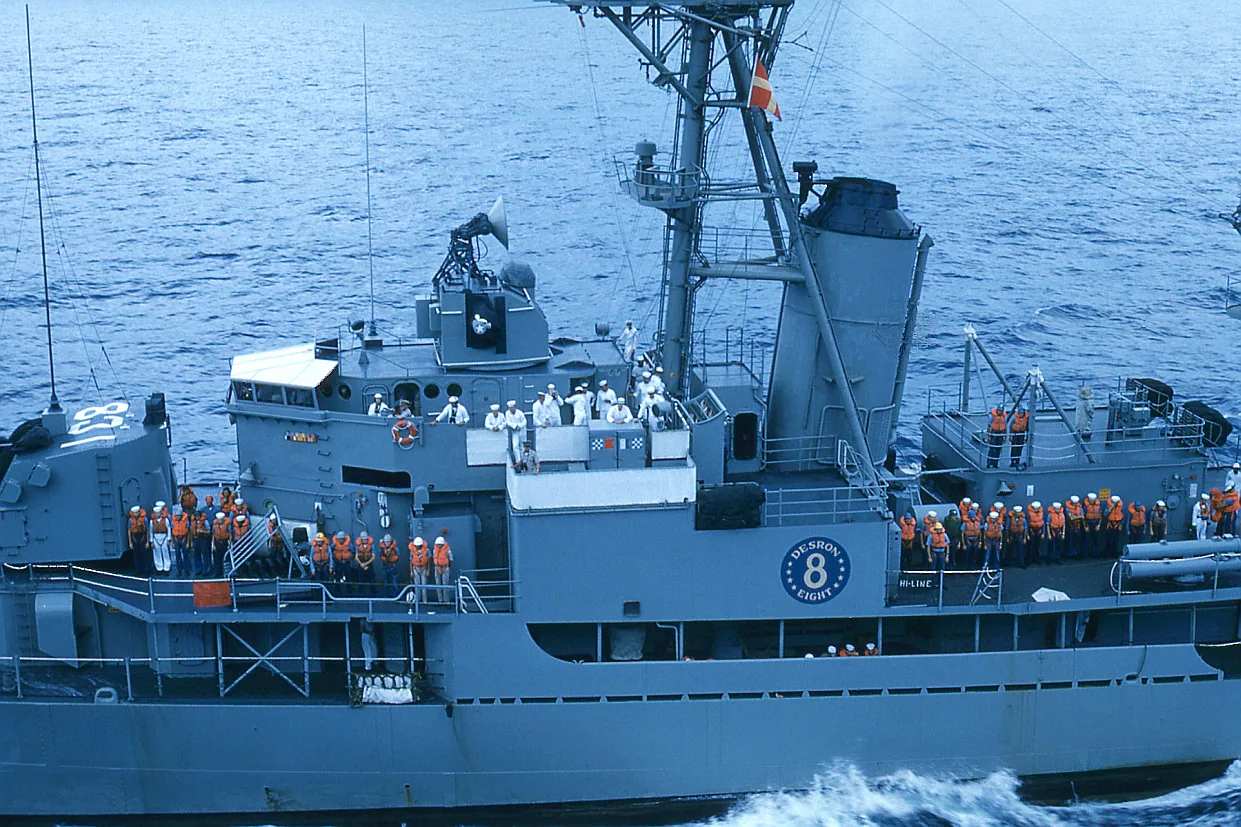
Goodrich went on alert again with the 6th Fleet during 24 October to 20 November 1962 when the Navy responded to President Kennedy's call for a quarantine of Cuba that choked off the flow of military supplies and enforced the American demands for the withdrawal of the Soviet missile experts and equipment. On 22 July 1966 the destroyer got underway from Mayport on her 13th 6th Fleet deployment. She cruised throughout the Mediterranean for 5 months, unobtrusively patrolling with the 6th Fleet and taking part in combined naval warfare exercises with units of the Turkish, Greek, British, and Italian Navies. She returned to Mayport 20 December 1966 for upkeep and type training.
Other photographs
Held for this vessel, and not tied to any part of the account above.
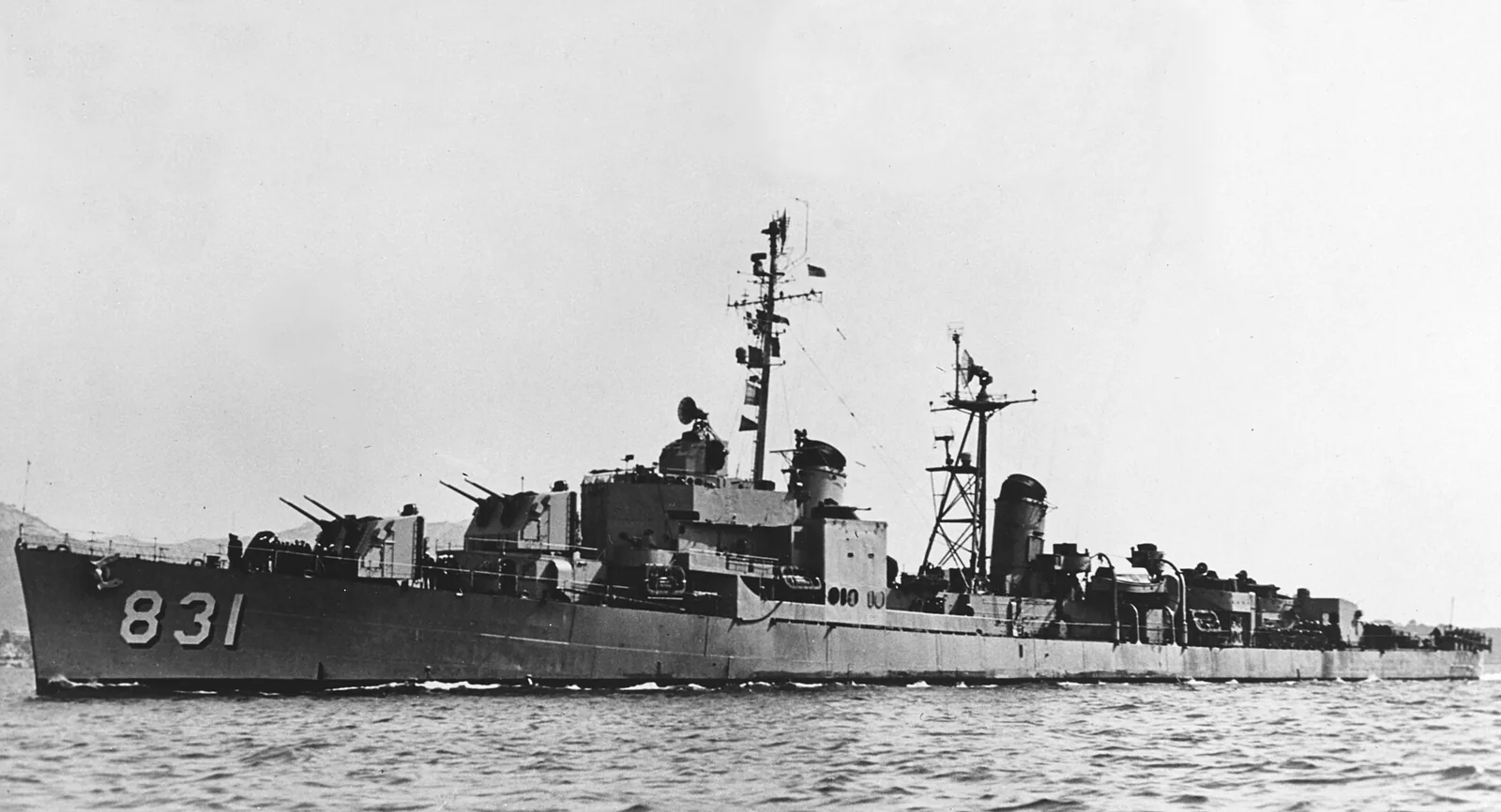
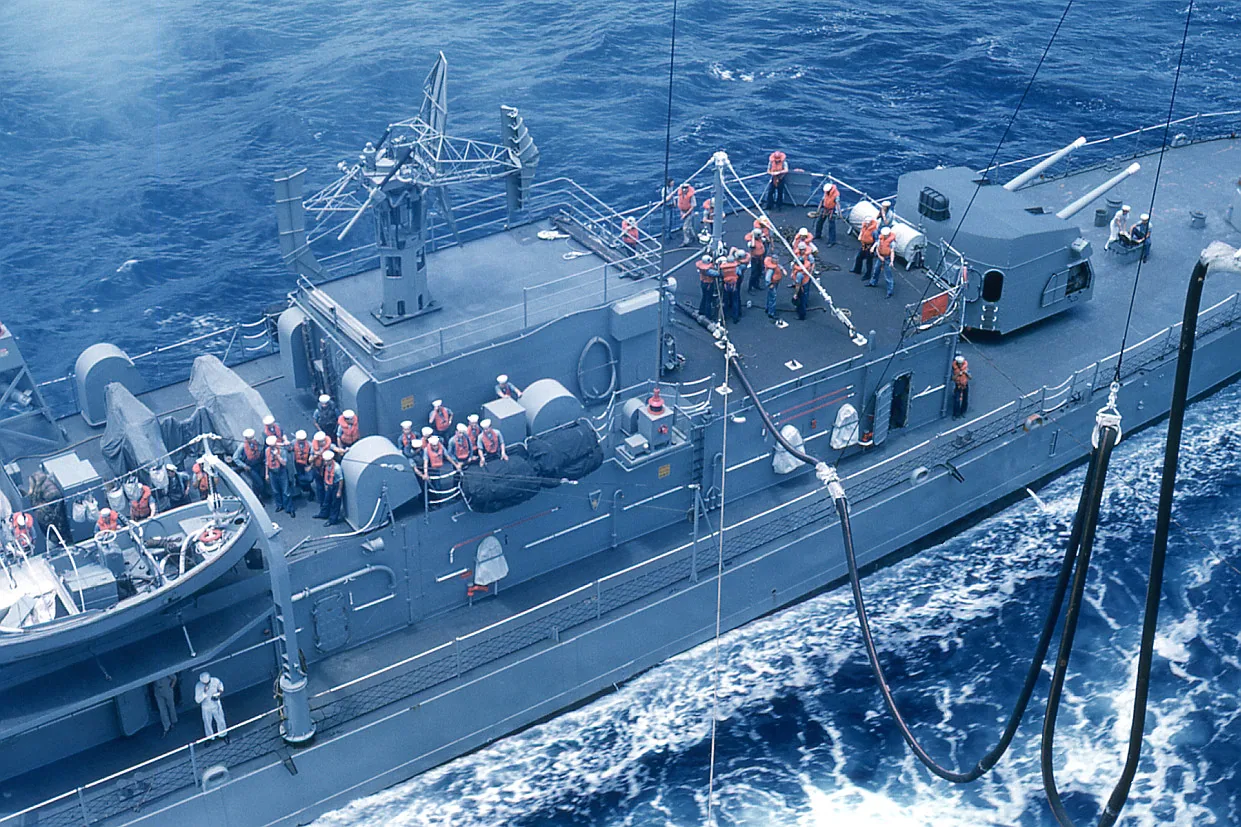
References
Every work this entry draws on. There are no numbered markers in the text above: what we hold is the provenance of the page — this history, this article, these photographs.
- History Goodrich (DD-831) Dictionary of American Naval Fighting Ships, Naval History and Heritage Command. A work of the United States Government, in the public domain — the only text on this site reproduced verbatim.
- Facts USS Goodrich Structured facts only — dates, dimensions, armament and fate. No wording is taken from it. Harvested 1 August 2026.
- Photograph USS Goodrich (DDR-831) underway at sea in the 1960s U.S. Navy — U.S. Navy photo [1] from Navsource.org — Public domain — Wikimedia Commons
- Photograph USS Goodrich (DD-831) underway in 1945 U.S. Navy — Official U.S. Navy photo [1] available at Destroyerhistory.org — Public domain — Wikimedia Commons
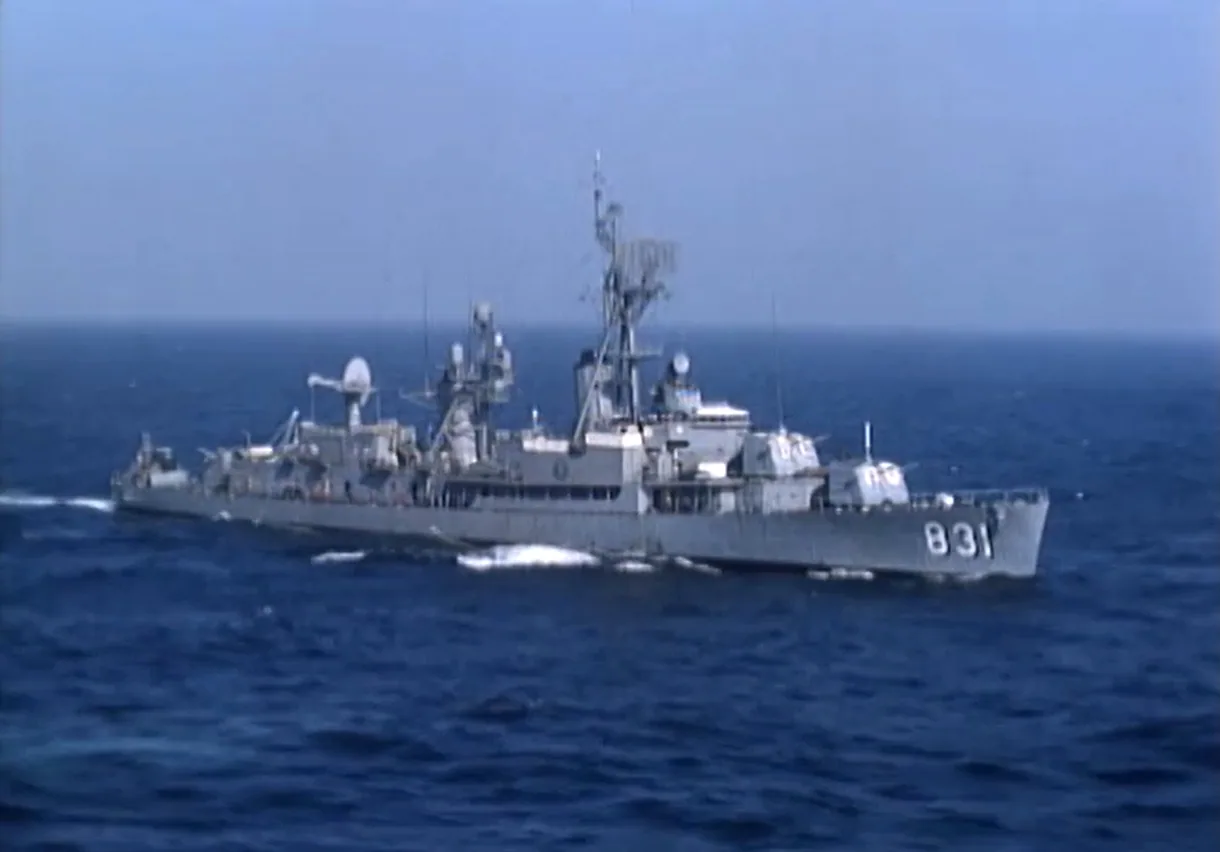
- Photograph USS Goodrich (DD-831) underway in the Atlantic Ocean, 12 April 1969 (428-NPC-42191) U.S. Navy film 428-NPC-42191 — Public domain — Wikimedia Commons
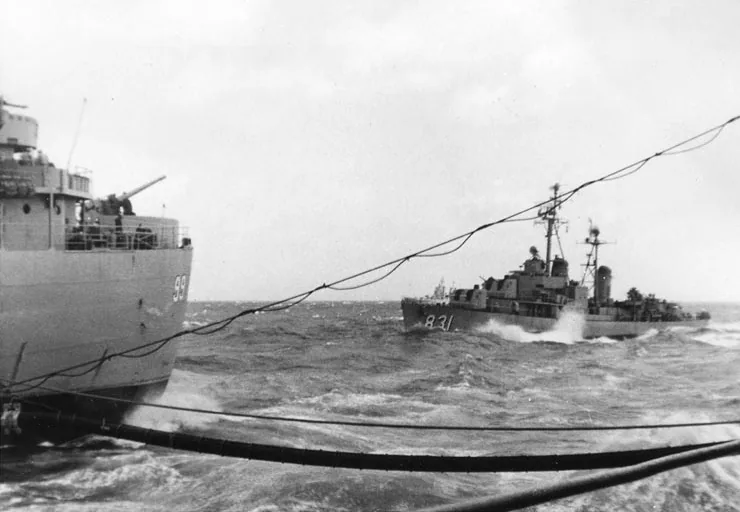
- Photograph USS Goodrich (DDR-831) steaming astern of USS Canisteo (AO-99) in the 1950s U.S. Navy — Official U.S. Navy photo NH 104869 from the U.S. Navy Naval History and Heritage Command — Public domain — Wikimedia Commons
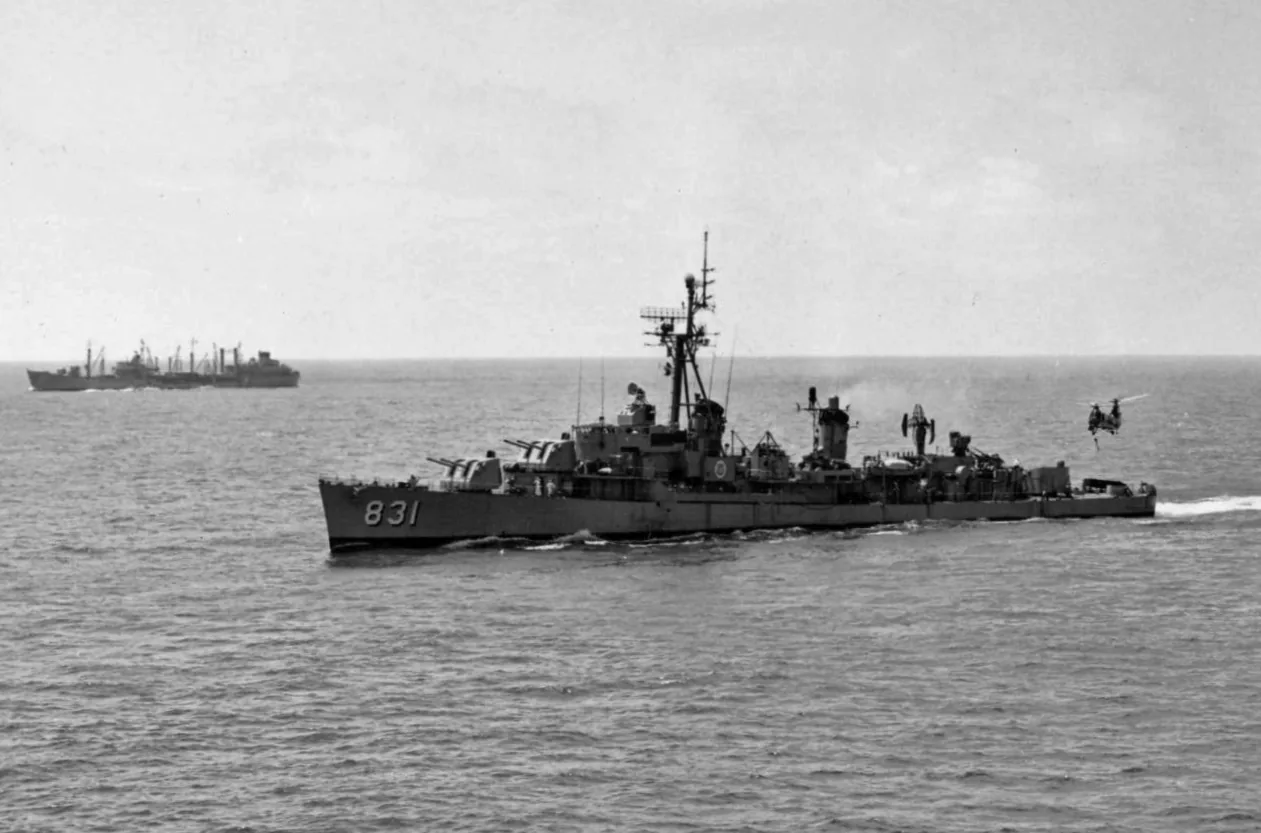
- Photograph USS Goodrich (DDR-831) underway c1958 U.S. Navy — U.S. Navy National Museum of Naval Aviation photo No. 2008.122.110 — Public domain — Wikimedia Commons
- Photograph USS Goodrich (DDR-831) underway during the early 1950s (NH 102979) Unknown author — U.S. Navy photo NH 102979 — Public domain — Wikimedia Commons
- Photograph USS Goodrich DDR-831 bridge c1962 Steve Kunzada, USN — USS Franklin D. Roosevelt veteran's website [1] photo [2] — Public domain — Wikimedia Commons
- Photograph USS Goodrich DDR-831 SPS-8A radar c1962 Steve Kunzada, USN — USS Franklin D. Roosevelt veteran's website [1] photo [2] — Public domain — Wikimedia Commons