United States Navy — Destroyer
USS Gregory (DD-802) — service history
This is the full service history. For the vessel's particulars, photograph and specifications, see the entry.
In the words of the US Navy. The account below is reproduced verbatim from the Dictionary of American Naval Fighting Ships, compiled by the Naval History and Heritage Command — a work of the United States Government, in the public domain, and the only text on this site not written here.
Before commissioning
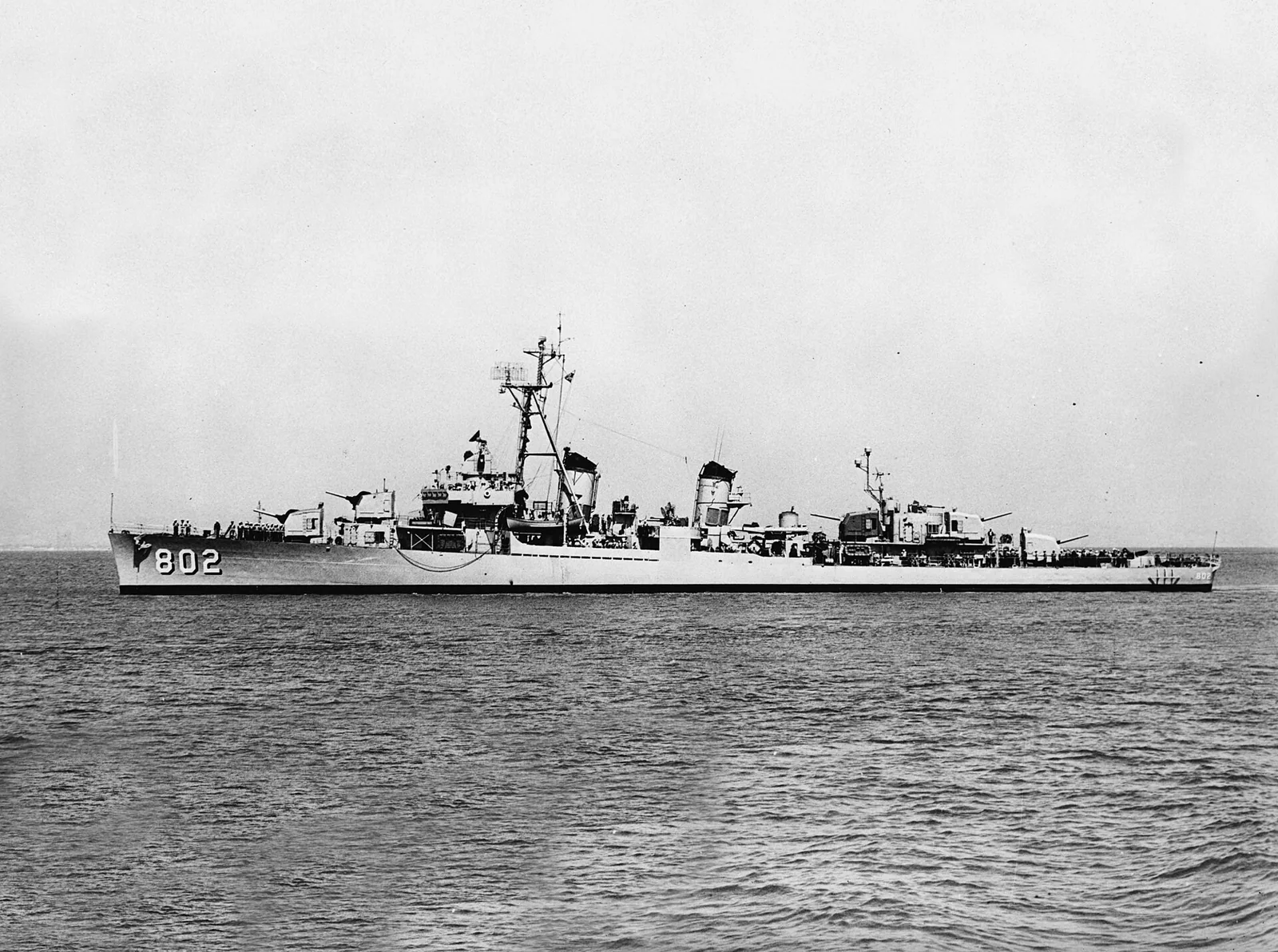
The second Gregory (DD-802) was named to honor the late Rear Adm. Francis Hoyt Gregory (1780-1866) as well as the first ship of the name, Gregory (Destroyer No. 82/APD-3), that had been sunk in 1942. See Gregiory I (Destroyer No.82) for biography. .
Second World War 1939–1945
1944 Iwo Jima
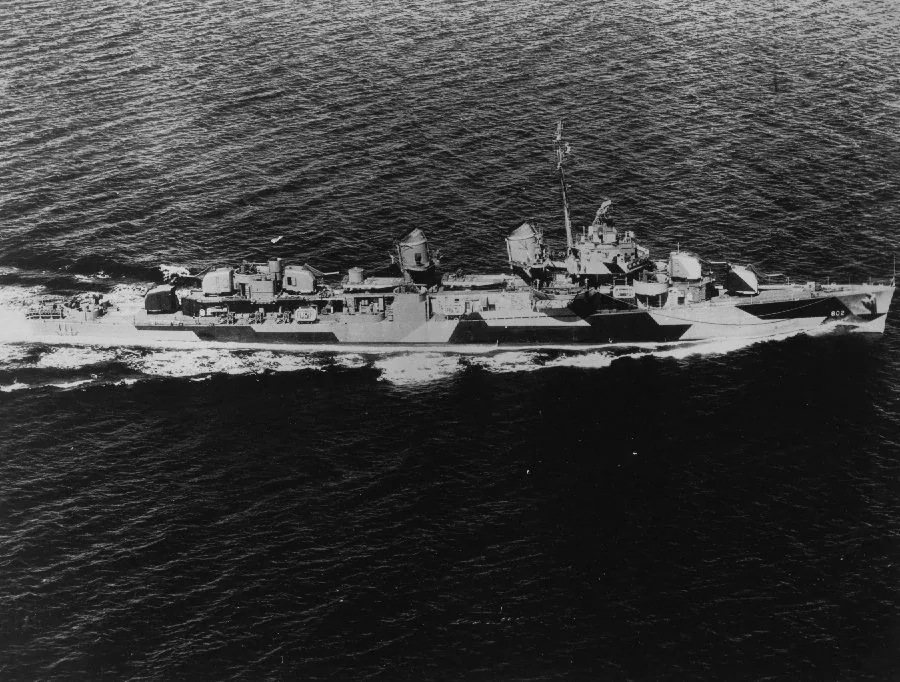
The second Gregory (DD-802) was launched by the Todd-Pacific Ship Building Co., Tacoma, Wash., 8 May 1944; sponsored by Miss Ann McGuigan, daughter of Capt. McGuigan, superintendent of construction at Tacoma ; and commissioned 29 July 1944, Cmdr. Bruce McCandless commanding.
After shakedown along the West Coast, Gregory sailed for the Pacific with Hull (DD-350), reaching Pearl Harbor 23 October 1944. Two months of local operations terminated in January 1945 as Gregory began practice for the impending invasion of Iwo Jima, next-to-last great campaign of the long and bloody Pacific war. Gregory sailed for the island 22 January, arriving off Iwo Jima via Saipan and Eniwetok on D-day, 19 February. For the next month she remained off the rocky coast under almost constant fire to screen transports and provide fire support for the invasion forces. Departing Iwo Jima 15 March, Gregory reached Saipan four days later to prepare for her role in the Okinawa campaign.
1945
Okinawa, last step prior to invasion of the Japanese home islands themselves, involved over a thousand ships and half a million men, under Admiral R. A. Spruance, in the Pacific's war largest amphibious effort. Gregory joined this modern armada as it sailed from Saipan 27 March and was off Okinawa 1 April 1945 as the first waves of Marines waded ashore to bloody battle. Her task group, under Admiral Jerauld Wright, conducted a "demonstration landing" on the southeast coast, hoping to distract some Japanese attention from the actual invasion along Okinawa's western coast. This diversion complete, Gregory remained off Okinawa on patrol and radar picket station.
Post-war 1946–1949
1947
On the afternoon of 8 April, Gregory's lookouts spotted three Japanese planes coming in out of the setting sun, a favorite kamikaze device. One of the suicide craft, pieces of fuselage spinning wildly off as Gregory's guns registered hit after hit, crashed into the destroyer amidships just above the waterline to port. Gregory shuddered under the impact and began to slow in the water as power failed in her forward engine and fire rooms flooded. The two other kamikazes mercilessly pressed on their attack, but the wounded DD downed both of them in blazing gunfire. Gregory then steamed to the anchorage at Kerama Retto for temporary repairs, and on 19 April departed Okinawa. After escorting the carrier Intrepid to Pearl Harbor, she sailed for San Diego, reaching there 18 May for battle repairs. While Gregory was still in overhaul, the Japanese surrendered and the destroyer was placed in inactive 'Status, in commission in reserve, at San Diego. She decommnssioned 15 January 1947.
Korean War period 1950–1953
1950
Gregory's rest was to be brief, as Communist forces launched their war in Korea 24 June 1950 and the U.S. Navy joined United Nations forces; she recommissioned 27 April 1951, Cmdr. H. C. Lank in command. Reaching Yokosuka, Japan, via Pearl Harbor and Midway 16 August 1951, Gregory immediately began patrol duty along the Korean coast. Her principal duties were screening American carriers, such as Essex and Boxer, from which air strikes against North Korean positions and supply lines were launched; blockading the coast, and participating in coastal bombardment as the tide of war ebbed and flowed along the Korean peninsula. In addition, she was frequently assigned to the Formosa patrol, intended to prevent Communist action against the beleaguered republic. Here Gregory came under fire from mainland Communist Chinese shore batteries. While on a search-and-rescue mission for a downed P2V 19 January 1953, she closed to within 8,000 yards of Nan'ao Tao, a Communist-held island just off the China coast. Though shore batteries opened fire on her Gregory did not return the fire, instead clearing the area immediately to continue her SAR mission.
1953
After the Korean Armistice ended the shooting war in August 1953, Gregory returned to a peactime routine of local operations out of San Diego interspersed with yearly deployments, usually 6 months long, to the Far East. These deployments took her to Yokosuka, Sasebo, Hong Kong, Bangkok, Sydney, Okinawa, the Philippines, and Formosa for training maneuvers with American and other warships. In the fall of 1958 Gregory spent a tension-filled 2% months off the China coast during one of the periodic intensifications of the Quemoy-Matsu crisis.
Vietnam War period 1964–1975
1964
Gregory earned the Battle Efficiency "E" three times during her post-war career, 1955, 1956, and 1959. Gregory decommissioned at San Diego 1 February 1964 and entered the reserve. She was struck from the Navy List 1 May 1966, renamed Indoctrinator, and served as an inoperable trainer at San Diego.
Other photographs
Held for this vessel, and not tied to any part of the account above.

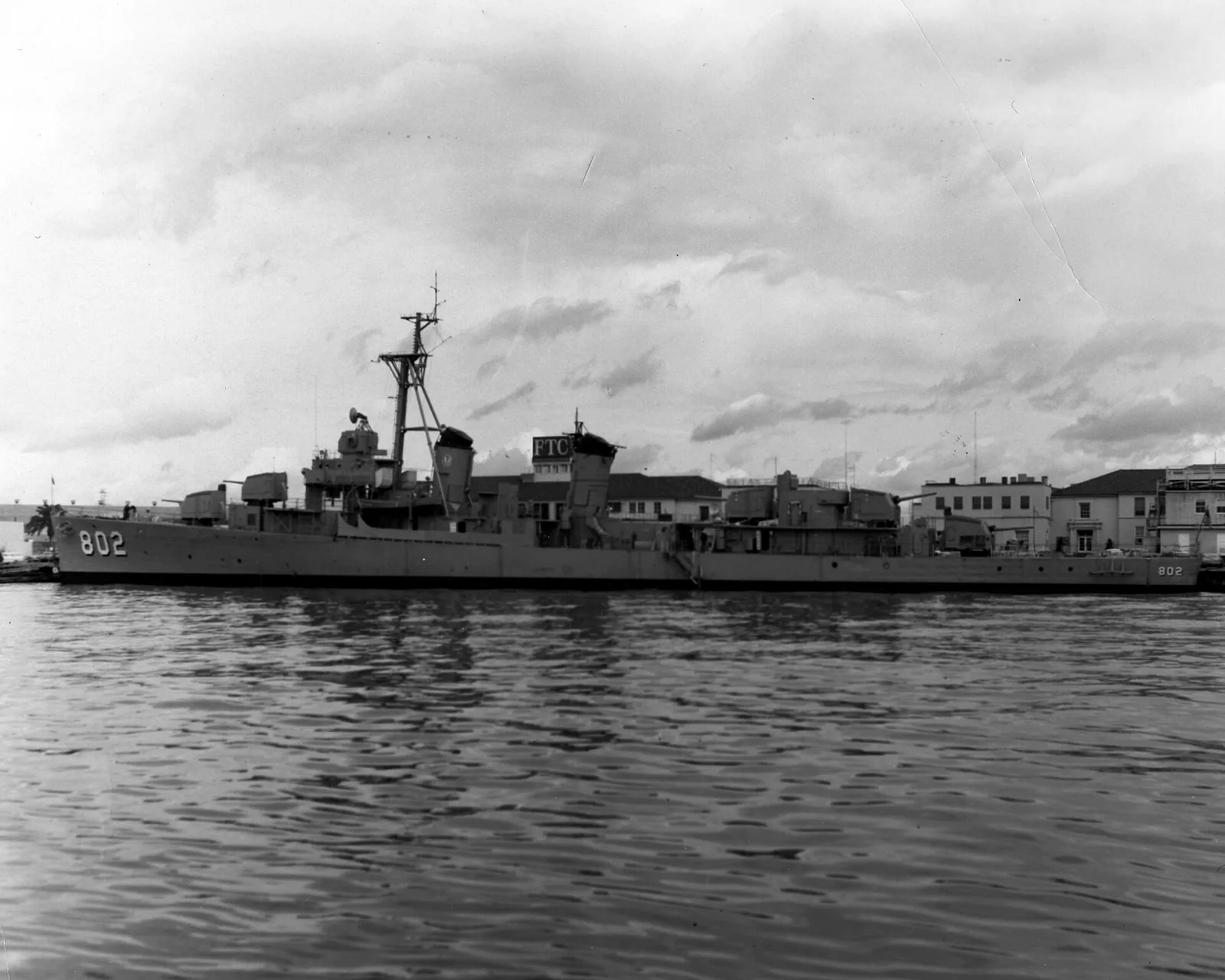
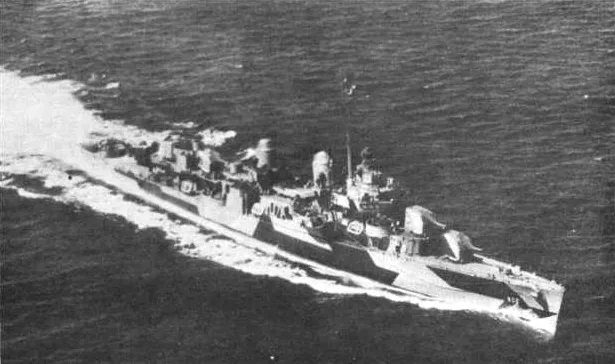
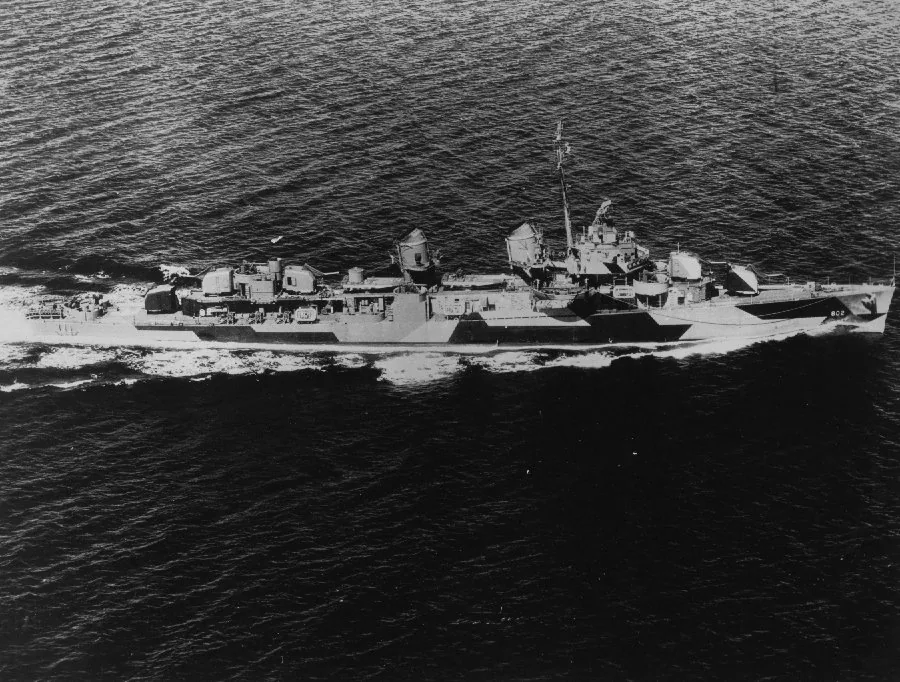
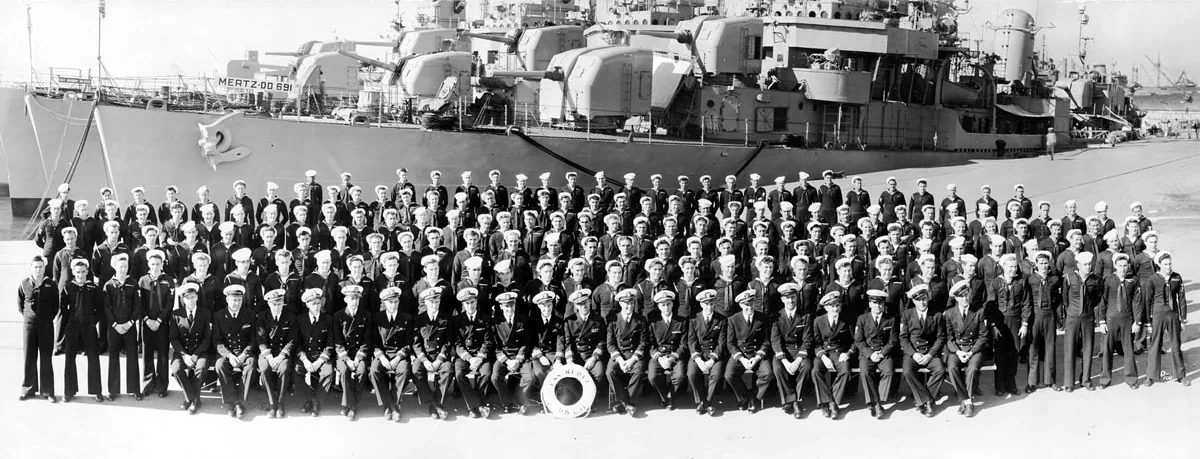
References
Every work this entry draws on. There are no numbered markers in the text above: what we hold is the provenance of the page — this history, this article, these photographs.
- History Gregory II (DD-802) Dictionary of American Naval Fighting Ships, Naval History and Heritage Command. A work of the United States Government, in the public domain — the only text on this site reproduced verbatim.
- Facts USS Gregory (DD-802) Structured facts only — dates, dimensions, armament and fate. No wording is taken from it. Harvested 1 August 2026.
- Photograph USS Gregory (DD-802) underway in the Pacific L. Hoglind, USN, photographed from USS Vega (AF-59) — U.S. Navy photo [1] from Navsource.org — Public domain — Wikimedia Commons
- Photograph USS Gregory 1944 U.S. Navy Bureau of Ships — U.S. Navy Bureau of Ships photo [1] / BS 70254 from Navsource.org — Public domain — Wikimedia Commons
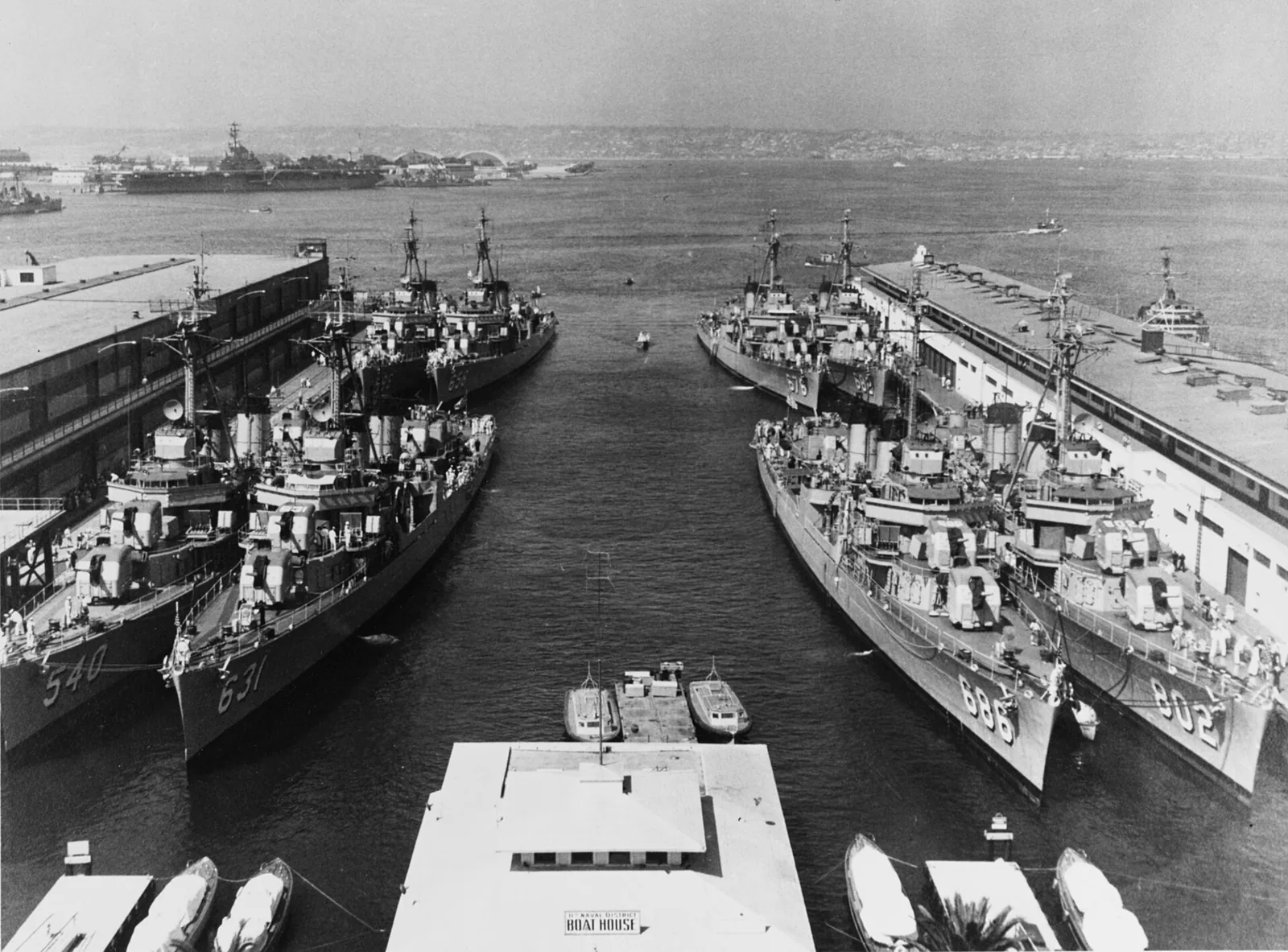
- Photograph U.S. Navy Destroyer Squadron 17 ships docked at San Diego, California (USA), in March 1955. (NH 91826) Unknown author — U.S. Navy photo NH 91826 — Public domain — Wikimedia Commons
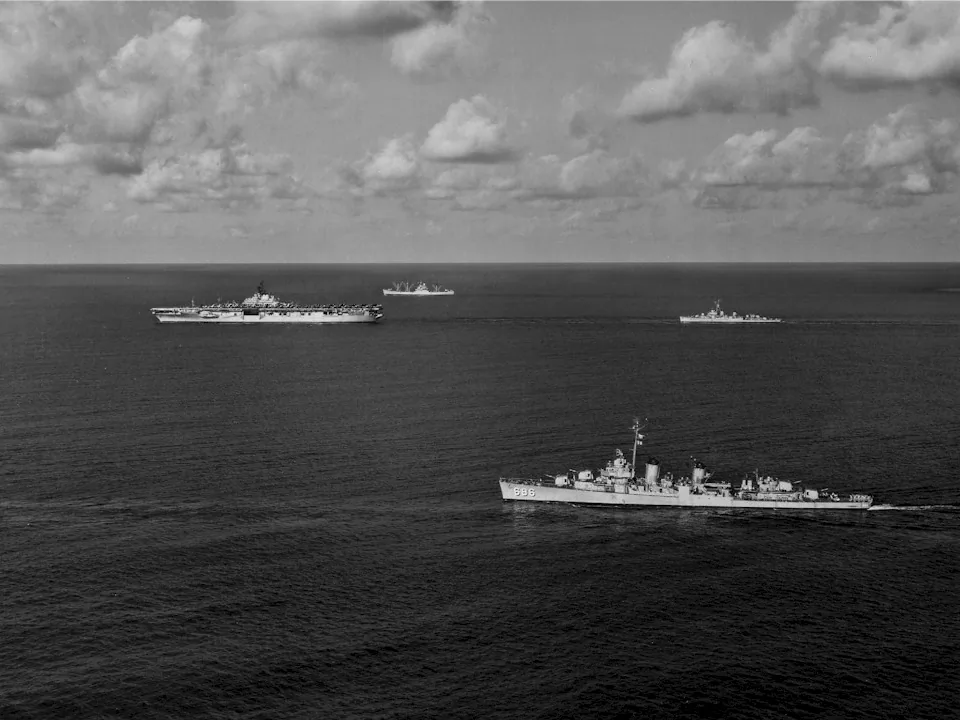
- Photograph US Task Force 70.2 in the South China Sea in 1954 USN — U.S. Navy photo [1] from Navsource.org — Public domain — Wikimedia Commons
- Photograph USS Dixie (AD-14) with destroyers at San Diego 1960 U.S. Department of Defense — U.S. Navy All Hands magazine March 1963 , p. 37; also July 1981 , p. 20 — Public domain — Wikimedia Commons
- Photograph USS Gregory (DD-802) as a damage control trainer at San Diego, 20 December 1967 (L45-111.08.02) PH3 Lochotzki, U.S. Navy — U.S. Naval History and Heritage Command photo L45-111.08.02 — Public domain — Wikimedia Commons
- Photograph USS Gregory (DD-802) off the San Francisco Naval Shipyard on 30 June 1952 U.S. Navy Bureau of Ships photo 19-NN - DD-802 Gregory - 141176 — Public domain — Wikimedia Commons
- Photograph USS Gregory (DD-802) underway c1944 USN — Official U.S. Navy photo [1] from the ship's entry in the U.S. Navy Dictionary of American Naval Fighting Ships (DANFS) available at the Naval History and Heritage Command — Public domain — Wikimedia Commons
- Photograph USS Gregory (DD-802) underway in Puget Sound, Washington (USA), on 11 August 1944 (BS 70254) U.S. Navy Bureau of Ships — U.S. Navy Bureau of Ships photo [1] / BS 70254 from Navsource.org — Public domain — Wikimedia Commons
- Photograph USS Mertz (DD-691) crew and ship in early 1946 U.S. Navy — Official U.S. Navy photo NH 107496 from the U.S. Navy Naval History and Heritage Command — Public domain — Wikimedia Commons