United States Navy — Destroyer
USS Harding (DD-625) — service history
This is the full service history. For the vessel's particulars, photograph and specifications, see the entry.
In the words of the US Navy. The account below is reproduced verbatim from the Dictionary of American Naval Fighting Ships, compiled by the Naval History and Heritage Command — a work of the United States Government, in the public domain, and the only text on this site not written here.
Before commissioning
Seth Harding was born at Eastham, Mass., 17 April 1734. He went to sea early in his life and commanded several merchant ships during the French and Indian War. At the beginning of the American Revolution, he offered his services to Connecticut and was commissioned commander of the state brig Defence. Harding captured many British ships while in command of this and two other vessels. In September 1778 Harding accepted a Continental commission and took command of Confederacy. He cruised along the coast in company with Deane during 1779, taking three prizes and performing convoy duties. He was ordered to take John Jay, newly appointed minister to Spain, to Europe in September 1779, but the ship was dismasted 10 days out. Harding, through skillful seamanship, sailed his ship to Martinique for repairs, his passengers continuing on another ship. Confederacy raided British merchantment and guarded convoys until 18 April 1781, when she was forced to surrender to two British ships, Roebuck and Orpheus. Harding was subsequently exchanged, commanded the letter of marque Diana, but was captured again. After this release the fighting captain volunteered to serve as First Lieutenant to John Perry in Alliance, and was wounded on board during the last engagement of the revolution, off the coast of France. Harding spent his last years as a merchant sailor and in retirement in Schoharie, N.Y., where he died 20 November 1814.
Second World War 1939–1945
1942
The second Harding (DD-625) was launched 28 June 1942 by Seattle-Tacoma Shipbuilidng Corp., Seattle; sponsored by Mrs. Sherwood A. Taffinder; and commissioned 25 May 1943, Lt. Comdr. G. G. Palmer in command.
1943
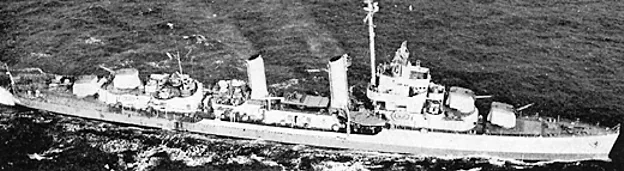
After shakedown out of San Diego Harding sailed 1 July for Norfolk, via the Panama Canal. Arriving Hampton Roads 19 July, she trained in Chesapeake Bay and off the East Coast. She joined a convoy at Norfolk 16 August 1943 and for the next 8 months was assigned antisubmarine patrol for merchant convoys in the Atlantic. During this period of guarding the sea Harding made three round trips to Casablanca.
1944
After escorting battleship Texas on training exercises, Harding sailed 18 April with a convoy for Europe, and began her first great combat operation, the Normandy Invasion. She spent the month of May training with other ships between Plymouth and Clyde. Then, early on the 6th of June 1944, Harding joined other naval units in the historic assault. Harding was assigned fire support station, and delivered close gunfire support to the troops ashore for the first hours of the lauding. Her accurate gunfire destroyed pill boxes and machine gun emplacements, blasting a way for the troops. Harding also sent a boat ashore at Point Du Hoe to take supplies to the intrepid rangers and bring out prisoners and wounded. She continued operations in the assault area until 16 July, protecting against air attack and assisting several transports in distress.
Shifting her operations to the Mediterranean, Harding sailed 1 August for Oran, Algeria, and from there proceeded 15 August to the southern France assault area, as a screening ship. She sailed almost immediately to Corsica, later returning to take up patrol station outside the assault area in southern France. On the night of 17 August she detected a downed German plane, and after recovering bodies, proceeded to investigate an unidentified contact. As Barding's signalman sought to illuminate the stranger, a burst of machine gun fire extinguished the light and revealed the presence of four enemy E-boats.
In company with three other destroyers, Harding began a running, twisting battle with the four boats, illuminated by starshell fire, and despite their superior maneuverability all four were sunk; three by Harding's accurate batteries. She brought survivors ashore and resumed her patrol until 24 August.
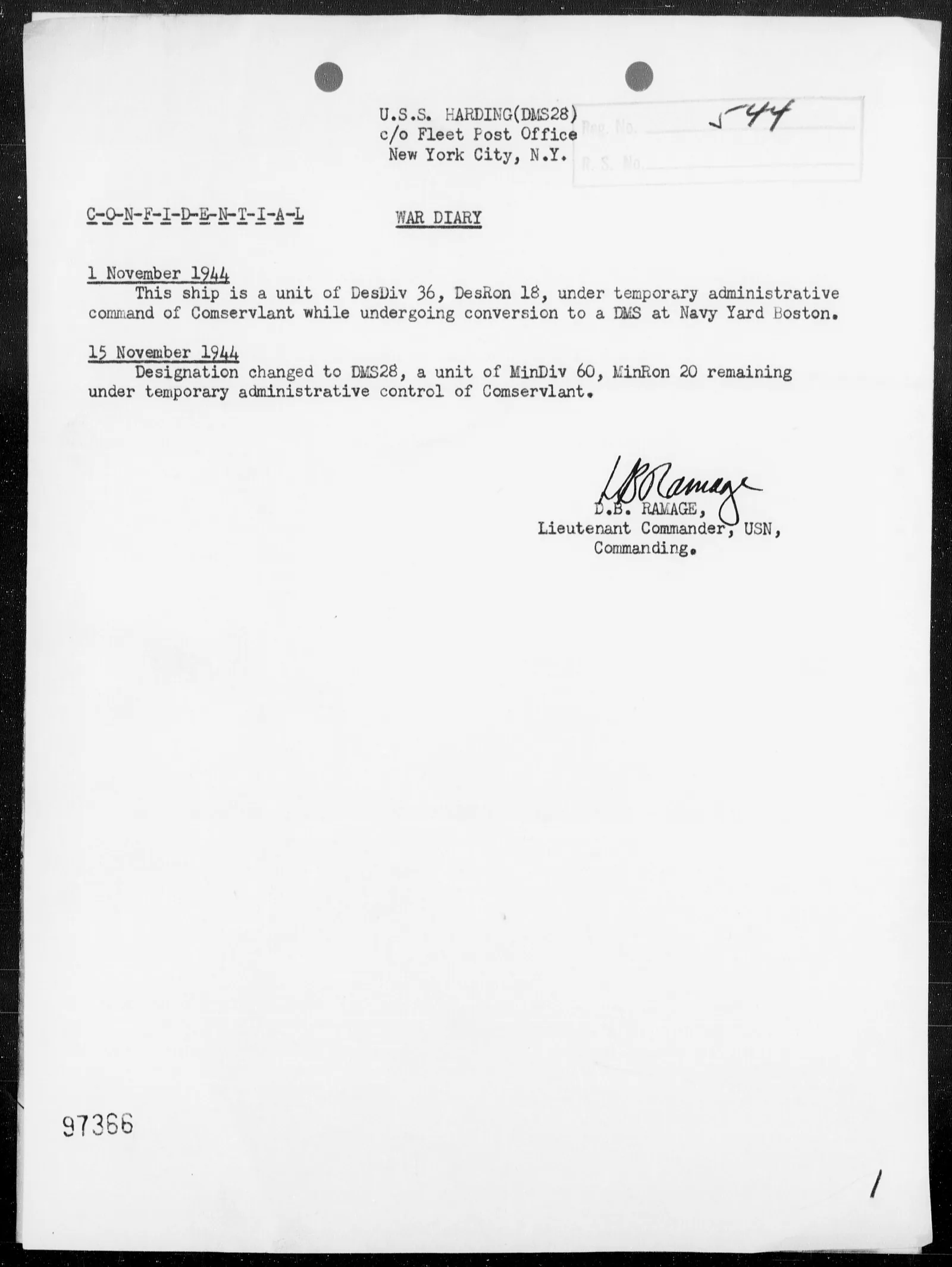
Harding joined a convoy of LCI's en route to Oran, Algeria, 24 August, returned to spend another week in southern France until 6 September, and sailed for New York 25 September 1944. Arriving New York 3 October she proceeded to Boston for conversion to a destroyer-minesweeper; Harding was reclassified DMS-28, 15 November 1944. Emerging 1 December for her trials, Harding underwent training until 30 December and sailed for for the Pacific. She arrived San Diego via 'the Canal Zone 15 January 1945, and continued her training in mine-sweeping techniques.
1945 Okinawa
Sailing 10 February via Pearl Harbor, Harding arrived Ulithi 9 March to prepare for the invasion of Okinawa, the last and largest of the giant Pacific amphibious assaults. She departed for Okinawa 19 March and began her minesweeping operations in the surrounding areas 24 March. During the initial landings 1 April 1945 Harding served as an outer screening ship, and continued this dangerous duty during the savage air attacks which followed. After a near miss by a horizontal bomber during the first heavy raids of 6 April, Harding was assigned to provide fire support to forces ashore the night of 8 April. She returned to screening duties next day and 16 April was attacked with other ships by four suicide planes. One was driven off, another shot down, but a third steered directly for Harding's bridge. As gunfire ripped into her, the aircraft splashed close aboard to starboard, tearing a huge gash in Harding's side from keel to main deck when her bomb exploded.
The stricken ship backed toward Kerama Retto, counting 14 men killed, 8 missing, and 9 wounded. She repaired at Okinawa, and arrived Pearl Harbor 22 August via Saipan.
From Hawaii Harding transited the Panama Canal via San Diego and arrived Norfolk 17 September. She decommissioned 2 November 1945 and was sold for scrap 16 April 1947 to Luia Brothers Co., Inc., of Philadelphia.
Other photographs
Held for this vessel, and not tied to any part of the account above.
References
Every work this entry draws on. There are no numbered markers in the text above: what we hold is the provenance of the page — this history, this article, these photographs.
- History Harding II (DD-625) Dictionary of American Naval Fighting Ships, Naval History and Heritage Command. A work of the United States Government, in the public domain — the only text on this site reproduced verbatim.
- Facts USS Harding (DD-625) Structured facts only — dates, dimensions, armament and fate. No wording is taken from it. Harvested 1 August 2026.
- Photograph USS Harding (DD-625) at anchor in October 1943 USN — Official U.S. Navy Bureau of Ships photo 19-N-53735 available at Destroyerhistory.org — Public domain — Wikimedia Commons
- Photograph USS Harding (DD-625) underway c1943 U.S. Navy — U.S. Navy photo [1] from DMS-28 USS Harding (ex DD-625) on Hyperwar — Public domain — Wikimedia Commons
- Photograph USS HARDING - War Diary, 11-1-15-44 - DPLA - ed7cc6d7e4ffdf07a2850bde515e09dd Department of the Navy. Office of the Chief of Naval Operations. Intelligence Division. Office of Naval Records and Library. (1922 - 10/10/1945) — This file was contributed to Wikimedia Commons by National Archives at College Park - Textual Reference as part of a cooperation project. The donation was facilitated by the Digital Public Library of America , via its partner Digital Public Library of America . Record in source catalog DPLA identifier: ed7cc6d7e4ffdf07a2850bde515e09dd National Archives Identifier: 78704375 — Public domain — Wikimedia Commons