United States Navy — Destroyer
USS Hawkins — service history
This is the full service history. For the vessel's particulars, photograph and specifications, see the entry.
In the words of the US Navy. The account below is reproduced verbatim from the Dictionary of American Naval Fighting Ships, compiled by the Naval History and Heritage Command — a work of the United States Government, in the public domain, and the only text on this site not written here.
Before commissioning
William Deane Hawkins was born 19 April 1914 in Fort Scott, Kansas, and enlisted in the Marine Corps 5 January 1942. He accepted a battlefield commission in the Solomons 18 November 1942, and was killed 21 November 1943 in the assault on Tarawa. First Lieutenant Hawkins received the Medal of Honor for his gallantry during the bloody assault on Betio in which he gave his life. The citation reads in part: "Fearlessly leading his men on to join the forces fighting desperately to gain a beachhead, he repeatedly risked his life throughout the day and night to direct and lead attacks on pill boxes and installations with grenades and demolitions. . . . Refusing to withdraw after being seriously wounded in the chest during this skirmish, First Lieutenant Hawkins steadfastly carried the fight to the enemy, destroying three more pillboxes before he was caught in a burst of Japanese shell fire and mortally wounded. His relentless fighting spirit in the face of formidable opposition and his exceptionally daring tactics were an inspiration to his comrades during the most crucial phase of the battle and reflect the highest credit upon the United States Naval Service."
Second World War 1939–1945
1944
Hawkins (DD-873), originally Beatty but renamed 22 June 1944, was launched by Consolidated Steel Co., Orange, Tex., 7 October 1944; sponsored by Mrs. Clara Hawkins, mother of First Lieutenant Hawkins; and commissioned 10 February 1945, Comdr. C. Iverson in command.
1945
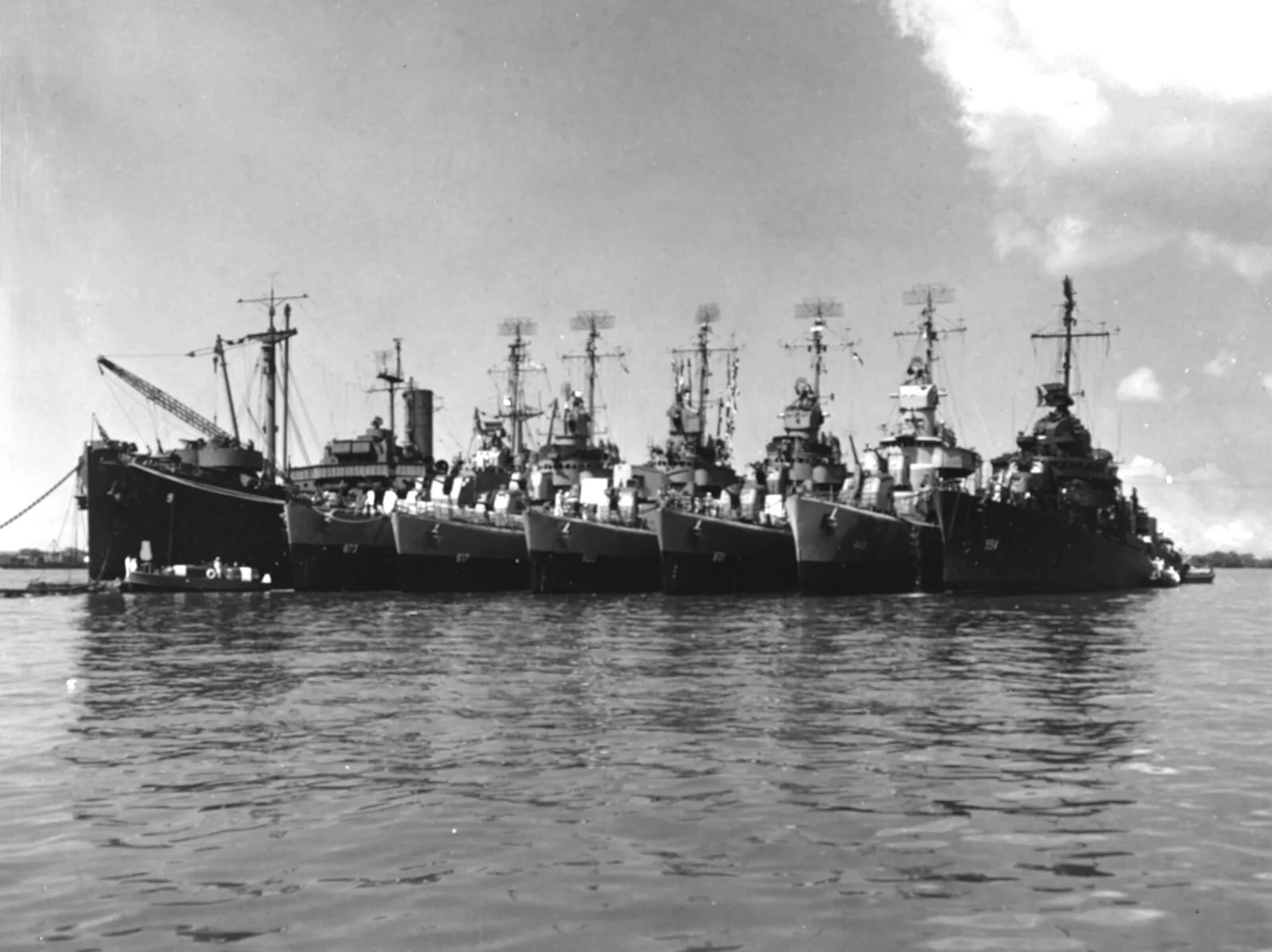
Following shakedown training in the Caribbean, Hawkins arrived Norfolk 23 March 1945 to undergo conversion to a radar picket ship. Emerging 26 May, she conducted training exercises before sailing 18 June from Guantanamo Bay, Cuba, for San Diego and Pearl Harbor. After her arrival 8 July Hawkins prepared to enter the last phase of the Pacific War, but 3 days after her 12 August departure from Pearl Harbor for Eniwetok the Japanese surrendered. The destroyer continued from Eniwetok to Iwo Jima and Tokyo Bay, arriving 27 August, and assisted in early occupation operations. She then escorted ships to and from the Marianas, remaining in Japanese waters until 3 January 1946. Hawkins then steamed to the Philippines and Saipan, finally arriving Pearl Harbor 3 April.
Post-war 1946–1949
1947
Arriving San Diego 11 April, the destroyer took part in training operations off the west coast until sailing again for the far east 0 January 1947. During the months that followed she steamed between Chinese and Korean ports, assisting and supporting American Marine units in their attempts to stabilize the explosive Chinese situation and protect American lives. Hawkins also took part in rescue operations off Hong Kong 19 July 1947, when giant steamer Hong Kong sank with over 2,000 passengers on board. She returned to the United States 8 October 1947.
1949
After a year of operations out of San Diego the ship sailed again for the troubled Far East, arriving Tsingtao, China, 29 October. Following operations off the China coast Hawkins got underway from Tsingtao C December. On this long voyage, completing a circuit of the globe, the destroyer visited Ceylon, Turkey, Gibraltar, New York, and Panama before arriving San Diego 10 March 1949.
Hawkins was reassigned to Atlantic Fleet soon afterward, arriving her new home port, Newport, 23 May 1949. For the next year she took part in reserve training cruises and readiness exercises in the Caribbean. The ship had been reclassifled DDR-873 18 March 1949. Hawkins departed 2 May 1950 for a cruise with 6th Fleet in the strategic Mediterranean.
While there she and the world were shocked by the Communist invasion of South Korea. After NATO maneuvers she returned to Newport 10 October and prepared to become part of the nation's far flung bulwark in the Korean conflict. Sailing 3 January via the Panama Canal she arrived Pusan 5 February. During her 4 months of Korean duty Haickins screened the mobile carrier forces during strikes on enemy positions and supply lines, provided antisubmarine protection, and controlled jet aircraft in combat air patrols. She also acted as plane guard during operations in the Formosa Straits designed to discourage Communist aggression against the friendly island. Departing the Far East in June, the destroyer returned to Newport 8 August via the Mediterranean.
Cold War 1954–1963
1960
For the next few years the veteran ship alternated picket duty and training operations in the western Atlantic with periodic cruises to the Mediterranean with the (6th Fleet. She was in the Eastern Mediterranean during the summer of 1950 when the Suez crisis threatened the security and peace of the area. Hawkins arrived Mayport, Fla., her new homeport, 18 August 1960, and soon resumed her pattern of cruises to the Mediterranean. In 1961 she operated with a special Task Group in connection with American space experiments and missile tests off Cape Canaveral, now Cape Kennedy. When the introduction of offensive missiles into Cuba in 1962 threatened the security of the United States, Hawkins joined with other ships in quarantining that Caribbean country, cruising the Caribbean from late October until December in a modern demonstration of the power of forces afloat. In 1963 the ship returned to the Mediterranean in the Spring and in August took part in Polaris missile tests in the Caribbean with submarine Alexander Hamilton. During the next 5 months Hawkins operated with carriers off Florida and in the Caribbean. Following additional Polaris missile tests with Andrew Jackson (SSBN-619) in February 1964, she steamed to Boston 21 March and was placed in commission, in reserve, prior to undergoing FRAM I overhaul.
Vietnam War period 1964–1975
1966
Reclassified DD-873 on 1 April, Hawkins completed FRAM late in 1964. Assigned to Destroyer Squadron 24, she operated out of Newport until departing 29 September for duty in the Far East. Steaming via the Panama Canal and the West Coast, she joined the 7th Fleet 23 November as part of America's powerful naval commitment to thwart Communist aggression in Southeast Asia. For the next 3 months she guarded hard-hitting carriers in the South China Sea and the Gulf of Tonkin and provided gunfire support for ground troops along the coast of South Vietnam. She departed Subic Bay late in February 1966, steamed via the Suez Canal, and arrived Newport 8 April.
1967
Hawkins maintained the peak readiness of her crew and equipment over the next few months with exercises off the East Coast and in the Caribbean. Departing Newport 28 November, she joined the 6th Fleet at Gibraltar 8 December and became flagship for ComDesRon 24. For more than 3 months she cruised the Mediterranean from Spain to Greece before returning to Newport 20 March 1967. Into mid-1967 she operated along the Atlantic Coast from New England to Florida, prepared as always to cruise in defense of the United States and the free world. Hawkins received two battle stars for Korean service.
Other photographs
Held for this vessel, and not tied to any part of the account above.
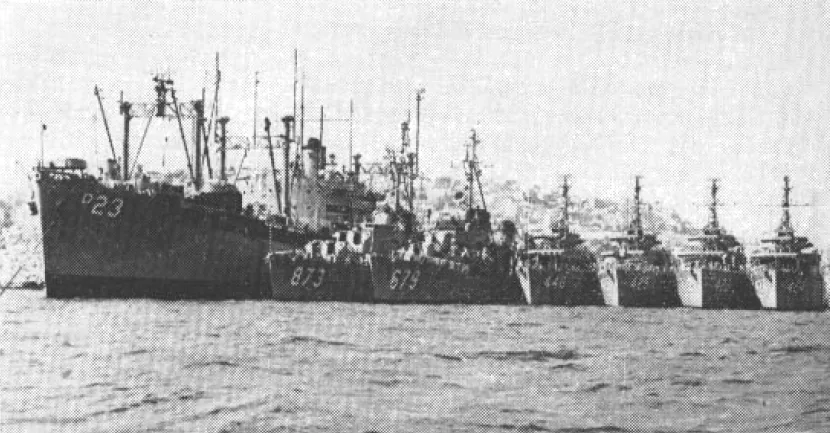
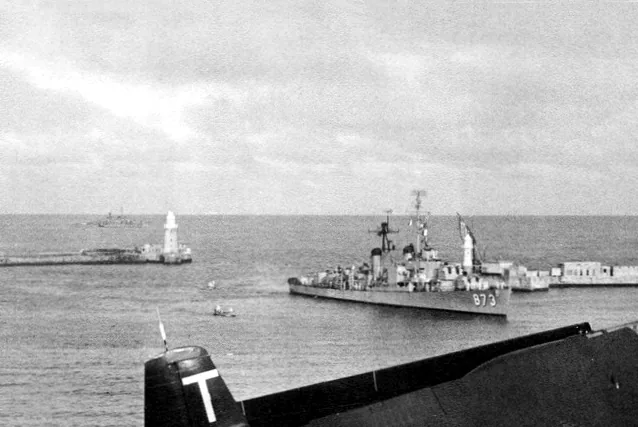
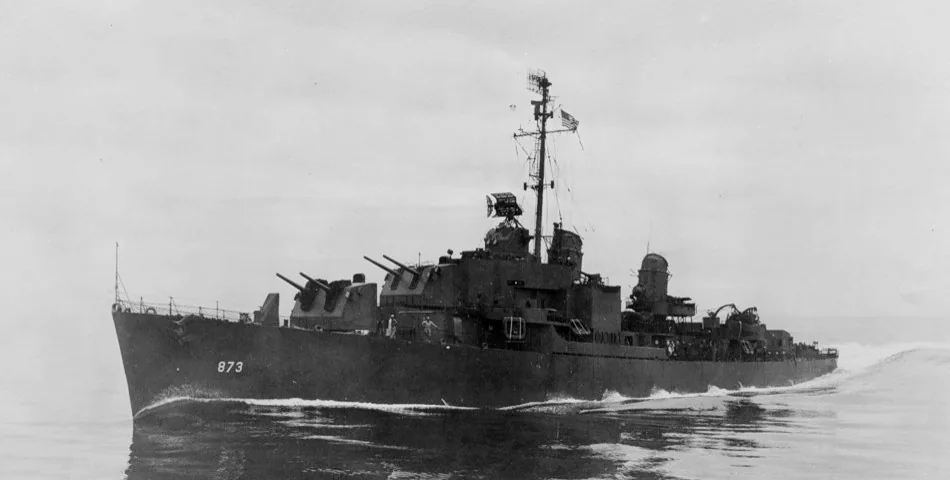

References
Every work this entry draws on. There are no numbered markers in the text above: what we hold is the provenance of the page — this history, this article, these photographs.
- History Hawkins (DD-873) Dictionary of American Naval Fighting Ships, Naval History and Heritage Command. A work of the United States Government, in the public domain — the only text on this site reproduced verbatim.
- Facts USS Hawkins Structured facts only — dates, dimensions, armament and fate. No wording is taken from it. Harvested 1 August 2026.
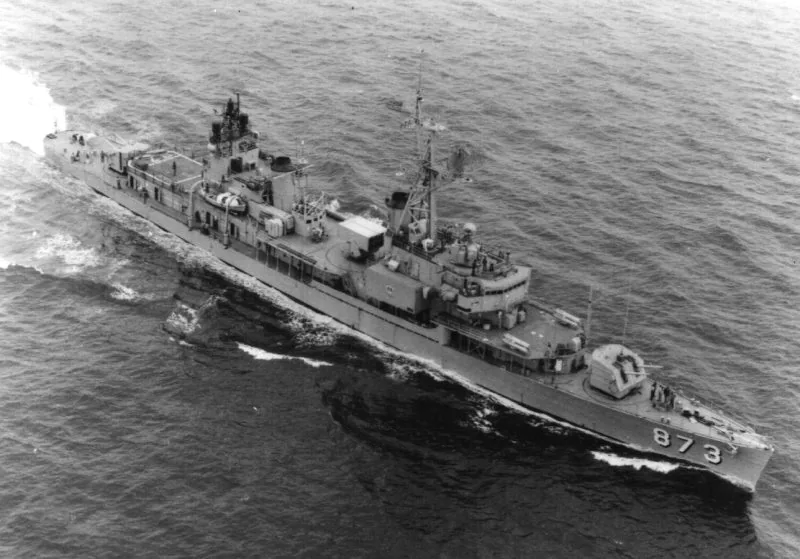
- Photograph USS Hawkins (DD-873) underway on 30 May 1965 (NH 99067) PH3 Henry Craig Hensel, U.S. Navy — U.S. Navy photo NH 99067 — Public domain — Wikimedia Commons
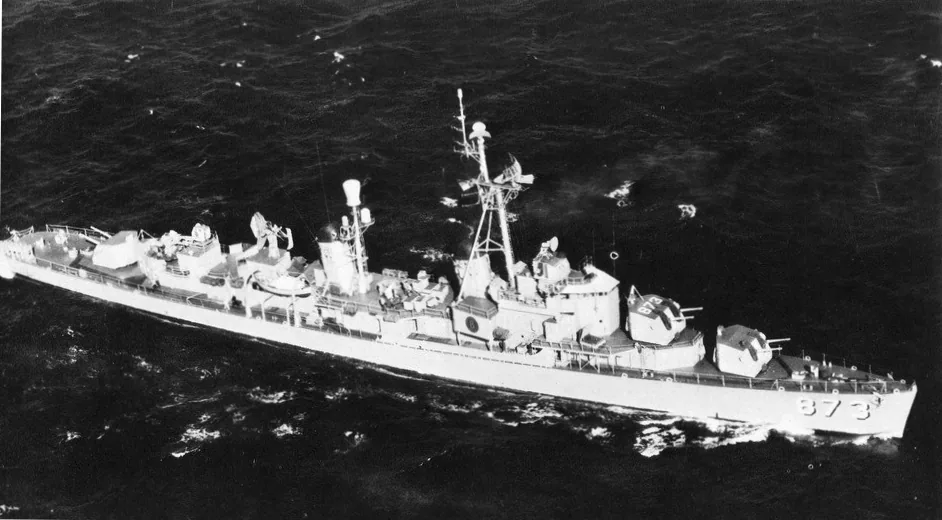
- Photograph USS Hawkins (DDR-873) underway in the Mediterranean Sea on 9 September 1957 Charles Stocke — Own work , colour slide — Public domain — Wikimedia Commons
- Photograph USS Hawkins (DD-873) with DASH drone c1965 Gunnar Sedleniek, USN (USS Galveston (CLG-3)). — U.S. Navy photograph via ussgalveston.org — Public domain — Wikimedia Commons
- Photograph ROCS DD-930 Tze Yang (original USS Hawkins,part of her superstructure) RGZ95 — Own work — CC BY-SA 4.0 — Wikimedia Commons
- Photograph USS Arcadia (AD-23) with destroyery and minesweepers c1955 U.S. Navy — U.S. Navy All Hands magazine January 1956 , p. 18 — Public domain — Wikimedia Commons
- Photograph USS Black Hawk (AD-9) at anchor at Pearl Harbor with six destroyers, in July 1945 (80-G-354885) Unknown author — U.S. Navy photo 80-G-354885 — Public domain — Wikimedia Commons
- Photograph USS Hawkins (DD-873) at Colombo in December 1948 USN — U.S. Navy photo [1] from the USS Tarawa (CV-40) 1948-1949 cruise book available at Navysite.de — Public domain — Wikimedia Commons
- Photograph USS Hawkins (DD-873) in 1945 (19-N-78937) U.S. Navy Bureau of Ships — Official U.S. Navy Bureau of Ships photo 19-N-78937 available at Destroyerhistory.org — Public domain — Wikimedia Commons
- Photograph USS Hawkins (DD-873) insignia Unknown author — https://www.navsource.net/archives/05/873.htm — Public domain — Wikimedia Commons
- Photograph USS Hawkins (DD-873) underway in 1965 PH3 Henry Craig Hensel, USN — Official U.S. Navy photo NH 99067 from the U.S. Navy Naval History and Heritage Command — Public domain — Wikimedia Commons
- Photograph USS Hawkins (DDR-873) refueling fom Independence (CVA-62) 1959 USN — Official U.S. Navy photo NH 99066 from the U.S. Navy Naval History and Heritage Command — Public domain — Wikimedia Commons
- Photograph USS Hawkins (DDR-873) underway c1959 USN — U.S. Navy photo [1] from the USS Saratoga (CVA-60) 1959-60 cruise book available at Navysite.de — Public domain — Wikimedia Commons
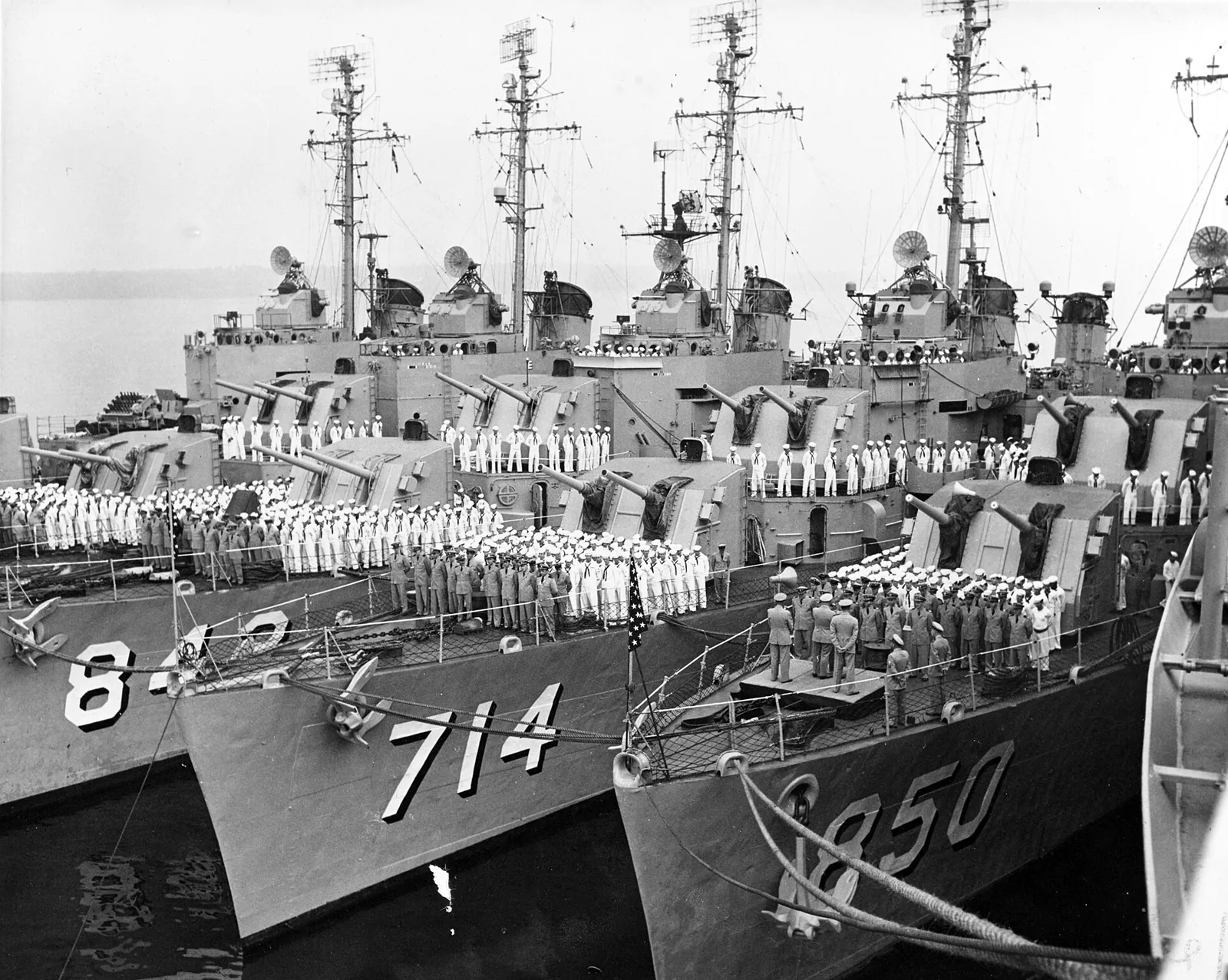
- Photograph USS Joseph P. Kennedy, Jr. (DD-850), USS William R. Rush (DD-714), USS Fiske (DD-842) and USS Hawkins (DDR-873) at Newport, Rhode Island (USA), in 1951 (NH 97062) Unknown author — U.S. Navy photo NH 97062 — Public domain — Wikimedia Commons