United States Navy — Destroyer
USS Hazelwood (DD-531) — service history
This is the full service history. For the vessel's particulars, photograph and specifications, see the entry.
In the words of the US Navy. The account below is reproduced verbatim from the Dictionary of American Naval Fighting Ships, compiled by the Naval History and Heritage Command — a work of the United States Government, in the public domain, and the only text on this site not written here.
Before commissioning
John Hazelwood, born in England in 1726, was appointed to superintend the building of fire rafts for the protection of Philadelphia against the British during the Revolutionary War. A commissioned officer in the Pennsylvania Navy, Commodore Hazelwood commanded all units of the Pennsylvania and Continental navies participating in the defense of the Delaware River approaches to Philadelphia in 1777. His gunboats and galleys engaged British men-of-war 23 October near river obstructions; and, after the British frigate Merlin and ship of the line Augusta grounded, their crews were forced to burn them. Later Commodore Hazelwood took command of Continental vessels in Delaware Bay. In recognition of his services in the War for Independence, the Continental Congress voted him a handsome sword, now in the collection of the Naval Historical Foundation. Commodore Hazelwood died at Philadelphia 1 March 1800.
Second World War 1939–1945
1942
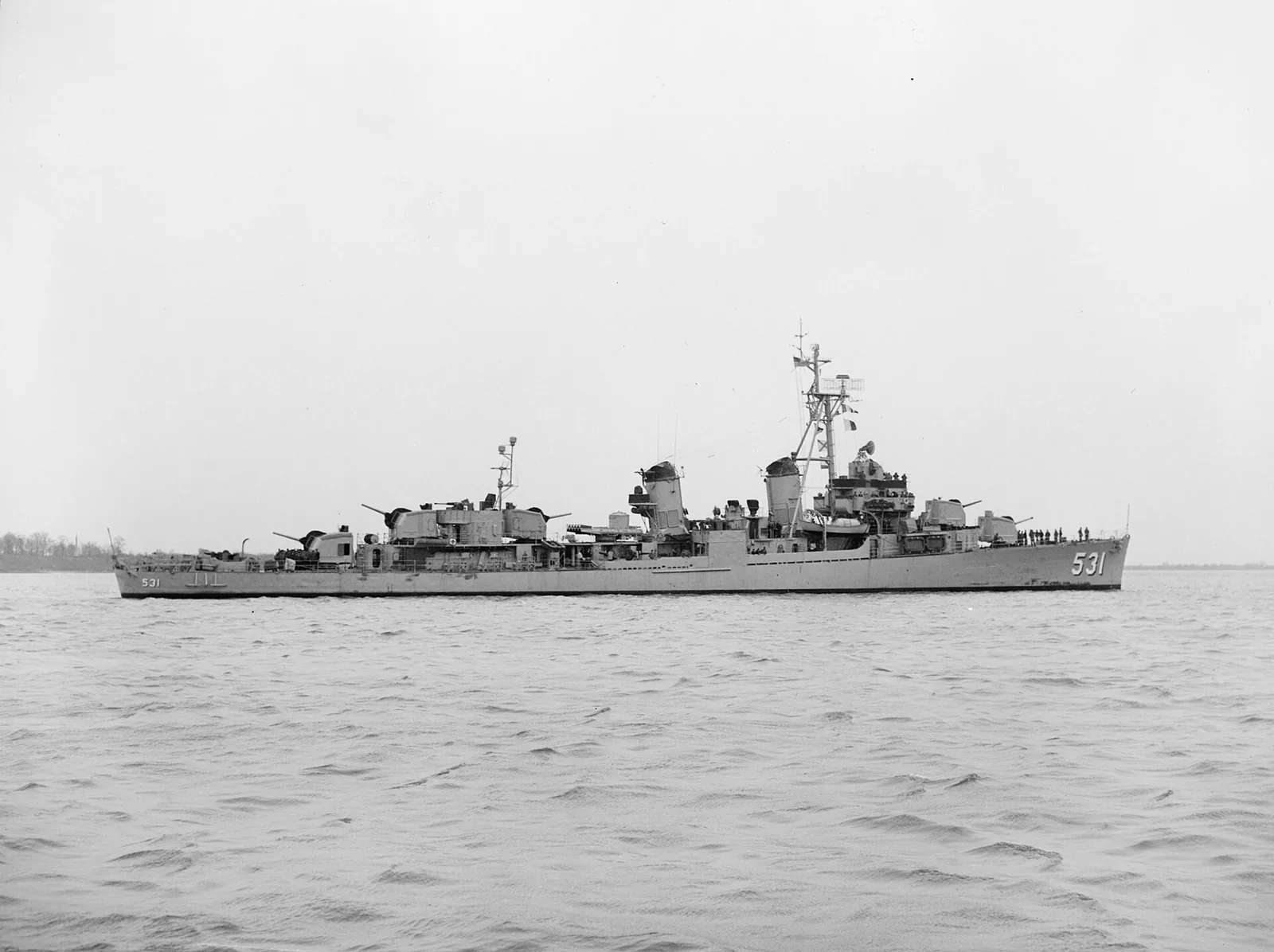
The second Hazelwood (DD-531) was laid down 11 April 1942 by the Bethlehem Shipbuilding Co., San Francisco, Calif., launched 20 November 1942; sponsored by Mrs. Harold J. Fosdick; and commissioned 18 June 1943, Comdr. Hunter Wood, Jr., in command.
After shakedown, Hazelwood departed the West Coast 5, September. Reaching Pearl Harbor 9 September, she sailed 2 days later with a fast carrier strike force under Rear Admiral C. A. Pownall in Lexington to launch carrier-based air strikes against Tarawa, Gilbert Islands. Hazelwood next joined a second fast carrier force, 6 carriers, 7 cruisers, and 24 destroyers under Rear Admiral A. E. Montgomery, for strikes against Wake Island 5 and 6October.
1943 Gilbert Islands
Returning to Pearl Harbor 11 October, the destroyer took part in intensive training to prepare for the giant amphibious drive to Japan. She joined Task Force 53 under Vice Admiral R. A. Spruance at Havannah Harbor, New Hebrides, 5 November. Departing 13 November, she took part in invasion of the Gilbert Islands 20 November. In one of the bitterest struggles during the fleet's push across the Pacific, she served on antisubmarine patrol and as standby fighter-director ship. Hazelwood returned to Pearl Harbor 7 December 1943 to prepare for the next operation.
1944 Kwajalein
As the war in the Pacific gained momentum, Hazelwood sortied from Pearl Harbor 22 January 1944 as part of Task Force 52 under Admiral Spruance for the invasion of Kwajalein and Majuro Atolls in the Marshall Islands. After troops stormed ashore 31 January, she anchored in Kwajalein Harbor as primary fighter-director ship and also patrolled against enemy submarines. This objective secured, she departed Kwajalein 15 February for several months of patrol and escort duty through the Solomons and Marshalls. She also bombarded Japanese shore positions at Ungalabu Harbor and a tank farm on New Ireland.
Hazelwood next participated in the invasion of the Palaus. As the 1st Marine Division landed on Peleliu, Palau Islands, 15 September, she pounded enemy shore positions with gunfire to lessen Japansese opposition. She remained off Peleliu on patrol until 3 October, when she sailed to Seeadler Harbor, Manus Islands. There the never-resting veteran joined Vice Admiral T. C. Kinkaid's naval forces for the invasion and liberation of the the Philippine Islands. As troops landed under naval cover on Leyte 20 October, Hazelwood came under heavy Japanese air attacks.
The next week brought constant enemy air raids and a succession of far-reaching fleet moves as the Imperial Navy made one final but futile effort to drive America out of the Philippines and regain some measure of control over the seas. In this struggle, known to history as the Battle of Leyte Gulf, the Japanese Navy was all but annihilated. Three enemy battleships, four carriers, six heavy cruisers, four light cruisers, nine destroyers, and a host of planes fell victim to America's naval prowess and determination. Hazelivood herself accounted for at least two kamikazes among many destroyed.
1945 Iwo Jima
Hazelwood engaged in patrols off Leyte Gulf and gunnery and training exercises out of Ulithi during December. She then joined Vice Admiral J. S. McCain's fast carrier strike force and sailed 30 December. Carrying the war home to the enemy, the carriers launched heavy air raids against Japanese positions in the Ryukyu Islands, Formosa, Okinawa, and along the China coast from 3 to 7 January 1945. These devastating strikes also diverted Japanese attention from the Philippines, where landings were made at Lingayen Gulf 9 January. After further strikes on Japanese positions in Indochina, the hardhitting force returned to Ulithi 26 January.
Joining another fast and mobile carrier task force, Hazelwood sortied 11 February to protect carriers as they launched heavy air strikes against the Japanese home islands 16 and 17 February. Swiftly shifting positions as only sea-based power can, the fleet then sped south to provide support for the landings on Iwo Jima, begun 19 February. Although under constant attack from kamikazes as well as fighters and dive-bombers, Hazel- wood came through the invasion untouched and on the night of 25 February sank two small enemy freighters with her guns.
Returning to Ulithi 1 March, the battle-tried destroyer sailed again for action 14 March with a fast carrier force to provide air cover and shore bombardment for the Invasion of Okinawa, last step before invasion of the Japanese home islands. After the invasion 1 April, Hazel wood operated off Okinawa on radar picket and escort patrols through intense Japanese air attacks. On 29 April the carrier group she was shepherding was attacked by kamikazes who dove out of low cloud cover.
Post-war 1946–1949
1946
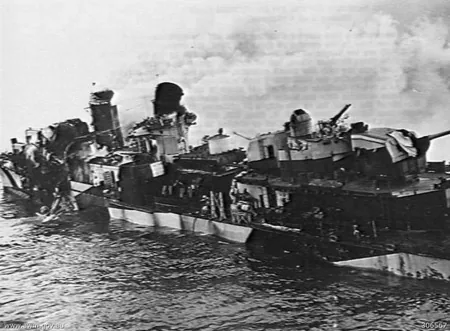
Hazelwood, all guns blazing, maneuvered to avoid two of the Zeros. A third screamed out of the clouds from astern. Although hit by Hazelwood's fire, the enemy plane careened past the superstructure. It hit #2 stack on the port side, smashed into the bridge, and exploded. Flaming gasoline spilled over the decks and bulkheads as the mast toppled and the forward guns were put out of action. Ten officers and 67 men were killed, including the Commanding Officer, Comdr. V. P. Douw, and 35 were missing. Hazelwood's engineering officer, Lt. (j.g.) C. M. Locke, took command and directed her crew in fighting the flames and aiding wounded. Proceeding by tow and part way under her own power, the gallant ship reached Ulithi 5 May for temporary repairs, thence to Mare Island via Pearl Harbor 14 June for permanent repairs. Hazelwood decommissioned 18 January 1946 and entered the Pacific Reserve Fleet at San Diego.
Korean War period 1950–1953
1951
Hazelwood recommissioned at San Diego 12 September 1951, Comdr. R. M. Niles in command, and joined the enlarged fleet necessary to fight Communist aggression in Korea and to bolster the free world's strength everywhere. After shakedown she departed San Diego 4 January 1952, and reached Newport, R.I., 21 January to join Destroyer Forces, Atlantic Fleet. Operations and exercises along the East Coast and in the Caribbean, as well as hunter-killer training with carrier groups, occupied Hazelwood until she departed Newport for the Far East 7 December 1953.
Cold War 1954–1963
1954
She reached Tokyo 12 January 1954, via Pearl Harbor and spent the next few months operating with a fast carrier task force and patrolling along the Korean coast to enforce an uneasy armistice. The far-ranging destroyer returned to the States the long way, departing Hong Kong 28 May 1954 and sailing through the Suez Canal to reach Newport 17 July.
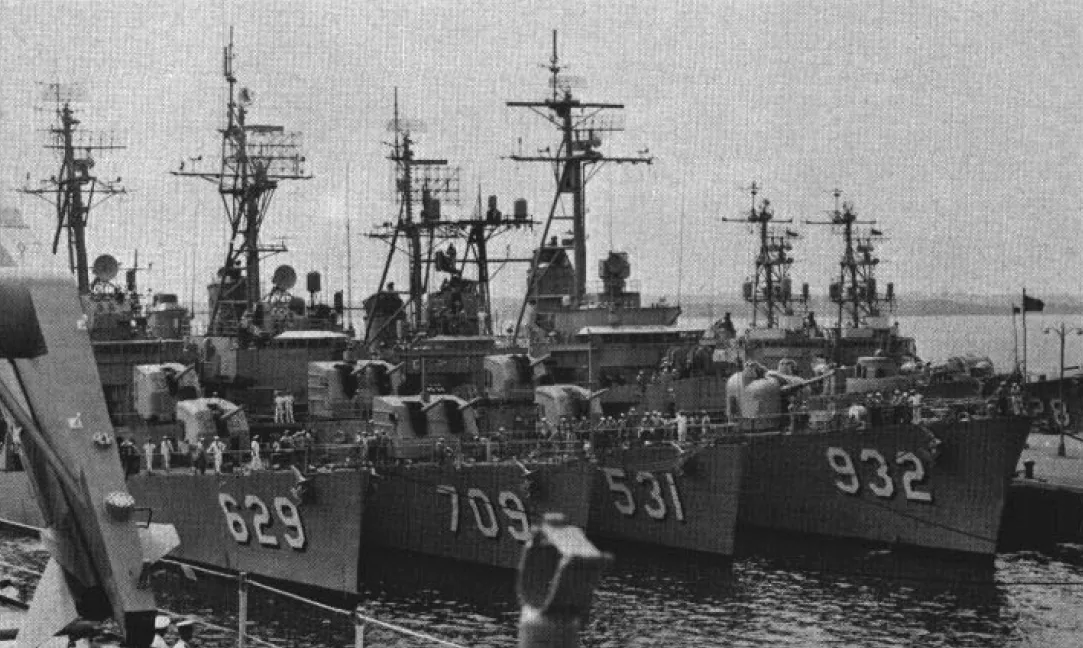
During the next few years Hazelwood maintained a pattern of training and readiness operations along the East Coast and in the Caribbean interspersed with deployments to the Mediterranean. During the Suez crisis in the fall of 1956 she served with the mighty 6th Fleet, patrolling the eastern Mediterranean and helping to stabilize a tense international situation.
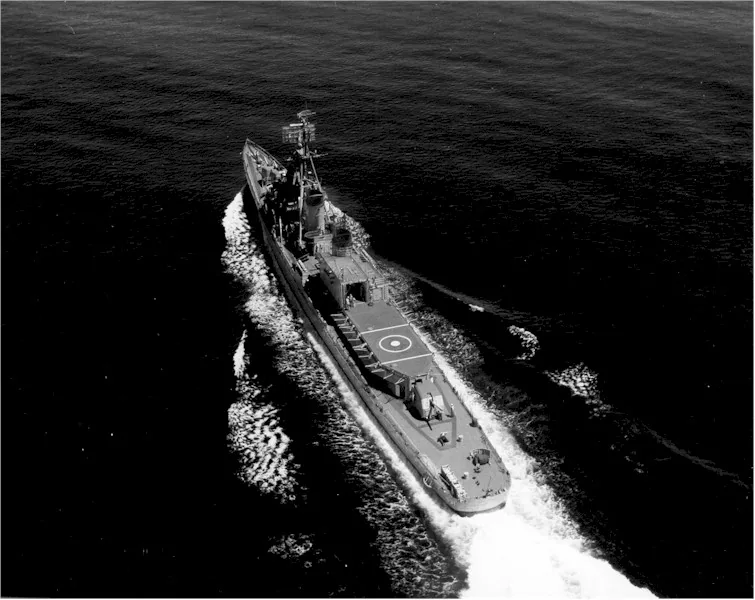
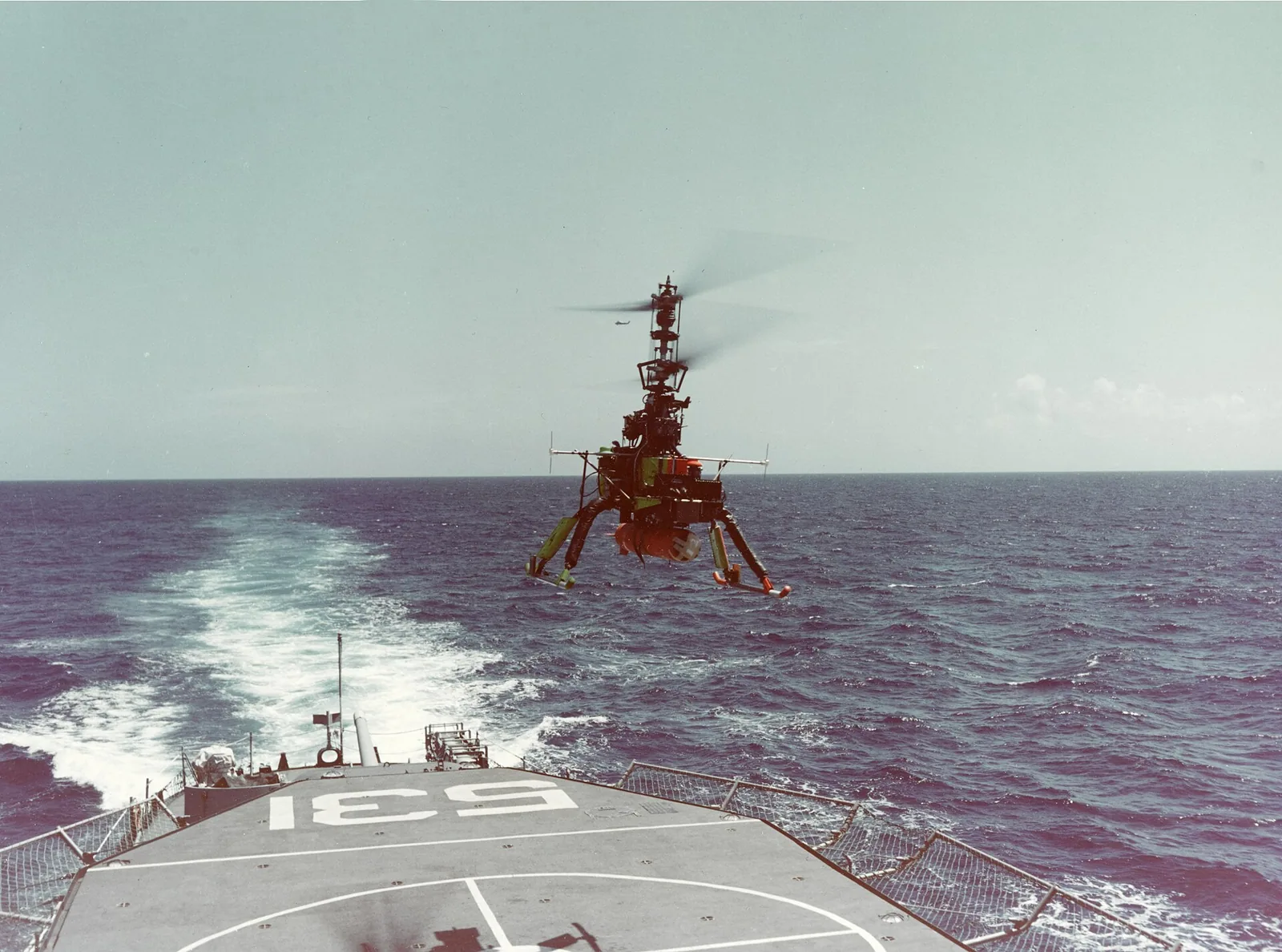
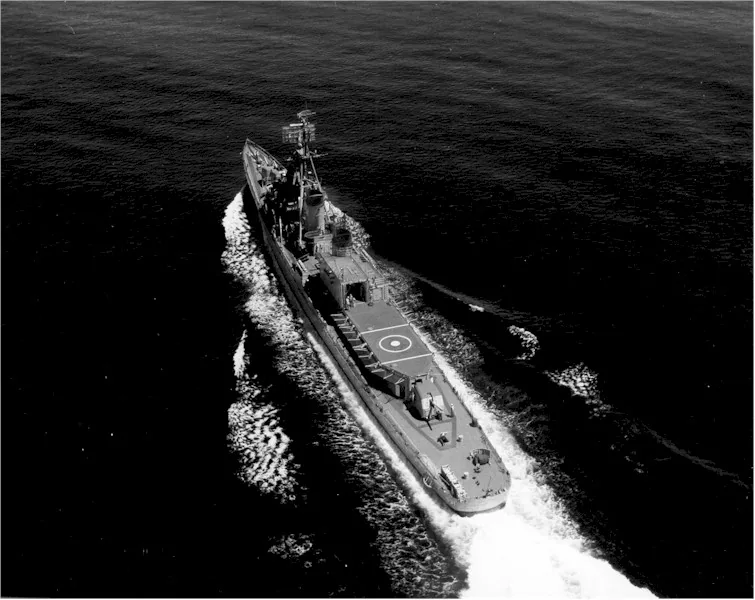
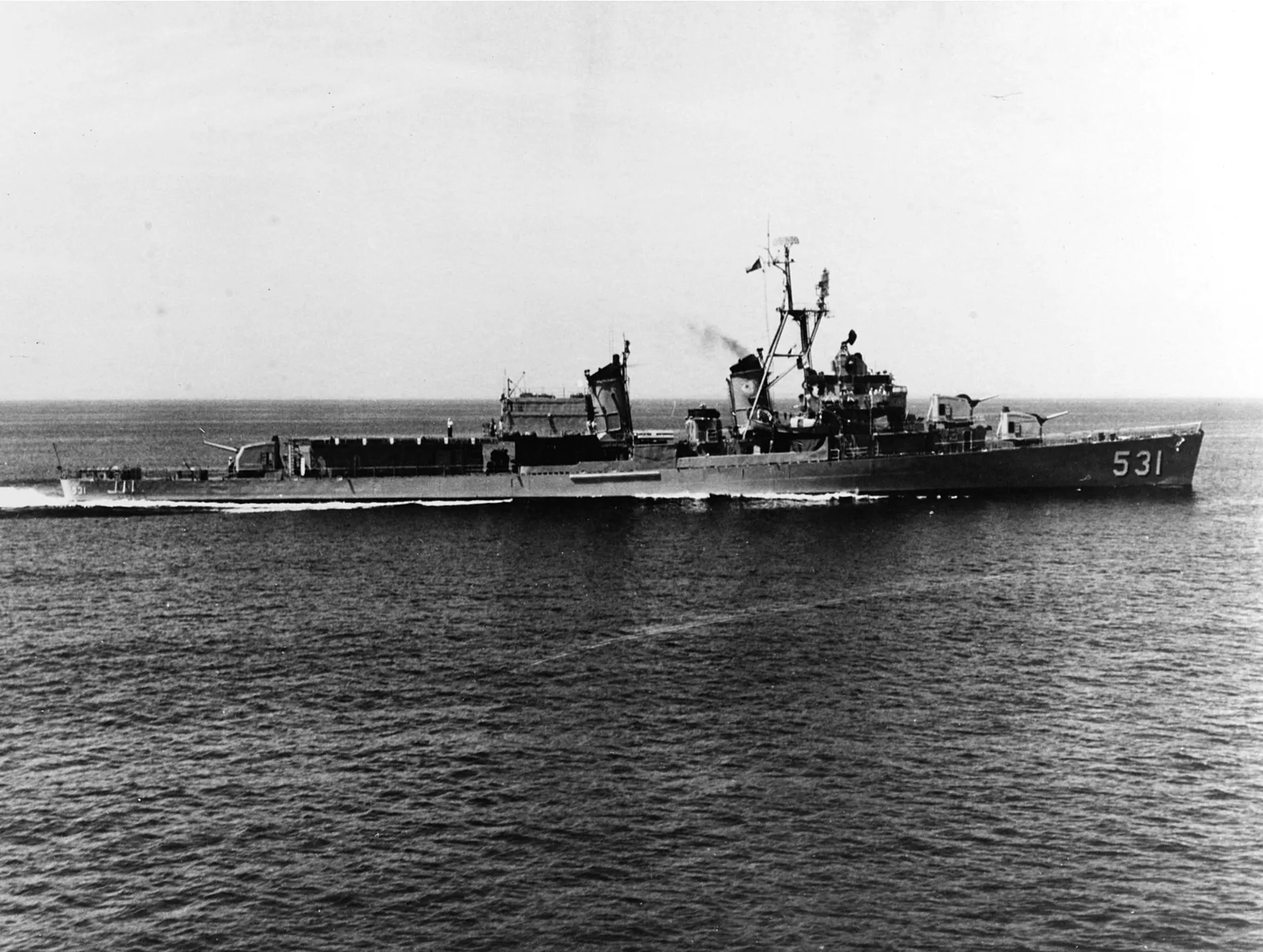
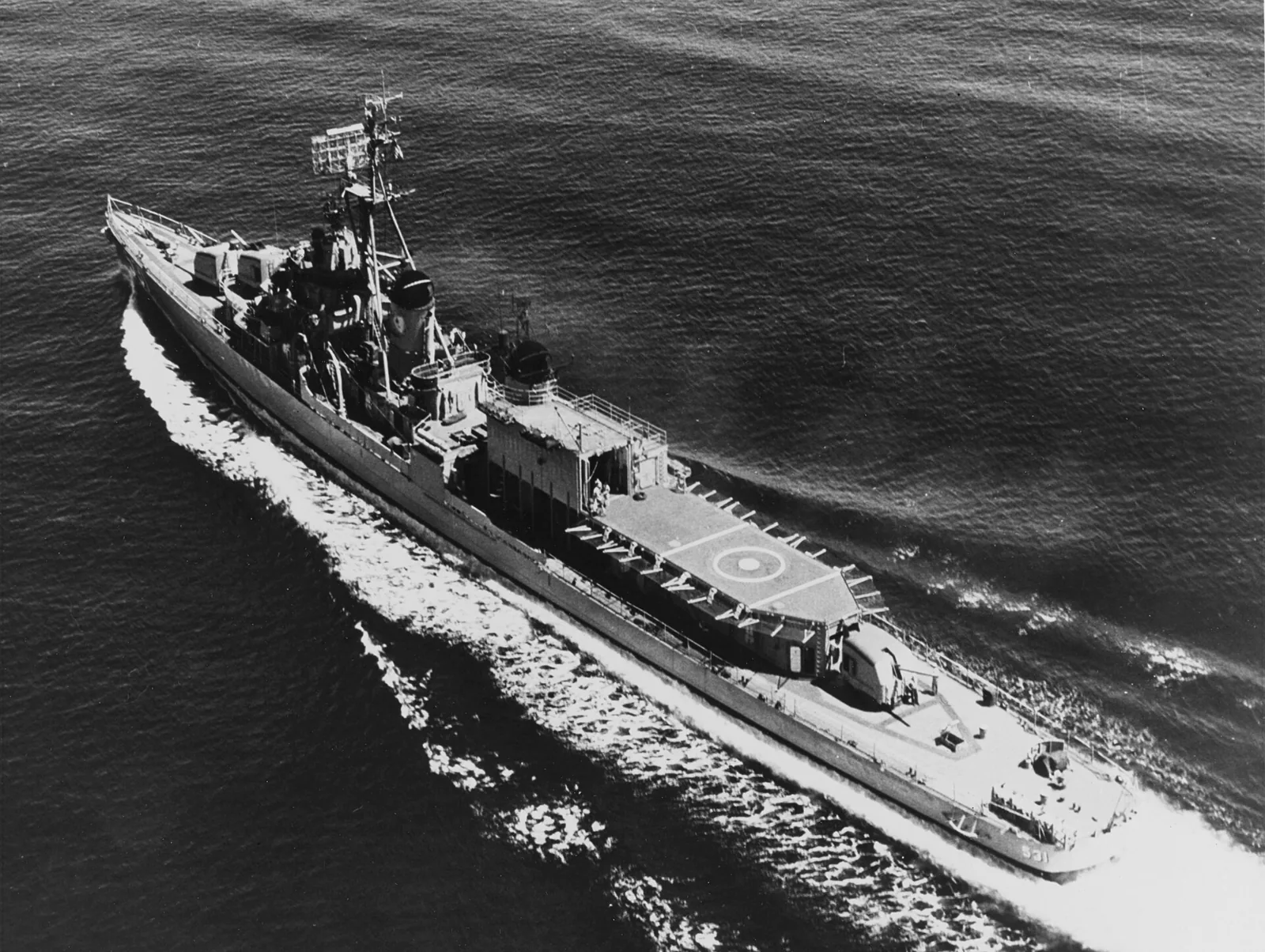
In 1958 Hazelwood began extensive testing of helicopters for antisubmarine warfare both in Narragansett Bay and out of the Naval Ordnance Laboratory in Maryland. Assigned to the Destroyer Development Division, she participated in tests on equipment used with radar and electronic counter-measure systems. Her primary research and development work involved the testing of the Drone Anti-Submarine Helicopter (DASH), an example of the Navy's continuing effort to apply the technological advances of modern science for the security of our nation and the free world. Hazelwood provided on board testing facilities and helped make posssihle the perfection of DASH, an advanced and vital ASW Weapons system. In August 1963 alone the drone helicopter made 1,000 landings on the versatile destroyer's flight deck.
1962
In addition to experimental developments, Hazelwood continued to engage in the many duties assigned to a destroyer. As America confronted Russia over the introduction of offensive missiles into Cuba in October 1962, she steamed again to the troubled Caribbean for antisubmarine and surveillance patrols. Hazelwood arrived Guantanamo Naval Base 5 November, just after the quarantine of Cuba had gone into effect and remained on guard during the crisis, serving as a Gun Fire Support Ship for Task Force 84. When the nuclear submarine Thresher failed to surface 10 April 1963, Hazelwood immediately deployed to the scene of the tragedy with scientists from the Woods Hole Oceanographic Laboratories to begin a systematic search for the missing ship.
Vietnam War period 1964–1975
1965
Hazelwood resumed testing of DASH during June and later in the year conducted on board trials of the Shipboard Landing Assist Device (SLAD). She continued both developmental and tactical operations along the East Coast during the next year. She decommissioned 19 March 1965, and entered the Atlantic Reserve Fleet. At present she is berthed at Norfolk. Va.
Other photographs
Held for this vessel, and not tied to any part of the account above.


References
Every work this entry draws on. There are no numbered markers in the text above: what we hold is the provenance of the page — this history, this article, these photographs.
- History Hazelwood II (DD-531) Dictionary of American Naval Fighting Ships, Naval History and Heritage Command. A work of the United States Government, in the public domain — the only text on this site reproduced verbatim.
- Facts USS Hazelwood (DD-531) Structured facts only — dates, dimensions, armament and fate. No wording is taken from it. Harvested 1 August 2026.
- Photograph USS Hazelwood (DD-531) in 1943 USN — Official U.S. Navy photo 80-G-72296 available at Destroyerhistory.org — Public domain — Wikimedia Commons
- Photograph USS Hazelwood (DD-531) after Kamikaze hit 1945 Australian armed forces — Public domain — Wikimedia Commons
- Photograph USS Hazelwood (DD-531) 1960 Robert J. Studen, Destroyer Development Group Two, U.S. Navy — U.S. Navy photo [1] from Navsource.org — Public domain — Wikimedia Commons
- Photograph QH-50 DASH drone in flight over USS Hazelwood (DD-531), circa in the early 1960s USN — U.S. Navy Naval Aviation News January/February 1988 [1] — Public domain — Wikimedia Commons
- Photograph 330-ps-9689-428-gx-usn-710543 15415540231 o Unknown author — National Museum of the U.S. Navy — Public domain — Wikimedia Commons
- Photograph Destroyers at Naval Station Newport RI c1963 U.S. Department of Defense — U.S. Navy All Hands magazine July 1964 , p. 54 — Public domain — Wikimedia Commons
- Photograph DSN-1 DASH in flight over flight deck of USS Hazelwood (DD-531) on 22 March 1961 U.S. Navy — Official U.S. Navy photo KN-1814 from the U.S. Navy Naval History and Heritage Command — Public domain — Wikimedia Commons
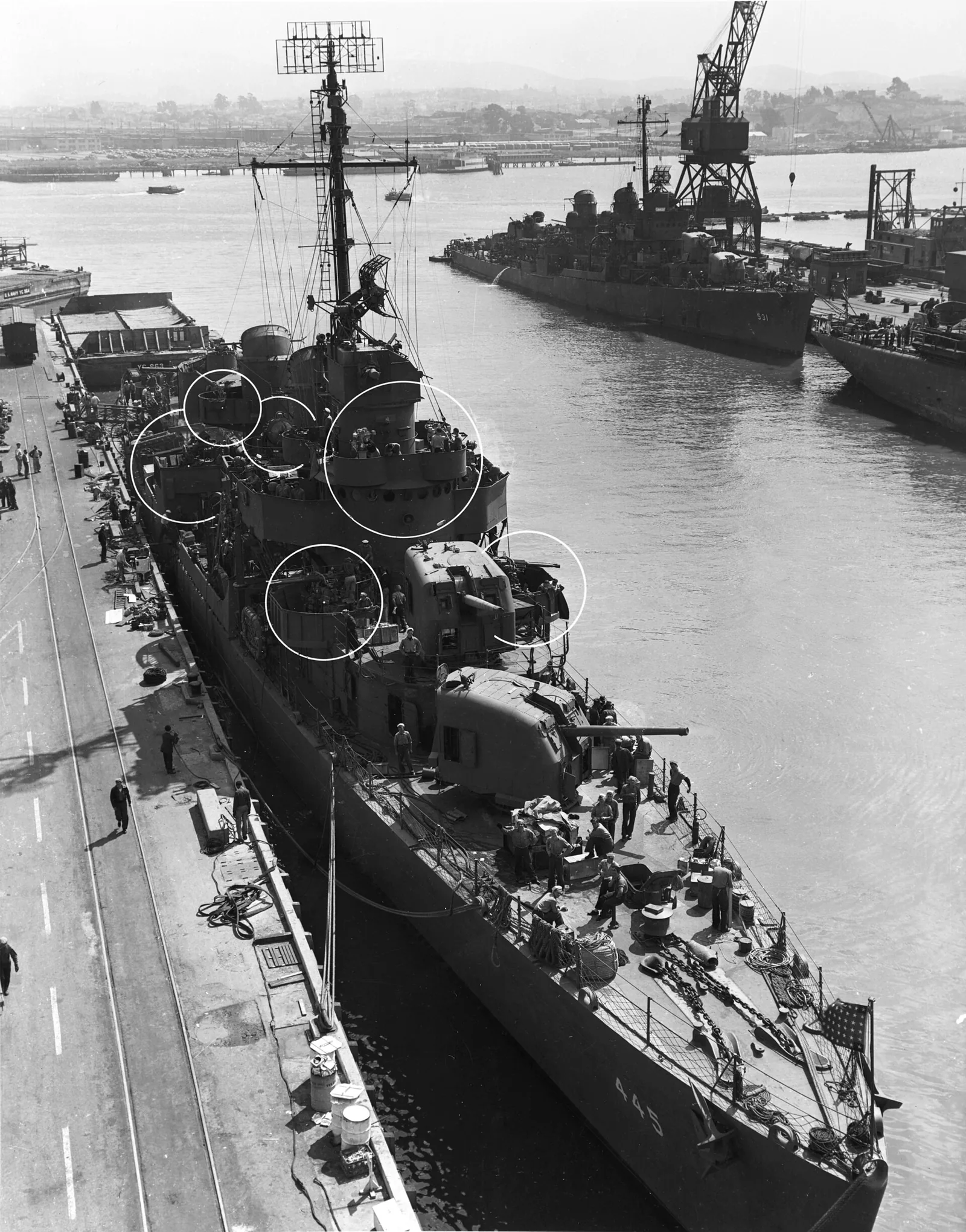
- Photograph USS Fletcher (DD-445) at the Mare Island Naval Shipyard, California (USA), 13 August 1943 (19-N-50812) Unknown author — U.S. Navy Bureau of Ships photo 19-N-50812 — Public domain — Wikimedia Commons
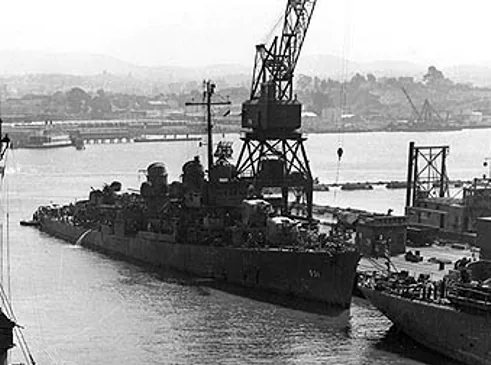
- Photograph USS Hazelwood (DD-531) at the Mare Island Navy Yard in August 1943 U.S. Navy — Official U.S. Navy photo 19-N-50812 from the U.S. Navy Naval History and Heritage Command — Public domain — Wikimedia Commons
- Photograph USS Hazelwood (DD-531) underway at sea, in early 1960 Robert J. Studen, Destroyer Development Group Two, U.S. Navy — U.S. Navy photo [1] from Navsource.org — Public domain — Wikimedia Commons
- Photograph USS Hazelwood (DD-531) underway c1952 U.S. Navy Burau of Ships photo 19-NN - DD-531 Hazelwood - 141983 — Public domain — Wikimedia Commons
- Photograph USS Hazelwood (DD-531) underway during the early 1960s U.S. Navy — Official U.S. Navy photo NH 79114 from the U.S. Navy Naval History and Heritage Command — Public domain — Wikimedia Commons
- Photograph USS Hazelwood (DD-531) underway of Newport RI c1959 U.S. Navy — Official U.S. Navy photo NH 107246 from the U.S. Navy Naval History and Heritage Command — Public domain — Wikimedia Commons
- Photograph View of a US Navy anti-submarine warfare demonstration in June 1960 U.S. Navy — Official U.S. Navy photo USN 710724 from the U.S. Navy Naval History and Heritage Command — Public domain — Wikimedia Commons