United States Navy — Destroyer
USS Henderson (DD-785) — service history
This is the full service history. For the vessel's particulars, photograph and specifications, see the entry.
In the words of the US Navy. The account below is reproduced verbatim from the Dictionary of American Naval Fighting Ships, compiled by the Naval History and Heritage Command — a work of the United States Government, in the public domain, and the only text on this site not written here.
Before commissioning
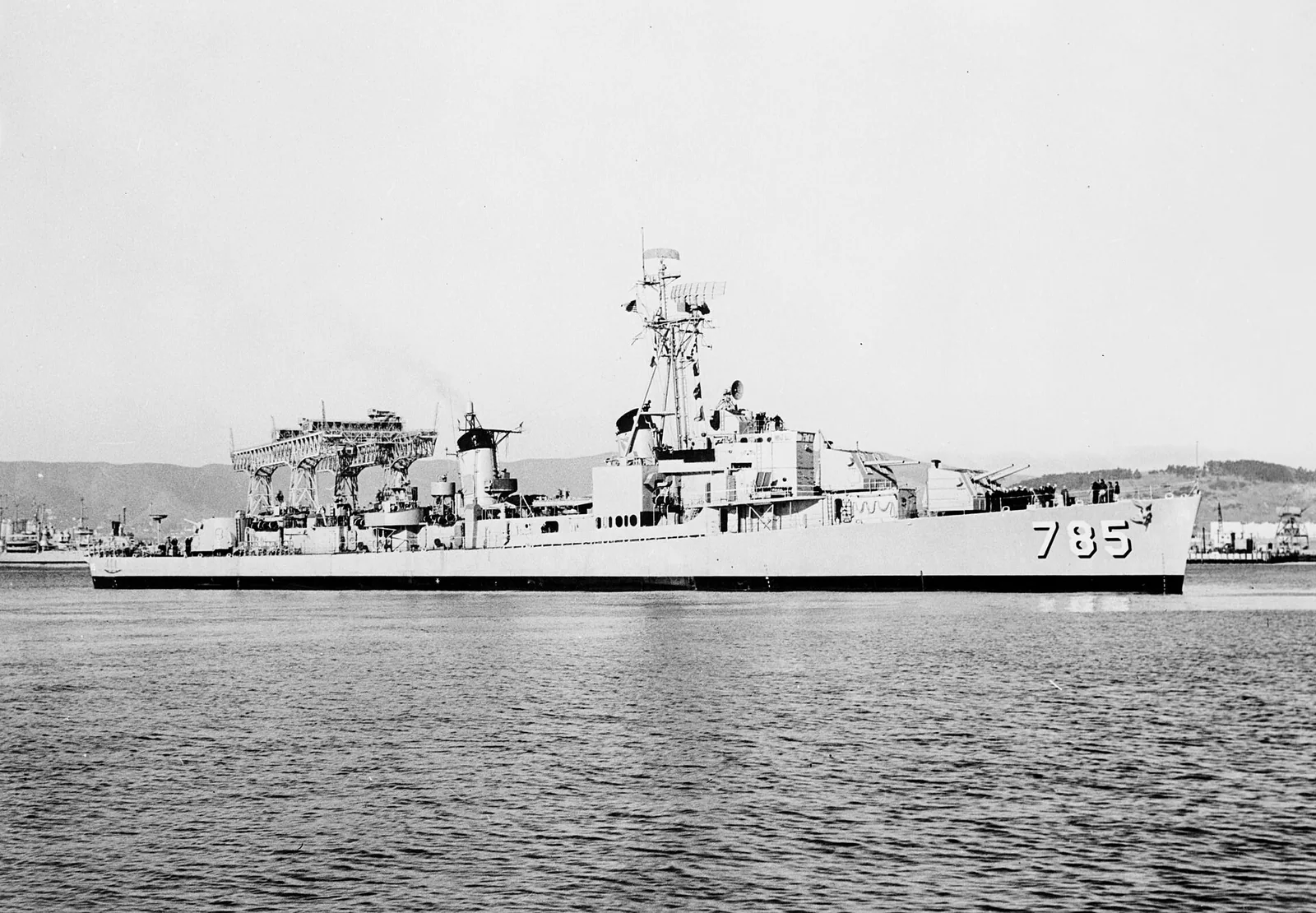
The second Henderson (DD-785) was named for Lofton R. Henderson, who was born in Cleveland 24 May 1903 and graduated from the Naval Academy in 1926. Prior to World War II he served in China, and various Caribbean stations, and on carriers Langley, Ranger and Saratoga. Major Henderson was posthumously awarded the Navy Cross for his heroism at the historic Battle of Midway, one of the decisive battles of history in which the leadership of the fleet commander and the valor of a handful of pilots changed the course of the war. While his plane was leading 16 Marine Corps planes in a glide bombing attack on carrier Hiryu, the left wing burst into flames as he began his final approach. Henderson continued the attack and perished as his plane dived toward the enemy carrier. Henderson Field, Guadalcanal, was named in his honor.
Second World War 1939–1945
1944
The second Henderson (DD-785) was laid down on 27 October 1944 at Seattle, Wash., by Todd Pacific Shipyards, Inc.; launched on 28 May 1945; sponsored by Mrs. Alexander R. Early, Jr,; and commissioned at Seattle 4 August 1945, Cmdr. Halford "A" Knoertzer in command.
1945 Operation High Jump
Henderson conducted shakedown cruise out of San Diego, Calif., then departed Seattle on 31 October 1945 for the Territory of Hawaii. Upon her arrival on 7 November she screened escort carriers in Hawaiian waters and conducted experimental sonar tests with submarines before returning to San Diego on 23 April 1946. After divisional exercises off California she departed on 2 December 1946 for Operation High Jump , an Antarctic exploration and test program. This important operation included tests of clothing and equipment as well as mapping and weather work. Henderson reached Sydney, Australia, on 13 March 1947 and San Diego on 6 April.
Korean War period 1950–1953
1950

After two long cruises to the Pacific in support of U.S. occupation forces in Japan. Henderson departed San Diego on 5 August 1950 to join the United Nations forces in Korea. Arriving at Yokosuka on 19 August she served as a screening ship for fast carrier task forces whose planes flew ground support and other missions in Korea. As U.S. forces prepared to leap northward with the historic Inchon invasion, Henderson was with the assault forces. She steamed up Flying Fish Channel on 13 September, destroying mines and bombarding the Inchon waterfront preparatory to the invasion. The destroyers also traded blows with Communist shore batteries. The gunfire support group again entered the channel into Inchon Bay 14 to 15 September, softening up shore defenses. General of the Army Douglas MacArthur soon signaled as the marines landed that day: "The Navy and Marines have never shone more brightly than this morning." Henderson remained on fire support duty at Inchon until 1 October.
1951
The destroyer returned to screening duty after Inchon, first along the coast of Korea and then in the Formosa Strait. This duty continued until she departed Keelung on 20 March 1951, arriving at San Diego on 7 April. After coastwise exercises and a cruise to Hawaii for training, Henderson sailed on 4 January 1952 for her second tour of duty in Korea. She arrived off Hungnam on 16 February to take part in the blockade of that port and the coastal areas to the north. Her duties included gunfire support and bombardment of industrial sites until 7 March, when she screened the small carrier Bataan (CVL-29) off the coast of Japan. For the remainder of her tour Henderson operated with the fast carrier task forces around Korea and in the Formosa Strait. She departed Yokosuka on 25 July and reached San Diego on 10 August.
1953

Henderson conducted training exercises off San Diego until 22 March 1953, when she departed for her third Korean tour. She took part in the siege of Wonsan harbor, supporting Korean troops with accurate and continuous gunfire, and conducted antisubmarine operations off Okinawa. The destroyer engaged in the vital coastal patrol, maintaining Allied control of the seas around Korea, until after the Korean armistice in July 1953. She arrived at San Diego on 19 October 1953, after a total of 22 months of Korean duty.
Cold War 1954–1963
1954
Following Korea, Henderson established a pattern of cruises to the Far East, cruising to various crisis spots in the western Pacific for the next decade. Highlights of this phase of her service include protection of the Quemoy Islands from Communist aggression in September 1954, relief of Ceylonese flood victims in January 1958, and important fleet and individual exercises during her periods at sea.
Vietnam War period 1964–1975
1964
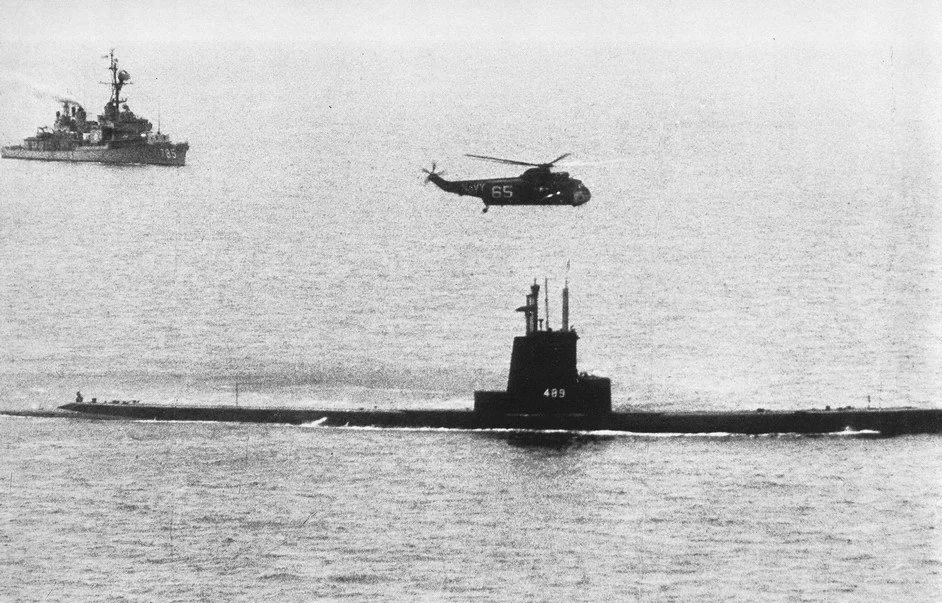
Commencing on 11 August 1964, Henderson began annual cruises in Vietnamese waters, supporting Seventh Fleet amphibious and shore bombardment operations, and guarding aircraft carriers on Yankee Station. She returned to Long Beach, Calif., on 16 December, underwent modernization overhaul and intensive shore bombardment training, and returned to the intensified struggle against Communist aggression in South Vietnam on 10 July 1965. During the next five months she ranged the South China Sea and Gulf of Tonkin while screening Oriskany (CVA-34) and serving on the gun line. In December she steamed to the Gulf of Siam, where she conducted shore bombardment missions against Viet Cong positions on the Ca Mau Peninsula. As escort for Bon Homme Richard (CVA-31) the veteran destroyer departed Hong Kong on 26 December, the day after Christmas, and arrived Long Beach on 13 January 1966.
1967
Henderson spent the next year serving as an antisubmarine warfare (ASW) school ship out of San Diego and taking part in squadron exercises out of Long Beach. Late in July, she joined in a massive but unsuccessful air-sea search for the Hawaii-bound aircraft carrying Brigadier General Joseph W. Stilwell, Jr., USA. After completing preparations for another WestPac deployment, she returned to the troubled waters of Southeast Asia in January 1967. Over the next four months she supported attack carrier operations and conducted more shore bombardment assignments. Henderson returned to Long Beach in mid-June, conducted ASW refresher training that summer and fall.
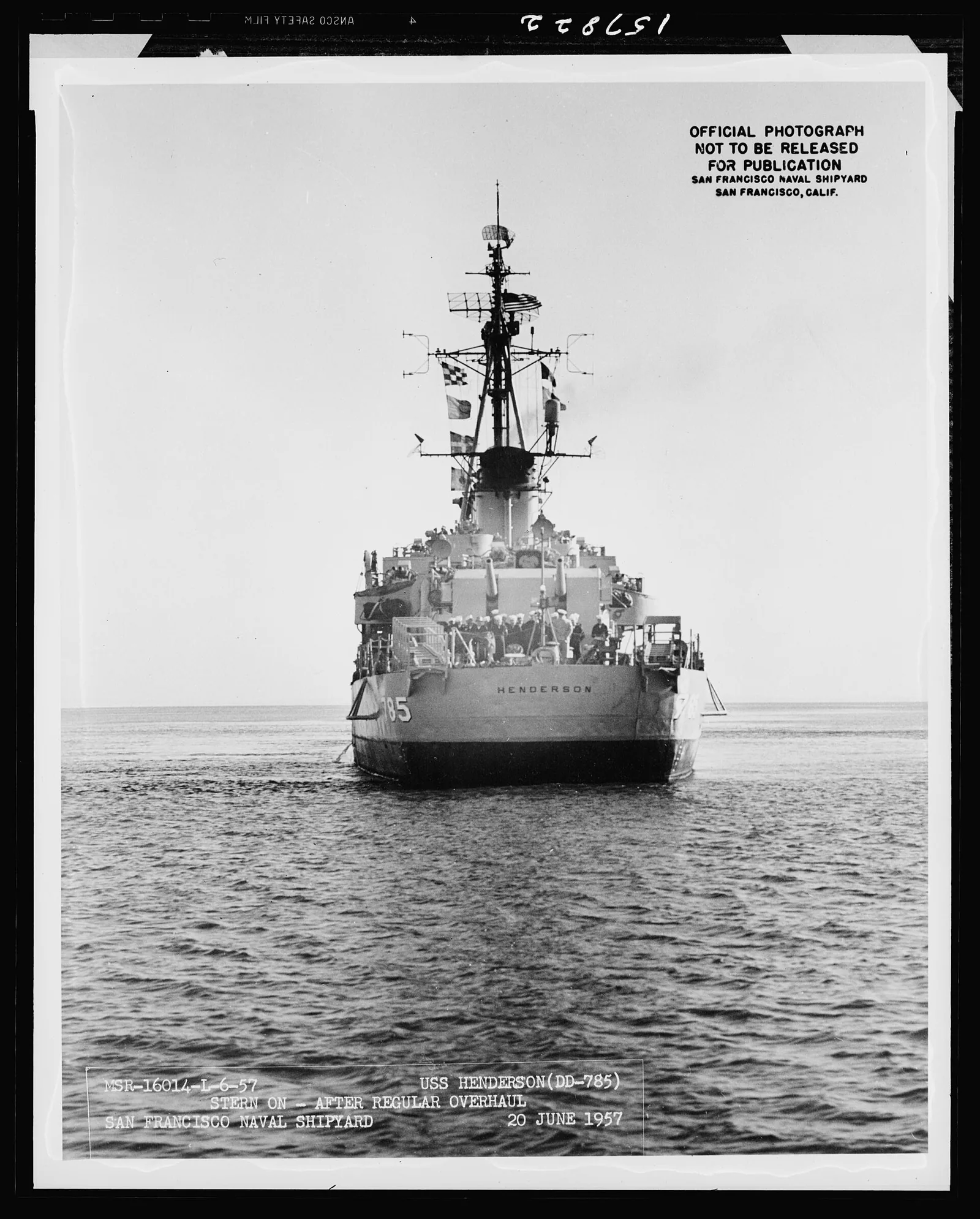
After a short restricted availability in early 1968, Henderson returned to Vietnam in April and resumed her familiar gunline and escort duties in the South China Sea. Interspersed with visits to Hong Kong, Subic Bay and Japan, Henderson remained there until 26 September when she sailed for Long Beach. She received a regular overhaul alongside the destroyer tender Isle Royale (AD-29) later in the year and a dry dock period at San Francisco January through March of 1969, where she received new sonar and communications equipment.
1969 Operation Ringmaster I
After completing the overhaul in May 1969, Henderson spent the summer and fall conducting refresher training before deploying to the Far East on 18 November. Caught in a storm near Midway Island, the destroyer suffered damage to her forward 5-inch gun mount and diverted to Yokosuka for repairs. After a brief yard period, the destroyer then spent several weeks on patrol off the Korean peninsula, as tensions remained high following the downing of a U.S. reconaissance aircraft the previous year. Henderson then spent three months off Vietnam, supporting riverine operations and participating in Operation Ringmaster I . During this period, the destroyer also rescued six passengers from an SH-3 helicopter that splashed while enroute from Da Nang to Constellation (CVA-64).
1970
Returning to Long Beach on 8 May 1970, Henderson underwent several months of inspections and certifications, which ultimately kept the warship in service in contrast to the mass 1970s decommissioning of many of her war-built sister ships. Following training and preparations that fall, Henderson departed for her sixth Vietnam deployment on 26 January 1971. Arriving in theater on 22 February, she served on the gunline and on Yankee Station, both familiar assignments. In a change of pace, the destroyer participated in an ASW exercise at one point and successfully fired an exercise torpedo against diesel-electric submarine Sailfish (SS-572). In April, Henderson conducted a variety of duties, including serving as naval gunfire support school ship at the Tabones range in the Philippines, conducting a short surveillance patrol in the Paracel Islands and visiting ports in Taiwan. Departing the region on 30 June, the destroyer swung south for visits to Manus Island, Papua, New Guinea; Cairns and Sydney, Australia; Auckland, New Zealand; and Pago Pago, American Samoa; before arriving home in Long Beach on 10 August.
1972 Operation End Sweep
The destroyer began another major overhaul at Long Beach that winter and began pre-deployment preparations starting in July 1972. The warship sailed on her seventh Vietnam tour on 16 November, arriving in Da Nang harbor on 14 December. She spent the next few weeks conducting naval gunfire support missions, including one gunnery duel with an enemy battery on Christmas Eve that earned her the Combat Action Ribbon. On New Years's Eve, the destroyer's motor whaleboat rescued four cremen from a crashed SH-3 helicopter. After port visits to Singapore, Thailand and Hong Kong during truce talks, Henderson steamed into the Gulf of Tonkin for Operation End Sweep in April 1973. After helping minesweepers clear Haiphong harbor, the warship sailed for home, reaching Long Beach on 26 May.
1973
After participating in two fleet exercises that summer and fall, Henderson was retired from active duty and assigned to the Naval Reserve Fleet in Destroyer Squadron (DesRon) 27 on 1 October 1973. She then moved into Long Beach Naval Shipyard for conversion to Navy distillate fuel. The active duty crew was also reduced in number and the ship only reached a full complement on drill weekends.
Henderson spent the next six years conducting reserve training operations out of Long Beach. The destroyer spent the majority of her time sailing in local operating areas, though the warship also conducted reserve unit training cruises to Pearl Harbor or the Pacific Northwest on an annual basis. Highlights of this period included visits to the Portland [Oregon] Rose Festival (where the ship was "streaked" on one occasion by two young women on a nearby cabin cruiser), being struck by a practice torpedo fired by Salmon (SS-573) and a series of excellent inspections that extended the service life of the destroyer through the end of the decade.
Later service 1976 onwards
1980
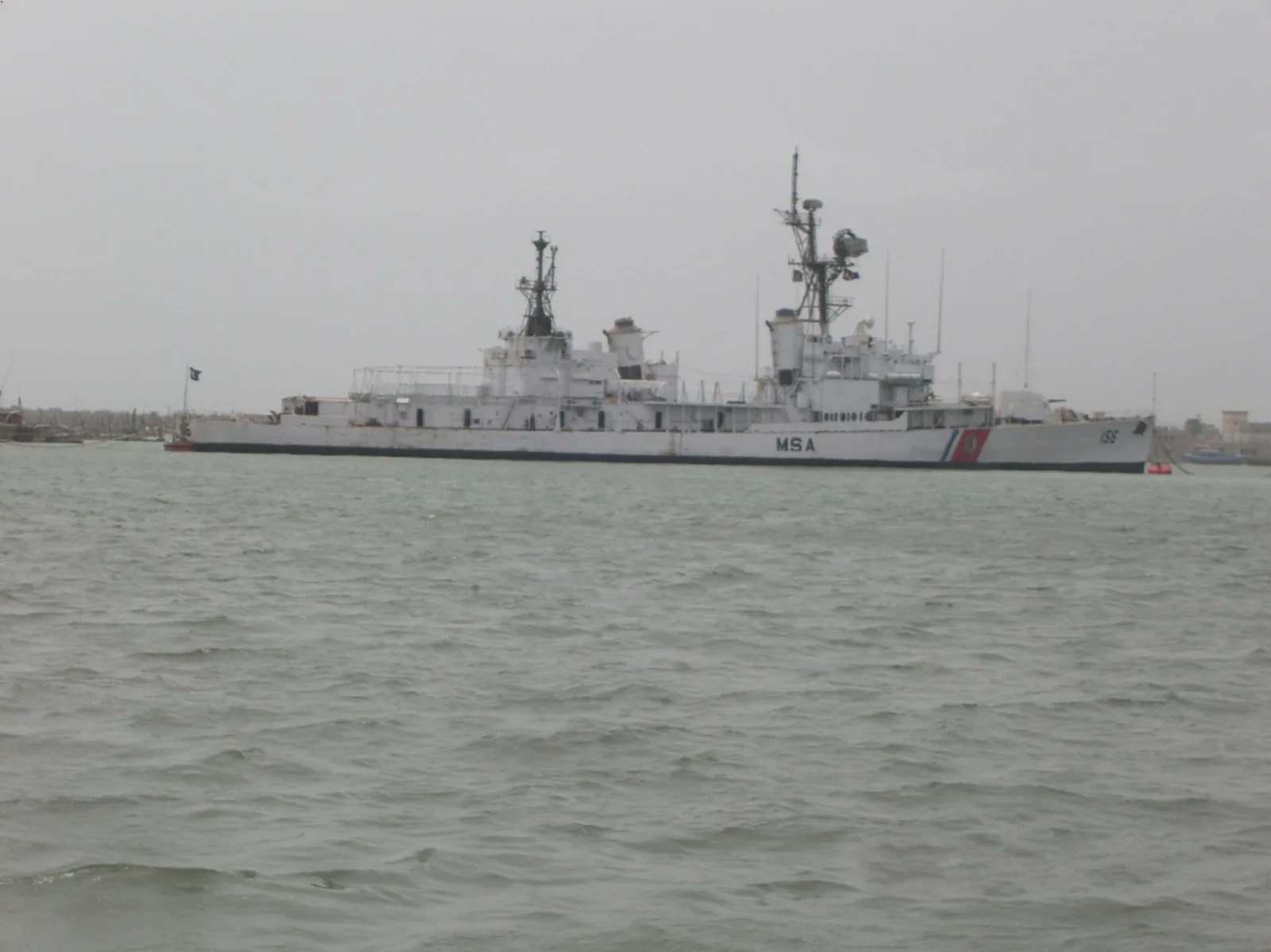
Henderson was decommissioned on 30 September 1980 and was stricken from the Navaal Vessel Register that same day and sold to Pakistan. The destroyer served in the Pakistani Navy as Tughril (167) until transferred to Pakistan's Maritime Security Agency in 1998 and renamed Nazim , serving actively until decommissioned in 2001.
Other photographs
Held for this vessel, and not tied to any part of the account above.

References
Every work this entry draws on. There are no numbered markers in the text above: what we hold is the provenance of the page — this history, this article, these photographs.
- History Henderson II (DD-785) Dictionary of American Naval Fighting Ships, Naval History and Heritage Command. A work of the United States Government, in the public domain — the only text on this site reproduced verbatim.
- Facts USS Henderson (DD-785) Structured facts only — dates, dimensions, armament and fate. No wording is taken from it. Harvested 1 August 2026.
- Photograph USS Henderson (DD-785) underway 1971 USN — Official U.S. Navy photograph [1] from the USS Cochrane (DDG-21) 1971 Cruise Book — Public domain — Wikimedia Commons
- Photograph USS Leyte (CV-32) and USS Henderson (DD-785) refueling from an oiler off Korea, circa in 1950 USN — U.S. Navy Naval Aviation News October 1951 [1] — Public domain — Wikimedia Commons
- Photograph DD-785 Henderson - DPLA - ce64461ea4cebeb33f90ed4de5c57af9 Department of Defense. Department of the Navy. Bureau of Ships. 9/18/1947-5/1/1966 — This file was contributed to Wikimedia Commons by National Archives and Records Administration as part of a cooperation project. The donation was facilitated by the Digital Public Library of America , via its partner Digital Public Library of America . Record in source catalog DPLA identifier: ce64461ea4cebeb33f90ed4de5c57af9 National Archives Identifier: 24744045 — Public domain — Wikimedia Commons
- Photograph Pakistan destroyer Nazim (156) at the Karachi dockyard, circa in 1999 Shayanshaukat ( talk ) — Own work — CC BY-SA 3.0 — Wikimedia Commons
- Photograph USS Henderson (DD-785) off the San Francisco Naval Shipyard on 20 June 1957 U.S. Navy Burau of Ships photo 19-NN - DD-785 Henderson - 157823 — Public domain — Wikimedia Commons
- Photograph USS Henderson (DD-785) underway in 1953 U.S. Navy — U.S. Navy All Hands magazine August 1953 , p. 67 — Public domain — Wikimedia Commons
- Photograph USS Salisbury Sound (AV-13) with destroyers in 1959 USN — U.S. Navy All Hands magazine November 1959 , p. 22 — Public domain — Wikimedia Commons
- Photograph USS Spinax (SS-489) with Henderson (DD-785) and SH-3A of HS-6 in 1964 U.S. Navy — U.S. Navy photo [1] from the USS Kearsarge (CVS-33) 1964 cruise book available at Navysite.de — Public domain — Wikimedia Commons