United States Navy — Destroyer
USS Lang (DD-399) — service history
This is the full service history. For the vessel's particulars, photograph and specifications, see the entry.
In the words of the US Navy. The account below is reproduced verbatim from the Dictionary of American Naval Fighting Ships, compiled by the Naval History and Heritage Command — a work of the United States Government, in the public domain, and the only text on this site not written here.
Before commissioning
Born 17 June 1794 in Curacao, D.W.I., and a resident of New Brunswick, N.J., John Lang was a seaman on board Wasp during her engagement with HMS Frolic 18 October 1812. He was the first man to board the British ship in the closing stage of the action, and his ardor and impetuosity carried the remainder of the boarding party with him.
Interwar 1919–1938
1937
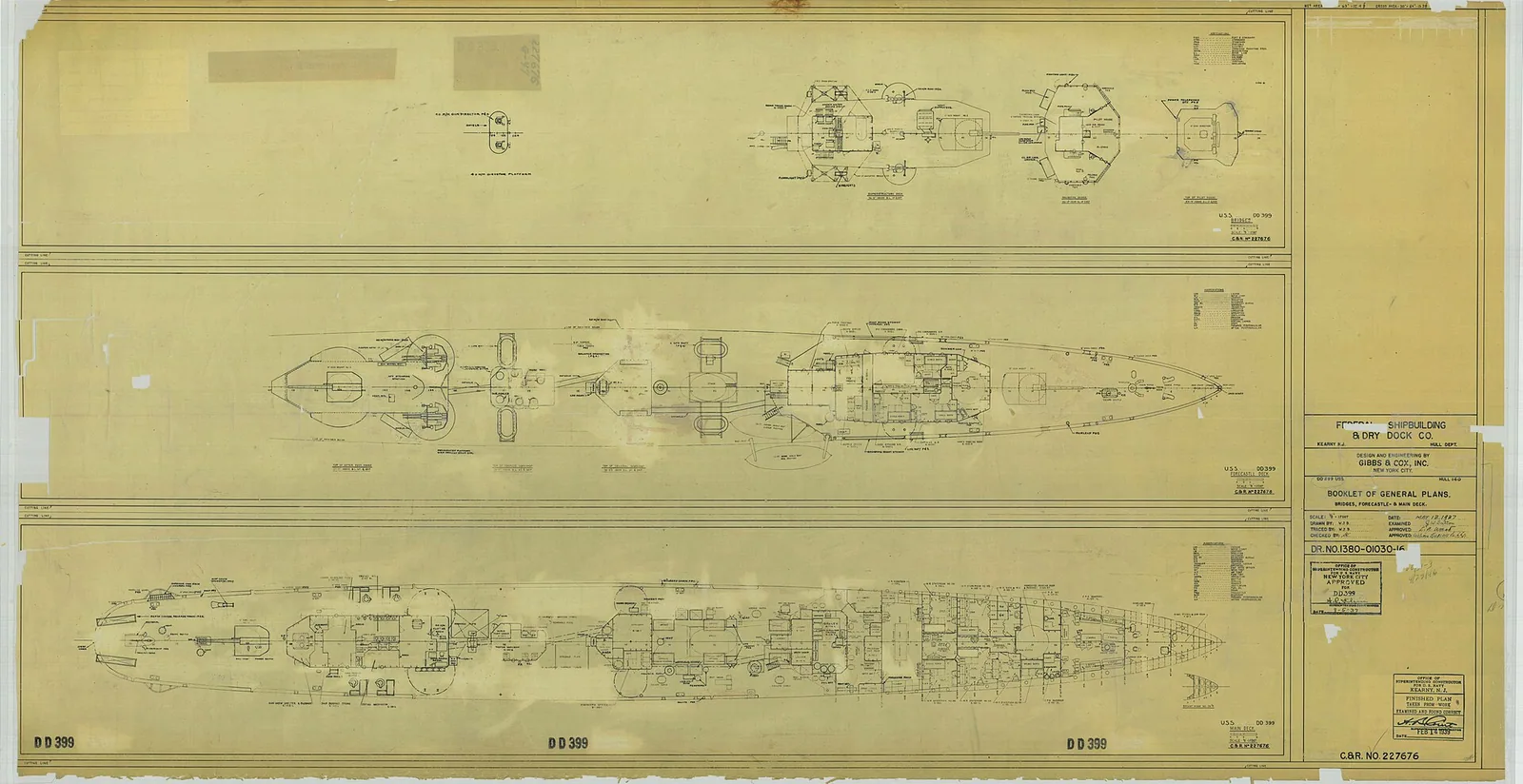
Lang (DD-399) was laid down by the Federal Shipbuilding & Dry Dock Co., Kearny, N.J., 5 April 1937; launched 27 August 1938; sponsored by Mrs. William D. Leahy, wife of Adm. William D. Leahy, Chief of Naval Operations; and commissioned 30 March 1939, Lt. Comdr. Felix L. Johnson in command.
Second World War 1939–1945
1939
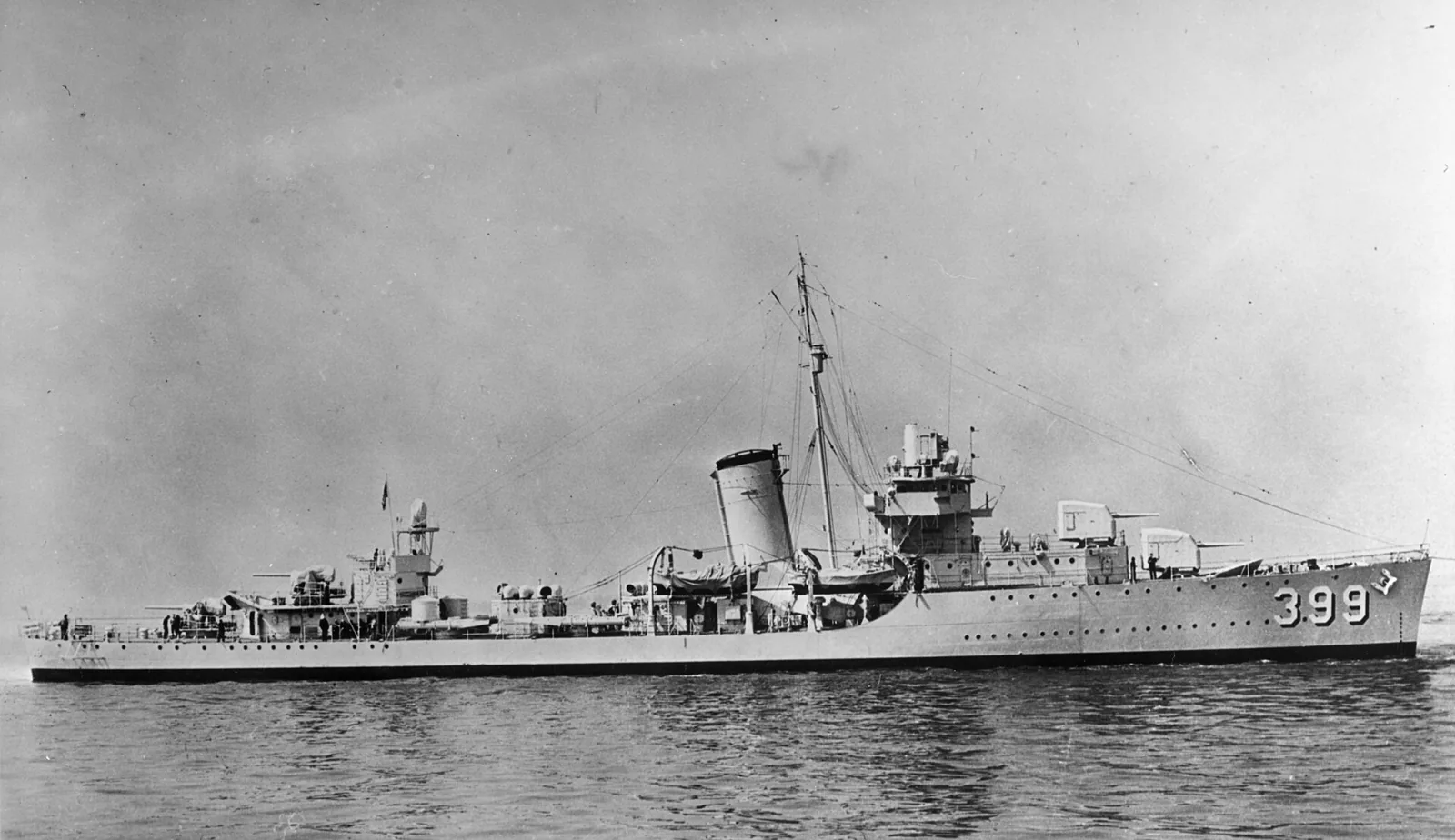
Lang departed New York 12 August 1939 guarding President Franklin D. Roosevelt-s passage to Campobello, Newfoundland, and Nova Scotia. The President came on board the 24th at Sandy Hook, N.J., for transit to Fort Hancock. In November, the destroyer left Newport, R.I., for Galveston, Tex., and duty on the Gulf Patrol. Transferred to the Pacific, she reached San Diego 18 March 1940 and Pearl Harbor 2 April, where she participated in fleet problems and training exercises. She voyaged between the west coast and Hawaii throughout the remainder of 1940 and into early 1941 engaged in escort duties and training.
1941
In June 1941 she returned to the Caribbean and Atlantic coast for carrier and antisubmarine training. In December she acted as screen and plane guard during flight operations for Yorktown and Ranger offthe Maine coast and Bermuda.
1942
She next sailed to Port Royal, Nova Scotia, for patrols with ships of the Royal Navy, then sailed for the British West Indies in January 1942. In transit she answered a distress call from torpedoed SS Empire Wildebeest, and rescued 34 survivors. She left Bermuda 18 March for Casco Bay, Maine, and thence sailed 26 March escorting TF 39 which included carrier Wasp. The force rendezvoused with three British ships 3 April and entered Scapa Flow, Scotland, the next day. The destroyer then became a part of Force "W", sailing between England and the Mediterranean to deliver desperately needed Spitfires to the besieged island of Malta. After two such missions, Lang returned to Norfolk 28 May and was transferred to San Diego a month later.
As flagship for DesDiv 15, part of TF 18, Lang departed San Diego 1 July to join in shore bombardment exercises off Tonga in preparation for the Guadalcanal-Tulagi landings. Three weeks later she screened Wasp as the carrier launched her aircraft against enemy territory in the first American land offensive of the Pacific war.
1943 Onaiavisi
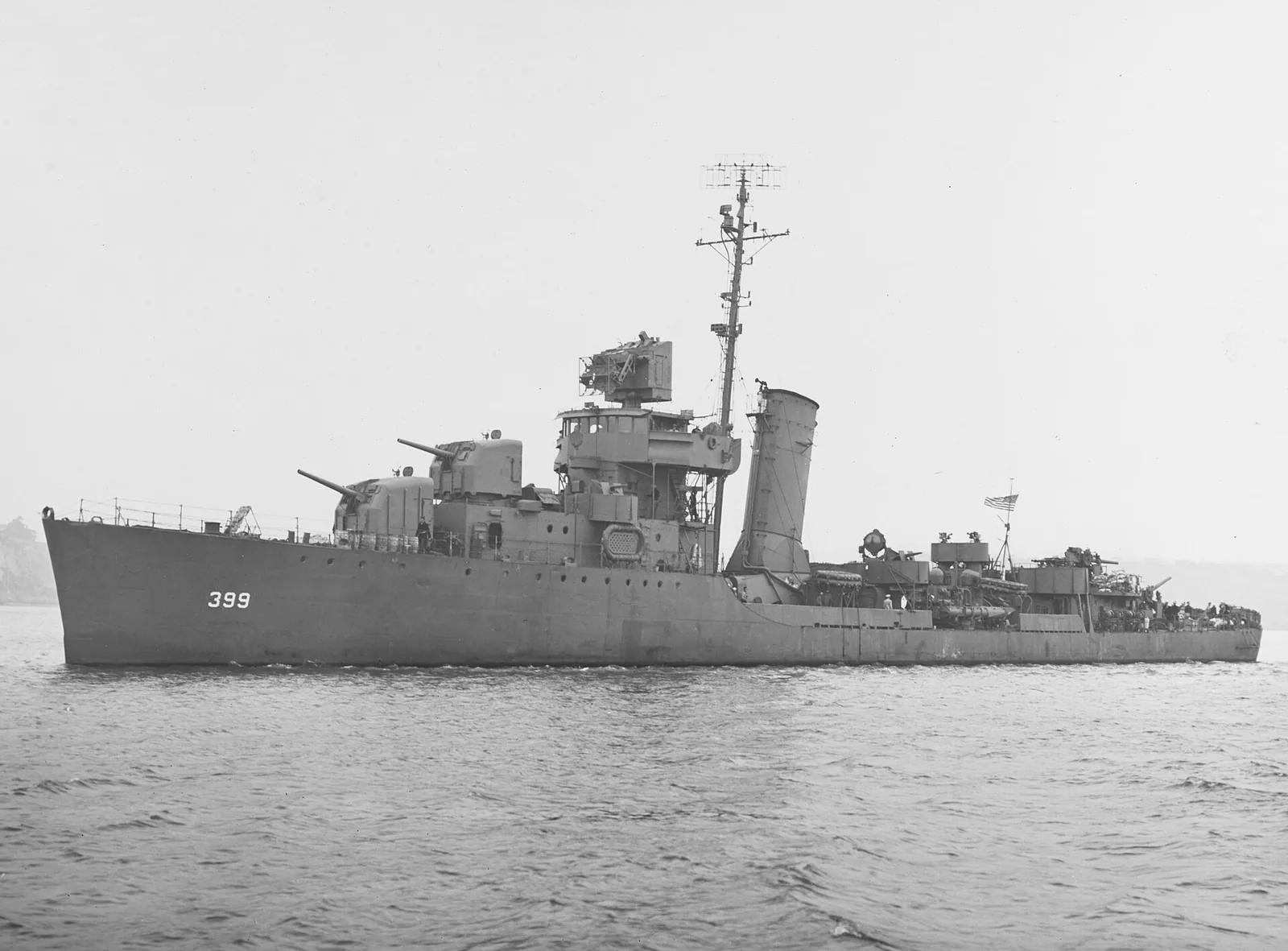
Operating from the New Hebrides, Lang carried out patrol and escort missions in the continuing effort to reconquer the Solomons. On 22 and 24 January 1943 she bombarded Japanese positions near Kokumbona Beach, Guadalcanal, inflicting heavy casualties upon the enemy. In July, Lang and four other destroyers sailed for Kula Gulf escorting six APDs to the New Georgia landings. Early on the 18th, the American force sighted and attacked three Japanese destroyers forcing them to retire behind a smokescreen. After warding off enemy fighter attacks, the ships completed their mission and sailed for Purvis Bay, Florida, from which Lang and two other destroyers escorted five LCIs to the landings at Onaiavisi, New Georgia, 31 July. During enemy air attack here Lang splashed one aircraft
1944 Gilberts
Lang's next mission, in company with five other destroyers, was to destroy enemy forces in Vella Gulf, part of the "Tokyo Express" route. On the nights of 6 and 7 August her task group sank three Japanese destroyers, Kawakaze, Arashi, and Hagikaze, which had been attempting to reinforce Kolombangara. Two nights later the victorious vessels conducted a sweep in the same area and drove off three groups of enemy troop barges. After 3 months- continued escort duty. Lang joined TF 50 for the invasion of the Gilberts 23 to 30 November, bombarded Nauru 9 December, and early in the new year bombarded Roi, Namur, and Abraham. Then she joined TF 58 for the occupation of Kwajalein, returning to escort duties 15 March 1944. During the summer she again operated with TF 58 during the Marianas campaign, screening the fast carrier force as it launched attacks on Japanese convoys, pulverized enemy installations on Guam, and decimated Japanese airpower. She returned to Tulagi 17 August after the victory in the Marianas.
Lang next sailed to Wewak, New Guinea, 31 August to lay a minefield and bombard shore positions. She then escorted two reinforcement convoys bound for Morotai 16 September to 3 October through heavy enemy air attacks. On 8 October she took torpedoed Shelton (DE-407) in tow, and brought her in to Morotai before the stricken ship capsized and sank.
1945
Lang departed Hollandia 10 October for the Leyte Gulf operation. Though she came under six kamikaze attacks, the ship suffered no damage and shot down one enemy plane. She departed the battle area for Manus 31 October, and on Christmas Day sailed with TF 78 for the Lingayen Gulf landings. Again attacked numerous times by suicide planes, Lang suffered no damage and splashed another enemy. She returned to Leyte Gulf 16 January 1945 to escort a resupply echelon to Lingayen, patrolled the entrance to Lingayen until 28 January, then sailed to train in the Solomons for the Okinawa assault.
Departing Ulithi 27 March as flagship for ComDesDiv 4, Lang screened the transports of TF 53 to Okinawa. Under air attack from 12 to 29 April, Lang again incurred no damage and accounted for another enemy kamikaze. From 29 April to 17 May she screened three escort carriers providing direct air support for Okinawa operations, and then screened other flight operations near Okinawa to 11 June.
Lang departed the Pacific battle zones in June and arrived in San Francisco 3 July for repairs. En route to New York she rescued two downed pilots 25 August. She decommissioned 16 October 1945; was sold to George Nutman, Inc., Brooklyn, N.Y., 20 December; and scrapped 31 October 1947.
Other photographs
Held for this vessel, and not tied to any part of the account above.

References
Every work this entry draws on. There are no numbered markers in the text above: what we hold is the provenance of the page — this history, this article, these photographs.
- History Lang I (DD-399) Dictionary of American Naval Fighting Ships, Naval History and Heritage Command. A work of the United States Government, in the public domain — the only text on this site reproduced verbatim.
- Facts USS Lang (DD-399) Structured facts only — dates, dimensions, armament and fate. No wording is taken from it. Harvested 1 August 2026.
- Photograph USS Lang (DD-399) U.S. Navy, photographed from a USS Wasp (CV-7) aircraft. — Official U.S. Navy photo NH 91383 from the U.S. Navy Naval History and Heritage Command — Public domain — Wikimedia Commons
- Photograph USS Lang (DD-399) off Mare Island in October 1943 U.S. Navy — Official U.S. Navy photo 19-N-53408 from the U.S. Navy Naval History and Heritage Command — Public domain — Wikimedia Commons
- Photograph USS Lang (DD-399) underway c1939 U.S. Navy — Official U.S. Navy photo NH 63109 from the U.S. Navy Naval History and Heritage Command — Public domain — Wikimedia Commons
- Photograph USS Lang (DD-399)- Booklet of General Plans - Bridges, Forecastle- and Main Deck - NARA - 78116649 Unknown author or not provided — U.S. National Archives and Records Administration — Public domain — Wikimedia Commons
- Photograph USS Lang (DD-399)- Booklet of General Plans - First and Second Platform and Hold - NARA - 78116651 Unknown author or not provided — U.S. National Archives and Records Administration — Public domain — Wikimedia Commons
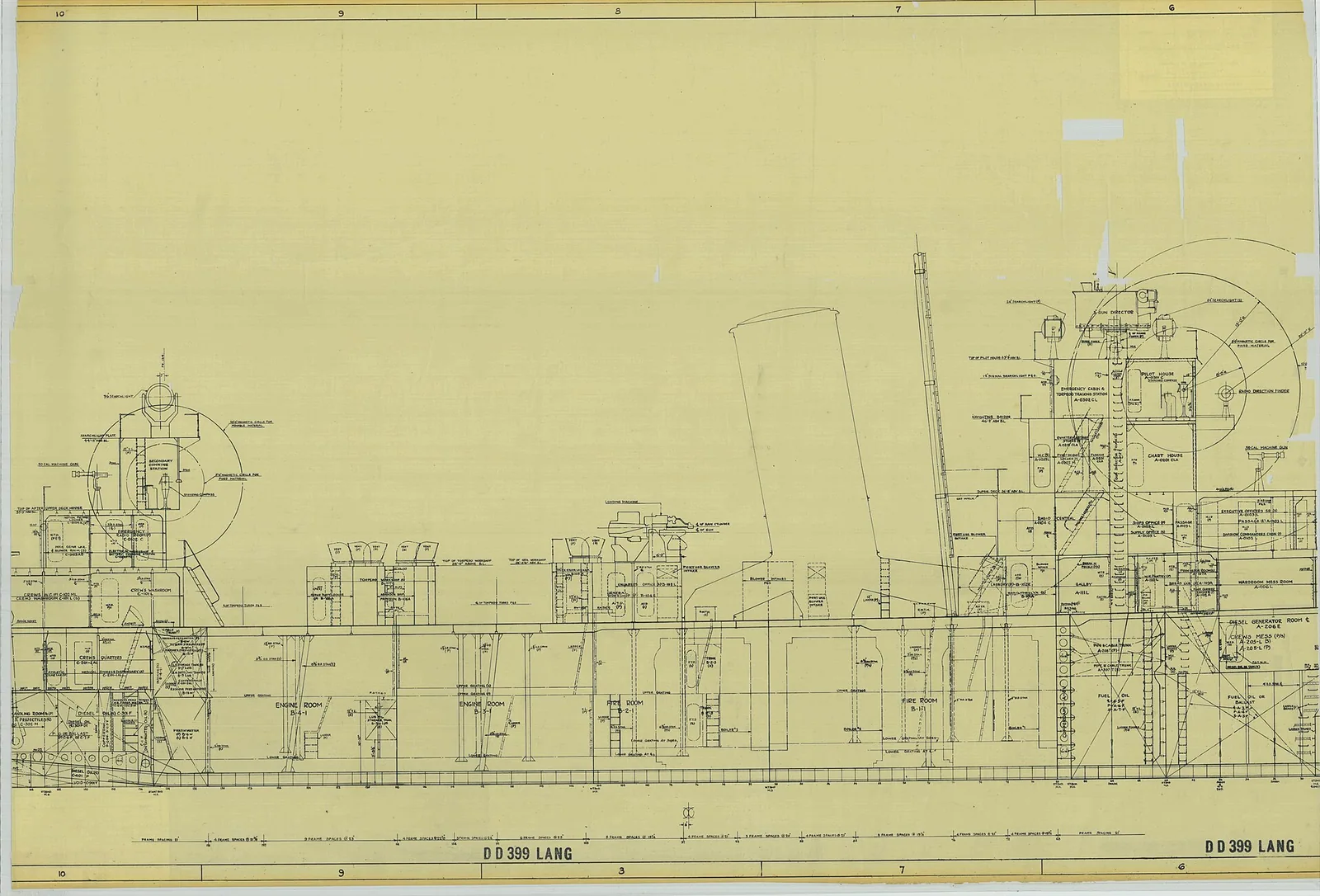
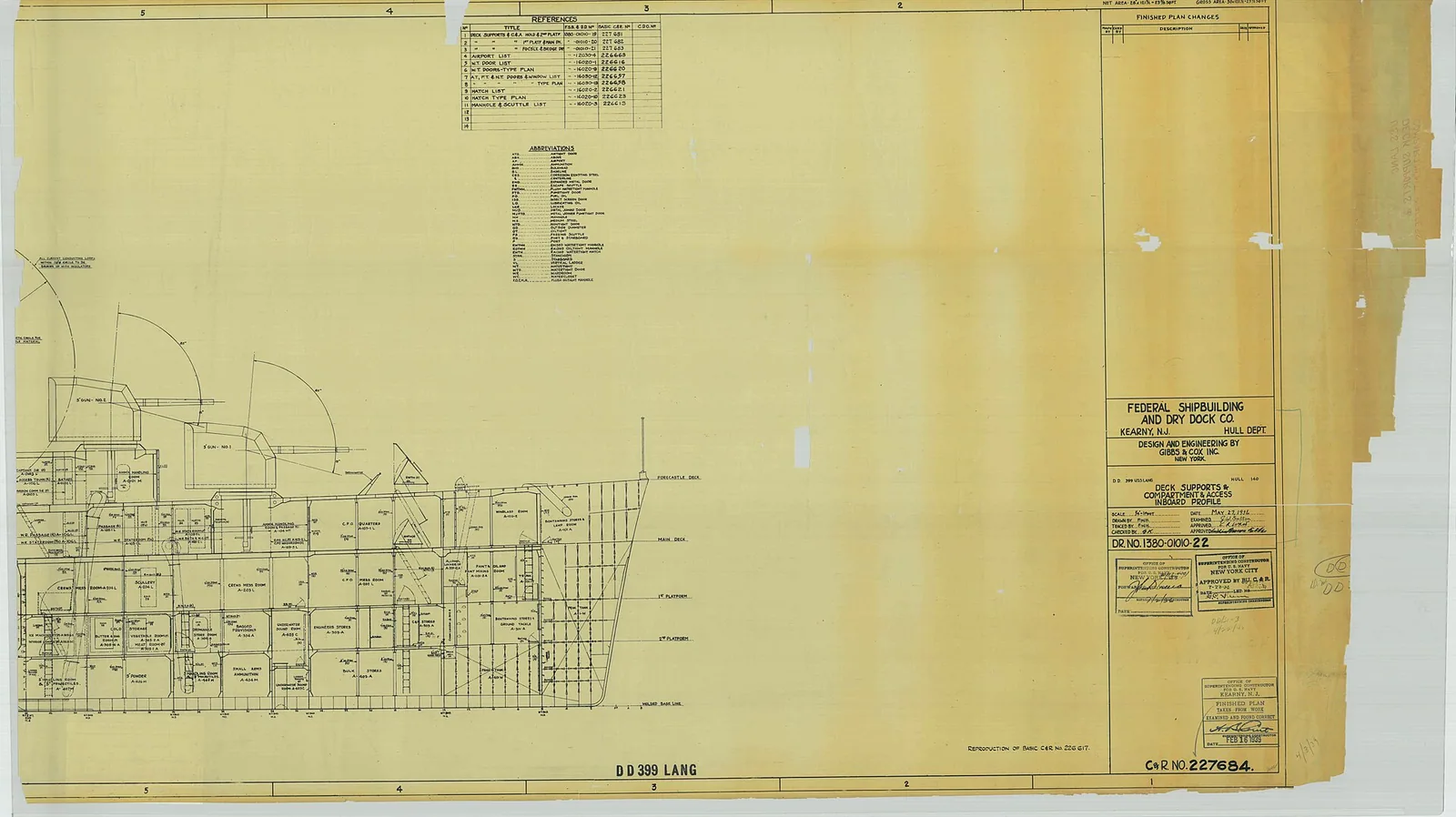
- Photograph USS Lang (DD-399)- Deck Supports and Compartment and Access Inboard Profile - NARA - 78116653 (page 1) Unknown author or not provided — U.S. National Archives and Records Administration — Public domain — Wikimedia Commons
- Photograph USS Lang (DD-399)- Deck Supports and Compartment and Access Inboard Profile - NARA - 78116653 (page 2) Unknown author or not provided — U.S. National Archives and Records Administration — Public domain — Wikimedia Commons
- Photograph USS Lang (DD-399)- Deck Supports and Compartment and Access Inboard Profile - NARA - 78116653 (page 3) Unknown author or not provided — U.S. National Archives and Records Administration — Public domain — Wikimedia Commons