United States Navy — Destroyer
USS Lardner (DD-487) — service history
This is the full service history. For the vessel's particulars, photograph and specifications, see the entry.
In the words of the US Navy. The account below is reproduced verbatim from the Dictionary of American Naval Fighting Ships, compiled by the Naval History and Heritage Command — a work of the United States Government, in the public domain, and the only text on this site not written here.
Before commissioning
James L. Lardner was born at Philadelphia, Pa., 20 November 1802. He was appointed Midshipman 10 May 1820. Lardner served in the Pacific squadron from 1821 to 1824 and joined the Mediterranean squadron in 1825 after escorting General Lafayette in Brandywine back to France. He cruised in various squadrons and held important positions on shore until 1860. In September 1861 during the, Civil War, Lardner, in command of frigate Susquehanna, tooka pertinent part in the Battle of Port Royal and the capture of Forts Walker and Beauregard. He was commended for gallantry in action by Rear Admiral DuPont; his name was sent to Congress for a vote of thanks by President Lincoln. In May 1862, be assumed command of the East Gulf Blockading Squadron and was promoted to commodore 16 July 1862. From May 1863 to October 1864, Lardner commanded the West India Squadron. After his retirement 20 November 1864, he was appointed rear admiral 25 July 1866. He served on special duty with various boards until 1869, when he was appointed Governor of the Naval Asylum, Philadelphia. He held this post until 1871. Rear Admiral Lardner died 12 April 1881 in Philadelphia, Pa.
Second World War 1939–1945
1941
Lardner (DD-487) was laid down 15 September 1941 by Federal Shipbuilding & Dry Dock Co., Kearney, N.J.; launched 20 March 1942; sponsored by Mrs. Sidney F. Tyler II, great-granddaughter of Rear Adm. James L. Lardner; and commissioned 13 May 1942, Lt. Comdr. Willard M. Sweeter in command.
1942
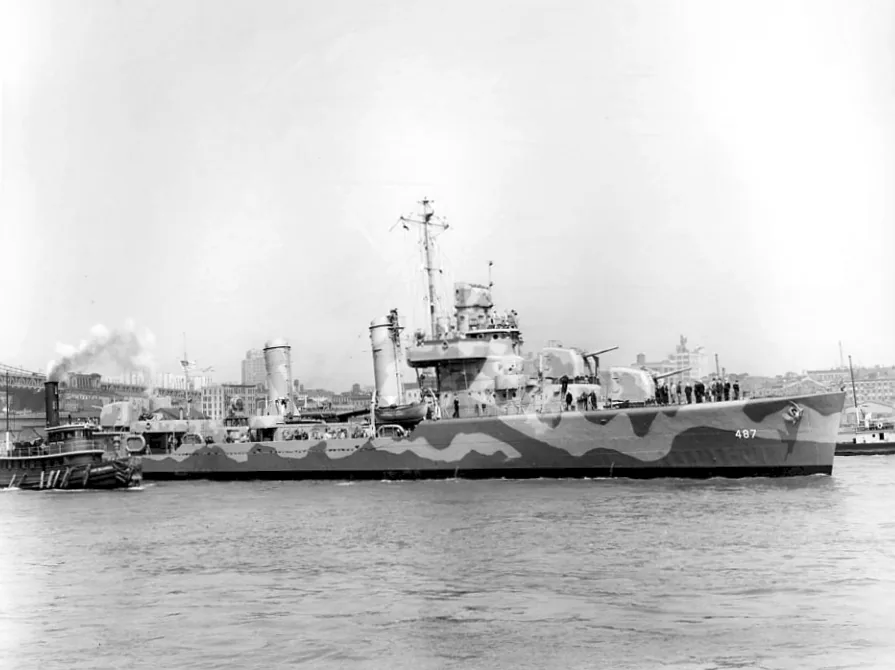
Her shakedown cruise off the New England coast began 28 May and lasted until 1 July 1942. During this period, she investigated several reports of submarines near the coast of Maine and searched for a reported U-boat off Guantanamo Bay, Cuba.
On 21 August, Lardner departed Balboa, Canal Zone, for the South Pacific, arriving Tongatabu 3 September. There the ship acted as escort and screen for convoys and fleet units, making numerous passages to Noumea and Espiritu Santo, and screening transports landing troops on Guadalcanal, where she bombarded enemy positions.
While Lardner was serving in the screen for TF 18 steaming from the Santa Cruz Islands to Espiritu Santo, aircraft carrier Wasp (CV-7) was torpedoed and sank 15 September. Lardner immediately launched a depth charge attack while her boats picked up 322 survivors, debarking them at Espiritu Santo the next day.
On 17 and 30 October Lardner headed for Guadalcanal, arriving off Lunga Point at dawn, and splashed two enemy planes during attacks shortly thereafter. She then proceeded to her bombardment position and shelled Japanese positions from Kolumbona to Cape Esperance.
Lardner screened transports while they unloaded at Guadalcanal during November, and at dawn 28 November searched in vain for the enemy submarine which had torpedoed Alchiba (AK-23). On 30 November Lardner, as part of TF 7's five cruisers and seven destroyers, engaged the enemy off Tassafaronga in the decisive battle in the struggle for Guadalcanal. At the end of the contest, the Japanese withdrew, never again to send large naval forces into the area. After escorting damaged cruisers Honolulu (CL-48) and Pensacola (CA-24) to Espiritu Santo. the destroyer arrived at Noumea, New Caledonia, 10 December and moored for overhaul alongside tender Dixie.
1943
During the first part of January 1943, the destroyer screened battleships and convoys between Espiritu Santo, Purvis Bay, and Guadalcanal. She visited New Zealand 15 February and upon return sailed from Noumea with a group of transports and tankers for Guadalcanal, fighting off attacking enemy planes 17 February and anchoring next day with her charges unscathed. The remainder of the month, Lardner escorted various convoys between Guadalcanal and Noumea. During March she escorted convoys between Guadalcanal and Fiji, New Hebrides, and Espiritu Santo, and in April joined TF 15. Lardner returned to Pearl Harbor 8 May for installation of new equipment keeping up with the rapid technological advances of the U.S. Navy.
Lardner operated in Hawaiian waters until sailing 14 July for the United States, escorting carrier Enterprise to Bremerton, Wash. She arrived San Francisco 21 July, and sailed on the 27th for Samoa, touching at Pearl Harbor 1 August and arriving Pago Pago 14 August. While there, Lardner operated with TF 37, returning to Espiritu Santo 2 September before patrol duty off Florida Island until 18 September, when she escorted amphibious craft and transports to Vella Lavella for landings.
1944 Green Island
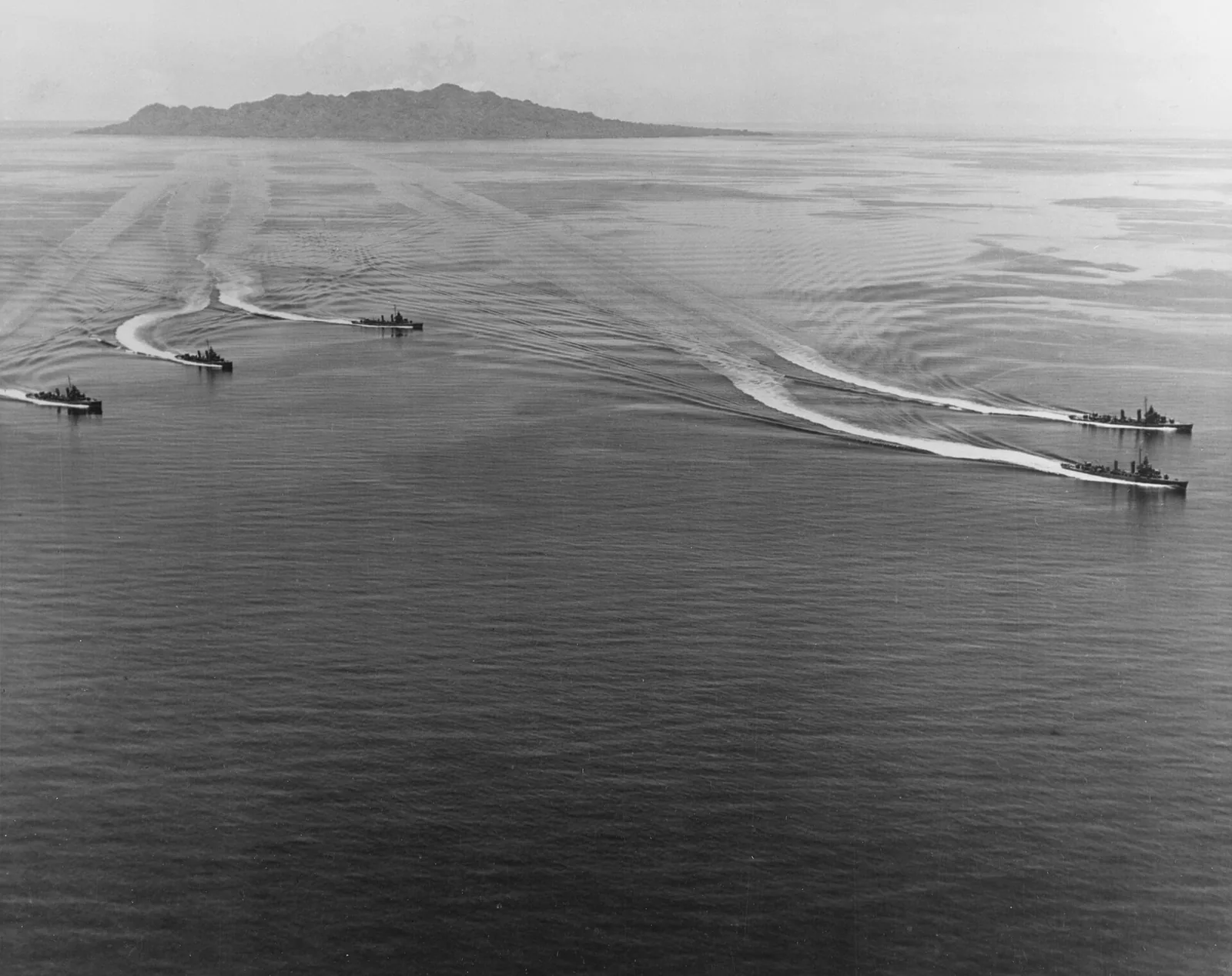
After patrol duty early in October, Lardner returned to escort duty between New Caledonia and the Solomons, then screened task forces operating out of Purvis Bay in the Bougainville campaign. She bombarded Bougainville 29 November, and continued occasional bombardments along with escort missions through January 1944. On 14 February, Lardner sailed north with TF 38 to cover initial landings on Green Island, and on the way was attacked by 6 -Val- divebombers. Late in February, the destroyer bombarded Rabaul; searched the Bismark Sea for enemy shipping; and then attacked Karavia Bay, sinking an enemy cargo ship of the Heito Maru class 25 February. Later that day she bombarded Kavieng, receiving a few shrapnel holes from extremely heavy and accurate enemy return fire. During March and April, Lardner operated with support forces for the Palaus raid, and with escort carriers during the landing at Hollandia, New Guinea.
In June and July, Lardner participated in the occupation of Guam, Saipan, and Tinian; escorted carriers on the first Bonin Islands raid; and joined in the Battle of the Philippine Sea.
1945
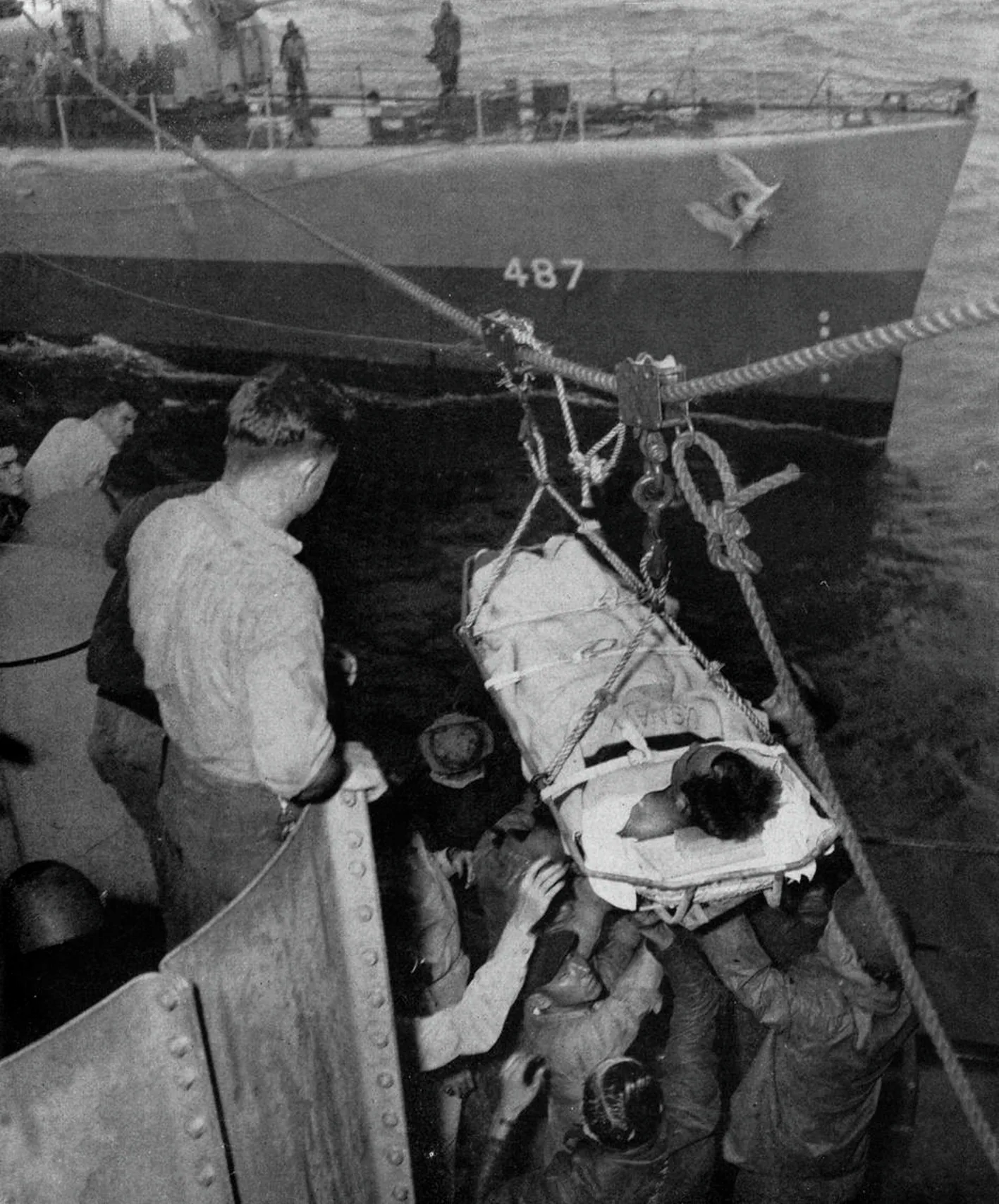
Lardner returned to the United States for overhaul at Bremerton, Wash., and headed back toward the South Pacific 29 September. She spent most of the month of October in Hawaiian waters. From 19 November until March 1945, the destroyer escorted convoys between Ulithi, Eniwetok, Kossol Passage, and Leyte. While on antisubmarine and air guard patrol off Pelelieu and Angaur, she rescued five downed air corps flyers 27 December. While investigating an unidentified small craft, Lardner ran aground on a submerged shoal 29 January 1945 and proceeded to Ulithi for repairs.
On 23 February she got underway escorting a convoy to Kossol Roads and took up patrol station between Pelelieu and Angaur. Throughout March and April, Lardner remained in the vicinity on patrolling duty with occasional visits to Kossol for refueling and replenishment. Throughout May and June, the destroyer operated with a support force of escort carriers containing the chain of Japanese island bases from Okinawa to Formosa while Okinawa was being secured. During July and August the ship was continuously at sea operating off the east coast of Japan supplying direct logistic support to 3d Fleet ships during their sustained attacks on the Japanese homeland.
With the end of hostilities and Japan-s unconditional surrender, Lardner escorted the crippled Borie (DD-704) to Saipan 17 August, and from Saipan sailed to Okinawa to join a group of battleships preparing to sail to Japan for the Japanese surrender. Lardner arrived Sagami Wan 27 August and entered Tokyo Bay 29 August, escorting Fleet Adm. Chester Nimitz' flagship South Dakota (BB-57). Lardner next joined in evacuating several hundred prisoners-of-war from southern Honshu. Lardner operated with several task groups and units performing varied occupation duties until 15 October when she departed Honshu with TG 50.5 for home. On the homeward voyage, she touched at Singapore, Ceylon, Capetown, and Saldanha, South Africa, before arriving New York 7 December 1945.
Post-war 1946–1949
1946
The veteran destroyer remained at New York until 9 February 1946, then sailed to Charleston, S.C. Lardner decommissioned 16 May 1946 and joined the Atlantic Reserve Fleet until transferred to Turkey 10 June 1949 under the Military Assistance Program. She serves the Turkish Navy as Gemlik (D-347).
Other photographs
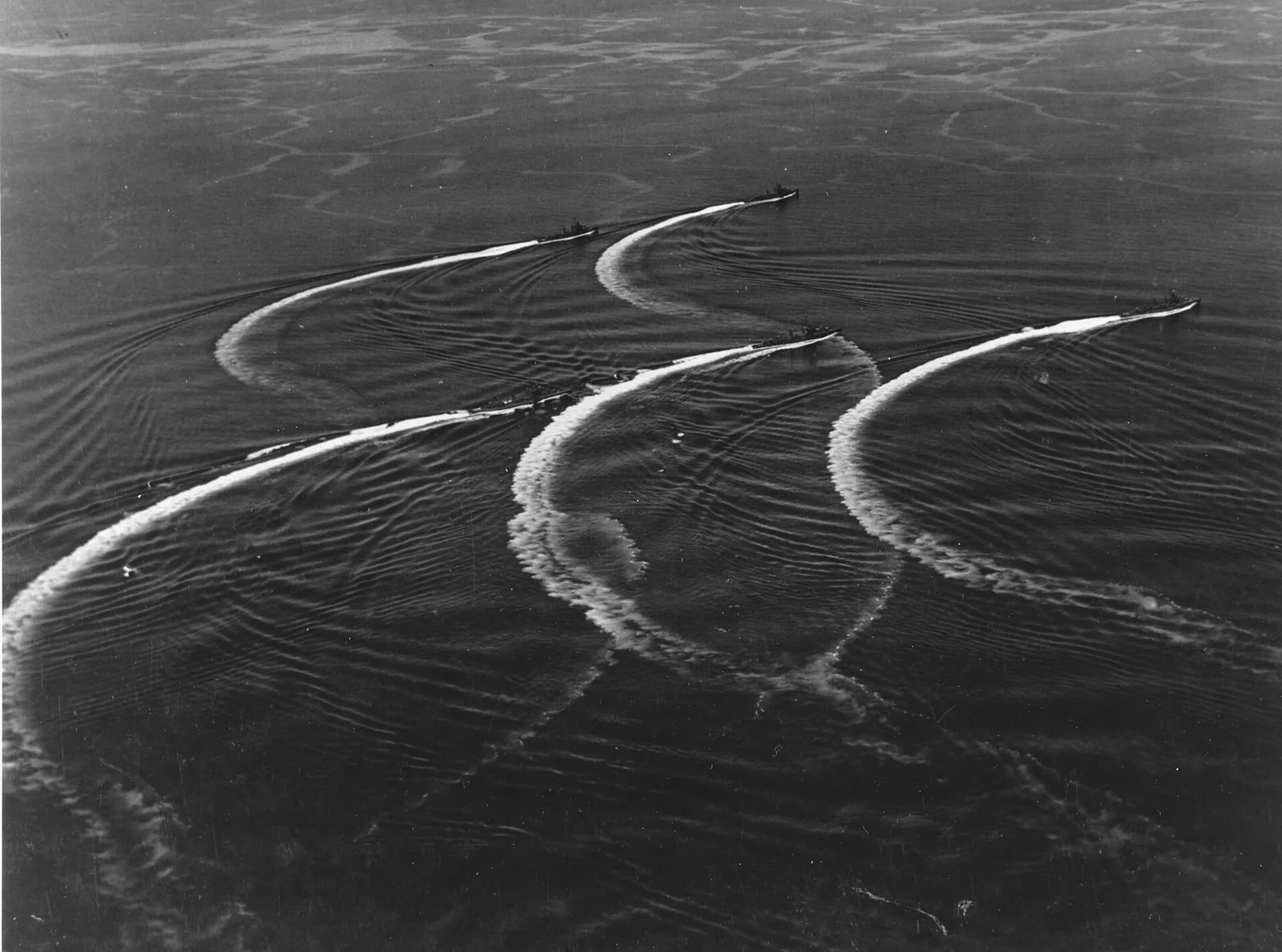
Held for this vessel, and not tied to any part of the account above.

References
Every work this entry draws on. There are no numbered markers in the text above: what we hold is the provenance of the page — this history, this article, these photographs.
- History Lardner II (DD-487) Dictionary of American Naval Fighting Ships, Naval History and Heritage Command. A work of the United States Government, in the public domain — the only text on this site reproduced verbatim.
- Facts USS Lardner (DD-487) Structured facts only — dates, dimensions, armament and fate. No wording is taken from it. Harvested 1 August 2026.
- Photograph USS Lardner (DD-487) underway in 1945 (80-G-321649) U.S. Navy — Official U.S. Navy photo 80-G-321649 available at Destroyerhistory.org — Public domain — Wikimedia Commons
- Photograph Turkish destroyer Gemlik (D347) at anchor c1956 U.S. Navy — Official U.S. Navy photo NH 76311 from the U.S. Navy Naval History and Heritage Command — Public domain — Wikimedia Commons
- Photograph US Navy Destroyer Squadron 12 in Ironbottom Sound in early 1944 U.S. Navy — Official U.S. Navy photo NH 109597 (80-G-220760) from the U.S. Navy Naval History and Heritage Command — Public domain — Wikimedia Commons
- Photograph US Navy Destroyer Squadron 12 in Ironbottom Sound in February 1944 U.S. Navy — Official U.S. Navy photo 80-G-220757 from the U.S. Navy Naval History and Heritage Command — Public domain — Wikimedia Commons
- Photograph USS Lardner (DD-487) in 1942 USN — U.S. Navy photo NH 107413 from Navsource.org — Public domain — Wikimedia Commons
- Photograph USS Lardner (DD-487) transfers patient to USS Suwannee (CVE-27), circa in 1945 U.S. Navy — U.S. Navy photo [1] from the USS Suwannee (CVE-27) 1942-1945 cruise book available at Navysite.de — Public domain — Wikimedia Commons