United States Navy — Destroyer
USS Leonard F. Mason — service history
This is the full service history. For the vessel's particulars, photograph and specifications, see the entry.
In the words of the US Navy. The account below is reproduced verbatim from the Dictionary of American Naval Fighting Ships, compiled by the Naval History and Heritage Command — a work of the United States Government, in the public domain, and the only text on this site not written here.
Before commissioning
Leonard Foster Mason, born Middleboro, Ky., 22 February 1920, enlisted in the Marine Corps in April 1943. Promoted to private first class in March 1943, Mason was sent to the Pacific war zone in October.
Second World War 1939–1945
1944 Guam
During the landing on Guam 22 July 1944, two enemy machineguns opened fire on Mason's platoon. Although mortally wounded, Mason cleared out the hostile position, acting on his own initiative. His heroic act in the face of almost certain death enabled his platoon to accomplish its mission. He was posthumously awarded the Medal of Honor.
1945
Leonard F. Mason (DD-852) was laid down 2 May 1945 by the Bethlehem Steel Co., Quincy, Mass.; launched 4 January 1946; sponsored by Mrs. Hillery Mason, mother of Private First Class Mason; and commissioned 28 June 1946, Comdr. S. D. B. Merrill in command.
Post-war 1946–1949
1947
Following shakedown in the Caribbean, the new destroyer joined DesDiv 32 in the Pacific 22 January 1947. From 1947 to 1950, the ship completed two cruises in the western Pacific, as well as stateside operations. During the early stages of the Korean war, Leonard F. Mason steamed for the Pacific 13 November 1950 and joined in antisubmarine exercises. On 16 May she joined TF 85 at the siege of Wonsan to fire in the continuous shore bombardment which inflicted heavy damage on enemy bridges, tunnels, and troop concentrations. Departing Wonsan 23 July, she steamed for San Diego, arriving 8 August 1951.
Korean War period 1950–1953
1952
After overhaul, the ship sailed 23 February 1952 for the Orient, and again operated in Wonsan Harbor and along the eastern coast of Korea. Departing Yokosuka 13 September, she arrived Long Beach 27 September and remained there until 16 May 1953 when she again steamed for the Far East. Arriving in Korean waters 9 June, Leonard F. Mason joined TG 70.1 for escort and bombardment action with mighty battleship New Jersey off Wonsan and in the Yellow Sea.
Cold War 1954–1963
1956
After the close of Korean hostilities, she departed Yokosuka 20 November for Long Beach, arrived 8 December, and readied herself for peacetime duty. Between 1954 and 1960 Leonard F. Mason made three more WestPac cruises, providing an element of security in the turbulent Far East. During the Suez crisis of November 1956 she sailed with fast carrier TF 11 on guard against any spread of trouble to the Far East.
1960
From May 1960 to May 1962, Leonard L. Mason was homeported at Yokosuka for antisubmarine patrols and other peacekeeping missions. During 1963 she underwent FRAM I conversion at Boston. Naval Shipyard, then returned by way of the west coast to Yokosuka 21 July 1964. For the next 2 years, she operated with various task groups of the 7th Fleet, conducting gunflre support missions off the coast of Vietnam, patrolling in the Taiwan Straits, and serving in the Gemini Recovery Force. Long experience and training paid off 17 March 1966 when Gemini VIII splashed down southeast of Okinawa. Leonard F. Mason had Astronauts Maj. David Scott, USAF, and Mr. Neil Armstrong and their capsule aboard within 3 hours and was headed for Okinawa, where her distinguished passengers and cargo were offloaded the next day.
Leonard F. Mason then returned to gunfire support chores off Vietnam until June. With an overhaul projected, her home port changed to Long Beach, Calif. She departed Yokosuka 17 June and arrived at the west coast 2 July. The remainder of the year was spent in diverse operations off the California coast, with a trip to Alcapulco in November.
Vietnam War period 1964–1975
1967
On 5 January 1967 the destroyer entered San Francisco Bay Naval Shipyard, Vallejo, for overhaul. She returned to Long Beach in May, then resumed local operations, including 6 weeks of refresher training. On 19 September she departed for WestPac, where she conducted plane guard duty on Yankee Station and naval gunfire support, until sailing for home, arriving Long Beach 12 March. Her stay was not long, however, for she left once again for the Far East at the end of July. Yokosuka again became her homeport 19 August 1968, and she continued to operate with the 7th Fleet, ranging from Japan to the South China Sea into 1969.
Other photographs
Held for this vessel, and not tied to any part of the account above.



References
Every work this entry draws on. There are no numbered markers in the text above: what we hold is the provenance of the page — this history, this article, these photographs.
- History Leonard F. Mason (DD-852) Dictionary of American Naval Fighting Ships, Naval History and Heritage Command. A work of the United States Government, in the public domain — the only text on this site reproduced verbatim.
- Facts USS Leonard F. Mason Structured facts only — dates, dimensions, armament and fate. No wording is taken from it. Harvested 1 August 2026.
- Photograph USS Leonard F. Mason (DD-852) underway in 1974 PHC C.C. Curtis, USN — U.S. Navy photo KN-21911 from Navsource.org ; Official U.S. Navy photo NH 107131 (b/w) from the U.S. Navy Naval History and Heritage Command — Public domain — Wikimedia Commons
- Photograph USS Leonard F. Mason (DD-852) underway on 26 September 1950 U.S. Navy Bureau of Ships photo 19-NN - DD-852 Leonard F. Mason - 136457 — Public domain — Wikimedia Commons
- Photograph DD-852 Leonard F. Mason - DPLA - f9939f4a87f53cb68a93d460fb53b20e Department of Defense. Department of the Navy. Bureau of Ships. 9/18/1947-5/1/1966 — This file was contributed to Wikimedia Commons by National Archives and Records Administration as part of a cooperation project. The donation was facilitated by the Digital Public Library of America , via its partner Digital Public Library of America . Record in source catalog DPLA identifier: f9939f4a87f53cb68a93d460fb53b20e National Archives Identifier: 24744891 — Public domain — Wikimedia Commons
- Photograph USS Leonard F. Mason (DD-852) at Naval Station San Diego, in April 1974 David Faige (cosmicship); The original uploader was Cosmicship at English Wikipedia ., 2005-11-28 (original upload date) — U.S. Navy photo [1] from Navsource.org . Transferred from en.wikipedia to Commons — CC BY-SA 3.0 — Wikimedia Commons
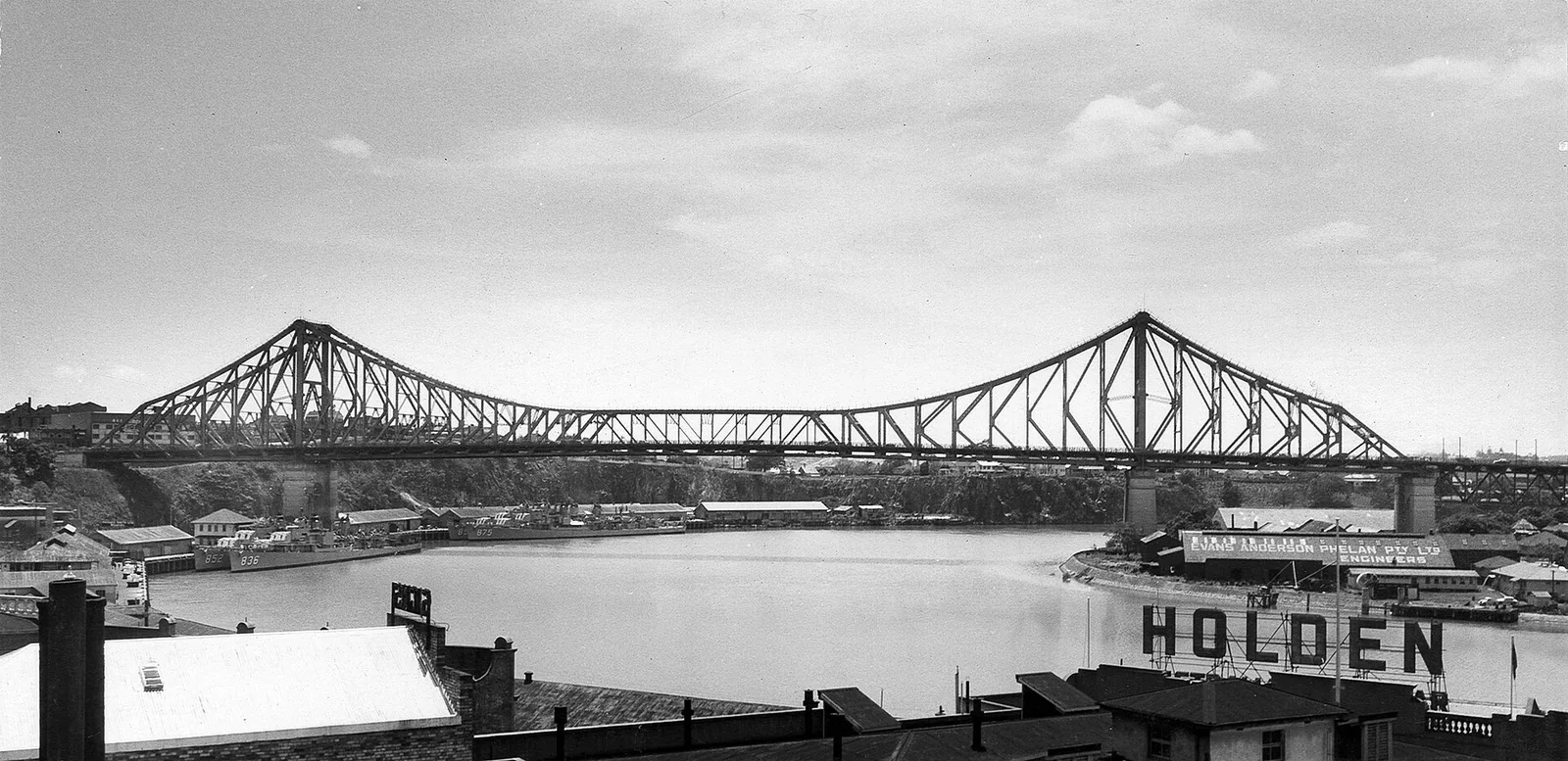
- Photograph QSA Item ID 436402 United States Navy ships under the Story Bridge, Brisbane, January 1958 cropped Queensland State Archives — https://www.flickr.com/photos/queenslandstatearchives/34180070374/ (cropped) — CC BY 2.5 — Wikimedia Commons
- Photograph QSA Item ID 436402 United States Navy ships under the Story Bridge, Brisbane, January 1958 Queensland State Archives — https://www.flickr.com/photos/queenslandstatearchives/34180070374/ — CC BY 2.5 — Wikimedia Commons
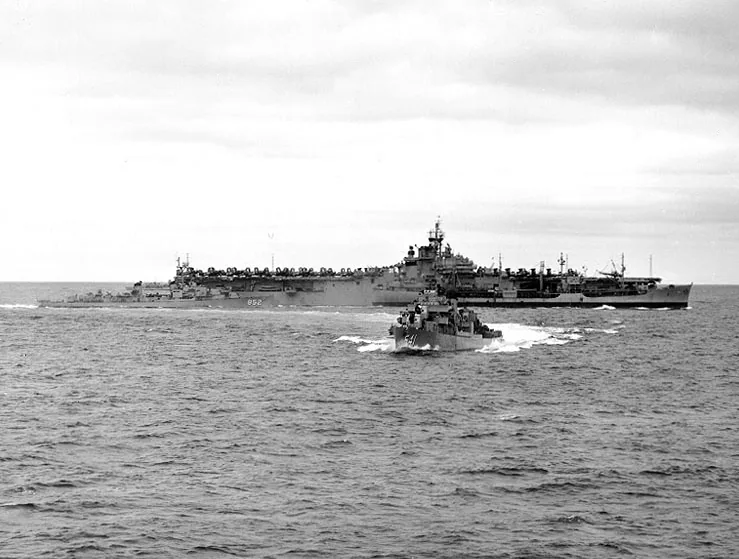
- Photograph USS Bon Homme Richard (CV-31) and destroyers refueling off Korea 1951 USN — Official U.S. Navy photo NH 97348 from the U.S. Navy Naval History and Heritage Command — Public domain — Wikimedia Commons
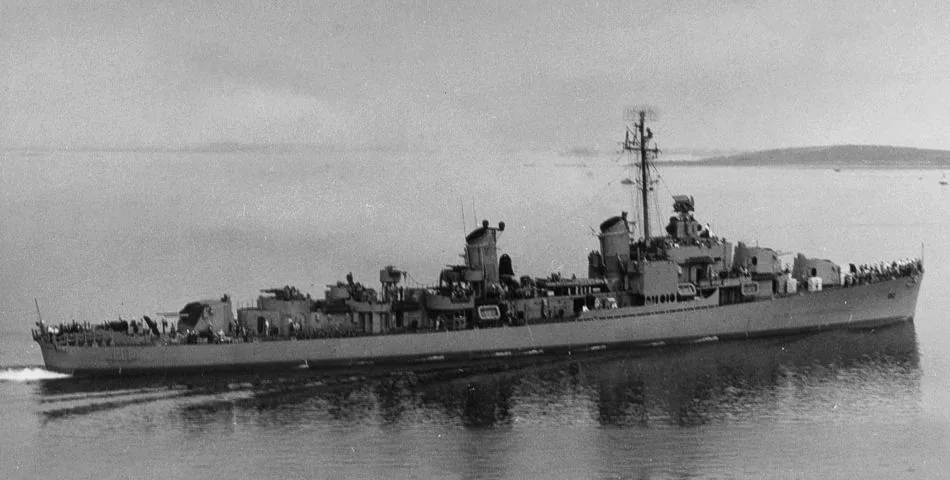
- Photograph USS Leonard F. Mason (DD-852) underway c1946 USN — Official U.S. Navy Bureau of Ships photo 19-N-98430 available at Destroyerhistory.org — Public domain — Wikimedia Commons
- Photograph USS Rupertus (DD-851) and USS Leonard F. Mason (DD-852) at Cebu c1949 U.S. Navy — U.S. Navy All Hands magazine March 1950 , p. 2 — Public domain — Wikimedia Commons