United States Navy — Aircraft carrier
USS Leyte (CV-32) — service history
This is the full service history. For the vessel's particulars, photograph and specifications, see the entry.
In the words of the US Navy. The account below is reproduced verbatim from the Dictionary of American Naval Fighting Ships, compiled by the Naval History and Heritage Command — a work of the United States Government, in the public domain, and the only text on this site not written here.
Second World War 1939–1945
1944
Named for the Battle for Leyte Gulf (23–26 October 1944). The first Leyte retained the name she carried when captured by the Navy, the second was named for the island in the Philippines.
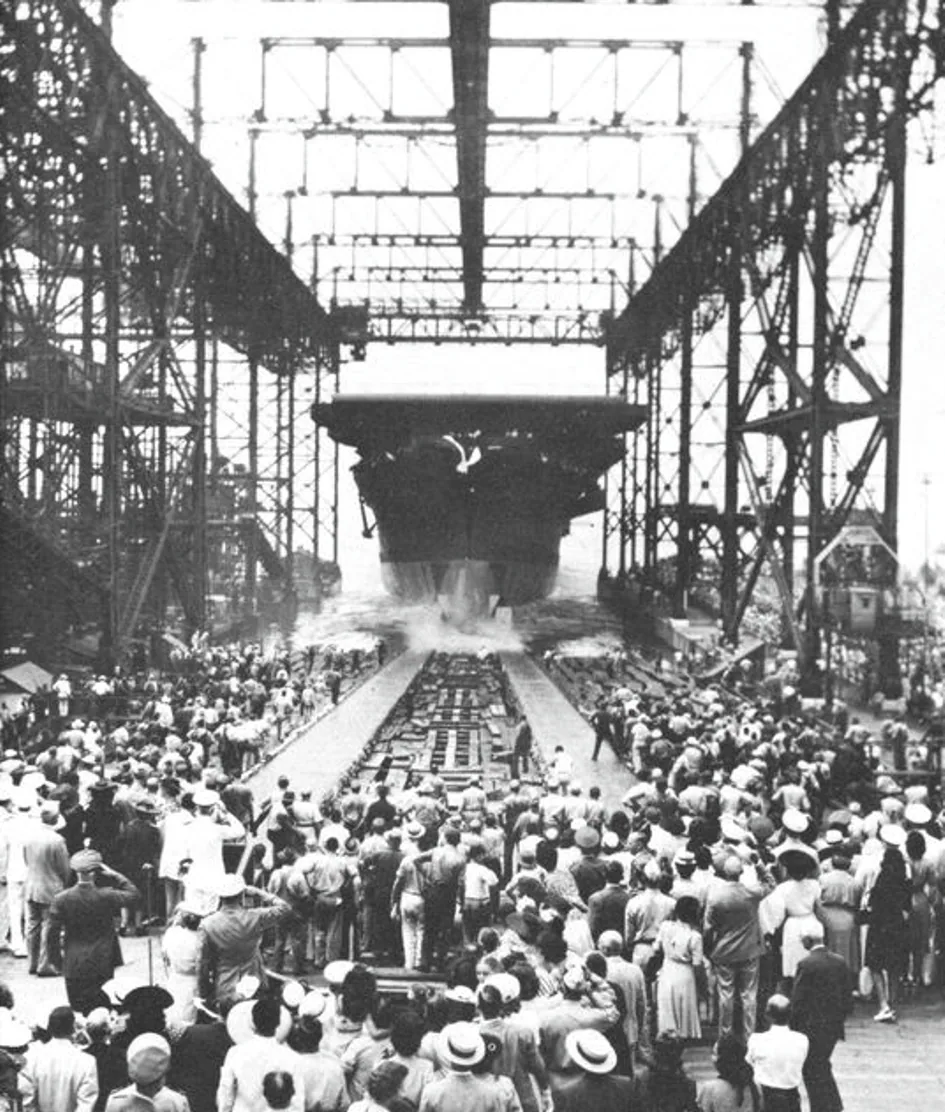
Crown Point (CV-32) was laid down on 21 February 1944, at Newport News, Va., by the Newport News Shipbuilding & Dry Dock Co.; renamed Leyte on 8 May 1945; launched on 23 August 1945; sponsored by Mrs. Alice M. [Dillon] Mead, wife of U.S. Senator James M. Mead, New York (D); and commissioned at the Norfolk Naval Shipyard, Portsmouth, Va., on 11 April 1946, Capt. Henry F. MacComsey in command.
Post-war 1946–1949
1946
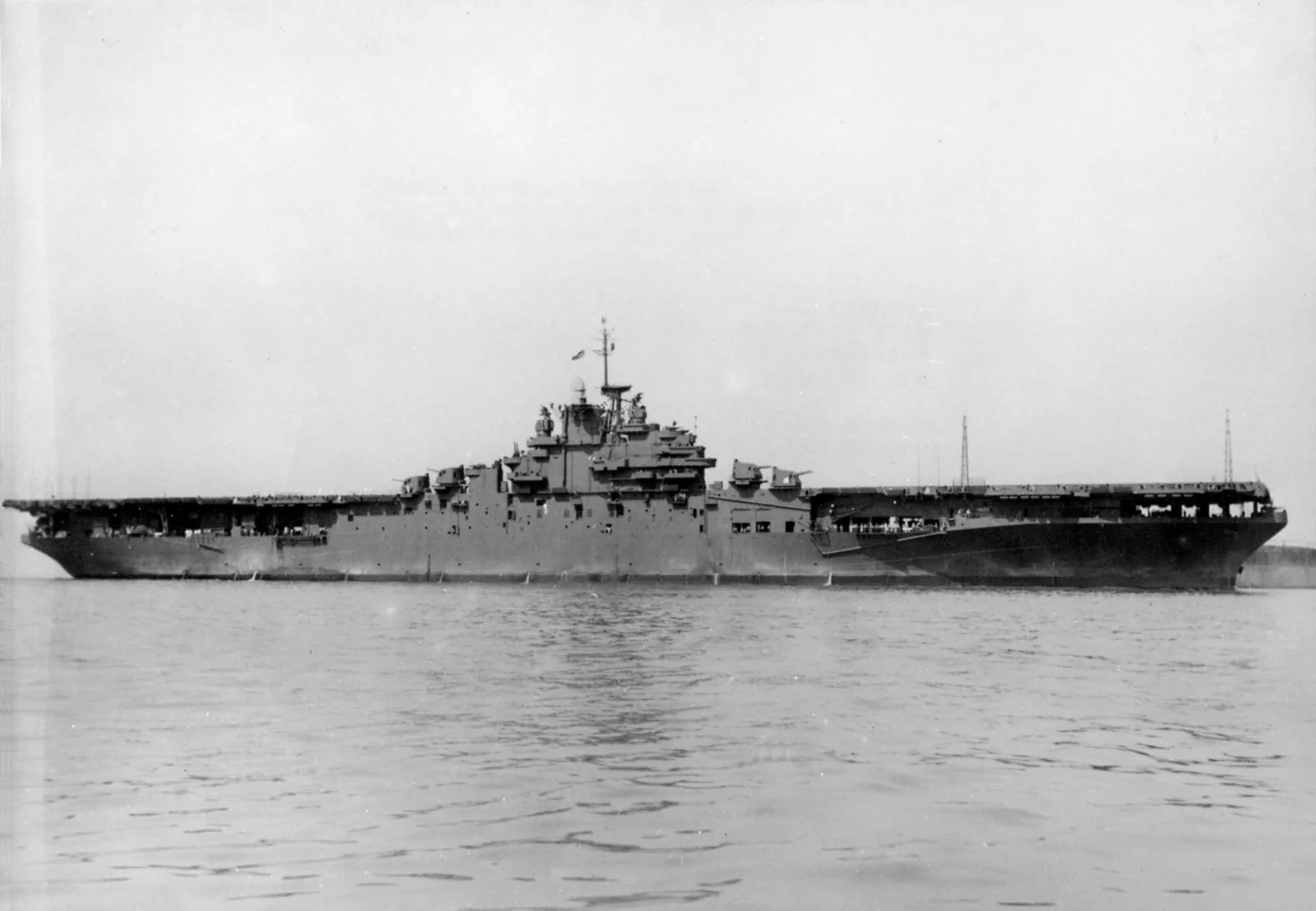
Personnel shortages having impacting the Navy’s being able to fully man its ships delayed Leyte from carrying out her shakedown, but she ultimately departed Hampton Roads, Va., on 30 August 1946 for Quonset Point, R.I., where she embarked Carrier Air Group (CVG) 18. After embarkation, she carried out her carrier qualification landings, then shaped a course for Cuba.
She arrived at Guantanamo Bay, Cuba, on 16 September 1946, for shakedown training and then transited the Panama Canal on 20 October, to join the battleship Wisconsin (BB-64) on a good will cruise down the western seaboard of South America. After embarking the Surgeon General of the Chilean Army at Balboa, Chile, she proceeded to Valparaiso, Chile. Her officers and bluejackets attended the Presidential inauguration of President Gabriel Gonzales Videla in Santiago, Chile, before she paid a goodwill call to Callao, Peru. She again transited the Panama Canal on 18 November 1946, to resume shakedown operations that took her to the waters of Cuba and the U.S. Virgin Islands. She stood into Yorktown, Va., on 12 December.
1947 Operation Frigid
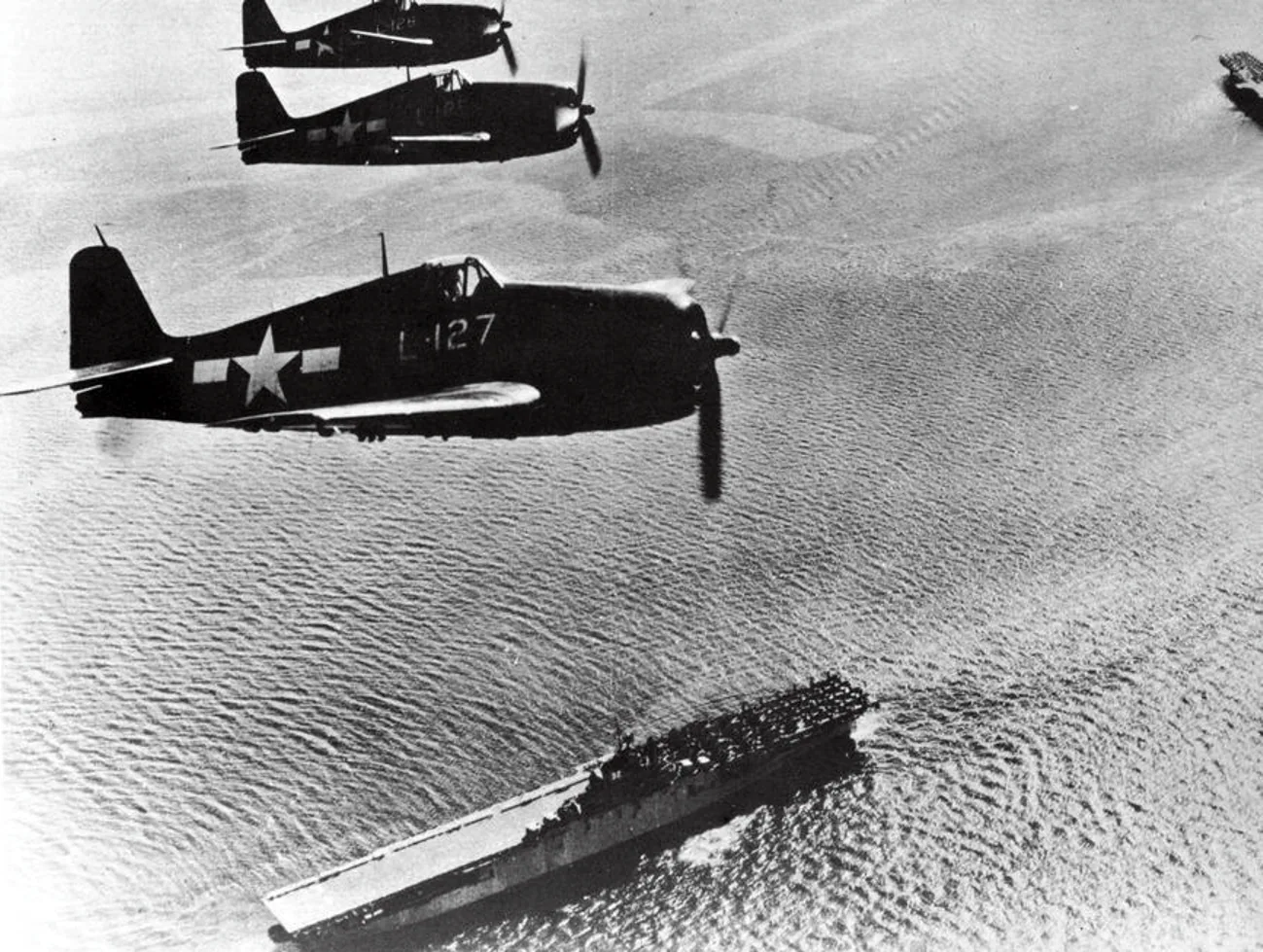
On 30 January 1947, the Greek government proclaimed martial law in response to the rising threat posed by communist insurgents during the Greek Civil War. On 21 February, the British announced the reduction of their forces deployed to the eastern Mediterranean Sea and the withdrawal of military assistance to the Greeks and Turks effective on 1 April. U.S. intervention against communist expansionism in the ensuing power vacuum saw Leyte , as flagship of Carrier Division (CarDiv) 4, deployed to the Mediterranean from 3 April to 9 June 1947. This deployment saw a visit by Leyte to Greece, on 16 April, as a show of support for that country’s government.
Shortly afterward, again as a result of ongoing Soviet pressure, this time against Turkey, and the British withdrawal from the eastern Mediterranean, U.S. ships including Leyte made a show of support for the Turkish government during a week-long visit to Istanbul beginning on 2 May. She also made port visits to Alexandria, Egypt, Naples, Italy, and Gibraltar. After a brief return to the United States, Leyte again deployed to the Mediterranean (30 July–19 November 1947). During this second cruise, she made port visits to Gibraltar; Algiers, Algeria; Golfe Juan, France; Izmir, Turkey; Naples; Taranto, Italy; and Athens, Greece. Upon her return to the U.S. she underwent a period of maintenance, then conducted fleet exercises and training of Naval Reservists in the United States and Caribbean. She went back to sea in February 1948 for fleet maneuvers in the Caribbean, during which she made port visits to Trinidad and Tobago and Panama. Leyte returned to the U.S. and entered New York Naval Shipyard and underwent four months of regular inspection and overhaul. Leaving the yard on 28 August, the ship spent two weeks in the waters around Guantanamo Bay, and then steamed to the frigid climes of the Davis Strait between Greenland and Canada to conduct cold weather flying tests in Operation Frigid.
1949 Operation Portrex
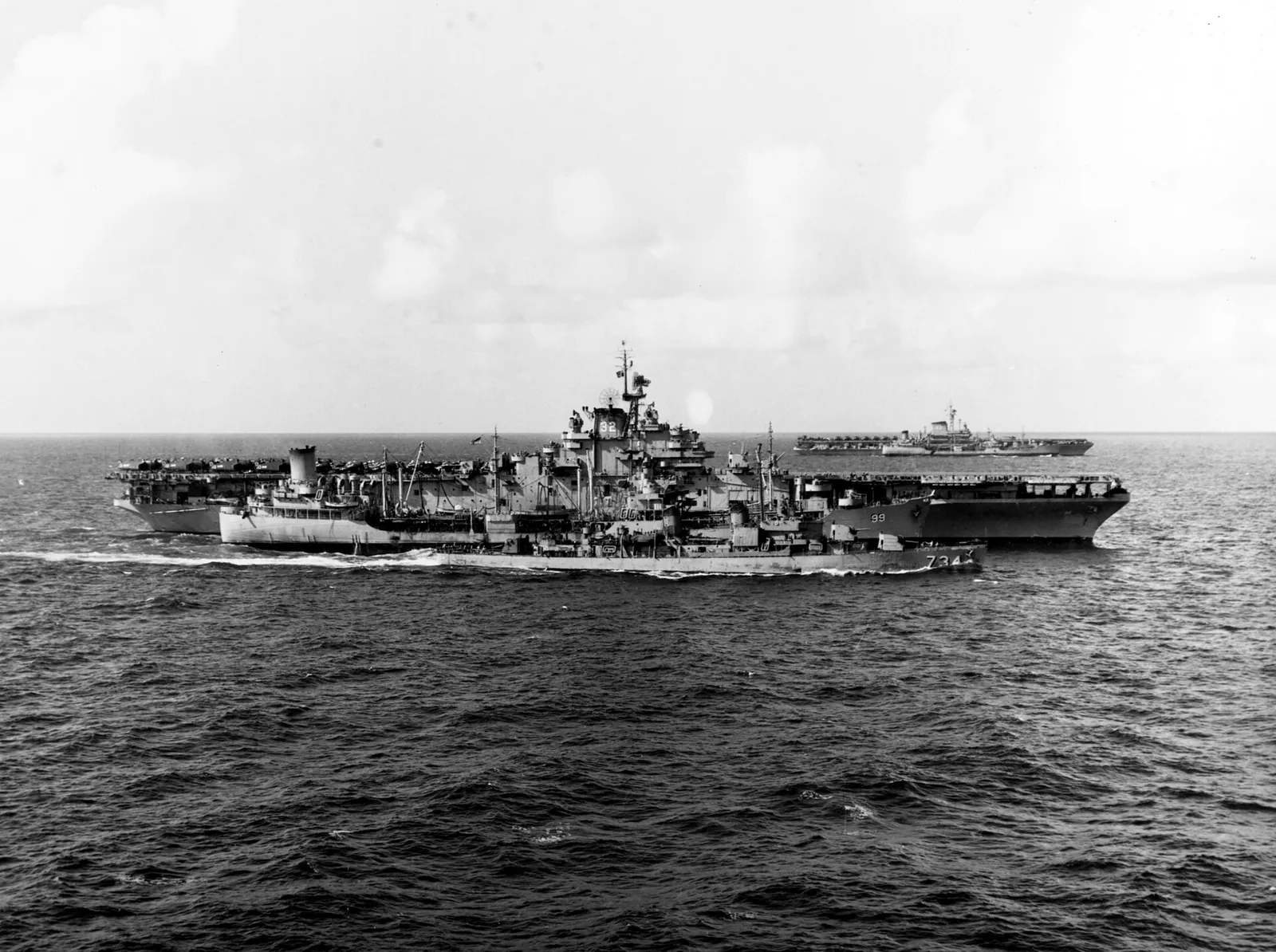
Leyte , in January 1949, returned to the Caribbean and operated in the vicinity of Guantanamo Bay with 700 Naval Reservists embarked for a brief indoctrination cruise.
During the next two months, she conducted fleet maneuvers and made port visits to Trinidad and Tobago. After a short visit to New York, she returned to Quonset Point. She visited the U.S. Naval Academy at Annapolis, Md. for a week in May and then spent the next six weeks conducting visits to Bayonne, N.J. and Norfolk, Va. before returning to Quonset Point. From 7-25 July, she conducted two short cruises for Naval Academy and Naval Reserve Officer Training Candidate (NROTC) midshipmen out of Newport, R.I. and then spent the month of August at Quonset Point, painting ship and taking on supplies for her third Mediterranean deployment (6 September 1949–26 January 1950). During February–March 1950, Leyte participated in Operation Portrex off Puerto Rico and then returned to Norfolk for an accelerated three-week overhaul.
Korean War period 1950–1953
1950
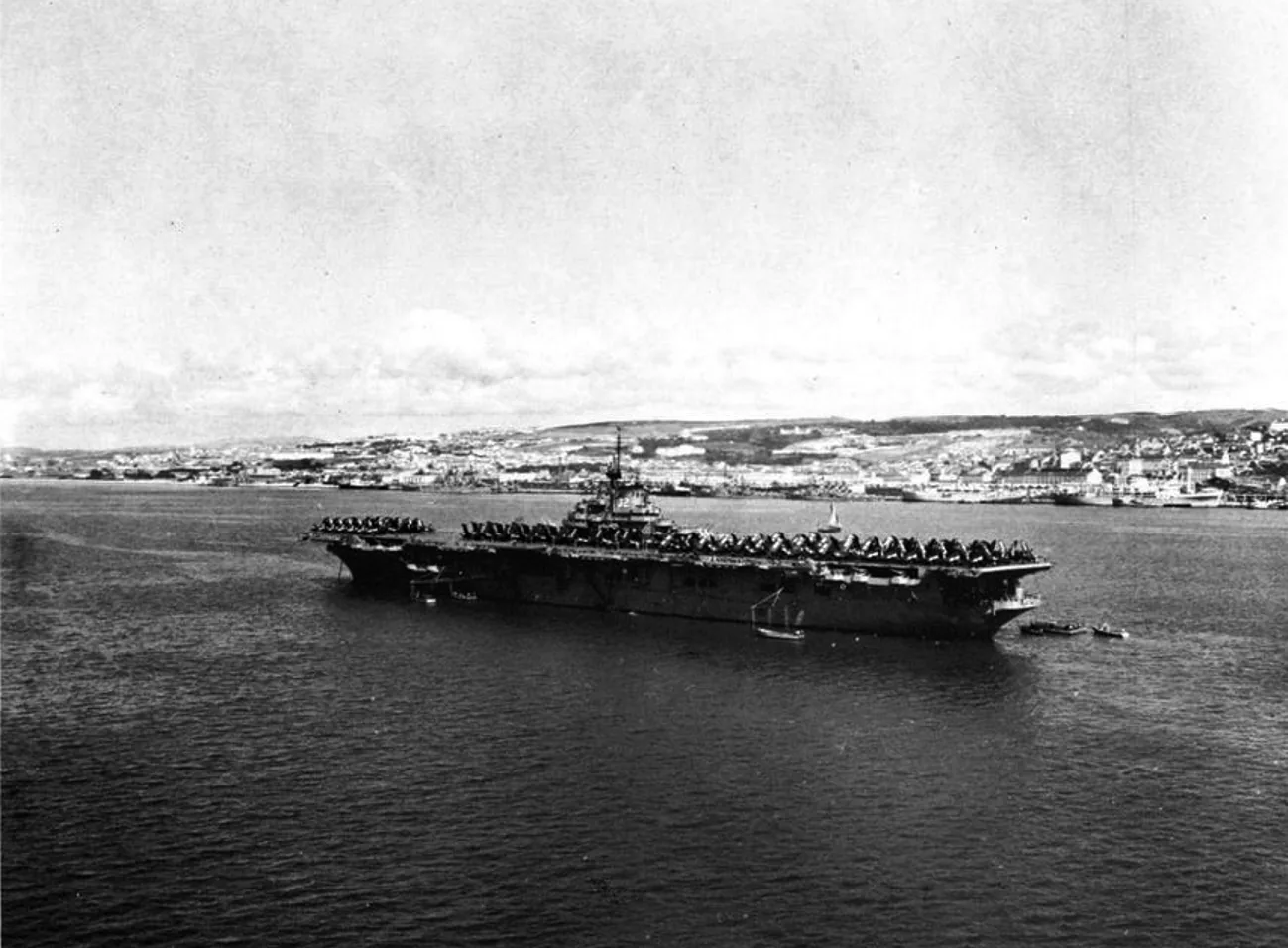
Leyte made a fourth deployment in her short career to the Mediterranean from 2 May–24 August 1950. She made port visits to Lisbon, Portugal; Augusta Bay, Italy; Naples, Leghorn, Italy, the French Riviera, Athens; Greece; Izmir; and Beirut, Lebanon.
While visiting Beirut, Leyte and Midway (CVB-41), at the request of the Lebanese government, launched a demonstration of U.S. air power over the Lebanese capital on 14 August, as further evidence of the U.S. support against communism in the Middle East. While off Beirut, the ship received word that she was needed to support United Nations forces in Korea. She hurried to Norfolk where she stood in to port on 24 August. After 15 days of preparations, she cleared Hampton Roads on 6 September bound for the western Pacific. Leyte maintained an average speed of 23 knots on the fast voyage via the Panama Canal to join the Fast Carrier Task Force (TF) 77 in the Far East.
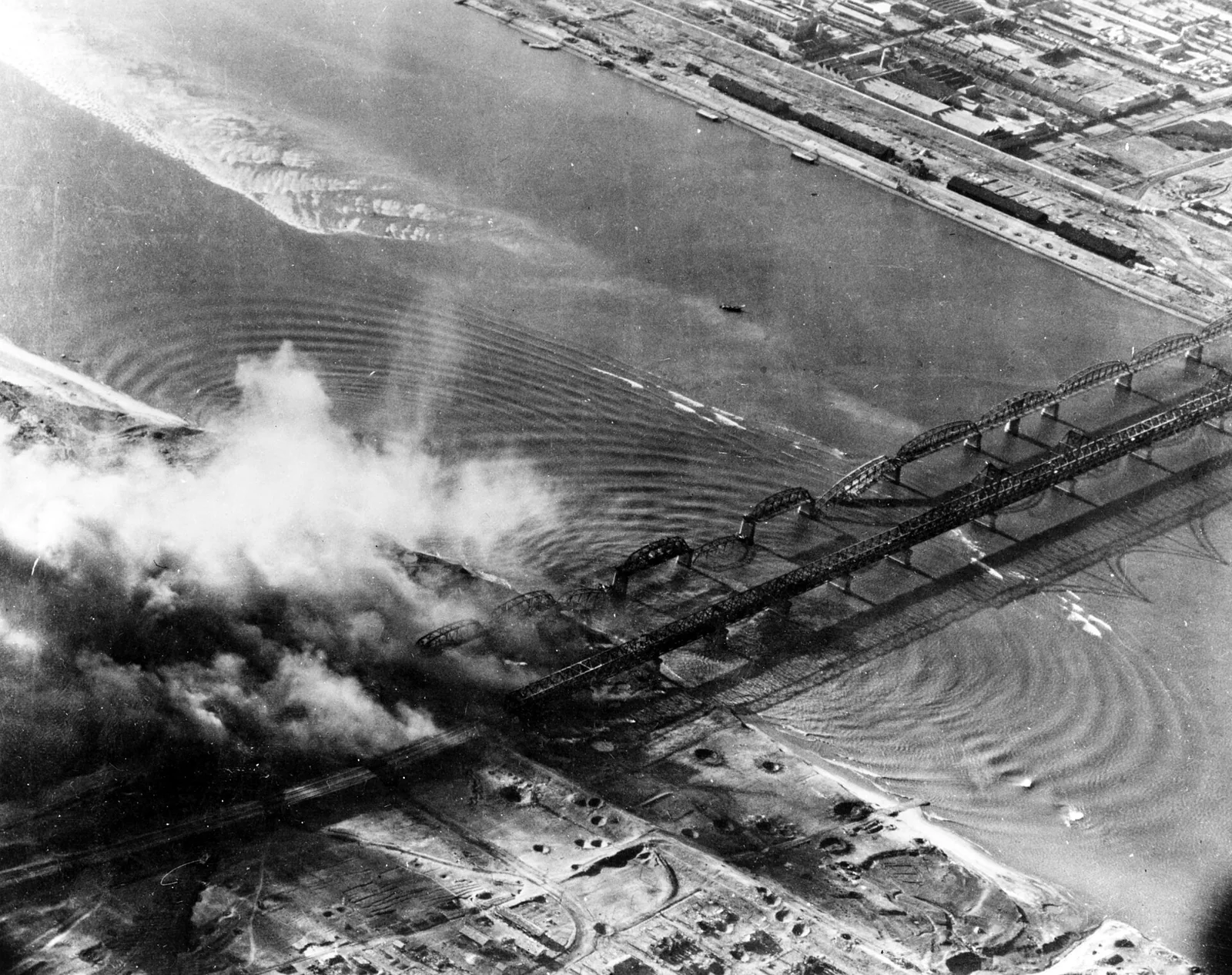
Leyte arrived at Sasebo, Japan, on 8 October 1950 and after reporting to Commander, Seventh Fleet, was engaged in combat operations the next day. From 9 October 1950 through 19 January 1951, the ship and her aircraft spent 92 days at sea and flew 3,933 sorties against North Korean targets. Her first strikes against targets in Korea were in support of landing operations around Wonsan. In the course of her deployment, Leyte ’s pilots accumulated 11,000 hours in the air while inflicting massive damage upon enemy positions, supplies, transportation, and communications. Having supported the Wonsan operations in October, her squadrons conducted bombing raids against the bridges over the Yalu River between North Korea and China.
Ens. Frederick C. Weber of Leyte ’s VF-31 piloted a Grumman F9F-2 Panther credited with one of the first kills of a MiG-15 fighter on 18 November 1950.
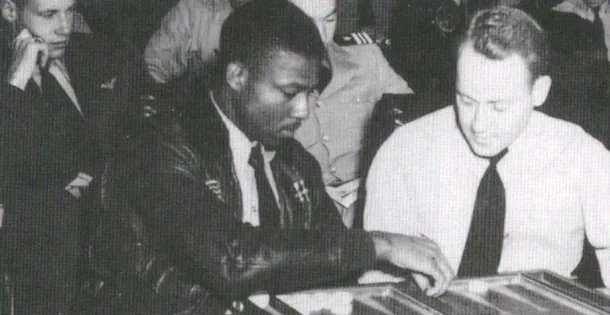
Of particular note, on 4 December 1950, Ens. Jesse L. Brown of VF-32 -- the first African American to complete the Navy’s basic flight training program for pilot qualification and to be designated a naval aviator -- embarked on board Leyte. Brown flew a Vought F4U-4 Corsair over Hagaru-ri, North Korea, in close support of the hard-pressed Marine Corps and Army forces around the Chosin Reservoir [Changjin Lake]. Antiaircraft fire struck the Corsair , forcing Brown to make an emergency landing beyond Chosin. In gathering darkness and falling temperatures, Lt. (j.g.) Thomas J. Hudner, his wingman, circled Brown to “protect him from enemy troops infesting the area.” Next, “fully aware of the extreme danger in landing on the rough mountainous terrain and the scant hope of escape or survival in subzero temperature,” Hudner made a wheels-up landing nearby. Working against time, Hudner attempted to pull Brown from the burning wreck. With the buckled fuselage trapping the pilot’s legs, Hudner packed snow around Brown to protect him from the flames and returned to his plane to radio for a rescue helicopter equipped with an axe and a fire extinguisher. A Sikorsky HO3S-1 from Marine Observation Squadron (VMO) 6, flown by 1st Lt. Charles C. Ward, USMC, responded but after repeated unsuccessful attempts by both men to free Brown, had to leave him with the onset of nightfall. Brown, unfortunately, died, but Ward rescued Hudner, who subsequently received the Medal of Honor for his attempt to rescue his wingman. Ward received the Silver Star for his volunteering for the rescue flight although he knew full well the hazards of the mission that would need to be carried out in gathering darkness.
Leyte , having provided close air support for operations around the Chosin Reservoir, also assisted with retrograde and evacuation operations around Hungnam, North Korea. She was at Sasebo (26 December 1950–7 January 1951) and then returned to Korean waters to help U.S. Army units hold the strategic town of Wonju in central Korea. She was detached from the Seventh Fleet on 19 January 1951 and ordered to return to the U.S. Steaming back home, Leyte returned to the Norfolk Naval Shipyard for overhaul, steaming via San Diego, Calif. (3 February) and the Panama Canal, on 25 February.
1951
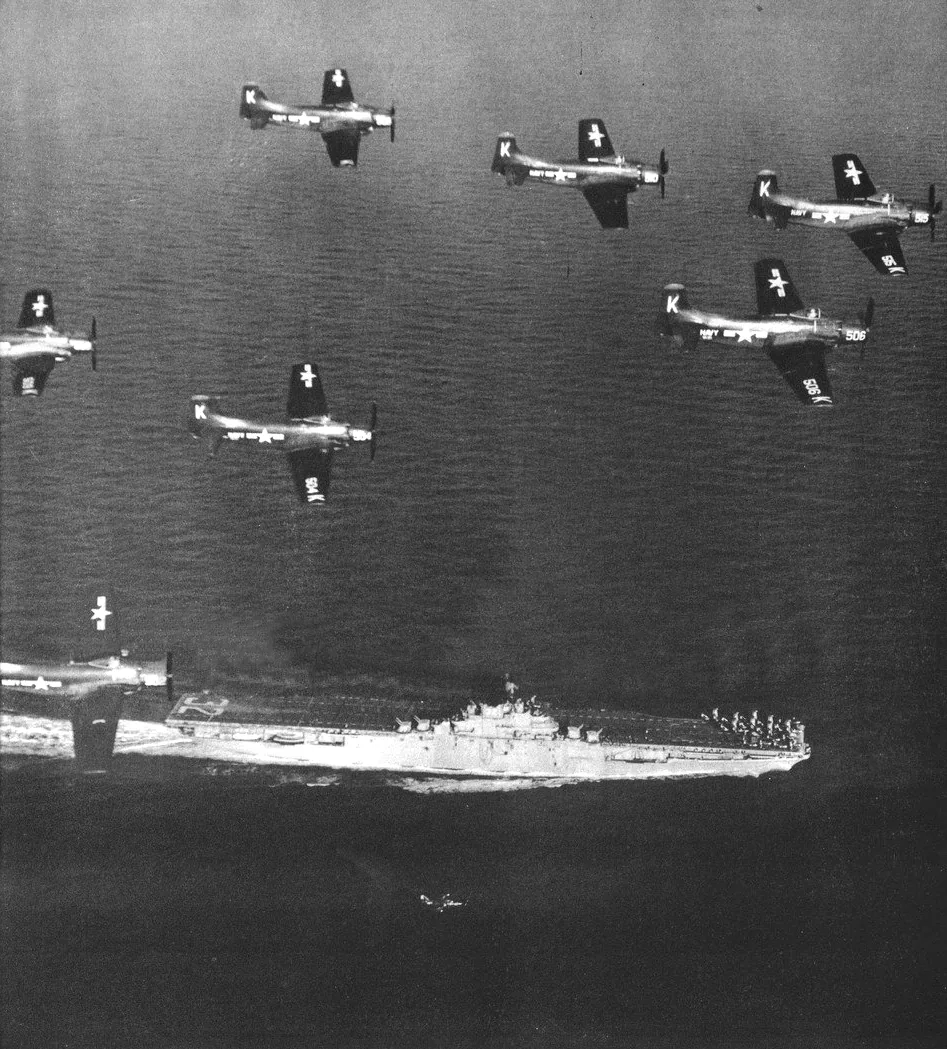
With her repairs complete, Leyte conducted six weeks of fleet training exercises in the Caribbean which terminated at Norfolk on 21 August 1951. She departed for a return to the Mediterranean, her fifth deployment, on 3 September. Leyte completed her duty with the Sixth Fleet and returned to Norfolk on 21 December to conduct operations out of Hampton Roads. Prior to steaming again for the Mediterranean on 29 August 1952, she was redesignated CVA-32. This sixth deployment lasted through the New Year during which she was again redesignated, this time as CVA-32. With her sixth Mediterranean deployment completed, she returned to the U.S. at the Boston Naval Shipyard on 16 February 1953 in preparation for her expected deactivation.
1953
On 8 July 1953, however, the designation Anti-Submarine Support Aircraft Carrier (CVS) was established for attack carriers assigned to hunt submarines. The decision became effective on 8 August, and from this date, the five assigned carriers, not all operational, were redesignated Leyte (CVS-32), Enterprise (CVS-6), Franklin (CVS-13), Bunker Hill (CVS-17), and Antietam (CVS-36). Ordered to be retained in the active fleet; and, redesignated CVS-32 on the same day, work was begun converting her to an ASW support carrier.
On 15 October 1953, at 1515, while still under conversion, Leyte suffered an explosion in her port catapult machinery room. Within minutes, naval base and city fire trucks were on the scene. After a hard and gallant fight, where acts of heroism were legion, the fire was extinguished at 1957. As a result of the fire, 37 men died and 28 were injured, the number including civilian workmen who were on board when the fire began.
Cold War 1954–1963
1954
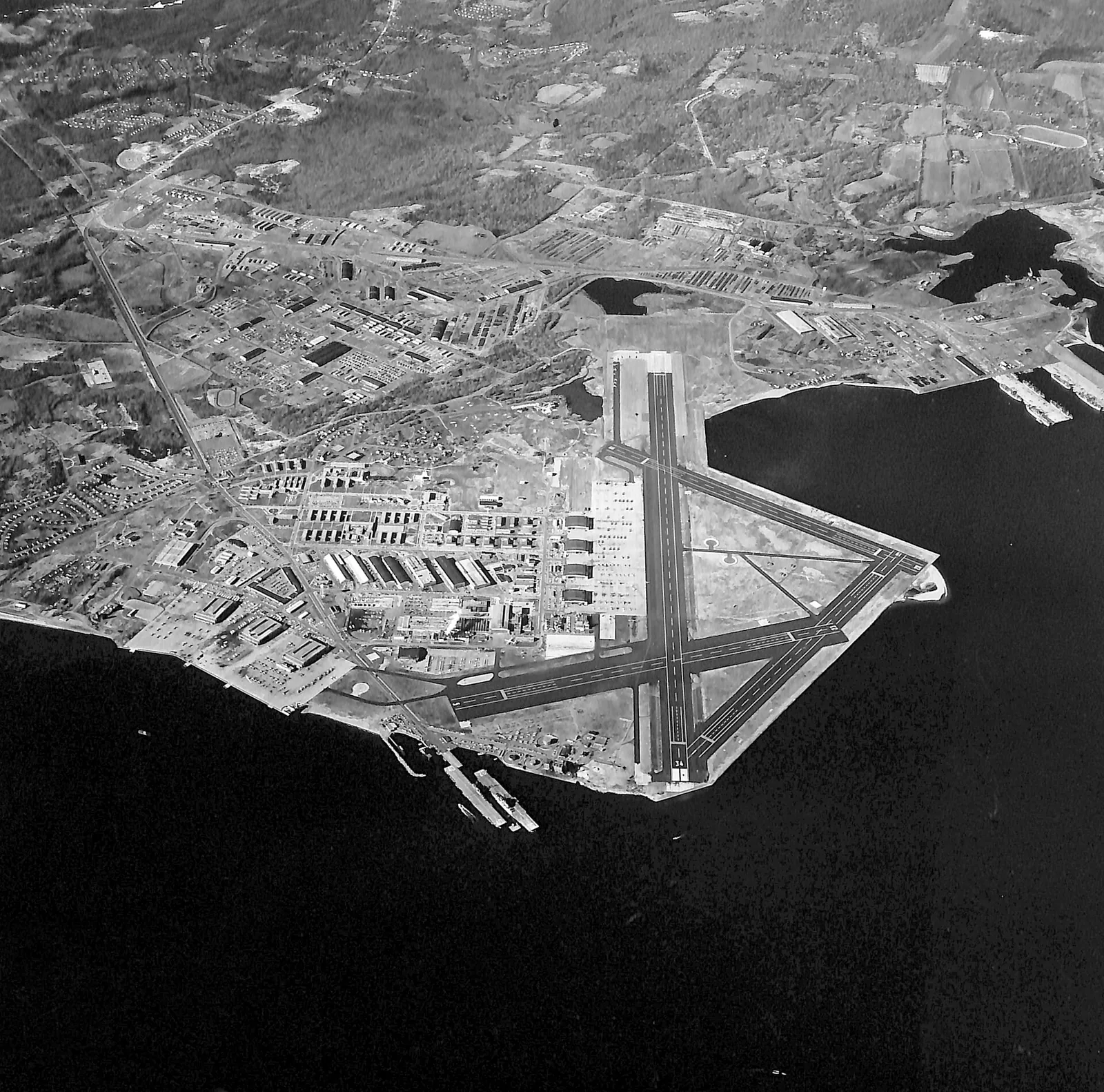
Leyte ’s conversion was completed on 4 January 1954, and she thus became the initial operational antisubmarine warfare carrier. After refresher training based on Guantanamo Bay, Leyte took part in the Atlantic Fleet’s spring training exercises in the Caribbean and conducted the convoy exercise New Broom III to Lisbon, Portugal. She also introduced the then new Grumman S2F Tracker antisubmarine type aircraft to the fleet while playing the role as the nucleus of a hunter-killer force comprising herself, as flagship, her embarked air groups, and an escorting squadron of destroyers.
1956
Leyte departed Quonset Point on 5 January 1956 and steamed to New York. Entering the yard on 8 January she underwent a maintenance availability until 21 June. After returning to Quonset Point on 22 June, she departed on 5 July for the Caribbean to conduct training. She returned to Quonset Point on 30 August. Later in the year she served as the flagship for Task Group 81.4 conducting antisubmarine patrols in the North Atlantic through the end of November. Having returned to Quonset Point, she remained there through the end of the year.
1958
Leyte ’s proficiency in antisubmarine warfare (ASW) was recognized in August 1958 when she received the Battle “E” Award as the outstanding ship of her class. Throughout most of her service as an antisubmarine warfare support aircraft carrier, she served as the CarDiv 18 flagship. Operating out of Quonset Point, with her hunter-killer force, she carried out a constant schedule of ASW tactics training with U.S. submarines based from New London, Conn., in areas along the U.S. eastern seaboard and into the Caribbean. On Saturday, 27 December 1958, Lt. (j.g.) Charles G. Lukitsch, of VS-30, carried out the last operational landing on board Leyte , the ship’s 69,700th.
1959
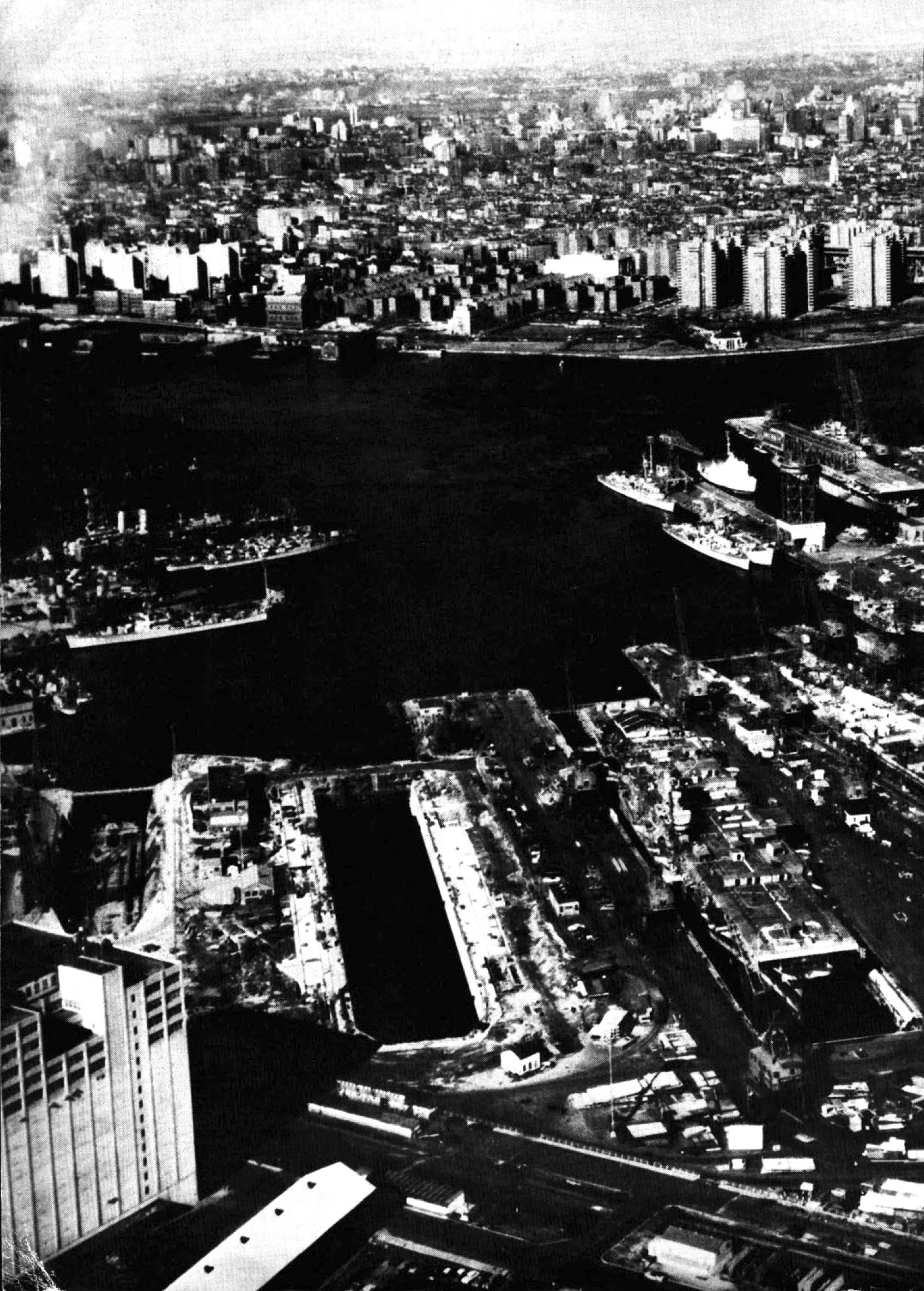
Leyte departed Quonset Point in January 1959 for the New York Naval Shipyard, where she commenced pre-inactivation overhaul. She was decommissioned at New York on 15 May 1959 and placed in reserve. That same day, she was redesignated as an auxiliary aircraft transport, AVT-10, a description that “properly describe[d] her mobilization capability in her present configuration.” She was assigned to the Philadelphia group of the Atlantic Reserve Fleet with a berth in New York. Naval Supply Center (NSC), Bayonne, N. J., assumed temporary custody of Leyte and Franklin (AVT-8), the latter having been redesignated as an auxiliary aircraft transport as well, on 25 August 1962.
Vietnam War period 1964–1975
1969
Having been moved to the graving dock at the Military Ocean Terminal (MOT) (formerly the Naval Supply Center), Bayonne, Leyte underwent an inspection by a sub-board of inspection and survey (3-6 March 1969) that found her “unfit for further service.” The sub-board recommended, on 12 March 1969, that the ship be stricken from the Naval Vessel Register (NVR).
Consequently, Leyte was stricken from the NVR on 1 June 1969. Although the ship was offered to the city of Pensacola, Fla., to serve as a memorial, various circumstances compelled the city to refuse the Navy’s offer. The removal of her machinery and equipment was completed on 20 February 1970. She was sold at public sale to the Portsmouth Salvage Co., Chesapeake, Va., for scrapping on 4 August 1970. Turned over to the purchaser, the ship was removed from the MOT and naval custody at 2210 on 24 September 1970 and began her last voyage to the breakers’ yard.
Leyte received a Navy Unit Commendation (for the period 9 October 1950 to 9 January 1951) and two battle stars for her Korean War service.
Other photographs
Held for this vessel, and not tied to any part of the account above.


References
Every work this entry draws on. There are no numbered markers in the text above: what we hold is the provenance of the page — this history, this article, these photographs.
- History Leyte III (CV-32) Dictionary of American Naval Fighting Ships, Naval History and Heritage Command. A work of the United States Government, in the public domain — the only text on this site reproduced verbatim.
- Facts USS Leyte (CV-32) Structured facts only — dates, dimensions, armament and fate. No wording is taken from it. Harvested 1 August 2026.
- Photograph USS Leyte (CV-32) with F9Fs U.S. Navy — U.S. Navy National Museum of Naval Aviation photo No. 1999.272.027 [1] — Public domain — Wikimedia Commons
- Photograph USS Leyte (CV-32) in 1946 U.S. Navy — U.S. Navy National Museum of Naval Aviation photo No. 1996.488.195.001 — Public domain — Wikimedia Commons
- Photograph USN Ens Jesse L. Brown USS Leyte (CV-32) National Archives photo NA 80-G-377908 — Scanned from Alexander, Joseph H., Fleet Operations in a Mobile War: September 1950-June 1951 , Washington, D.C.: Naval Historical Center, Department of the Navy, ISBN 0-16-050905-X , 2001, p. 38 — Public domain — Wikimedia Commons
- Photograph AD-4 Skyraiders of VA-35 fly over USS Leyte (CV-32) in 1951 U.S. Navy — U.S. Navy photo [1] from the USS Leyte (CV-32) 1951 cruise book available at Navysite.de — Public domain — Wikimedia Commons
- Photograph Aerial view of Brooklyn Navy Yard c1959 USN — U.S. Navy All Hands magazine May 1959 , p. 1 — Public domain — Wikimedia Commons
- Photograph Aerial view of the U.S. Naval Air Station Quonset Point, Rhode Island (USA), in the 1950s (89570480) U.S. Navy — Public domain — Wikimedia Commons
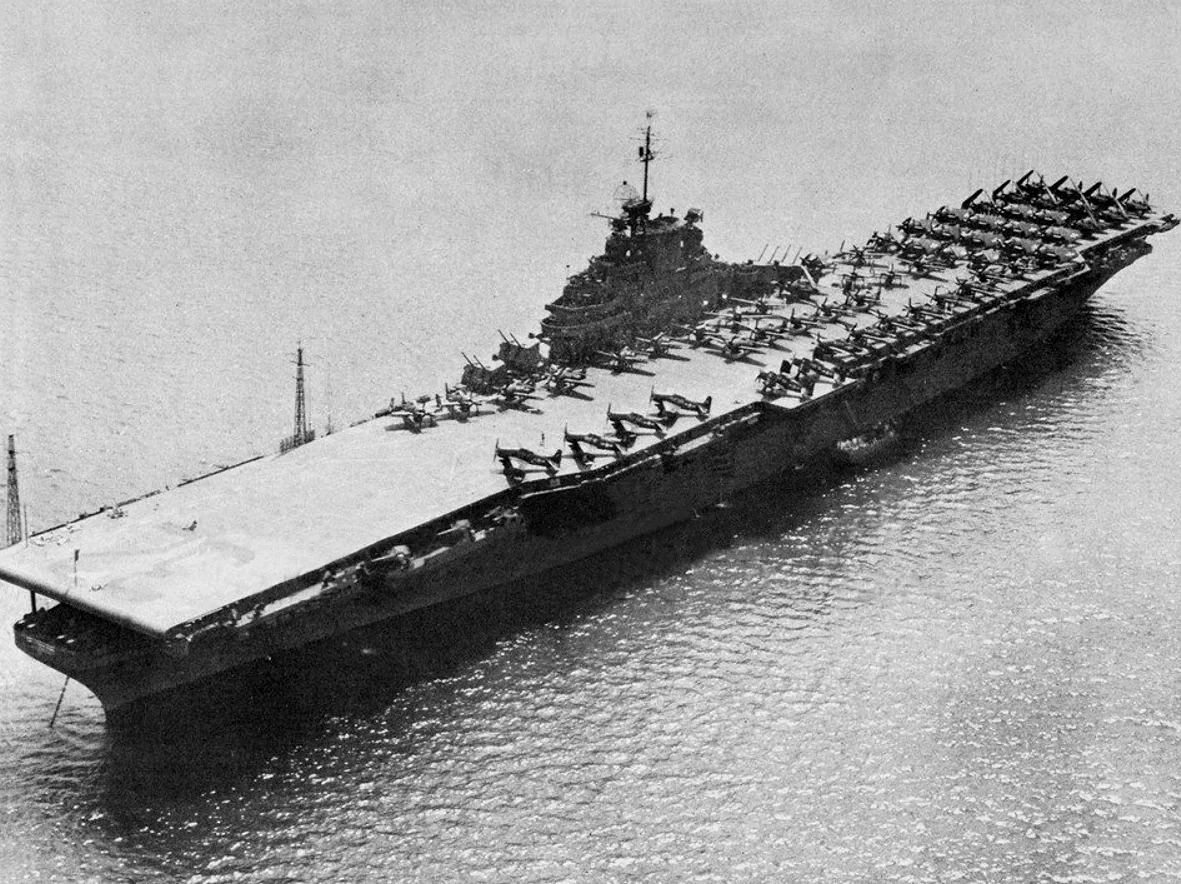
- Photograph Aft view of USS Leyte (CVS-32) c1957 U.S. Navy — U.S. Navy photo [1] from the USS Leyte (CVS-32) 1956-1957 cruise book available at Navysite.de — Public domain — Wikimedia Commons
- Photograph Aircraft carriers at Sasebo Japan 1950 U.S. Navy — U.S. Navy National Museum of Naval Aviation photo No. 1999.272.030 [1] — Public domain — Wikimedia Commons
- Photograph Attacks on Yalu River Bridges, November 1950 (51508694206) tormentor4555 — Attacks on Yalu River Bridges, November 1950 — Public domain — Wikimedia Commons
- Photograph Grumman F6F-5P Hellcats of VF-7A fly over USS Leyte (CV-32), circa in 1947 U.S. Navy — U.S. Navy photo [1] from the USS Leyte (CVS-32) 1958-1959 cruise book available at Navysite.de — Public domain — Wikimedia Commons
- Photograph Launch of USS Leyte (CV-32) at Newport News Shipbuilding, Virginia (USA), on 23 August 1945 U.S. Navy — U.S. Navy photo [1] from the USS Leyte (CVS-32) 1958-1959 cruise book available at Navysite.de — Public domain — Wikimedia Commons
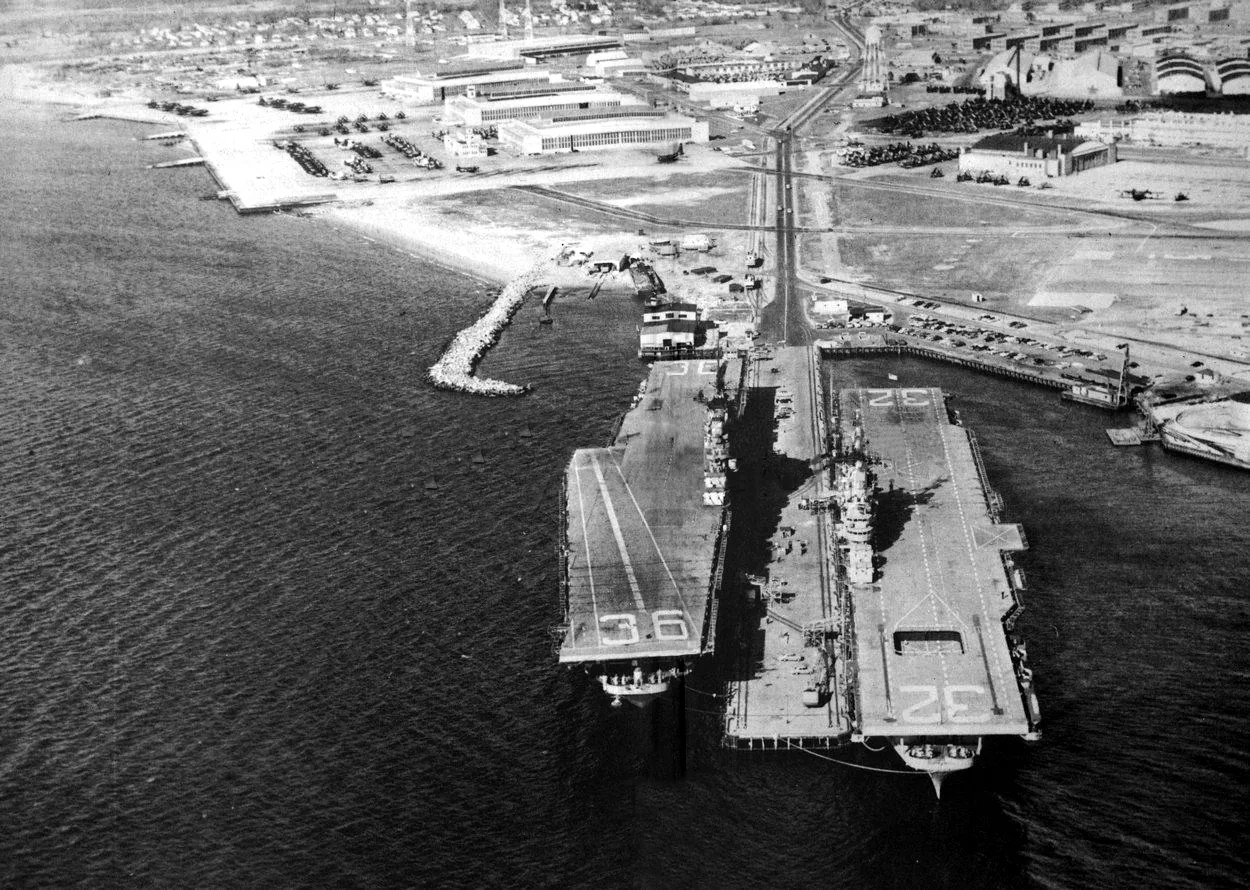
- Photograph USS Antietam (CVS-36) and USS Leyte (CVS-32) at NAS Quonset Point c1954 USN — U.S. Navy photo [1] from the USS Antietam (CVS-36) 1955 cruise book available at Navysite.de — Public domain — Wikimedia Commons
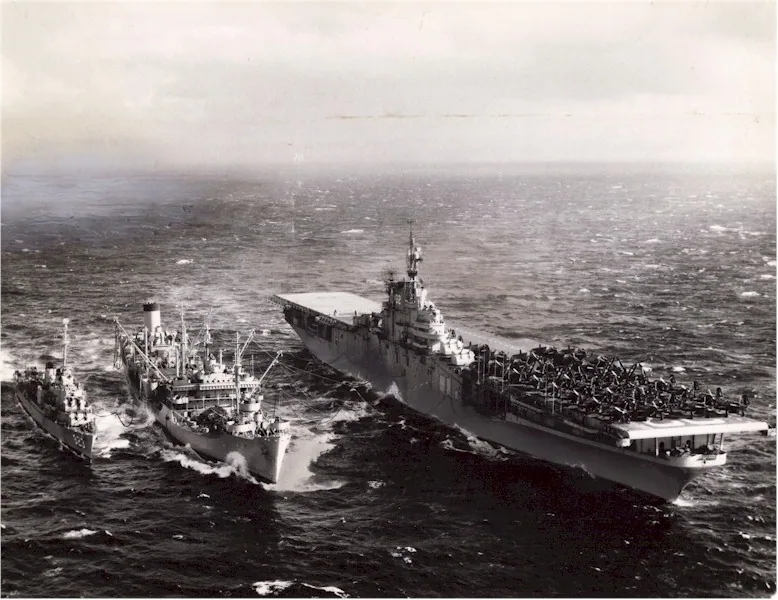
- Photograph USS Caloosahatchee (AO-98) refuels USS Leyte (CV-32) and USS Samuel B. Roberts (DD-823) during Operation Frigid on 20 November 1948 U.S. Navy — U.S. Navy photo [1] from Navsource.org — Public domain — Wikimedia Commons
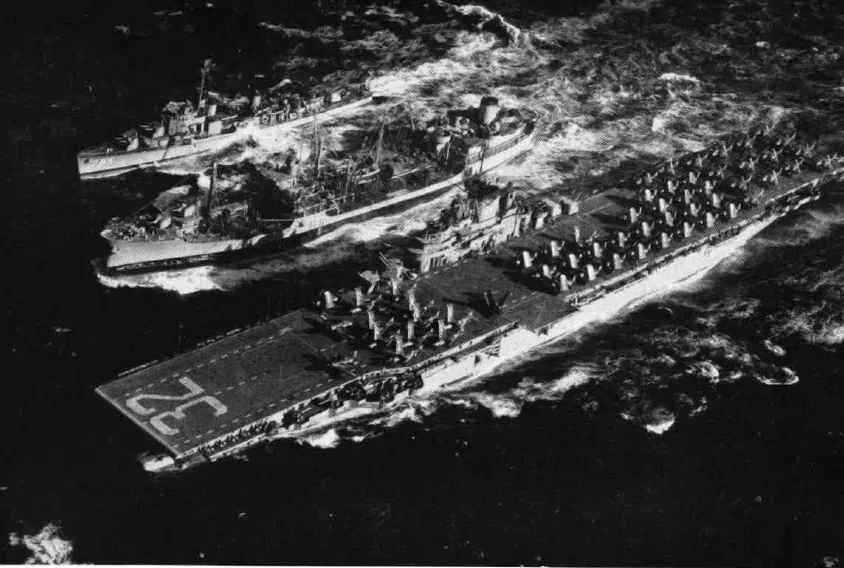
- Photograph USS Canisteo (AO-99) refuels USS Leyte (CV-32) and USS Purdy (DD-734) in the Atlantic Ocean on 4 March 1949 (80-G-419291) Unknown author — U.S. Navy photo 80-G-419291 — Public domain — Wikimedia Commons
- Photograph USS Leyte (CV-32) and USS Henderson (DD-785) refueling from an oiler off Korea, circa in 1950 USN — U.S. Navy Naval Aviation News October 1951 [1] — Public domain — Wikimedia Commons
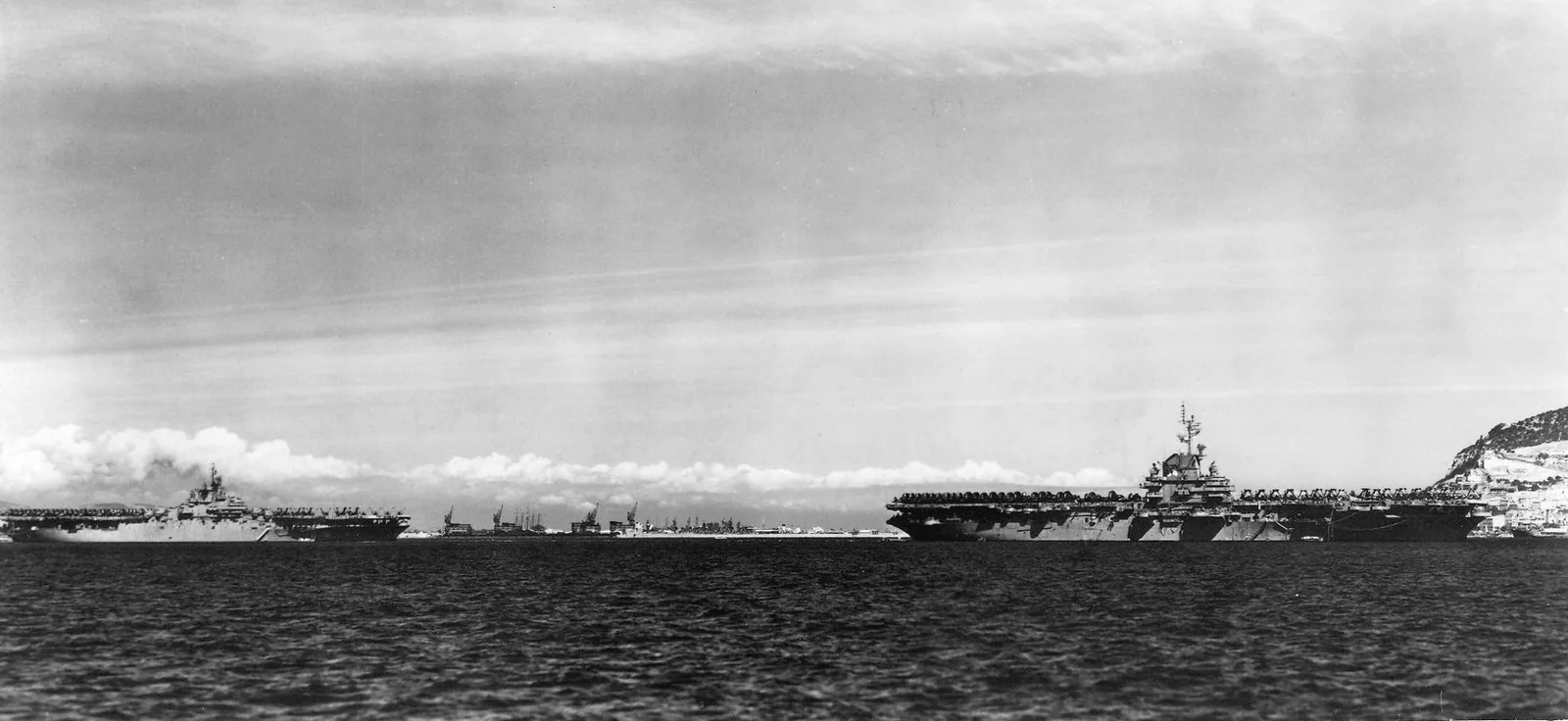
- Photograph USS Leyte (CV-32) and USS Oriskany (CV-34) at Genoa 1951 U.S. Navy — U.S. Navy National Museum of Naval Aviation photo No. 1996.488.195.010 — Public domain — Wikimedia Commons
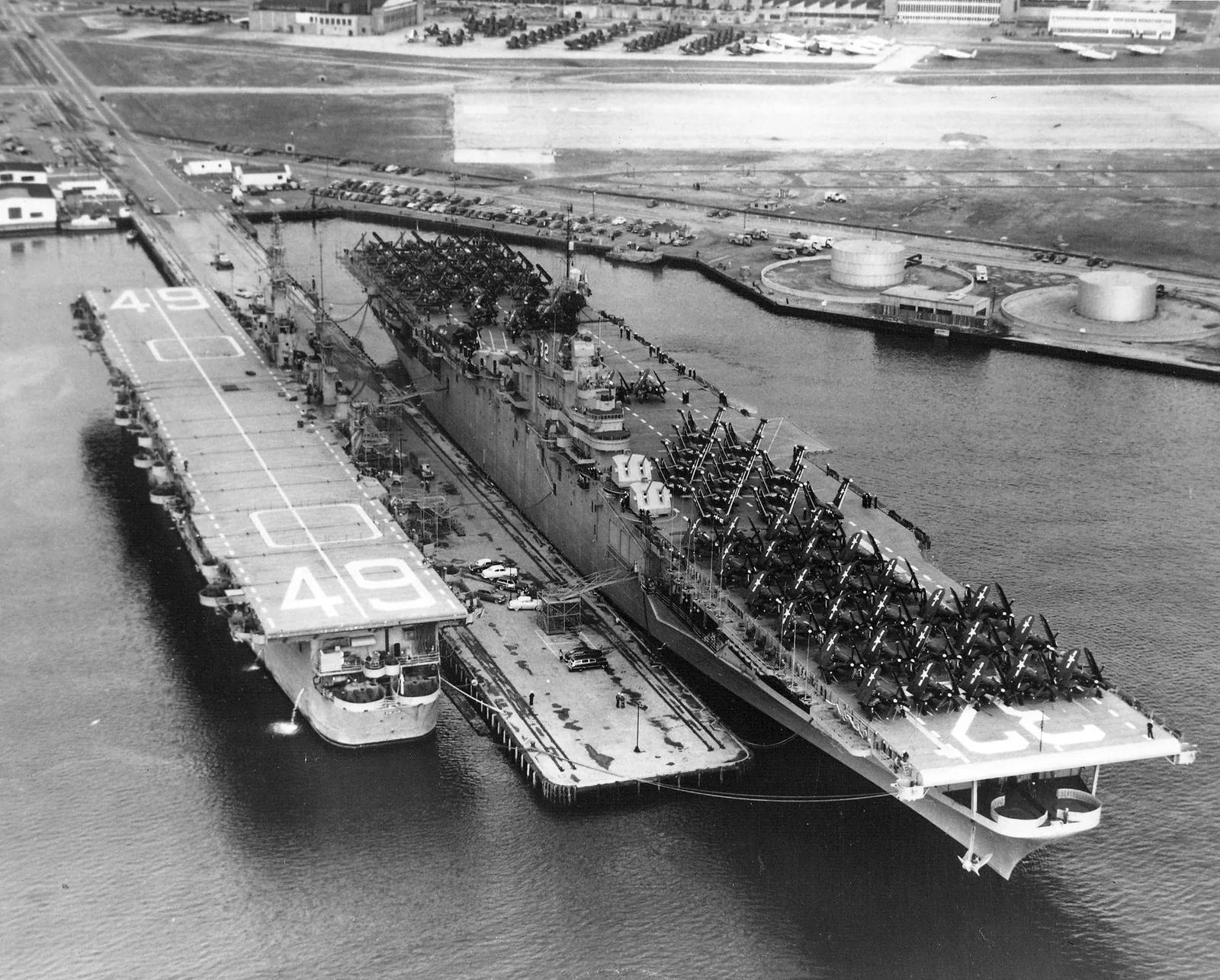
- Photograph USS Leyte (CV-32) and USS Wright (CVL-49) at Quonset Point c1950 U.S. Navy — U.S. Navy National Museum of Naval Aviation photo No. 1996.488.195.006 — Public domain — Wikimedia Commons
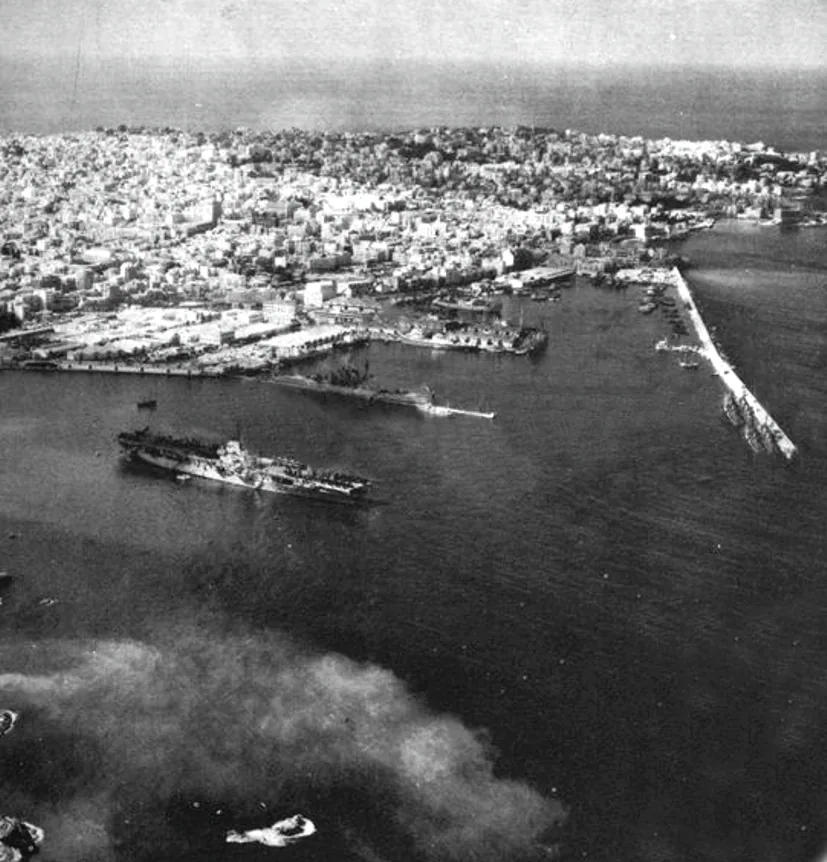
- Photograph USS Leyte (CV-32) at anchor at Beirut, Lebanon, in August 1950 U.S. Navy — U.S. Navy photo [1] from the USS Leyte (CVS-32) 1958-1959 cruise book available at Navysite.de — Public domain — Wikimedia Commons
- Photograph USS Leyte (CV-32) at anchor at Guantanmo Bay in 1946 U.S. Navy — U.S. Navy photo [1] from the USS Leyte (CV-32) 1946 cruise book available at Navysite.de — Public domain — Wikimedia Commons
- Photograph USS Leyte (CV-32) at anchor at Lisbon, Portugal, in 1950 U.S. Navy — U.S. Navy photo [1] from the USS Leyte (CVS-32) 1958-1959 cruise book available at Navysite.de — Public domain — Wikimedia Commons