United States Navy — Destroyer
USS McCook (DD-496) — service history
This is the full service history. For the vessel's particulars, photograph and specifications, see the entry.
In the words of the US Navy. The account below is reproduced verbatim from the Dictionary of American Naval Fighting Ships, compiled by the Naval History and Heritage Command — a work of the United States Government, in the public domain, and the only text on this site not written here.
Before commissioning
(DD‑496: dp. 1,630; l. 348'3"; b. 36'1"; dr. 17'5"; s. 35 k.; cpl. 276; a. 4 5", 4 40mm., 4 20mm., 5 21" tt., 6 dcp., 2 dct.; cl. Gleaves )
Comdr. Roderick S. McCook, USN, born 10 March 1839 at New Lisbon, Ohio, was appointed midshipman 21 September 1854. From 1859 to 1861 he cruised off the coast of Africa, searching for and capturing slavers. During the Civil War, he served in Minnesota (1861), Stars and Stripes (1862), and Canonicus (1863‑65). As executive officer of latter ship, he participated in operations along the James River and in attacks on and the surrender of Fort Fisher. He was also present at the surrender of Charleston, S.C. (February 1865). From 1866 to 1878 he was in command of vessels of war on the West India and Asiatic stations. His last duty, 1880‑82, was as lighthouse inspector, Ohio River. Promoted to commander 25 September 1873, McCook died at Vineland, N.J., 13 February 1886.
Second World War 1939–1945
1941
The second McCook (DD‑496) was laid down 1 May 1941 at the Seattle‑Tacoma Shipbuilding Corp., Seattle, Wash.; launched 30 April 1942; sponsored by Mrs. Reed Knox, granddaughter of Commander McCook; and commissioned 15 March 1943, Lt. Comdr. S. G. Anderson, in command.
1943
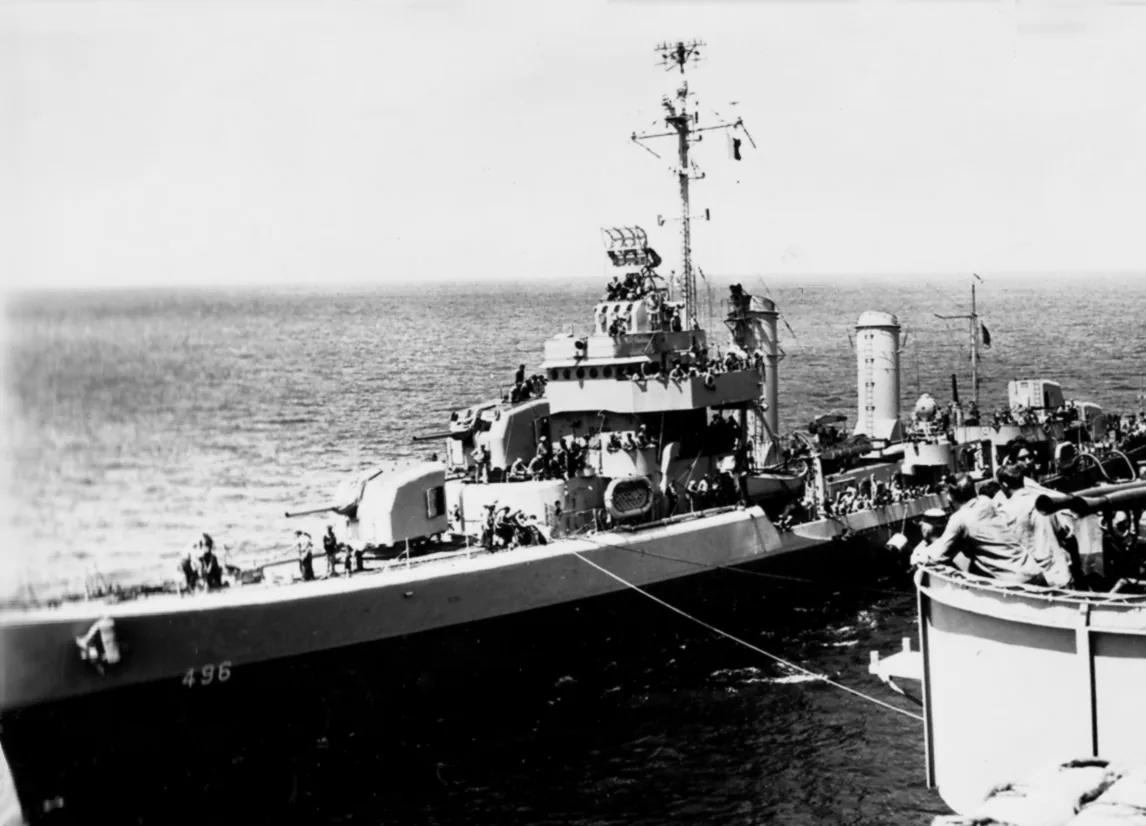
After shakedown out of San Diego, McCook sailed for the east coast 22 May 1943. She reported at Norfolk for duty in the Atlantic Fleet, 6 June, and by the end of the month had begun her first escort assignment, a convoy to Casablanca, departing Norfolk 26 June and returning 17 July. Before the end of the year she completed two more north African convoys, one to the United Kingdom and numerous escort assignments along the northeastern coast. On 15 December, she reported to COTCLANT and spent the next 6 weeks training destroyer crews out of Norfolk. Detached from training duties, McCook resumed escort work 31 January 1944 when she sailed for Trinidad with new carrier Wasp (CV‑8) on her shakedown cruise, returning with her to Boston 27 February.
Further training in antisubmarine and antiaircraft warfare took up much of March as McCook prepared to return to European waters. On 18 April, she joined TG 27.8 and steamed for the United Kingdom, arriving at Plymouth on the 28th. The destroyer continued on to Portland and from there participated in a month of intensive amphibious landing exercises at Slapton Sands and at Belfast.
At Weymouth Roads 28 May McCook was caught in an air raid in which she suffered damage to her radar, sound equipment, rangefinder, and main battery director in addition to having five guns disabled and losing steering control from the bridge. Luckily there were no personnel casualties. The damage threatened to keep her out of the upcoming invasion for which she had been training for the past month. But the fast and efficient craftsmen on board the destroyer tender Melville (AD‑2) quickly had her back in fighting trim.
On 5 June, McCook departed with DesRon 18 and ships of Assault Force "O" for the coast of France. Early 6 June, she arrived in the Bale de la Seine and at 0320 commenced bombardment of the beaches and waterfront of the Point du Hoe‑Vierville Sur Mer area. By 0616 she had neutralized her assigned targets (three pillboxes, 13 machinegun nests and three shore guns) and had begun to take on targets of opportunity. By the end of the day, she had added to her score seven pillboxes, eight gun emplacements and 10 stone houses, in which enemy machine guns and snipers had been placed.
Resupplying and fueling at Portland and Plymouth, McCook continued to operate in the invasion area until 14 July. Four days later she was en route to Bizerte screening a convoy of LSTs and LCIs. She delivered her charges on the 28th and steamed to Mers‑el‑Kebir, where she remained until 4 August. She then sailed to Naples to join the forces assembling for operation "Anvil," the invasion of southern France. On the 13th she sailed for France, arriving on the 14th to take up a screening position south of Toulon. For the next 35 days she remained in the assault area providing gunfire support and screen protection to the Allied combatants and to the supply and reinforcement convoys from Corsica and Naples.
1945
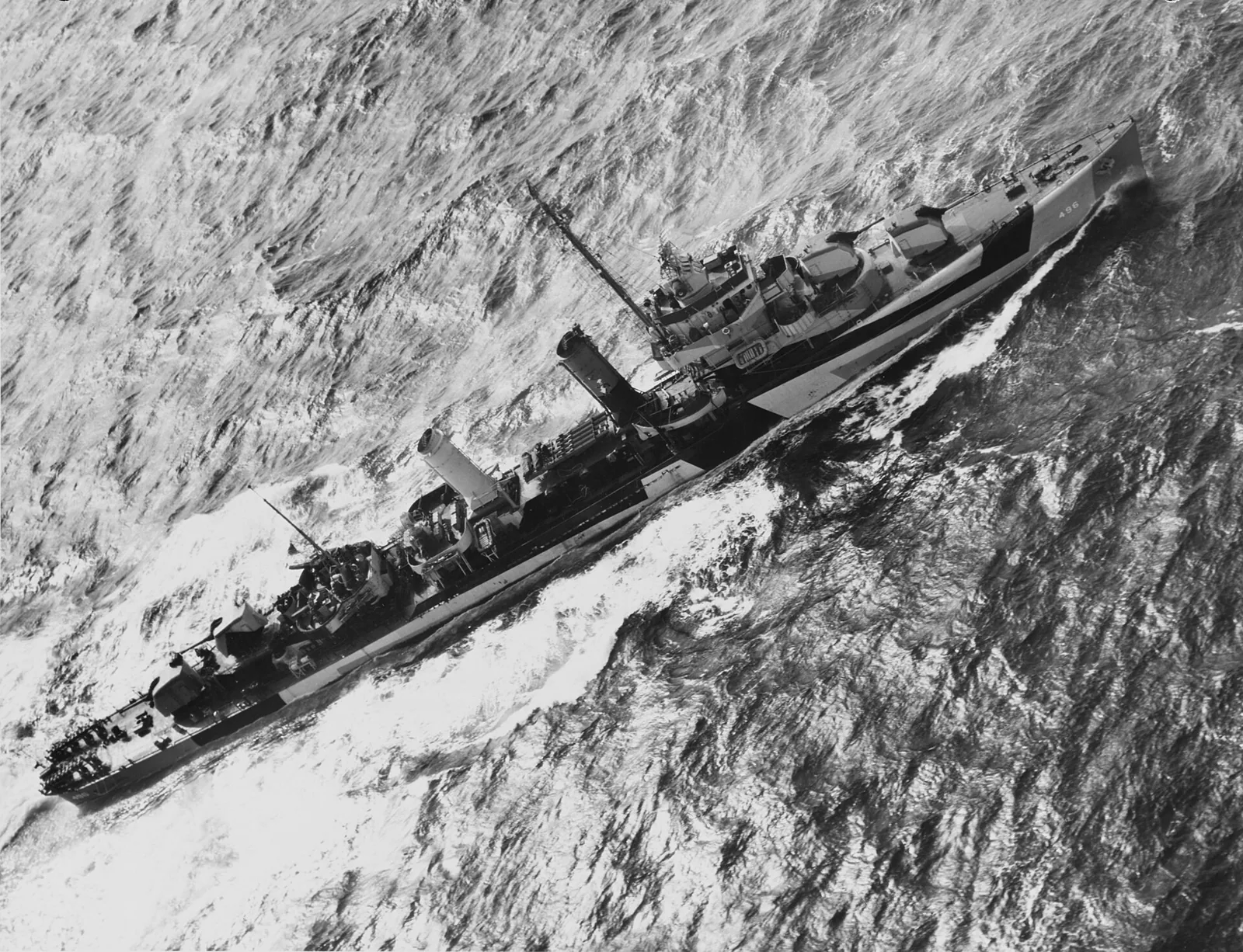
She departed for the United States via Oran and Gibraltar on 21 September. She arrived at New York 3 October, and operated off the east coast until close to the end of the year. She again resumed transatlantic convoy duties on 28 December, completing six by 24 May 1945 when she entered the Philadelphia Navy Yard. There she commenced conversion to a destroyer‑minesweeper. She was reclassified DMS‑36 on 30 May.
Her conversion completed on 12 July, she conducted minesweeping exercises until 12 August. She then departed for postwar duties in the western Pacific.
McCook arrived at Okinawa 28 September and, after riding out two typhoons, commenced minesweeping operations in the Yellow Sea toward the end of October. Working with MinRon 1, she cut 77 of the 500 mines swept by that group during the period 23 October to 15 November.
Post-war 1946–1949
1946
She arrived at Sasebo for duty in the coastal waters of Japan on 17 November. Assigned a courier trip to Wakayama, 14 December, she suffered extensive damage in a typhoon on the return voyage. Repairs were begun upon her return to Sasebo on the 18th and finished the next month. She sailed to the Kure‑Hiroshima area to check the swept channels in the Inland Sea on 3 February 1946. Accomplishing that mission by the 26th she steamed to Shanghai, returning 2 weeks later to Japan. She departed Yokosuka on 12 March for the United States, arriving at San Francisco on 31 March.
1947
McCook remained at San Francisco until 14 January 1947 when she was ordered to San Diego. Working primarily with the Underwater Training Unit, San Diego, she operated out of that port for the next 2 years. She also participated in destroyer squadron exercises and battle problems off the California coast and in the Hawaiian Islands. A cruise to the Marshalls and the Marianas, 7 July to 11 September 1947, was her only oversea deployment during this period.
1949
By January 1949, deactivation had begun aboard McCook and on 27 May she was decommissioned and was berthed at San Diego as a part of the Pacific Reserve Fleet. Reclassified DD‑495 on 15 July 1955, into 1969 she remains berthed at Bremerton.
Other photographs
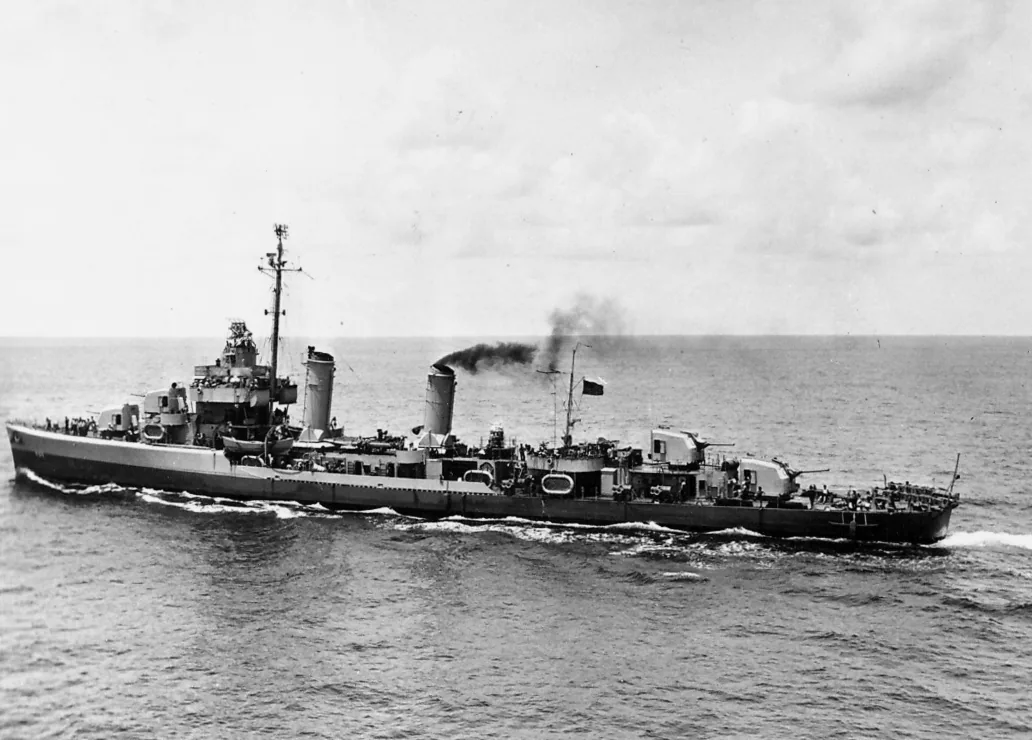
Held for this vessel, and not tied to any part of the account above.

References
Every work this entry draws on. There are no numbered markers in the text above: what we hold is the provenance of the page — this history, this article, these photographs.
- History McCook II (DD-496) Dictionary of American Naval Fighting Ships, Naval History and Heritage Command. A work of the United States Government, in the public domain — the only text on this site reproduced verbatim.
- Facts USS McCook (DD-496) Structured facts only — dates, dimensions, armament and fate. No wording is taken from it. Harvested 1 August 2026.
- Photograph USS McCook (DMS-36) undeway off the Philadelphia Naval Shipyard, Pennsylvania (USA), on 12 July 1945 (19-N-89495) U.S. Navy — Official U.S. Navy Bureau of Ships photo 19-N-89495 available at Destroyerhistory.org — Public domain — Wikimedia Commons
- Photograph USS McCook (DD-496) underway c1943 U.S. Navy — U.S. Navy National Museum of Naval Aviation photo No. 1986.150.003.015 — Public domain — Wikimedia Commons
- Photograph USS McCook (DD-496) in the Atlantic 1943 U.S. Navy — U.S. Navy National Museum of Naval Aviation photo No. 1986.150.003.019 — Public domain — Wikimedia Commons
- Photograph USS McCook (DD-496) underway at sea in March 1944 U.S. Navy — U.S. Navy photo [1] from Navsource.org — Public domain — Wikimedia Commons
- Photograph USS McCook (DD-496) underway in February 1945 U.S. Navy — Official U.S. Navy photo NH 107416 from the U.S. Navy Naval History and Heritage Command — Public domain — Wikimedia Commons