United States Navy — Destroyer
USS Mervine (DD-489) — service history
This is the full service history. For the vessel's particulars, photograph and specifications, see the entry.
In the words of the US Navy. The account below is reproduced verbatim from the Dictionary of American Naval Fighting Ships, compiled by the Naval History and Heritage Command — a work of the United States Government, in the public domain, and the only text on this site not written here.
Before commissioning
(DD‑489; dp. 1,630; l. 348'4"; b. 36'; dr. 17'5"; s. 35 k.; cpl. 276; a. 4 5", 4 40mm., 2 20mm., 5 21" tt., 6 dcp., 2 dct.; cl. Weaves )
Rear Adm. William Mervine, born 14 March 1791 at Philadelphia, Pa., was appointed midshipman in January 1809. Serving on Lake Ontario during the war of 1812, he later cruised off Africa and South America, in the West Indies and in the Pacific. While in command of Savannah during the war with Mexico, 1846‑47, he led a detachment of sailors and marines against Monterey, 7 July 1947, took possession and hoisted the American flag over the city. Serving also during the Civil War, he commanded the Gulf Squadron from 6 May 1861, until obliged by ill health to give up the command 22 September 1861. He died at Utica, N.Y., 15 September 1868.
Second World War 1939–1945
1941
The second Mervine (DD‑489) was laid down 3 November 1941 by the Federal Shipbuilding & Dry Dock Co., Kearny, N.J.; launched 3 May 1942; sponsored by Miss Mildred Mervine, great‑granddaughter of Rear Adm. Wm. Mervine; and commissioned 17 June 1942, Lt. Comdr. S. D. Willingham in command.
1942
Following a Cuban shakedown cruise, Mervine reported for duty with the Gulf Sea Frontier at New Orleans, 30 August 1942. Assigned to escort work, she accompanied merchantmen as they plied the gulf and West Indian shipping lanes. Lanes which during the preceding months had gained the dubious distinction of suffering the heaviest losses to U‑boat activity in the eastern Atlantic.
In October Mervine left the gulf and steamed to Norfolk where she joined TF 34 and sailed east. Toward midnight on 7 November she arrived off Safi, Morocco, and took up her station for operation "Torch," the invasion of north Africa. During the landings on the 8th she acted as control vessel and provided fire support for the assault forces on Red Beach, north of Safi. She remained an patrol in the area for the next 5 days and then returned to New York. There she resumed escort assignments and for the next 7 months guarded coastal and transatlantic convoys.
1943
On 8 June 1943, Mervine departed with TF 65 for north Africa. Arriving at Mers‑el‑Kebir on the 22d, she joined TF 85 and on 5 July departed for Sicily and operation "Husky." From the 10th through the 13th she cruised off Scoglitti and along the coast of the Camerina Plain, providing fire support for the 7th Army's assault troops. She then returned to escort work in the North Atlantic and the Mediterranean.
1945
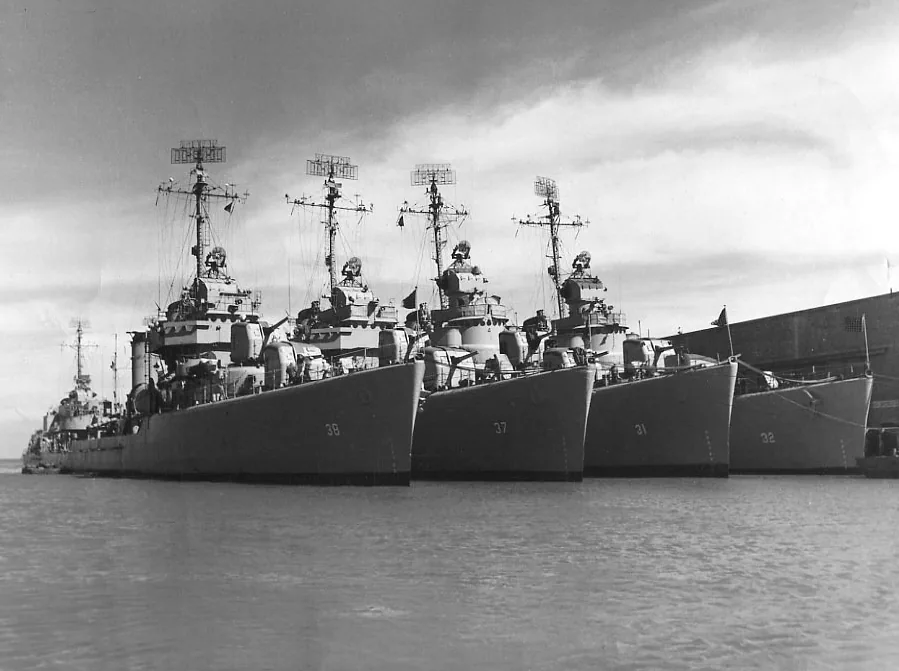
In the spring of 1945, as Allied Forces in the Pacific pushed closer to the Japanese home islands and their need for minesweepers increased, doubly so with the disastrous toll among that type ship in the Ryukyus, Mervine was designated for conversion. On 23 May she entered the Philadelphia Navy Yard where she became a destroyer-minesweeper. Reclassified DMS‑31 on 30 May 1945, she departed for Norfolk 15 July and continued on to the Pacific. En route at the time of the Japanese surrender, she arrived at Buckner Bay, Okinawa, 28 September. In October she swept mines off the China coast near Kokuzan. Shifting to Japanese waters the following month, she operated first off Kyushu and then off Honshu.
Post-war 1946–1949
1946
Mervine reported to San Francisco 31 March 1946 for 2 years of west coast operations before returning to the Far East. On 25 March 1948 she arrived at Yokosuka and continued on to Tsingtao, China, where she carried out escort, rescue and training assignments until 5 October when she departed for the United States. Arriving at her homeport, San Diego, in November, she soon departed again for training and availability at Pearl Harbor. On 15 February 1949 she returned to southern California for the last time. On 27 May she decommissioned and entered the Pacific Reserve Fleet at San Diego. Redesignated DD‑489 again, 15 July 1955, she remained at San Diego until the end of the decade and then was transferred first to the Columbia River Reserve Group and finally to Bremerton. Struck 31 July 1968 from the Navy list, she was sold for scrap in 1969.
Other photographs
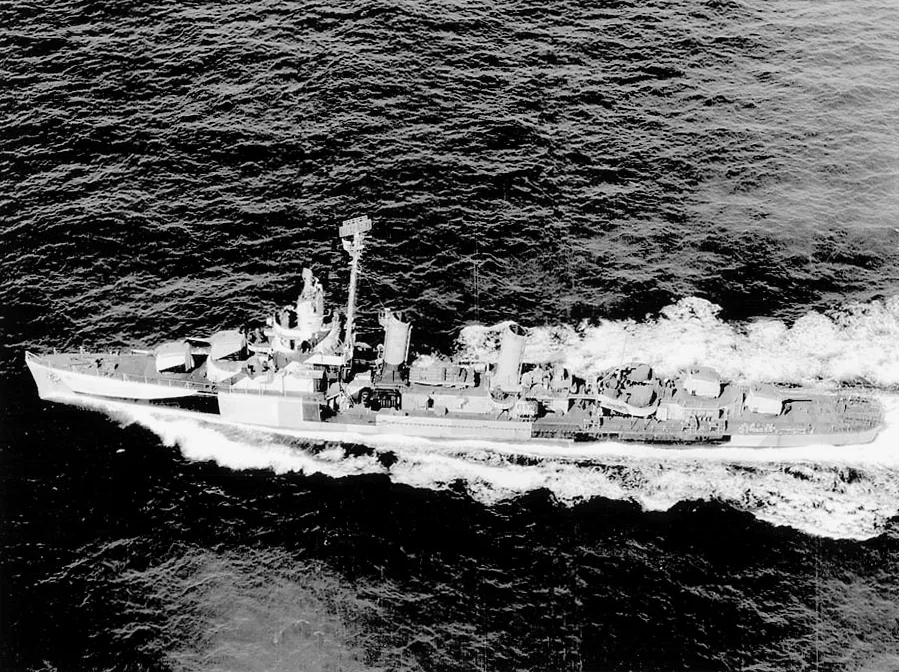
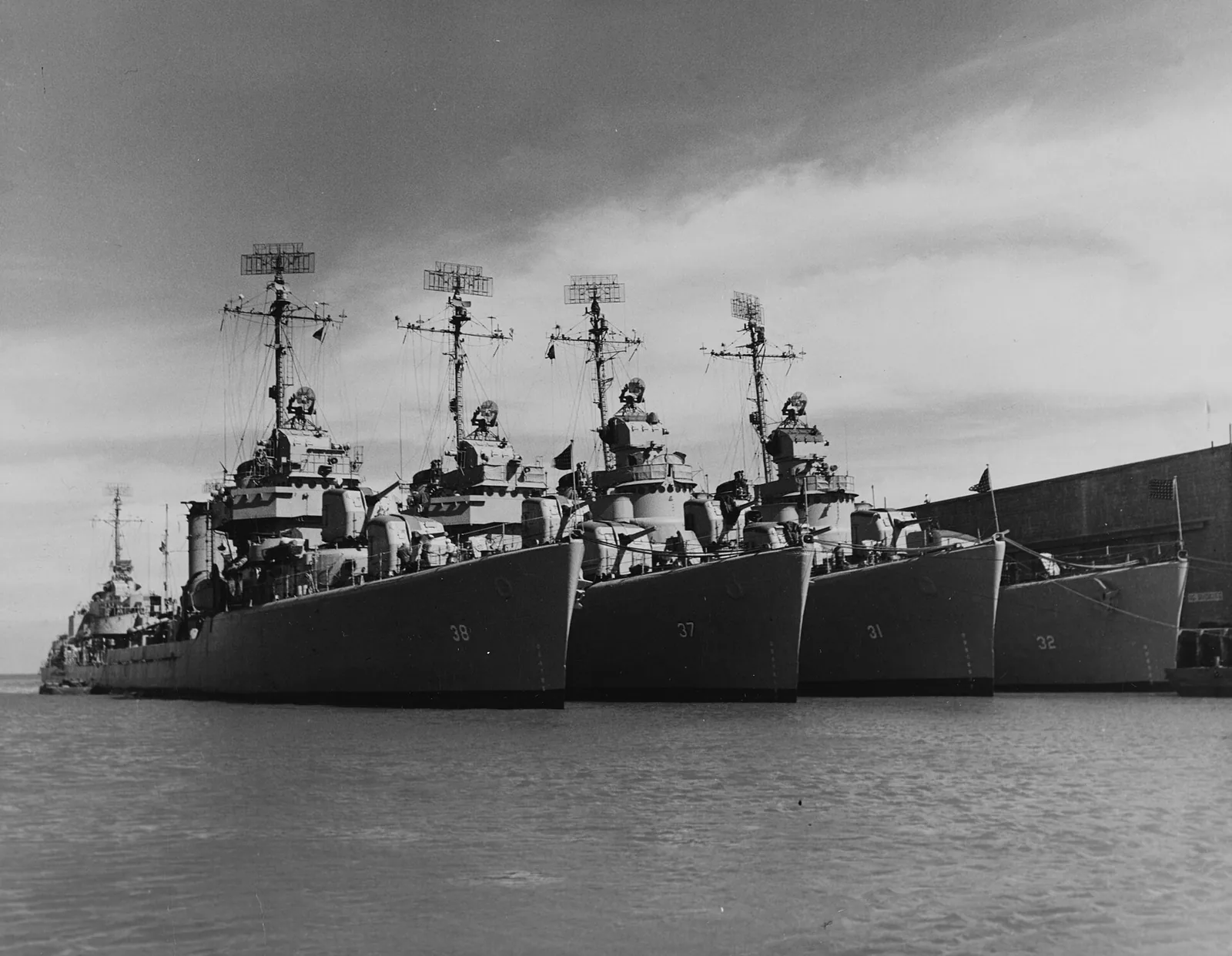
Held for this vessel, and not tied to any part of the account above.
References
Every work this entry draws on. There are no numbered markers in the text above: what we hold is the provenance of the page — this history, this article, these photographs.
- History Mervine II (DD-489) Dictionary of American Naval Fighting Ships, Naval History and Heritage Command. A work of the United States Government, in the public domain — the only text on this site reproduced verbatim.
- Facts USS Mervine (DD-489) Structured facts only — dates, dimensions, armament and fate. No wording is taken from it. Harvested 1 August 2026.
- Photograph 489mervine 01 USN — Official U.S. Navy Bureau of Ships photo 19-N-41140 available at [ Destroyerhistory.org] — Public domain — Wikimedia Commons
- Photograph High speed minesweepers of US Mine Squadron 21 in port 1945 U.S. Navy — Official U.S. Navy photo NH 107440 from the U.S. Navy Naval History and Heritage Command — Public domain — Wikimedia Commons
- Photograph USS Mervine (DD-489) underway in the Atlantic on 9 May 1945 U.S. Navy — Official U.S. Navy photo NH 107414 from the U.S. Navy Naval History and Heritage Command — Public domain — Wikimedia Commons
- Photograph USS Thompson USS Davison USS Mervine USS Quick (50841702572) tormentor4555 — USS Thompson USS Davison USS Mervine USS Quick — PDM-owner — Wikimedia Commons