United States Navy — Destroyer
USS Monssen (DD-436) — service history
This is the full service history. For the vessel's particulars, photograph and specifications, see the entry.
In the words of the US Navy. The account below is reproduced verbatim from the Dictionary of American Naval Fighting Ships, compiled by the Naval History and Heritage Command — a work of the United States Government, in the public domain, and the only text on this site not written here.
Before commissioning
(DD‑436: dp. 1,630; l. 348'2"; b. 36'1"; dr. 17'5"; s. 33 k.; cpl. 276; a. 5 5", 4 40mm., 2 20mm., 10 21" tt., 6 dcp., 2 dct.; cl. Gleaves )
Mons Monssen was born 20 January 1867, at Bergen, Norway, and enlisted in the U.S. Navy 3 June 1889. Warranted gunner in 1904, he was serving in Missouri 13 April when a charge ignited while a 12‑inch gun was being loaded for target practice. Eighteen officers and men lost their lives. Monssen entered the burning magazine through the scuttle and threw water on the fire with his hands until a hose was passed to him. For his actions he was awarded the Medal of Honor. Later commissioned lieutenant, July 1918, he retired 15 December 1925 and died at the Naval Hospital, Brooklyn, N.Y., 10 February 1930.
Second World War 1939–1945
1939
The first Monssen (DD‑436) was laid down 12 July 1939, by Puget Sound Navy Yard, Bremerton, Wash.; launched 16 May 1940; sponsored by Mrs. Mons Monssen, widow of Lieutenant Monssen; and commissioned 14 March 1941, Lt. Comdr. R. N. Smoot in command.
1941 Coral Sea
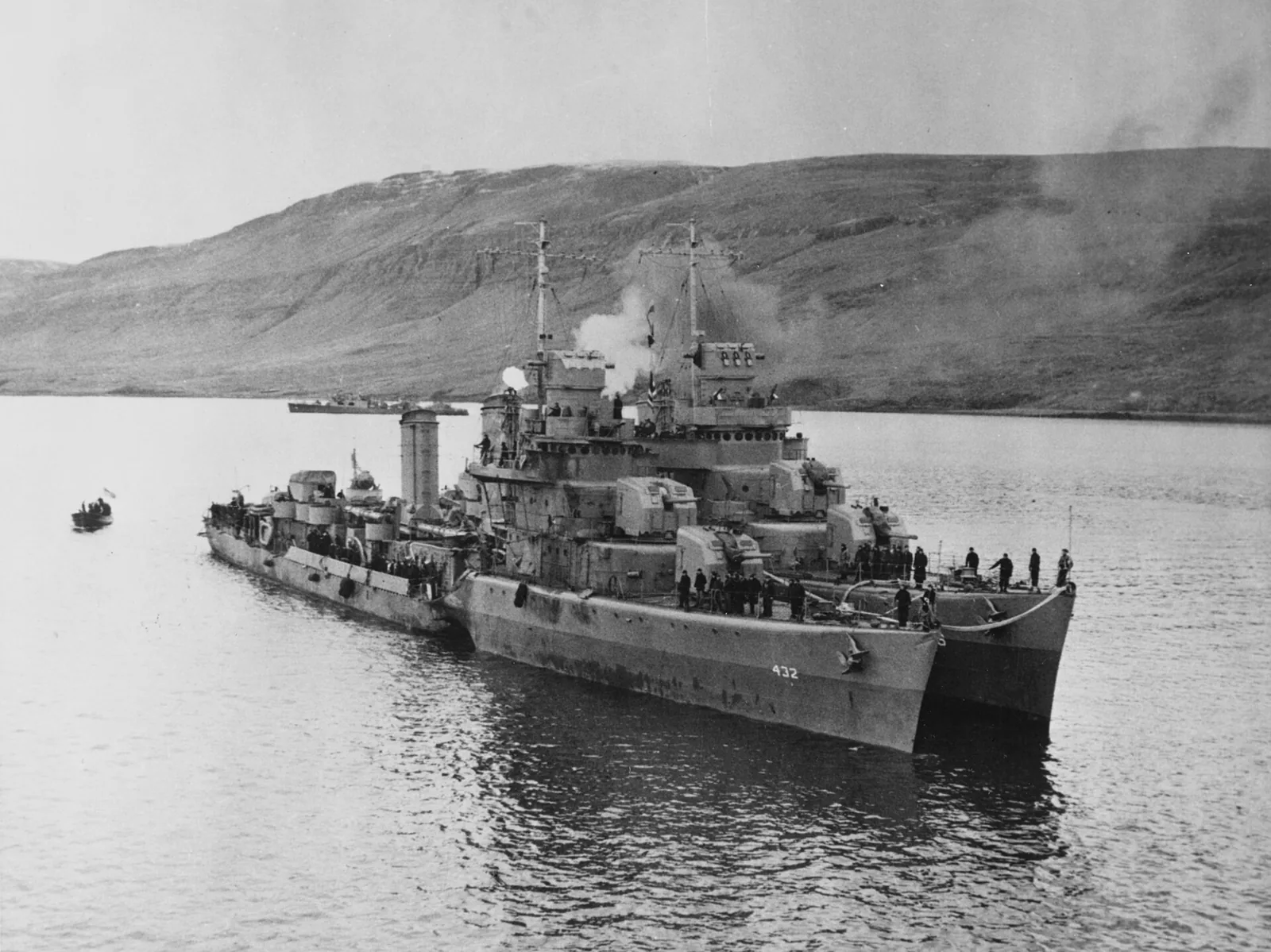
Following shakedown and training, Monssen reported to the Atlantic Fleet 27 June 1941 as a unit of DesDiv 22. For the next 5 months she operated in the northwestern Atlantic, from the coast of New England and the Maritime Provinces to Iceland, on neutrality patrol. Her escort and patrol duties changed from neutral to belligerent 7 December 1941, continuing until 9 February 1942 when she entered the Boston Navy Yard for overhaul in preparation for her transfer to the Pacific Fleet.
On 31 March she arrived at San Francisco, joined TF 16, and departed 2 April. Steaming west, she was in the antisubmarine screen for Hornet (CV‑8) as the carrier headed for "Shangri‑La" with Lt. Col. J. H. Doolittle's B‑25's on her flight deck. In the early morning hours 18 April the force was sighted by the enemy and the Army pilots manned their planes, ignoring the bad weather, the daylight hours, and the additional 168 miles they would have to fly over the planned 500 miles to their targets, Tokyo, Nagoya, Osaka, and Kobe.
Following the launch, the force returned to Pearl Harbor, from which it sortied 30 April to aid Yorktown (CV‑5) and Lexington (CV‑2) in the Battle of the Coral Sea. Reaching the scene after the battle was over, the force returned to Pearl Harbor, arriving 26 May. Two days later they departed again, this time for Midway to repulse an expected assault on that advanced base. By 2 June, TF 16 had rendezvoused with TF 17 and was in position 350 miles northeast of Midway. On the 4th the Battle of Midway commenced as Japanese carrier planes flew against installations on the island. By the 7th, the American forces had won one of the decisive battles of history, sinking four carriers and one cruiser at the cost of destroyer Hammann (DD‑412) and carrier Yorktown, and profoundly changing the course of the war.
After Midway the force remained at Pearl Harbor for a month before departing again for combat. Steaming via the Tonga Islands, they headed for the Japanese‑held Solomons. By 7 August they were 40 miles from the targets, Guadalcanal and Tulagi. On the 7th and 8th, Monssen, with Buchanan (DD‑484) stood off Gavutu and Tanambago, circling those islands and providing fire support to units of the 2d Marine Regiment as the U.S. Navy struck with the first of its giant amphibious assaults. She was then assigned to the screening forces guarding the eastern approaches to Sealark, Lengo, and Nggela Channels.
She remained in the immediate area through the Battle of the Eastern Solomons, which prevented Japanese reinforcements from reaching Guadalcanal, and then took up duties patrolling the sea routes to Guadalcanal. At the end of the month Saratoga (CV‑3) was damaged and Monssen was one of the ships designated to escort her to the Tonga Islands.
Monssen returned to Guadalcanal 18 September to insure the integrity of an Allied supply line and to block Japanese efforts at resupply. On 8 November, she departed Noumea with two cruisers and two other destroyers as TG 67.4, under Rear Admiral Callaghan, as escort for transports carrying reinforcements to the Marines on Guadalcanal. At the same time, another convoy set out from Espiritu Santo, covered by one cruiser and four destroyers under Rear Admiral Scott. Arriving off Lunga Point on the 12th, a day after those from Espiritu Santo, they commenced unloading. By dusk as reports of Japanese ship movements from Truk increased, 90 percent of the transports had been unladen despite afternoon torpedoplane attacks, one of which had cost Monssen the use of her fire control radar. The transports were pulled out, escorted through Lengo Channel, and seen safely on their way to Espiritu Santo. Then Admiral Callaghan's force, heavily outnumbered even with the addition of Admiral Scott-s ships, reversed course and steamed back to engage the enemy in the initial action of what would later be called the Naval Battle for Guadalcanal.
Shortly, after 0140, 13 November, they sighted the enemy fleet, under Vice Admiral Abe, 3 miles north of Kukum. The enemy was headed toward Henderson Field to bombard it and cripple Allied air operations long enough to sneak in 11 of their transports, then en route to relieve their beleaguered comrades fighting on the island.
Battle was given at 0150. At about 0220 Monssen, forced to rely on radio information and optics, was spotlighted, hit by some 37 shells, and reduced to a burning hulk. Twenty minutes later, completely immobilized in all departments, the ship was ordered abandoned. After daybreak Monssen was still a floating incinerator. C. C. Storey, BM2c, L. F. Sturgeon, GM2c, and J. G. Hughes, F1c, climbed back into the inferno and rescued eight men still aboard and alive, five of whom lived after reaching land. The survivors, 40 percent of the crew, were picked up at about 0800 and taken to Guadalcanal. The ship itself continued to blaze until early afternoon, when the waters of Ironbottom Sound closed over her.
Other photographs
Held for this vessel, and not tied to any part of the account above.
References
Every work this entry draws on. There are no numbered markers in the text above: what we hold is the provenance of the page — this history, this article, these photographs.
- History Monssen I (DD-436) Dictionary of American Naval Fighting Ships, Naval History and Heritage Command. A work of the United States Government, in the public domain — the only text on this site reproduced verbatim.
- Facts USS Monssen (DD-436) Structured facts only — dates, dimensions, armament and fate. No wording is taken from it. Harvested 1 August 2026.
- Photograph Uss Monssen 0543602 United States Navy — Originally from http://www.history.navy.mil/photos/sh-usn/usnsh-m/dd436.htm — Public domain — Wikimedia Commons
- Photograph Torpedoed USS Kearny (DD-432) alongside USS Monssen (DD-436) at Iceland, 19 October 1941 (80-G-28788) Unknown author — U.S. Navy photo 80-G-28788 — Public domain — Wikimedia Commons
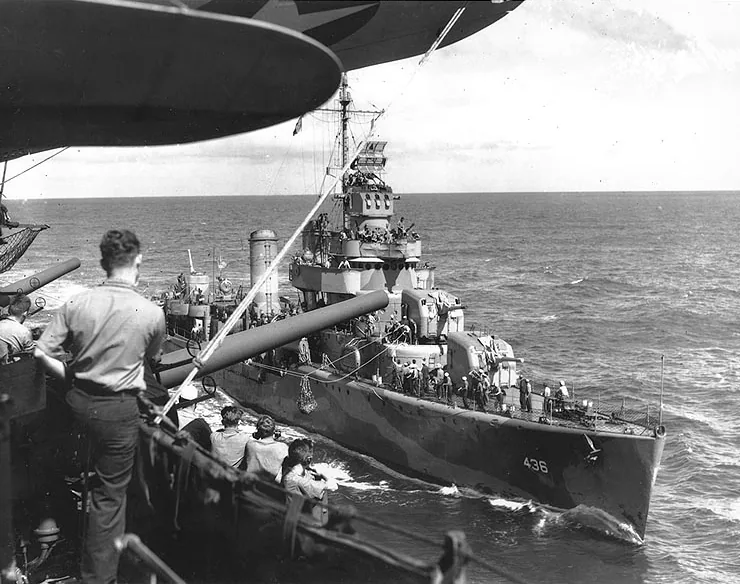
- Photograph USS Monssen (DD-436) passing mail to Enterprise (CV-6) 1942 USN — Official U.S. Navy photo NH 97817 from the U.S. Navy Naval History and Heritage Command — Public domain — Wikimedia Commons
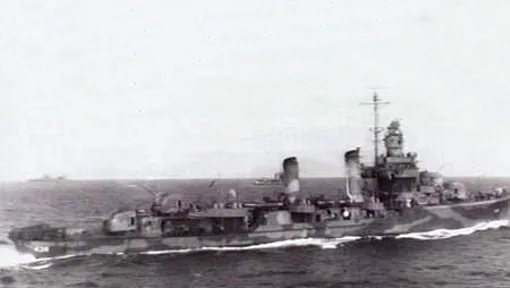
- Photograph USS Monssen (DD-436) underway in 1942 USN — Public domain — Wikimedia Commons