United States Navy — Destroyer
USS Murphy (DD-603) — service history
This is the full service history. For the vessel's particulars, photograph and specifications, see the entry.
In the words of the US Navy. The account below is reproduced verbatim from the Dictionary of American Naval Fighting Ships, compiled by the Naval History and Heritage Command — a work of the United States Government, in the public domain, and the only text on this site not written here.
Before commissioning
(DD‑603: dp. 1,620; l. 348'4"; b. 36'1"; dr. 17'4"; s 37.5 k.; cpl. 265; a. 4 5", 40mm., 5 21" tt., 4 dcp.; cl: Benson )
John McLeod Murphy was born 14 February 1827 in Westchester County, N.Y., and was appointed midshipman 10 August 1841. Resigning as a passed midshipman 10 May 1852, Murphy reentered service at the beginning of the Civil War as a colonel in the engineers. He was appointed acting lieutenant, USN, 4 December 1862 and took command of gunboat Carondelet 4 March 1863, skippering that ship during the joint Army‑Navy Expedition in Steele's Bayou under Rear Adm. David D. Porter, 18 to 24 March, in which he landed with two boat howitzers and 300 men near Rolling Fork to hold that place until the Union ships could cover it with their guns. He next took Carondelet off Vicksburg engaging batteries at that Confederate fortress many times from 18 May to 3 July, being commended by Admiral Porter for energetic attention to orders and ready cooperation with Army corps commanders assaulting the fortress. Acting Lieutenant Murphy relinquished command of the gunboat 1 September and resigned his commission 30 July 1864. He died in New York City in 1884.
Second World War 1939–1945
1941
Murphy (DD‑603) was laid down 19 May 1941 by Bethlehem Steel Corp., Staten Island, N.Y.; launched 29 April 1942; sponsored by Miss M. Elsie Murphy, daughter of Acting Lieutenant Murphy; and commissioned 25 July 1942, Comdr. Leonard W. Bailey in command.
Following shakedown to Casco Bay, Maine, and escort duty off Halifax, Nova Scotia, Murphy joined the Center Attack Group, Western Naval Task Force, at Norfolk, sailing in late October for Fedhala, Morocco, to participate in operation "Torch," the invasion of North Africa. Arriving off the landing beaches 7 November, the destroyer regulated the waves of landing craft hitting the beach the next day, then gave fire support off Point Blondin at which time the ship was hit in the after engineroom during a furious exchange of fire with the Sherkhi battery, losing three men killed and 25 wounded. Immediate damage control measures prevented any serious damage and Murphy's crew was able to effect repairs in time to join other fire support ships in silencing the Cape Blondin guns. The plucky warship remained off Fedhala, driving off an enemy air attack 9 November, until sailing for Boston to complete repairs, arriving on the 24th.
1943 Gela

The destroyer next escorted convoys between New York and Panama, and Norfolk and Casablanca, until joining the "Dime" attack force screen for the invasion of Gela, Sicily, in July 1943. On 10 July, while engaged in patrolling the beachhead, Murphy was straddled by near misses from a night air attack, puncturing her stern and wounding one man. She was again attacked two nights later, being missed by 100 yards by a German dive bomber, but continued her fire support off Sicily into August. Then, while escorting a group of transports to Palermo, she was once again attacked by dive bombers; but this time she splashed two enemy planes.
1944
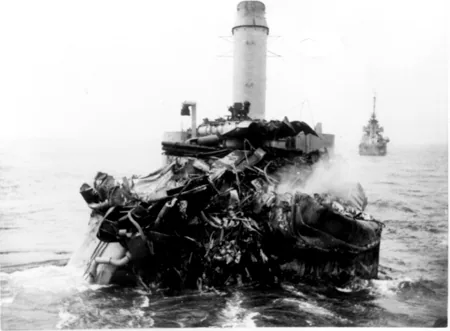
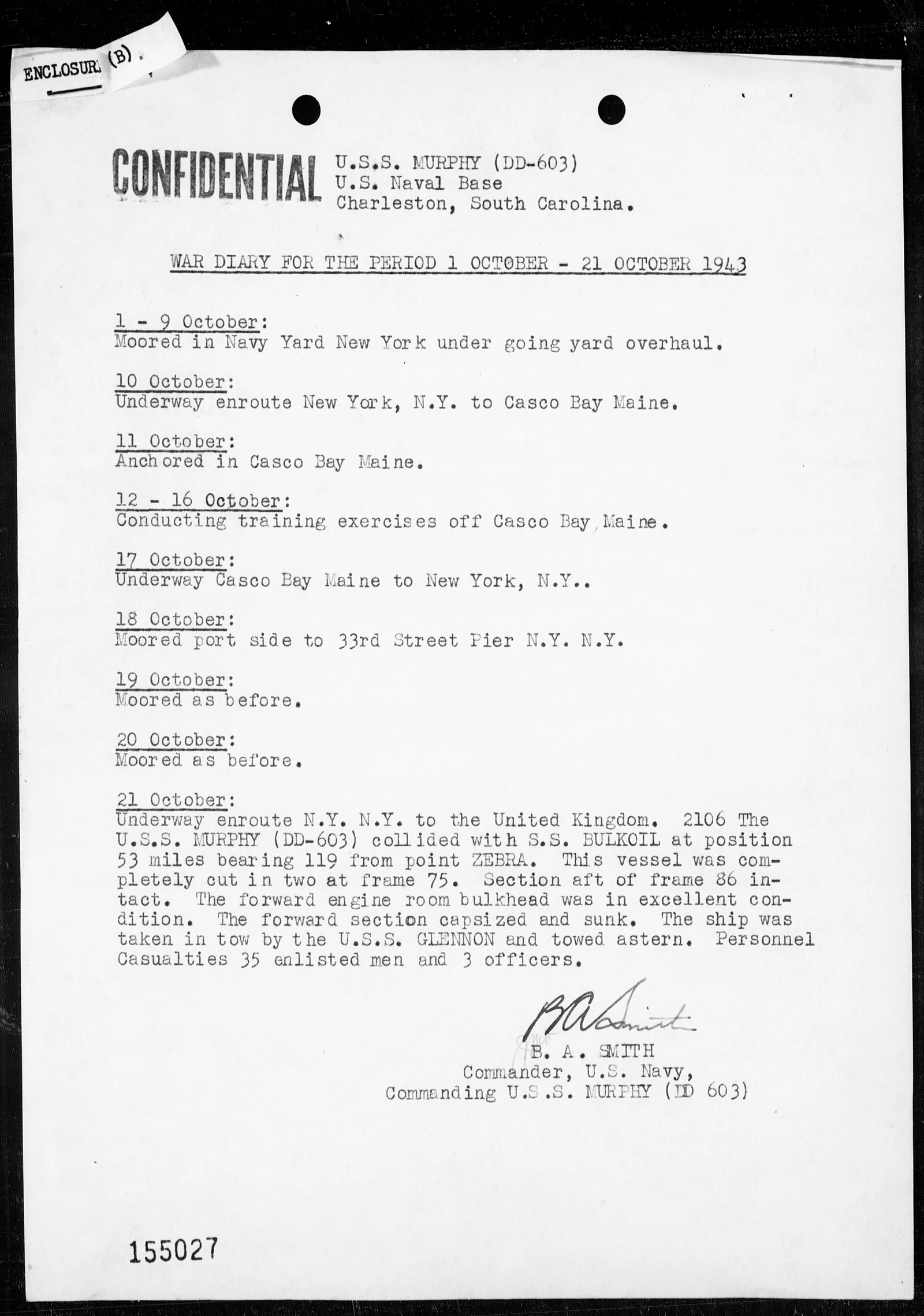
Murphy returned to the United States following the end of the Sicily invasion, next escorting United Kingdom bound convoys. Standing out of New York Harbor 21 October, the destroyer was struck on the portside between the bridge and forward stack by tanker Bulkoil. The forward half of the ship, sheared off, slowly sank, taking 38 officers and men with it. The after section was kept afloat and was towed into New York Navy Yard where, following a 7‑month repair job and replacement of the entire bow, the veteran warship rejoined the fleet in time for the Normandy invasion. On 5 June 1944, Murphy departed Portland, England, assigned to the assault area off Vierville, France, better known as Omaha Beach. She remained there, giving fire support and conducting screen duty for the transports through mid‑June, engaging in a gun duel with enemy shore batteries 8 June, and repelling numerous German E‑boat and torpedo attacks.
1945
In July, Murphy steamed south to the Mediterranean, operating with TF 88, the Aircraft Carrier Force in operation -Dragoon,- the invasion of southern France. She conducted fire support, plane guard, and screening duties during the landings and then departed for New York for overhaul in early September. The destroyer resumed operations in late 1944, joining cruiser Quincy at Norfolk to escort that ship carrying President Franklin D. Roosevelt to the Malta and Great Bitter Lake, Egypt, Conferences. Upon arrival at Great Bitter Lake, Murphy was detached and ordered to Jidda, Arabia, to transport King Ibn Saud of Saudi Arabia and his party to the Conference. Transiting the Suez Canal, she anchored off Jidda 11 February, taking on board the royal party the next day. The destroyer got underway immediately with her valuable supercargo settled in a tent on her forecastle and arrived Great Bitter Lake on the 15th. With her passengers disembarked, the warship then sailed for New York for a minor yard period, joined an antisubmarine "killer" group on duty off New England and Nova Scotia, and then in May escorted one of the last convoys to Oran, Algeria, and back. On 2 June 1945, with war in the Atlantic won, Murphy entered the Boston Navy Yard for refit prior to assignment to the Pacific Fleet.
Post-war 1946–1949
1946
The veteran warship departed Boston 10 July, steamed via the Panama Canal to the west coast, and then on the Okinawa, arriving 9 September. Being assigned to the 5th Fleet on occupation duty in southern Japanese waters, she visited Nagasaki, Yokosuka, Wakayama, and Nagoya until departing Okinawa 21 November for the United States. She steamed via Saipan, Pearl Harbor, San Diego, and the Panama Canal, arriving at Charleston to prepare for inactivation. She decommissioned there 9 March 1946, and joined the Charleston Group, Atlantic Reserve Fleet, where she remains into 1969.
Other photographs
Held for this vessel, and not tied to any part of the account above.
References
Every work this entry draws on. There are no numbered markers in the text above: what we hold is the provenance of the page — this history, this article, these photographs.
- History Murphy (DD-603) Dictionary of American Naval Fighting Ships, Naval History and Heritage Command. A work of the United States Government, in the public domain — the only text on this site reproduced verbatim.
- Facts USS Murphy (DD-603) Structured facts only — dates, dimensions, armament and fate. No wording is taken from it. Harvested 1 August 2026.
- Photograph 603murphy 01 Unknown author — Navsource.org here: https://www.navsource.net/archives/05/pix2/0560317.jpg — Public domain — Wikimedia Commons
- Photograph Murphy 01 US Navy — Public domain — Wikimedia Commons
- Photograph Murphy 02 US Navy — Public domain — Wikimedia Commons
- Photograph US Navy ships of Destroyer Squadron 17 at anchor c1943 U.S. Navy — U.S. Navy photo [1] from Navsource.org — Public domain — Wikimedia Commons
- Photograph USS MURPHY - War Diary, 10-1-21-43 - DPLA - f31aee0c2c9a3a13337fcb7379c8a434 Department of the Navy. Office of the Chief of Naval Operations. Intelligence Division. Office of Naval Records and Library. (1922 - 10/10/1945) — This file was contributed to Wikimedia Commons by National Archives and Records Administration as part of a cooperation project. The donation was facilitated by the Digital Public Library of America , via its partner Digital Public Library of America . Record in source catalog DPLA identifier: f31aee0c2c9a3a13337fcb7379c8a434 National Archives Identifier: 140084564 — Public domain — Wikimedia Commons