United States Navy — Destroyer
USS Nicholson (DD-442) — service history
This is the full service history. For the vessel's particulars, photograph and specifications, see the entry.
In the words of the US Navy. The account below is reproduced verbatim from the Dictionary of American Naval Fighting Ships, compiled by the Naval History and Heritage Command — a work of the United States Government, in the public domain, and the only text on this site not written here.
Before commissioning
A family renowned in American naval history, five of whose members gave especially distinguished service in the Revolution, the War of 1812, and the Civil War.
The first three, all sons of Joseph and Hannah Scott Nicholson, were born in Chestertown, Md.: James in 1737, Samuel in 1743, and John in 1756. James Nicholson served in the colonial Navy with the British in the assault on Havana in 1762, and was commissioned Captain in the Continental Navy 10 October 1776. He commanded Defense, Trumbull, and Virginia, and when blockaded at Baltimore, took his men to join Washington at Trenton to aid in that key victory. He died 2 September 1804 at his home in New York City.
Samuel Nicholson was a Lieutenant in Bon Homme Richard under John Paul Jones; then, in command of Deane, captured three British sloops-of-war. Appointed Captain upon the reorganization of the Navy in 1794, he superintended the construction of frigate Constitution and commanded her during her first commission. He died at Charlestown, Mass., 29 December 1811.
John Nicholson entered the Continental Navy as Lieutenant in October 1776 and the next month was promoted to Captain to command sloop Hornet. After the war he was active in public affairs in Maryland, where he died in the summer of 1844.
In the next generation, John's son William Carmichael Nicholson, born 1800 in Maryland, entered as a midshipman in 1812 and served in President under Stephen Decatur during the War of 1812. Commissioned Captain in 1855, he commanded steam frigate Roanoake from May 1861. Appointed Commodore on the Retired List in July 1862, he served a year on the Retiring Board. He died 25 July 1872 at the Naval Asylum, Philadelphia.
In the third generation, Samuel's grandson James William Augustus Nicholson, born 10 March 1821 in Dedham, Mass., carried on the family tradition, entering the Navy as a midshipman in February 1838. As a Lieutenant, he served in Vandalia in Commodore Matthew G. Perry's Japanese Expedition (1853-55). During the Civil War he served in Pocahontas and Pensacola, and commanded Isaac Smith, Shamrock, Manhattan, and Mohongo. Commodore from August 1873 and Rear Admiral from October 1881, he commanded the European Station 16 September 1881 to February 1883. When the British bombarded Alexandria, Egypt, in 1882, he rescued the records of the American Consulate and took American and other refugees aboard his flagship, Lancaster. Commendation from the Navy Department and awards of gratitude from European governments followed. He retired 10 March 1883 and died at his home in New York 28 October 1887.
Second World War 1939–1945
1939
The third Nicholson (DD-442) was laid down 1 November 1939 by Boston Naval Shipyard; launched 31 May 1940; sponsored by Mrs. S. A. Bathrick, a great-grandaughter of Samuel Nicholson; and commissioned 3 June 1941, Comdr. J S Keating in command.
After a shakedown cruise in the eastern Atlantic, Nicholson escorted convoys through the U-boat-infested, storm-tossed North Atlantic, first from Boston to Iceland, and then to Scotland and England until fall 1942. In a brief training period off the Virginia coast, she prepared for the Casablanca invasion, but a turbine casualty prevented her participation in the initial landings. She arrived four days later, 12 November, to assist in the consolidation of the beachhead and to patrol. She took part in the Bizerte campaign and the initial assaults on Salerno, coming under heavy air attack from the Luftwaffe at both Bizerte and Salerno.
1944 Palaus
After five months in the Mediterranean, Nicholson returned to the United States for overhaul in preparation for Pacific deployment, for which she sailed from New York early in January 1944. When she reached New Guinea in February, she was assigned to escort LST's in the Cape Gloucester campaign, already under way.
Throughout the long New Guinea campaign, a matter of successive assaults on coastal points and nearby islands, Nicholson gave gunfire support to troops ashore. She had similar duty in the Admiralties; when, during the conquest of Seeadler Harbor, she was assigned to draw fire from an enemy battery on Hauwei. Here she was hit by a 4' shell which struck in No. 2 ammunition handling room, killing 3 and wounding 4. She wiped out the enemy position.
In August 1944 Nicholson joined the 3d Fleet in the Marshalls. She screened fast carriers in raids on the Bonins, Formosa, and the Philippines, supporting the invasion of the Palaus and the neutralization of Yap. Returning to the Philippines, her group assisted the 7th Fleet during the invasion of Leyte and the decisive Battle for Leyte Gulf, from which Nicholson sailed for a Seattle overhaul.
1945
Returning to the western Pacific in February 1945, Nicholson escorted ships passing between Guam and Ulithi, and arrived off Okinawa for its invasion late in March. Serving in the exposed radar picket line, Nicholson came through untouched by kamikazes, but rescued survivors from stricken destroyers Little and Morrison.
Post-war 1946–1949
1946
Rejoining the 3d Fleet for the final air operations against the Japanese home islands, Nicholson was off Honshu at the war's end. She entered Sagami Wan 29 August and Tokyo Bay 15 September. Returning to San Diego 6 November, she sailed for Panama and Charleston, S.C., arriving 23 November to join the Atlantic Reserve Fleet. She decommissioned 26 February 1946, was assigned as a Naval Reserve Training ship in the 3d Naval District 30 November 1948, and recommissioned 17 July 1950. She decommissioned once more and transferred to the Italian Navy 15 January 1951. Through 1969 she serves Italy as Aviere.
Other photographs
Held for this vessel, and not tied to any part of the account above.
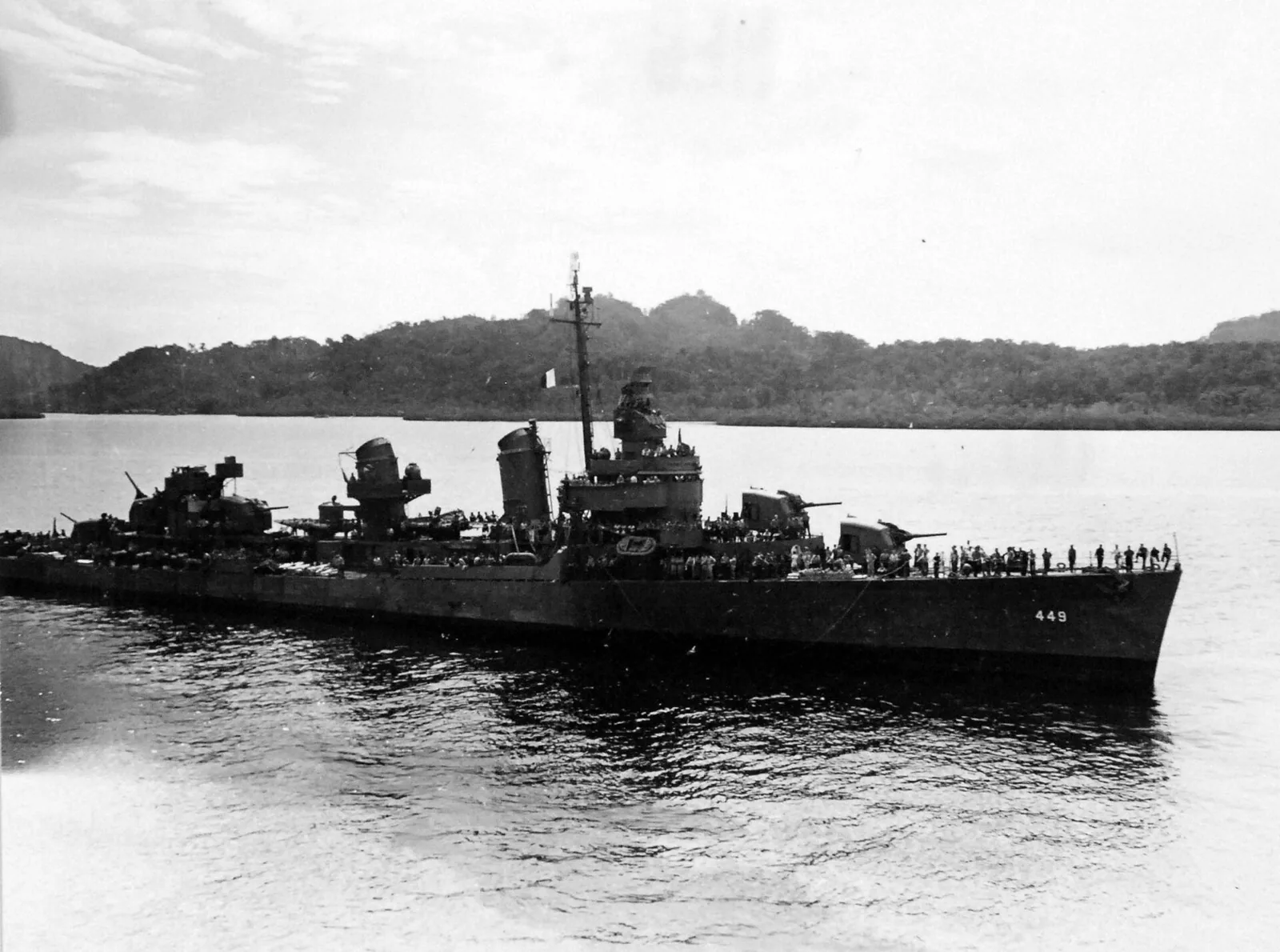
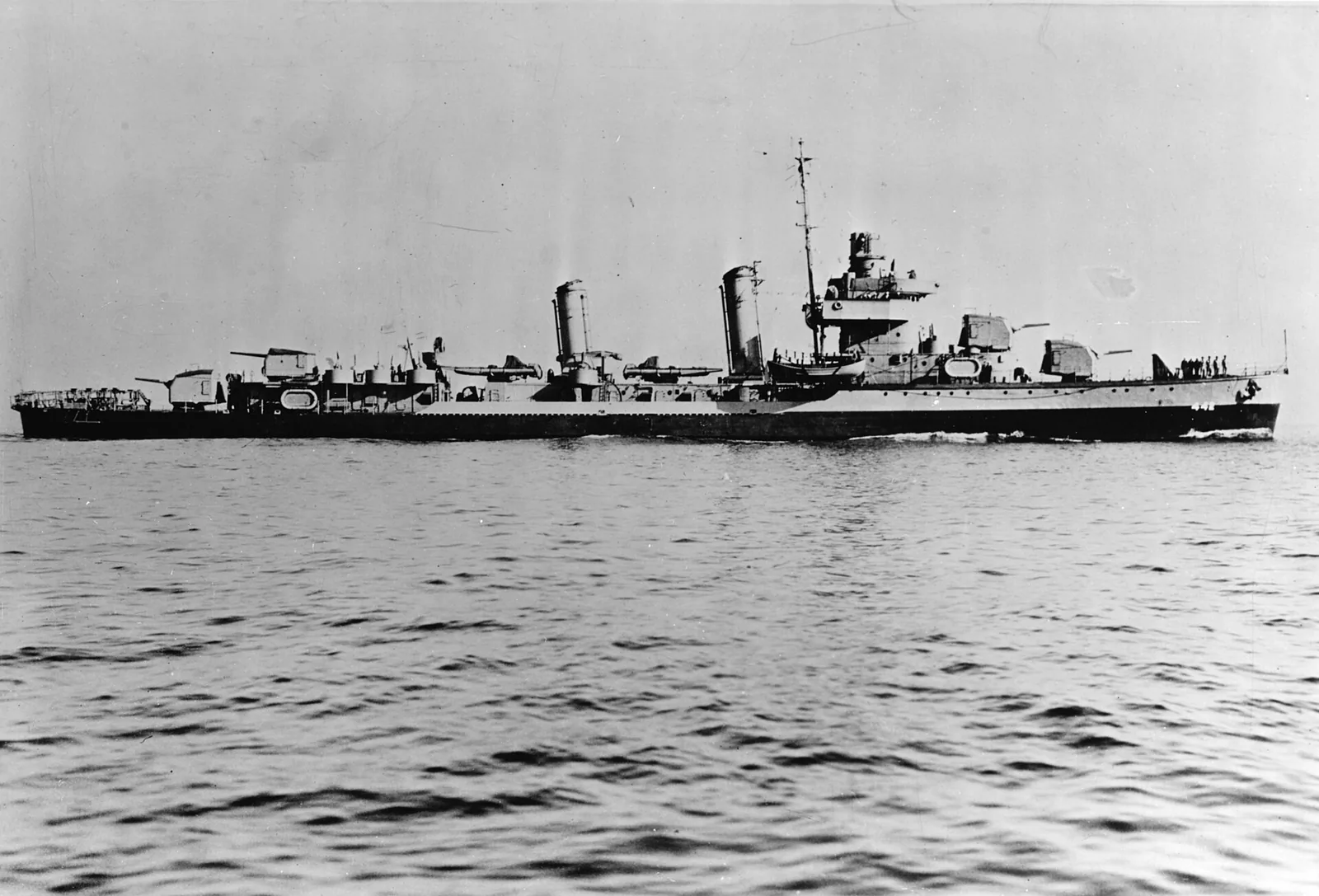
References
Every work this entry draws on. There are no numbered markers in the text above: what we hold is the provenance of the page — this history, this article, these photographs.
- History Nicholson III (DD-442) Dictionary of American Naval Fighting Ships, Naval History and Heritage Command. A work of the United States Government, in the public domain — the only text on this site reproduced verbatim.
- Facts USS Nicholson (DD-442) Structured facts only — dates, dimensions, armament and fate. No wording is taken from it. Harvested 1 August 2026.
- Photograph USS Nicholson (DD-442) off Boston in April 1942 USN — Official U.S. Navy Bureau of Ships photo 19-N-29042 available at Destroyerhistory.org — Public domain — Wikimedia Commons
- Photograph 80-G-52889 (41193652792) National Museum of the U.S. Navy — 80-G-52889 — Public domain — Wikimedia Commons
- Photograph USS Nicholson (DD-442) at sea c1943 U.S. Navy — Official U.S. Navy photo NH 50279 from the U.S. Navy Naval History and Heritage Command — Public domain — Wikimedia Commons