United States Navy — Light cruiser
USS Oklahoma City (CL-91) — service history
This is the full service history. For the vessel's particulars, photograph and specifications, see the entry.
In the words of the US Navy. The account below is reproduced verbatim from the Dictionary of American Naval Fighting Ships, compiled by the Naval History and Heritage Command — a work of the United States Government, in the public domain, and the only text on this site not written here.
Second World War 1939–1945
1942
Oklahoma City (CL-91) was laid down on 8 December 1942 at Philadelphia, Pa., by the Cramp Shipbuilding Co.; launched on 20 February 1944, sponsored by Mrs. Ella D. Classen, widow of prominent Oklahoman Anton H. Classen; commissioned on 22 December 1944, Capt. Charles B. Hunt in command.
1945

After outfitting in Philadelphia, Oklahoma City began shakedown and training in Chesapeake Bay and the Caribbean. She began post-shakedown availability on 10 March 1945, and resumed training on 9 April. On the 10th she lost her starboard anchor and 125 fathoms of chain overboard, which were replaced on the 11th.
While at sea on 15 April 1945, Oklahoma City held a memorial service in honor of President Franklin D. Roosevelt, who had passed away on the 12th at Warm Springs, Georgia. She departed for Pearl Harbor, Territory of Hawaii, on 21 April, transited the Panama Canal, and reported to Commander, Cruisers, Pacific, for duty on 2 May 1945. She conducted local training until 22 May when she sailed for Ulithi in the Caroline Islands and arrived on 1 June 1945.
Oklahoma City rendezvoused on 6 June with Carrier Task Group (CTG) 38.1 for operations in support of the Okinawa Gunto campaign. For the rest of June and into July she screened Third Fleet carriers during their intensified air operations against Japanese forces. On 18 July she formed a bombardment group with other cruisers and destroyers, then rejoined the carrier task group for continued action against the Japanese home islands.
During the closing days of the war, Oklahoma City endured intensified air assaults in her area, including kamikaze attacks. She was unaware of the atomic bomb attacks on Hiroshima and Nagasaki in August, and her formation was still under air attack when the cessation of hostilities was announced on 15 August 1945. Wartime wariness continued aboard her as she patrolled off the coast of Japan until 10 September when, after 72 days of continuous steaming, she escorted Bennington (CV-20) into Tokyo Bay.
Post-war 1946–1949
1946
Oklahoma City departed on the 15th with Task Group (TG) 38.2, consisting of four carriers, three cruisers, and 13 destroyers. After a month on patrol and a call at Eniwetok in the Marshall Islands, she returned to Tokyo Bay on 13 October, escorting Lexington (CV-16). She remained on occupation duty until 30 January 1946 when she departed for the United States. She arrived at San Francisco, Calif., on 14 February and remained there until 15 August when she entered the Mare Island Naval Shipyard, Vallejo, Calif., for inactivation. She was placed out of commission in reserve on 30 June 1947 and assigned to the San Francisco Group, U.S. Pacific Reserve Fleet.
Cold War 1954–1963
1957
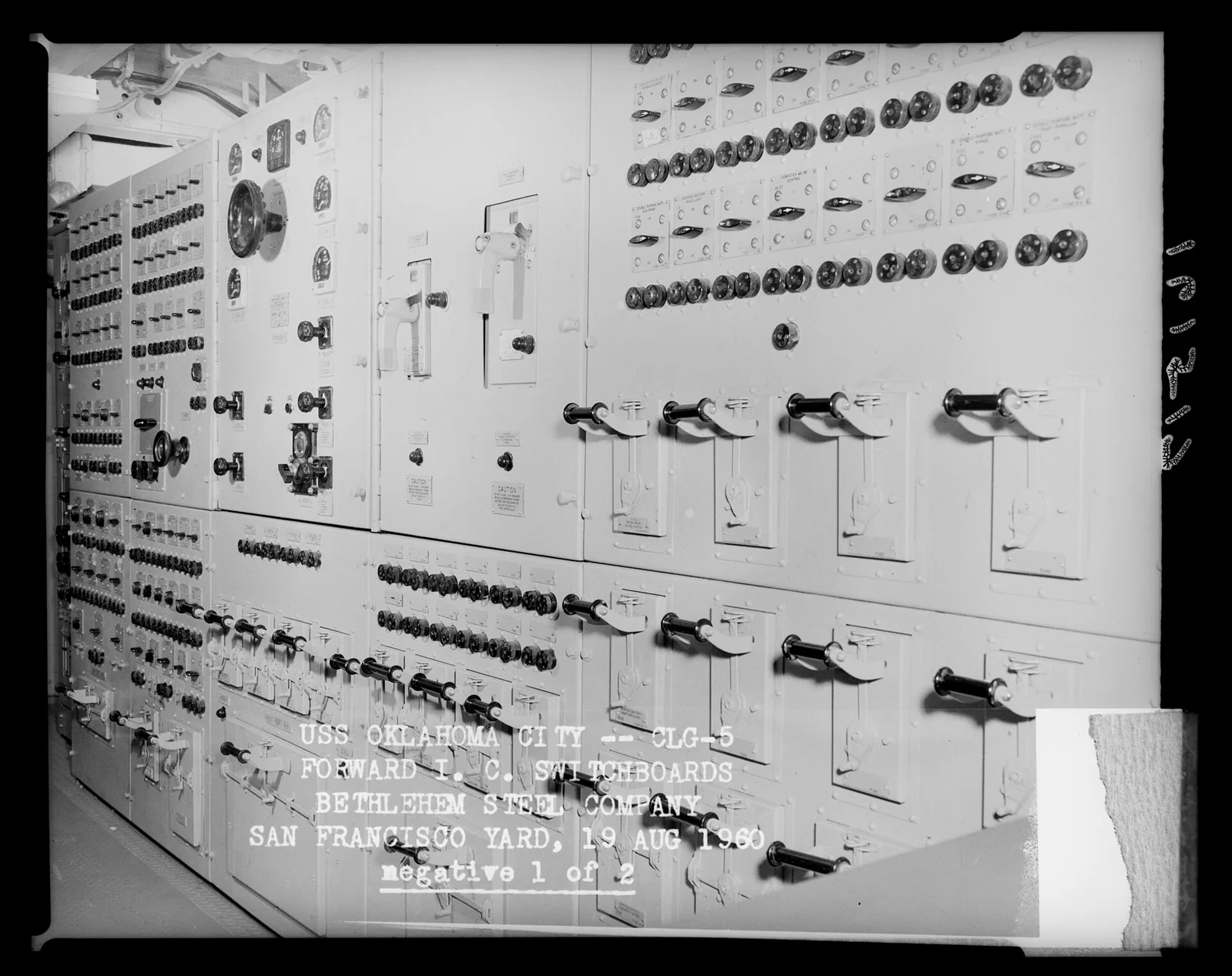
On 7 March 1957 Oklahoma City arrived at the Bethlehem Steel Corporation’s Pacific Coast Yard, San Francisco, where her conversion to a Galveston -class guided missile light cruiser began on 21 May. Her hull classification and number were changed two days later to CLG-5.
Her conversion was a major reconstruction of the ship and involved removing all her guns except for her forward 6-inch Turret I and 5-inch mount. The latter was relocated to approximately the position of the original Turret II. All the aft and almost all the forward superstructures were removed. Below the forward main deck, new 5-inch ammunition handling equipment was installed. The forward superstructure was significantly enlarged to provide space for flag officer and staff quarters and offices.
Her aircraft catapults and hangar were removed from the stern, and the hangar space was converted into crew quarters and storage space. A new armored deckhouse was constructed on the main deck for the Mk. 7 Talos m issle handling system and missile magazines.
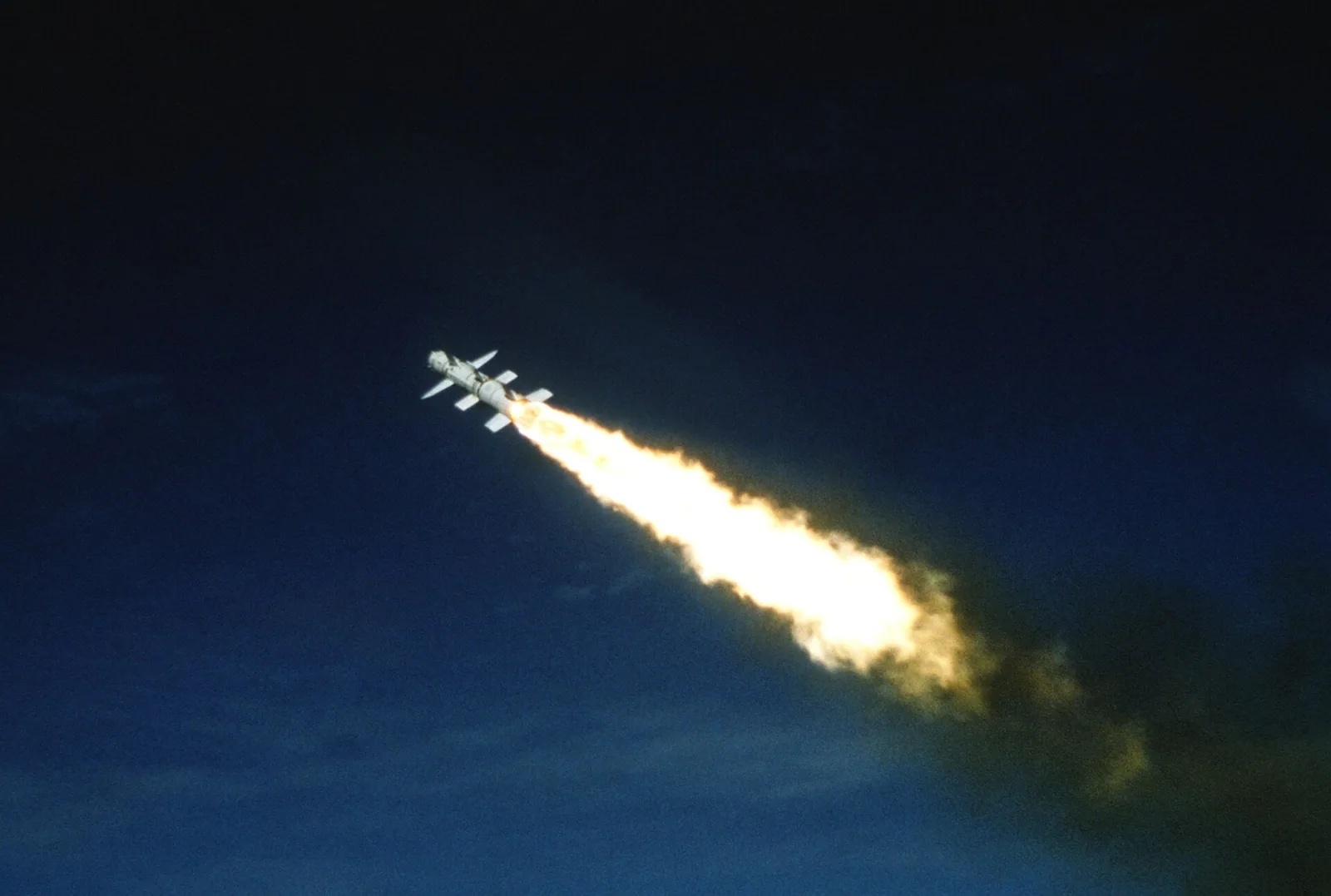
The Mk. 7 Mod 0 missile launcher was located at approximately the position of the original Turret IV. A new deckhouse was constructed on top of the missile house to accommodate weapons control and the Talos tracking radars. Below the main deck aft were the Talos warhead magazine and warhead handling systems. The Talos Mk.7 Guided Missile Launching System (GMLS) that was installed in all three Galveston -class cruisers carried 16 missiles in a ready-service magazine and up to 30 missiles and boosters in a storage area above the main deck. The 32-foot long, 3.5 ton missile was comparable in size to a small fighter aircraft. It could carry either a conventional or a nuclear warhead.
1960
New boat handling and stowage facilities were installed amidships. A large radar tower was located forward, amidships, and aft to carry dozens of radar, radio, and electronic countermeasure antennas. With all these changes the ship bore little resemblance to the original Cleveland -class ship and was essentially a new design. Oklahoma City ’s conversion was completed on 31 August 1960, and she was towed to Hunter's Point at the San Francisco Naval Shipyard where she was recommissioned at 1534 on 7 September 1960 with Capt. Ben W. Sarver in command.
Following a two-month fitting out period and sea trials, Oklahoma City commenced shakedown on 23 November 1960. She arrived at San Diego, Calif., on the 29th and moved to Seal Beach, Calif., on the 30th. There she loaded ammunition including Talos missiles. She continued shakedown exercises out of Long Beach, Calif., and entered the Long Beach Naval Shipyard on 12 December for shakedown availability.
1961
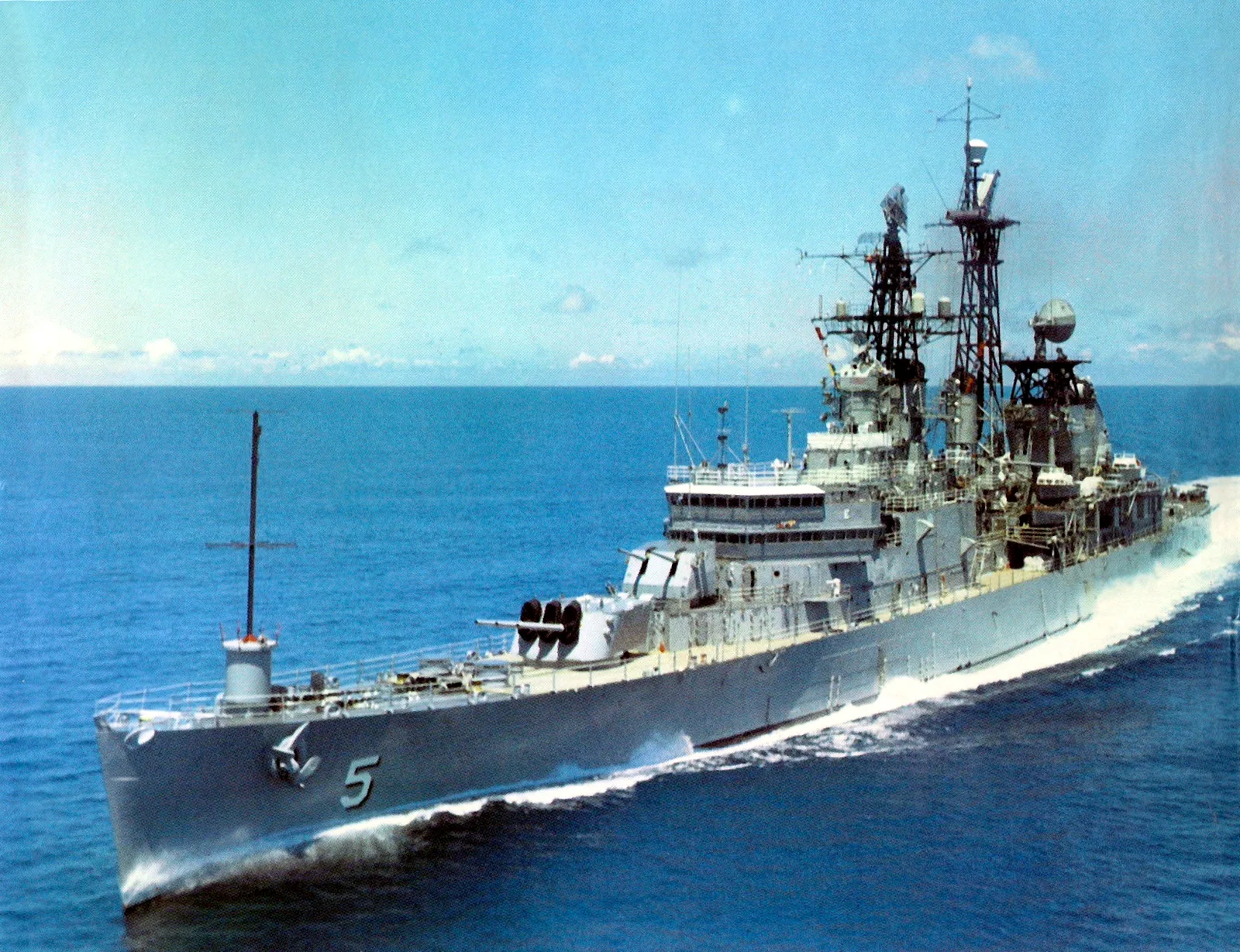
She resumed shakedown training and exercises on 16 January 1961 in the Southern California operating area. On 8 February in the Pacific Missile Range, Oklahoma City became the first combatant unit of the U.S. Pacific Fleet to successfully fire a Talos guided missile. On 24 March she returned to the Long Beach Naval Shipyard for further shakedown work. In April she conducted gunnery drills and fired a Talos missile booster with a slug to test the launch tube. Oklahoma City successfully fired seven Talos missiles over 3 and 4 May 1961 to complete the final phase of her operational training.
On 9 May 1961, Oklahoma City entered the San Francisco Naval Shipyard for two more months of post-shakedown work and repair. She left for Seal Beach, on 11 July 1961 to load ammunition including missiles and moored at Long Beach on the 14th.
Oklahoma City began local drills and exercises off Southern California on 25 July 1961. These continued until 1 December when she departed for Yokosuka, Japan, via Pearl Harbor. En route on the 14th, she was diverted to the position of Choei Maru , reported to be sinking. She reached the area on the 16th, searched for survivors, but found none. She arrived at the Yokosuka Ship Repair Facility on 20 December 1961 to begin a six-month deployment, and was designated the flagship of Vice Adm. William A. Schoech, Commander, U.S. Seventh Fleet.
1962 Operation Talungan
Oklahoma City began operations on 4 January 1962, putting to sea to rendezvous with Task Group (TG) 77.5. She joined Ranger (CVA-61) the next day, receiving a 15-gun salute to Vice Adm. Schoech’s flag. She exercised with TG 77.5, with Lexington replacing Ranger , until mooring at Iwakuni, Japan, on the 12th. As flagship, Vice Adm. Schoech received a steady stream of U.S. and Japanese military and civilian dignitaries on board Oklahoma City .
On 15 January, Oklahoma City steamed for Okinawa and arrived on the 17th. She departed on the 20th and rejoined Lexington the following day for Bandsaw , an anti-air warfare exercise. When Bandsaw ended on the 25th. Oklahoma City departed for Yokosuka and moored at the repair facility on 27 January 1962.
Her next voyage was to the Okinawa operating area. She departed on 13 February to conduct engineering exercises and helicopter operations. Oklahoma City launched a Talos missile on the 17th, and, following a report of a periscope in the area, conducted an unsuccessful search for an unidentified submarine. She rendezvoused with TG 77.7 ( Ranger ) on the 18th and anchored at Kobe and Sasebo briefly on 19 February. Rejoining Ranger ’s screen that night, she returned to Kobe and moored there on the 21st.
Oklahoma City departed Kobe on 26 February 1962 bound for Chinhae, Republic of Korea, and anchored there the following day. U.S., South Korean, and U.N. officials came on board to call upon Vice Adm. Schoech before the ship sailed on the 28th. She arrived at Yokosuka on 2 March and departed for Subic Bay, Republic of the Philippines, on the 17th. She arrived on the 20th, received several high-ranking officers making calls on Vice Adm. Schoech, and then steamed for shore bombardment practice.
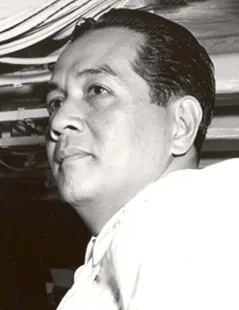
After firing 100 6-inch and 5-inch rounds on the 21st, Oklahoma City anchored in Bagac Bay south of Subic Bay. The following morning, she rendezvoused with Hancock (CVA-19) and TG 261.9 en route to Manila, Republic of the Philippines, for replenishment and anti-aircraft warfare exercises. The task group arrived at Manila on 24 February where Taiwanese and Philippine military commanders came aboard to meet Vice Adm. Schoech. Oklahoma City got underway on the 25th for Operation Talungan (“ Mutual Assistance ”), a major Southeast Asia Treaty Organization (SEATO) amphibious exercise involving U.S., Philippine, and Australian forces. It was the largest post-war Pacific amphibious exercise up to that time. Oklahoma City hosted numerous distinguished guests as observers, including the President of the Republic of the Philippines, Diosdado Macapagal, and U.S. Ambassador to the Philippines William Stevens.
On 26 March 1962, Oklahoma City and her guests anchored in Mindoro Strait and President Macapagal and Ambassador Stevens with their parties helicoptered to view amphibious exercises on Mindoro Island. The ship returned to Manila on the 27th and her crew manned the rails as the Philippine President departed to a 21-gun salute.
Foreshadowing Oklahoma City ’s future role in Southeast Asia, shortly after Talungan ended, U.S. Marine Medium Helicopter Squadron (HMM) 362 deployed from Okinawa on board Princeton (CV-37) . It landed on 15 April 1962 at Soc Trang Airfield in the Mekong Delta of South Vietnam. Under consideration for some time, the deployment decision was made during Operation Talungan , while allied forces were present in force in the region. HMM-362 was the first U.S. Marine air unit to directly aid South Vietnam in its battle against the Viet Cong.
Oklahoma City returned to Subic Bay on 28 March 1962 and steamed for Keelung, Taiwan, on 1 April for a protocol visit. She moored there after an exchange of salutes on the 4th. From there she sailed to Hong Kong, arriving on the 9th. She proceeded to Okinawa on 16 April after a week of formal visits with civil and military officials in the British Crown Colony. Oklahoma City moored in Buckner Bay on the 18th. She departed on the following day for Yokosuka and, once at sea, conducted an unsuccessful Talos missile firing. The missile self-destructed upon booster rocket/missile separation. She arrived at Yokosuka on 21 April 1962.
On 14 May, Oklahoma City sailed for the Okinawa operations area to meet Coral Sea (CVA-43) and four destroyers on the 16th. Upon rendezvous, they commenced a search and rescue (SAR) effort for a missing 16-foot boat north of Yuron Jima, Japan. The unsuccessful search was secured that evening and Oklahoma City exercised in the area until 19 May when she steamed for Yokosuka. She moored on the 21st for another series of official visits with Vice Admiral Schoech, who hauled down his flag on 26 May 1962 in anticipation of Oklahoma City ’s departure.
She sailed for Pearl Harbor on the 28th, accompanied by three destroyer escorts. The ships arrived on 5 June and Oklahoma City departed for Long Beach on the 6th. She arrived on 12 June at the Long Beach Naval Station. She spent the next several months conducting local training operations and launched multiple Talos missiles in the Pacific Missile Range in August.
On 26 November 1962 she entered the Long Beach Naval Shipyard for an overhaul survey and inspection, after which she returned to her naval station mooring. On 7 December she took part in observances for Pearl Harbor Day and on the 14th, she re-entered the Long Beach Naval Shipyard for an extensive overhaul that lasted into October 1963.
Oklahoma City was found to be top-heavy after the CLG Talos conversions. The huge forward superstructure, massive missile house, and tall radar towers caused the ship to roll excessively in heavy seas. While in the shipyard, an extensive program of topside weight reduction was initiated. Many of the antennas on the tall amidship radar tower were relocated to lower positions. The Mk. 34 director for the 6-inch battery was removed leaving both the 6-inch and 5-inch guns under the control of the remaining Mk. 37 director. All unnecessary material from the forward O4 level superstructure was removed. The amidship two-level boat davits were removed from port and starboard, and the boat stowage decks were reconstructed. A single-bank dual arm davit for a 26-foot motor whaleboat was installed on the starboard side. The Fleet Automatic Shuttle Transfer (FAST) system crane was installed on top of the missile house. The original AN/SPS-37 air search radar on the forward tower was replaced with an AN/SPS-43 and the AN/SPS-8B height finding air search radar on the aft tower was replaced with the AN/SPS-30.
1963
Returning to service on 9 October 1963, Oklahoma City conducted local operations out of Long Beach. On the 24th in the Pacific Missile Range off Southern California, she fired her first Talos missiles in ten months. Following the launch, while moored at Port Hueneme, Calif., on 25 October, where Secretary of the Navy Paul B. Fay, Jr., came aboard for an official visit.
Resuming local operations out of Long Beach and San Diego, Oklahoma City fired salutes on 23 November 1963 in honor of late-President John F. Kennedy, who had been assassinated during a visit to Dallas, Texas on 22 November. She commenced firing at 0800 and secured at sunset. She held memorial services on board on the 25th, the day of his burial, and at noon fired a 21-gun salute in honor of the former Navy officer and President.
More local exercises, gunnery practice, and missile launches occurred in December 1963 and Oklahoma City entered the Long Beach Naval Shipyard on 13 December. She returned to operation on 2 March 1964. She operated along the Southern California coast between Long Beach and San Diego through the spring in anticipation of a summer deployment to the Western Pacific. In April she sailed to Ensenada, Mexico, for a two-day official visit. Oklahoma City made periodic visits to the Long Beach Naval Shipyard for various pre-deployment inspections and upkeep, including an underwater hull inspection by divers in May.
Vietnam War period 1964–1975
1964
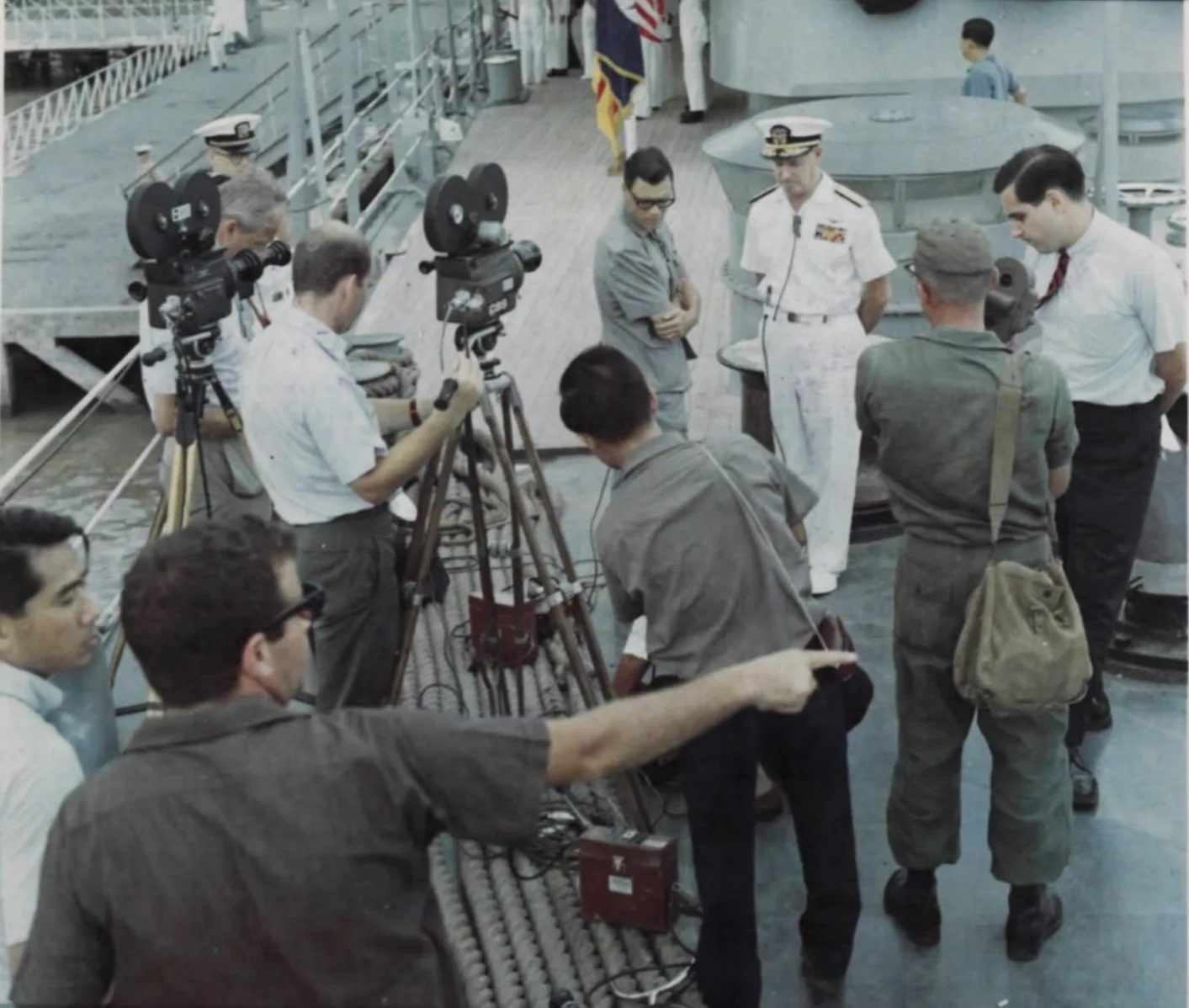
On 16 June 1964, Oklahoma City departed Long Beach for Pearl Harbor and arrived on the 23rd. She left on 27 June for Yokosuka and moored on 7 July. Vice Adm. Roy L. Johnson transferred his flag as Commander, Seventh Fleet from Providence (CLG-6) to Oklahoma City on the 10th, beginning the customary flow of official visits by various unit commanders and officials. On 15 July, she departed for Saigon, Republic of Vietnam.
On the 19th, she rendezvoused with Ticonderoga (CVA-14) and TG 77.5. Oklahoma City moored in the Saigon River on 21 July 1964 and fired a 21-gun salute to the Republic of Vietnam. Official visits by the ship’s captain and the vice admiral began, punctuated by the dropping of a hand grenade on suspicious bubbles in the water near the ship. Wariness over sabotage increased when a diver was reported in the river, but nothing was found. Divers performed a hull inspection before Oklahoma City got underway on 24 July for Camranh Bay, but she changed her destination to Yokosuka the following day.
She moored in the U.S. Naval Shipyard at Yokosuka on 30 July. On 2 August 1964, a confirmed exchange of fire occurred between U.S. and North Vietnamese naval forces in the Gulf of Tonkin. A reported engagement on the 4th turned out to be false, but that day Secretary of the Navy Paul Nitze and several Japanese Maritime Defense Force senior officers called upon Vice Adm. Johnson on board Oklahoma City . On 6 August, 1964, the ship was deployed to the Gulf of Tonkin with Task Force 77 in response to the Gulf of Tonkin incident, beginning her eight years of Vietnam service.
Oklahoma City rendezvoused on the 11th with Task Force (TF) 77 ( Ticonderoga , Kearsarge (CVS-33) , Constellation (CVA-64) , Valley Forge (LPH-8) , and escorts) in the South China Sea off South Vietnam. Despite the assembled firepower patrolling the coast, no action occurred, and on 29 August, Oklahoma City was detached to proceed to Subic Bay. She arrived on the 31st.
Oklahoma City got underway for Keelung, Taiwan, on 3 September and arrived on the 5th. As usual, a stream of military and civil officials came aboard to call upon Vice Adm. Johnson. She got underway on the 8th for Yokosuka and launched an exercise Talos missile en route. She arrived on 11 September 1964.
On the 23rd, Oklahoma City departed for formal visits to Manila and Hong Kong. In both ports Vice Adm. Johnson received visits from local civilian and military officials. She arrived back in Yokosuka on 14 October. On the 22nd, she fired a salute to mark the passing of former President Herbert C. Hoover on 20 October 1964. Another salute in his honor was fired on the 26th (25 October in the U.S.), the day of his burial in West Branch, Iowa.
Oklahoma City steamed for Subic Bay on 2 November 1964 and moored there on the 7th. She left for Port Swettenham, Malaysia, on the 14th and crossed the Equator with appropriate ceremony on 18 November. Later that day, the U.S. Naval Attaché, Singapore, boarded the ship for the run to Port Swettenham where she moored on the 19th for a formal visit. U.S. Ambassador to Malaysia James Dunbar Bell came aboard to call on Vice Adm. Johnson as did Royal Navy and Malaysian officials. Oklahoma City ’s commanding officer called formally upon His Royal Highness, the Sultan of Selangor on the 20th. The Sultan came aboard on the 21st to call upon Vice Adm. Johnson, as did the Indian High Commissioner to Malaysia. All appropriate honors were rendered to the distinguished visitors.
On 23 November, Oklahoma City moved to Singapore. She arrived the following day for formal calls and visits, including with Vice Adm. Sir Desmond Dreyer, R.N., Commander-in-Chief, Far East Fleet, Royal Navy, and the Deputy Prime Minister of Malaysia. On 27 November, she departed for Okinawa, rendezvousing with the Constellation and Kearsarge task groups for exercises en route. She anchored at Buckner Bay on 3 December, proceeded to Yokosuka, conducted a Talos missile firing on the 5th, and arrived on 6 December 1964. Training exercises and operational visits to various ports in the Far East followed. On 1 March 1965, Vice Adm. Paul P. Blackburn, Jr. relieved Vice Adm. Johnson as Commander, Seventh Fleet, with Oklahoma City as his flagship. In June 1965, she began gunfire support missions off Vietnam and was visited by Secretary of the Navy Nitze. She also hosted a visit by U.S. Chief of Naval Operations Adm. David L. McDonald on 12 September off the Vietnamese coast.
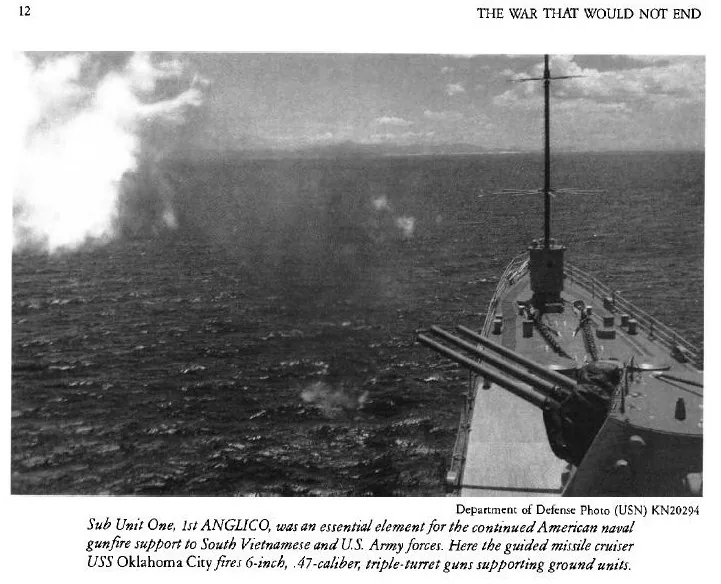
As Vietnam hostilities increased, Oklahoma City began to spend more time in the South China Sea. The ship alternated between gunfire support missions for U.S. and South Vietnamese troops, anti-aircraft suppression missions off North Vietnam (NVN), shipyard visits in Subic Bay, the Philippines and Yokosuka, and “show the flag” protocol visits to numerous ports in Asia. Oklahoma City provided gunfire support for amphibious assaults during operations Piranha , Double Eagle, Deckhouse IV,” and Hastings II” During 402 days in the Vietnam combat zone, Oklahoma City fired nearly 2,000 rounds of 6-inch and some 1,000 five-inch shells on enemy positions.
1966
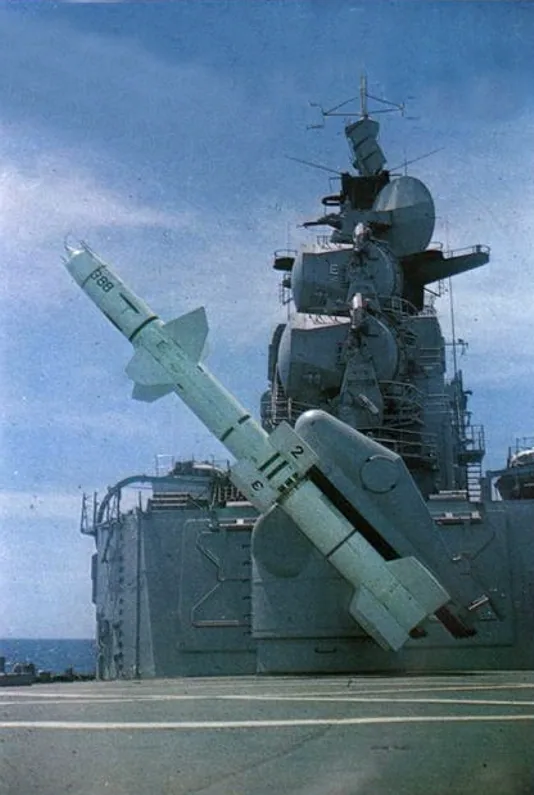
After two and a half years as Seventh Fleet flagship, Oklahoma City was relieved by Providence on 1 December 1966. The ship returned to San Francisco Naval Shipyard for overhaul on 15 December. During this yard period, extensive additions were made to the ship's electronic countermeasures (ECM) systems to improve defenses against anti-ship cruise missiles. More topside weight was removed, including platforms on the aft superstructure. She left the yard on 18 July 1967 for refresher training and steamed to her new home port of San Diego on 22 July, where she assumed duties as First Fleet flagship. After calls to several West Coast ports and an extensive training program, the ship began preparing for another WESTPAC deployment. During this period Oklahoma City conducted several surface-to-surface missile test firings as part of the development of the new RIM-8H Talos anti-radar missile, designed to target and destroy enemy radar sites.
1968
Oklahoma City steamed for the Royal Canadian Naval Base at Esquimalt, British Columbia, on 24 July 1968 with Vice Adm. Bernard F. Roeder, Commander, First Fleet, on board. After official calls from Canadian officers and the Honorable J. R. Nicholson, Lieutenant Governor of the province, she sailed to Vancouver, British Columbia, and was visited by British Consul-General Thomas Codrington. She moved to Seattle on 31 July to participate in the annual SeaFair celebration.
On 25 October 1968, Oklahoma City was relieved as First Fleet flagship by Saint Paul (CA-73) , and she sailed for WESTPAC on 7 November 1968. The ship arrived in Yokosuka, her new home port, on the 22nd and resumed Seventh Fleet flagship duties (Vice Adm. William F. Bringle) from Providence o n 26 November. On 6 December, en route to a Naval Gunfire Support (NGS) assignment off South Vietnam, Oklahoma City crewman Percy Micheaux, FN, USN, jumped overboard and was lost at sea.
The ship conducted NGS missions off South Vietnam and made protocol visits to several ports in Asia in December 1968 and the first part of 1969. Off Da Nang on 15 January 1969, Oklahoma City recovered the body of a Caucasian male from the water. The unidentified body was transferred to the Da Nang Naval Hospital. Most of spring 1969 was spent in NGS operations off Vietnam, but on 15 April, North Korean MiG-21 fighters shot down a U.S. Navy Lockheed EC-121 Warning Star from CVQ-1 (call sign Deep Sea 129) with 31 souls on board, over the Sea of Japan. From 18 to 27 April 1969, Oklahoma City participated in a SAR operation in the Sea of Japan with Task Force 71. She arrived in Manila on 16 May and returned to NGS duties on the 23rd.
1969
On 1 August 1969, Oklahoma City entered dry dock at Yokosuka for repair availability. Her 6-inch guns, worn from heavy use off Vietnam, were replaced, and extensive work was done on her boats, boilers, and air conditioning system. On 3 August, nine Oklahoma City sailors were involved in confrontations with Shore Patrolmen in Yokosuka which resulted in private and government property damage. Apprehended individuals received appropriate discipline and the ship returned to operations on the 21st. She resumed NGS action off Da Nang on 27 August.
At 0300 on 18 October 1969, near the DMZ, crewman Peter E. Gutloff, GMG 3, USN, was lost when he fell overboard in the dark. He was listed as Missing in Action. On 25 November, en route to Yankee Station, Oklahoma City received a call from Dubuque (LPD-8) for medical assistance. The ship’s doctor and a hospital corpsman were helicoptered to Dubuque where they successfully removed a sailor’s ruptured appendix. Two days later, her guns tore apart a communist position near Chu Lai, North Vietnam, destroying buildings, bunkers, and setting fires that resulted in secondary explosions.
Oklahoma City made port visits throughout Asia, performed upkeep and repairs in Subic Bay and Yokosuka, and fired her guns off Vietnam throughout 1969 and 1970. Approximately one third of the ship's time was spent off Vietnam, divided about equally between NGS missions in the south near Da Nang and the Demilitarized Zone (DMZ) and anti-aircraft suppression off North Vietnam. From a station off Vinh, North Vietnam, the ship's long-range air search radars could cover most of North Vietnam and Laos. The ship also cruised outside the harbor at Haiphong, hoping to get a shot at NVN MiGs. Earlier experience had taught the NVN that flying was not safe with a Talos cruiser in the vicinity. Thus, while Oklahoma City was in North Vietnamese waters, the ship did not have the opportunity to fire her Talos missiles at enemy aircraft.
1972 Dong Hoi
In 1971 the ship conducted NGS missions off South Vietnam and operated on PIRAZ (Positive Identification Radar Advisory Zone) and SAR stations off North Vietnam. Between periods in coastal combat zones, Oklahoma City visited ports in Asia and underwent upkeep and repair in Yokosuka. She took on board the new RIM-8H Talos anti-radiation missile in mid-1971. After a practice firing off Okinawa, Oklahoma City spent part of her time off North Vietnam "radar hunting." On 4 February 1972 Oklahoma City became the first U.S. warship to conduct a successful combat surface-to-surface missle shot, destroying a NVN mobile radar system with a RIM-8H.
The Navy stepped-up strikes against NVN targets as communist forces surged across the DMZ. Oklahoma City departed Yokosuka and arrived in the Gulf of Tonkin on 7 April 1972 and joined Task Unit (TU) 70.8.9. On 8 April the ship returned hostile fire from NVN shore batteries. Oklahoma City , in company with several destroyers, moved north along the coast and fired on a series of targets in North Vietnam including installations at Cap Lay, Vinh, and the Dong Hoi Airfield.
The ship was assigned to TU 77.1.1 on 13 April 1972. On the 14th she again engaged NVN shore batteries. On 19 April, Oklahoma City and accompanying destroyers conducted a second strike on Dong Hoi surface-to-air missile sites. During this strike intense hostile fire was received from coastal gun batteries. Oklahoma City received shrapnel-chipped paint and a cut wire antenna from near misses. Shortly thereafter the task unit was attacked by two MiG-17 aircraft from the NVN 923rd Fighter Regiment, one of which was reportedly shot down by a missile from Sterrett (DLG-31) . During the attack a 500-pound bomb exploded off Oklahoma City ’s starboard bow but caused no damage. In the same attack, Higbee (DD-806) was hit by a 500-pound bomb that destroyed her aft 5-inch gun mount, wounding four sailors, but there were no fatalities. Several NVN torpedo boats also attacked TU 77.1.1 and at least one was destroyed in the engagement known as the Battle of Dong Hoi. Oklahoma City and her consorts dueled NVN coastal guns for several weeks, destroying gun installations, radar sites, missile batteries, airfields, bridges, fuel storage sites, communications facilities, and barracks.
On 10 May 1972, Oklahoma City joined Newport News (CG-148) , Providence , Hanson (DD-832) , Myles C. Fox (DD-829) , and Buchannan (DDG-14) in shelling the Cat Bai military airfield on the Do Son Peninsula at the mouth of Haiphong Harbor. This was the first multi-cruiser bombardment since World War II and was a repeat of the bombardments the ship participated in 27 years earlier in WWII. The ship continued to conduct NGS operations throughout the rest of 1972, along with protocol visits to ports in Asia and upkeep in Subic Bay and Yokosuka.
Oklahoma City fired about 18,080 5-inch and 31,370 6-inch rounds in more than 1,100 NGS and shore bombardment operations during the Vietnam War. The total weight of the projectiles was approximately 4,211,430 pounds, or 2,105.7 tons. She earned the Armed Forces Expeditionary Service Medal with two campaign stars and the Vietnam Service Medal with eleven campaign stars for her Vietnam service.
1973
The cease fire for the Vietnam War was announced on 28 January 1973. After this, the pace of activities slowed dramatically, but Oklahoma City continued to sail into the Gulf of Tonkin through May to help enforce the cease fire. She continued her schedule of goodwill visits throughout WESTPAC, with frequent training exercises and inspections to keep the ship in a state of readiness. In 1974 the ship had a series of shipyard periods for a Navy Distillate fuel conversion modification to her engineering plant.
1975 Operation Frequent Wind

Oklahoma City participated in the final actions of the Vietnam War. Between 22 April and 2 May 1975, she served as the command ship for Operation Frequent Wind , the evacuation of Americans and allied Vietnamese during the fall of South Vietnam. On the 29th and 30th of April, the ship received 13 helicopters carrying 154 refugees fleeing Saigon as it fell to the North Vietnamese.
On 30 June 1975, Oklahoma City was re-designated CG-5. She underwent routine maintenance to keep her operational, serving as Seventh Fleet flagship and showing the flag in Asia and the South Pacific. Cruises took the ship to Guam, Australia, Indonesia, and along the east coast of Asia from Malaysia and Singapore to Korea and throughout Japan.
Later service 1976 onwards
1979

From 1975 through 1979 the ship continued to conduct training exercises and inspections to maintain a state of readiness. She conducted several multinational training operations with ships from Australia, New Zealand, Indonesia, and Japan. In May 1979, in a BuzzardEx (missile firing exercise), she launched Talos missiles as targets for aircraft and other ships with advanced Terrier and Standard missile systems. On 20 August 1979, Oklahoma City fired the Navy's last Talos surface-to-air intercept target missile in an exercise off Poro Point, Republic of the Philippines.
The inspection schedule became more rigorous as the Navy evaluated Oklahoma City ’s aging condition. She continued to get a passing grade on InSurv inspections after other ships of her generation were found unfit for service, a tribute to the efforts of the crew to keep her operational. In 1979 the Navy finally decided to retire her. On 5 October 1979 Oklahoma City was relieved as Seventh Fleet flagship by Blue Ridge (AGC-19) at Yokosuka.
On 9 October 1979 Oklahoma City sailed from Yokosuka for the last time. After eleven continuous years in WESTPAC as flagship of the Seventh Fleet, she sailed to Pearl Harbor and then to San Francisco. Oklahoma City participated in another BuzzardEx off Point Mugu, Calif., where Norton Sound (AVM-1) achieved the first successful intercept of a Mach 2.7 Talos target with a Standard 1 missile and the prototype Aegis fire control system. On 6 November, 1979, Oklahoma City fired the the last ship-launched Talos missile and the last 6-inch gun salvo from a U.S. Navy ship.
Oklahoma City was decommissioned and stricken from the Naval Vessel Register on 15 December 1979 at San Diego. She was towed to the Puget Sound Naval Shipyard in Bremerton, Wash., and placed in the mothball fleet. She remained there until 1992 when she was towed to the Suisun Bay Reserve Fleet at Benicia, Calif. After hull repairs at Richmond, Calif., the ship was modified to serve as a test platform for new weapons sensors and countermeasures systems. She was then moved to Port Hueneme, where she was occasionally towed out to sea to test new electronics and radars, including equipment for the B-2 bomber.
1998
In the spring of 1996, the ship was transferred to the Inactive Ships list, and the decision was made to use her as a target in a Sinkex (sink exercise). She was towed to the Suisun Bay Reserve Fleet to await her fate. In October 1998 she was moved to the Mare Island Naval Shipyard, Vallejo, Calif., for preparation as a target ship. Oklahoma City was towed through the Golden Gate on 6 January 1999 and arrived at Pearl Harbor on the 20th. While at Pearl, material was salvaged from her for use in outfitting Missouri (BB-63) as a museum ship, and the Stars and Stripes were hoisted to the top of her mast for one last time. On 16 February she was towed to Guam by the tug Narragansett (ATF-167).
1999 Operation Frequent Wind
As part of the Multinational Training Exercise 1999 ( Tandem Thrust ), ex- Oklahoma City was fired upon by ships and aircraft from 25 to 27 March and was finally sunk by a torpedo from the South Korean submarine Le Chung (SS-062). The ship sank in 6,000 feet of water in about 25 minutes, 230 miles southwest of Guam, on 27 March 1999 at 1103.
Oklahoma City was on active duty for 21 years, the longest service record of the original Cleveland -class cruisers. She served as the flagship for 13 Seventh Fleet commanders.
Oklahoma City received two battle stars for World War II: Okinawa Gunto operation (Assault and occupation of Okinawa Gunto, 24 March -30 June 1945), and 3rd Fleet operations against Japan (10 July - 15 August 1945).
She received 13 campaign stars for Vietnam service: Vietnam Defense Campaign (17 July – 12 December 1965); Vietnam Counter-offensive (20 January – 3 June 1966); Vietnam Counter-
Offensive II (11 July – 18 November 1966); Vietnam Counter-offensive VI (8 December 1968 – 22 February 1969); Tet 69 Counter-offensive (24 February – 8 June 1969); Vietnam, Summer – Fall 1969 (14 June – 22 October 1969); Vietnam, Winter-Spring 1970 (26 November 1969 – 14 April 1970); Sanctuary Counter-offensive (24 May – 17 June 1970); Vietnam Counter-offensive VII (22 July 1970 – 7 June 1971); Consolidation I (12 July – 16 November 1971); Consolidation II (1 December 1971 – 1 March 1972); Vietnam Ceasefire (7 April 1972 – 1 March 1973); Operation Frequent Wind (29 - 30 April 1975).
Other photographs
Held for this vessel, and not tied to any part of the account above.




References
Every work this entry draws on. There are no numbered markers in the text above: what we hold is the provenance of the page — this history, this article, these photographs.
- History Oklahoma City I (CL-91) Dictionary of American Naval Fighting Ships, Naval History and Heritage Command. A work of the United States Government, in the public domain — the only text on this site reproduced verbatim.
- Facts USS Oklahoma City (CL-91) Structured facts only — dates, dimensions, armament and fate. No wording is taken from it. Harvested 1 August 2026.
- Photograph USS Oklahoma City (CLG-5) underway 1974 DanMS at English Wikipedia — Transferred from en.wikipedia to Commons — Public domain — Wikimedia Commons
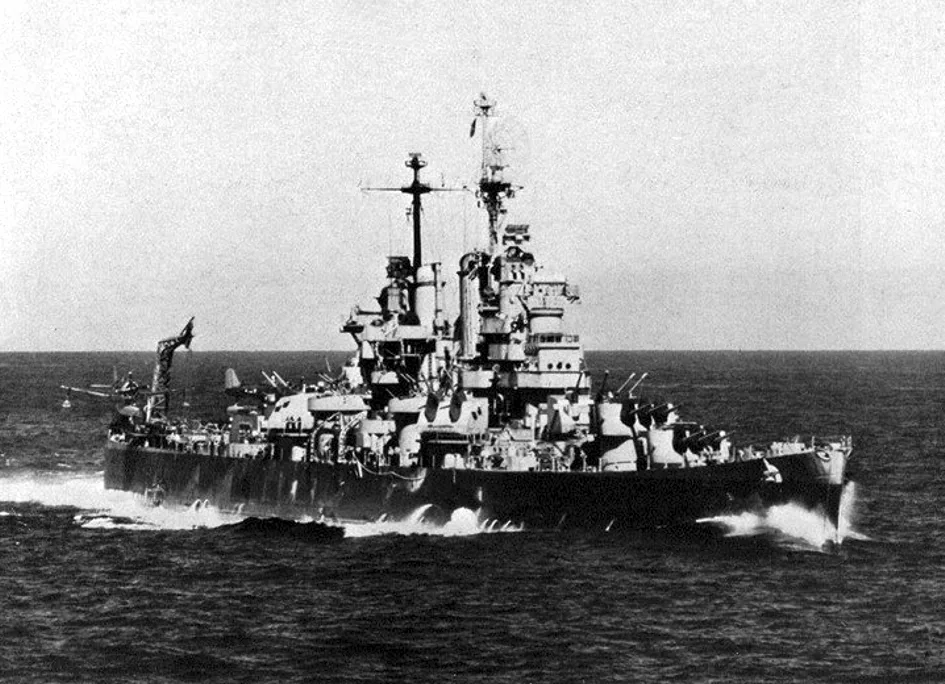
- Photograph USS Oklahoma City (CL-91) underway c1945 USN — U.S. Navy photo [1] from the USS Oklahoma City (CL-91) 1944-45 cruise book available at Navysite.de — Public domain — Wikimedia Commons
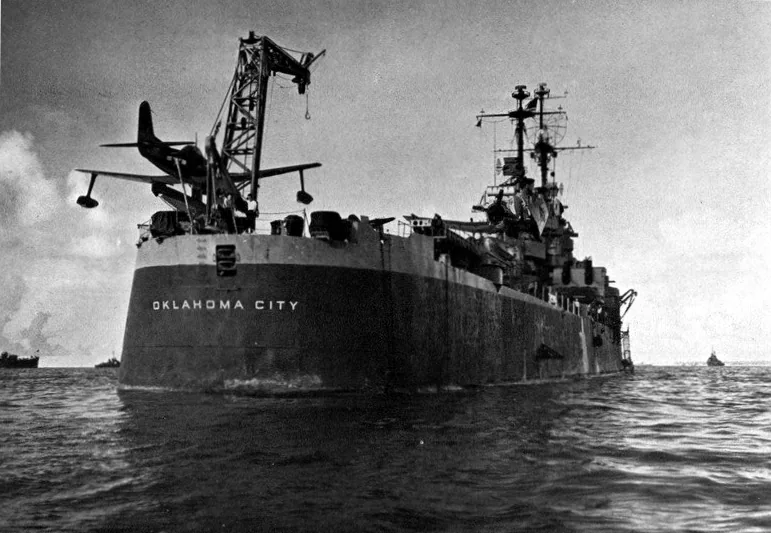
- Photograph USS Oklahoma City (CL-91) stern with SC Seahawks c1945 USN — U.S. Navy photo [1] from the USS Oklahoma City (CL-91) 1944-45 cruise book available at Navysite.de — Public domain — Wikimedia Commons
- Photograph USS Oklahoma City (CL-91) at sea c1945 USN — U.S. Navy photo [1] from the USS Oklahoma City (CL-91) 1944-45 cruise book available at Navysite.de — Public domain — Wikimedia Commons
- Photograph USS Oklahoma City (CLG-5) at sea in the early 1960s USN — Official U.S. Navy photo in: Stefan Terzibaschitsch Die Kreuzer der U.S. Navy: von der Omaha-Klasse (1922) bis zur Long Beach (1962) . Herford (Germany), Koehler, 1982, cover. ISBN 3-7822-0348-8 — Public domain — Wikimedia Commons
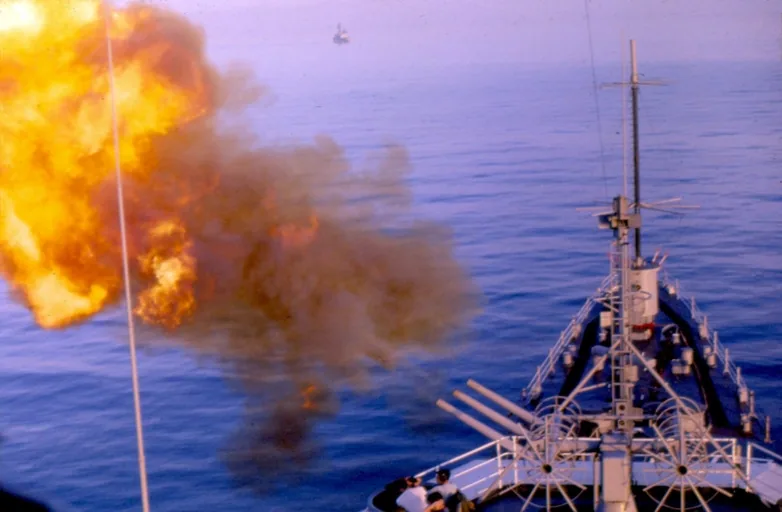
- Photograph CLG-5 firing forward guns early 1970s Paul Malcolm FTG2, USN — U.S. Navy photo [1] from the CLG-5 veteran's website [2] — Public domain — Wikimedia Commons
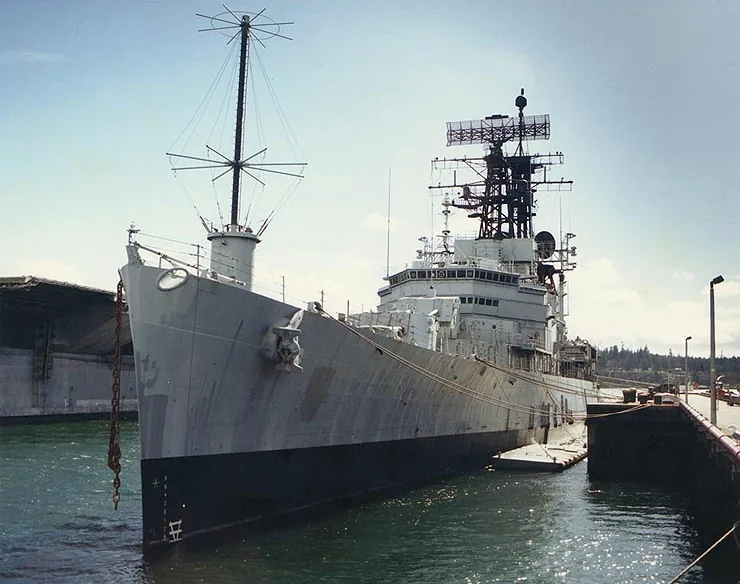
- Photograph USS Oklahoma City (CG-5) mothballed 1987 USN. — Official U.S. Navy photograph NH 98671-KN , from the collections of the Naval Historical Center — Public domain — Wikimedia Commons
- Photograph A view of a Talos surface-to-air missile, gaining altitude after being fired from the guided missile cruiser USS OKLAHOMA CITY (CG-5) - DPLA - 77058613d416e5319235df03df3aecc9 Department of Defense. American Forces Information Service. Defense Visual Information Center. 1994 — This file was contributed to Wikimedia Commons by National Archives at College Park - Still Pictures as part of a cooperation project. The donation was facilitated by the Digital Public Library of America , via its partner Digital Public Library of America . Record in source catalog DPLA identifier: 77058613d416e5319235df03df3aecc9 National Archives Identifier: 6372308 — Public domain — Wikimedia Commons
- Photograph Air America UH-1 approaches USS Blue Ridge PH3 M Musser — https://www-fold3-com.wikipedialibrary.idm.oclc.org/image/304731332?terms=k108231,428,746,gx — Public domain — Wikimedia Commons
- Photograph BR, Vietnam, 1972, Easter Counter-Offensive, file 014 U.S. MARINES IN VIETNAM, THE WAR THAT WOULD NOT END, 1971-1973 — http://www.marines.mil/Portals/59/Publications/U.S.%20Marines%20in%20Vietnam%20The%20war%20that%20would%20not%20end%201971-1973%20PCN%2019000311200_1.pdf — Public domain — Wikimedia Commons
- Photograph CLG 5 Oklahoma - DPLA - e4f95413630ba7cb08f9bae1dc7abb77 Department of Defense. Department of the Navy. Bureau of Ships. 9/18/1947-5/1/1966 — This file was contributed to Wikimedia Commons by National Archives at College Park - Still Pictures as part of a cooperation project. The donation was facilitated by the Digital Public Library of America , via its partner Digital Public Library of America . Record in source catalog DPLA identifier: e4f95413630ba7cb08f9bae1dc7abb77 National Archives Identifier: 7578049 — Public domain — Wikimedia Commons
- Photograph Diosdado Macapagal USS Oklahoma City 1962 cropped PH1 Nelson Archey — http://www.ussokcity.com/kinnemanpix.html — Public domain — Wikimedia Commons
- Photograph Diosdado Macapagal USS Oklahoma City 1962 PH1 Nelson Archey — http://www.ussokcity.com/kinnemanpix.html — Public domain — Wikimedia Commons
- Photograph Final US Navy RIM-8 Talos firing 1979 Camera Operator: PH1 DAVID C. MACLEAN — ID:DN-ST-84-03162 / Service Depicted: Navy / National Archive# NN33300514 2005-06-30 — Public domain — Wikimedia Commons
- Photograph Media interview VADM Roy L. Johnson aboard USS Oklahoma City in Saigon SP5 Gilbert L. Meyers — https://www-fold3-com.wikipedialibrary.idm.oclc.org/image/245041523/cc26863-page-1-us-photos-vietnam-war-army-1963-1973 — Public domain — Wikimedia Commons
- Photograph RIM-8 Talos launch from CLG-5 1961 Jerry Kinnaman PHAN, USN — U.S. Navy photo [1] from the CLG-5 veteran's website [2] — Public domain — Wikimedia Commons
- Photograph RIM-8 Talos launched USS Oklahoma City 1979 Camera Operator: PH1 David C. Maclean, U.S. Navy — U.S. DefenseImagery photo , VIRIN: DN-ST-84-03164 — Public domain — Wikimedia Commons
- Photograph RIM-8 Talos launched PH1 DAVID MACLEAN — DoDMedia — Public domain — Wikimedia Commons
- Photograph RIM-8 Talos missile aboard USS Oklahoma City (CLG-5), circa in 1966 U.S. Navy — U.S. Navy photo [1] from the USS Oklahoma City (CLG-5) 1965-1966 cruise book available at Navysite.de — Public domain — Wikimedia Commons
- Photograph RIM-8 Talos missiles on USS Oklahoma City (CG-5) 1979 PH1 David C. MacLean, USN — U.S. DefenseImagery photo VIRIN: DN-ST-83-04756 — Public domain — Wikimedia Commons