United States Navy — Destroyer
USS Putnam (DD-757) — service history
This is the full service history. For the vessel's particulars, photograph and specifications, see the entry.
In the words of the US Navy. The account below is reproduced verbatim from the Dictionary of American Naval Fighting Ships, compiled by the Naval History and Heritage Command — a work of the United States Government, in the public domain, and the only text on this site not written here.
Before commissioning
Charles Flint Putnam was born in Freeport, Illinois 1 December 1854 and entered the Naval Academy at the age of 14. Upon his request at graduation in 1873, he was ordered to the Far East in Kearsarge, serving in that vessel with the Asiatic Squadron until 1875. Master Putnam was stationed at San Francisco in 1876 and was attached to schoolship Jamestown in 1877-78. In 1879 he joined the Coast Survey steamer Hassler in the North Pacific. Putnam volunteered in 1881 for service in Rodgers, fitted out to search for Jeanette, which had been lost in the Arctic on an expedition to reach the North Pole. When Rodgers burned at St. Lawrence Bay, Siberia, 30 November 1881, Putnam took supplies to the survivors on dog sledges. On his return to his depot at Cape Serdze, he missed his way in a blinding snow storm 10 January 1882, drifted out to sea on an ice-floe and was never heard from again.
Second World War 1939–1945
1943
The second Putnam (DD-757), a flush-decked, "shorthulled" Sumner class, all-purpose destroyer, was laid down 11 July 1943 by Bethlehem Steel Co., Shipbuilding Division, San Francisco, Calif.; launched 26 March 1944; sponsored by Mrs. Doana Putnam Wheeler; and commissioned 12 October 1944, Comdr. Frederick V. IT. Hilles in command.
1944
Following shakedown off the Pacific coast, Putnam glided beneath the Golden Gate Bridge 30 December 1944 to take her place with the Pacific Fleet. Arriving Pearl Harbor 2 January 1945, the destroyer prepared for her first offensive operation, and got under way 29 January for the Marianas, screening the transports carrying 4th and 5th Division Marines.
Pausing briefly at Eniwetok, Saipan, and Tinian, the destroyer steamed from Guam 17 February in convoy enroute Iwo Jima. As she arrived off Iwo Jima on D-Day (19 February) the pandemonium of amphibious warfare engulfed her. Gunfire support ships lying off-shore kept a thunderous rain of destruction pouring on the island. Already frayed nerves were ground to tatters by the stentorian cracking of the heavy guns.
Putnam inched in dangerously close to blast shore installations in support of the invading leathernecks and illuminated Japanese troop concentrations at night with star-shells. On 23 February, Secretary of the Navy, James Forrestal and a high-ranking Navy-Marine Corps party, after observing the initial phases of the landing, embarked in Putnam for transportation to Guam. Fleet Admiral Chester W. Nimitz was on hand at Guam to greet Mr. Forrestal and his party.
Putnam departed Guam 12 March and escorted logistics ships to Leyte, P.I., arriving five days later. She stood out of San Pedro Bay, P.I. 27 March and escorted a transport group to Okinawa; arriving Easter Sunday, the destroyer immediately took up AAW screening duties. After escorting a convoy to Ulithi Putnam returned to Okinawa and was assigned a gunfire support station southwest of the Island 16 April.
Later assigned to a hazardous radar picket station, Putnam vectored Navy fighters against Kamikazes. She remained unscathed only because an unidentified American pilot heroically crashed into a Kamikaze 16 June just seconds before it would have hit the destroyer.
Soon after sundown the same day a torpedo dropped from a low-flyer struck Twiggs (DD-591) to port and exploded her No. 2 magazine. Captain Glenn R. Hartwig, the squadron commander in Putnam, quickly closed. Exploding ammunition made rescue operations hazardous, but of 188 Twiggs survivors snatched from the sea, Putnam accounted for 114.
1945
Retirement from a subdued Okinawa 1 July 1945 simply meant another variation on the theme of victory at sea for Putnam. Hard-hitting planes from the carriers of Task Force 38 were severing the flimsy Japanese supply lines in the East China Sea, rendering an explosive coup de grace to the Empire's once mighty merchant marine. Putnam's guns assisted in screening the carriers in these anti-shipping strikes, through 8 August.
With the "cease hostilities" order of 15 August, the occupation of the Japanese home islands became the immediate concern, and through the first week of September Putnam served as a guide and rescue destroyer for Tokyo-bound transport planes. She left her station, some 100 miles north of Okinawa, 13 September to serve in the escort for New Jersey (BB-62) as she steamed for Wakayama, on the central island of Honshu.
Putnam stood into Tokyo Bay 17 September, where she rode out a howling typhoon. She then made a return to Wakayama 25 September, thence to Okinawa 1 October, and then back to Wakayama. Steaming via Eniwetok 5 December, the destroyer touched at Pearl Harbor 10 December for fuel, and dropped her hook at San Diego 22 December.
Post-war 1946–1949
1946
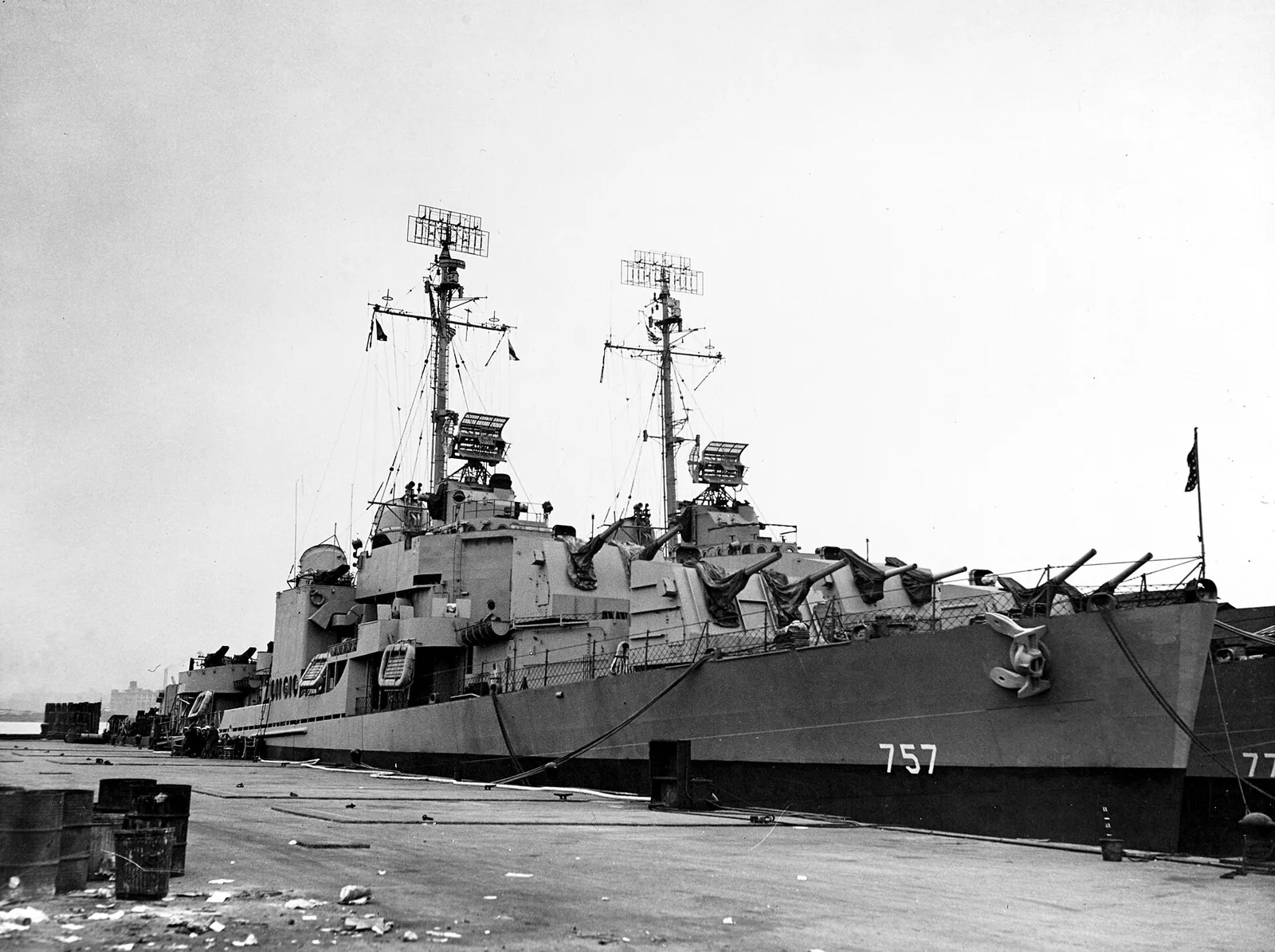
Standing out of San Diego 3 January 1946, Putnam steamed for the New York Naval Shipyard, Brooklyn, for availability. She subsequently operated out of Newport, R.I. until the beginning of 1947, when she made Pensacola, Fla. her base. Late April 1947, Putnam called at Norfolk, Va. to be readied for a peacetime cruise to European waters.
1948
Putnam was one of three destroyers assigned 19-25 April 1948 to the United Nations mediator, Count Folke Bernadotte, to attempt to maintain peace between Arab and Israeli forces. When the truce temporarily broke down Putnam stood into Haifa 23 July to evacuate the UN team from that port. She was thus the first U.S. Navy ship to fly the UN flag.
Korean War period 1950–1953
1950
After a brief period of decommissioned reserve status with the Atlantic Reserve Fleet, Putnam reactivated in October 1950. A Mediterranean cruise took her away from Norfolk from October 1951 through 4 June 1952. Local operations and overhaul were followed by Caribbean refresher training 21 May through 10 July 1953. Putnam departed Norfolk 25 September and transited the Suez Canal 15 October, arriving Yokosuka 10 November. She operated in the Sea of Japan and the East China Sea through 11 March 1954. Departing Midway 17 March, she touched at Pearl Harbor 21 March, called at various west coast ports, then transited the Panama Canal and arrived Norfolk 1 May.
Cold War 1954–1963
1958
Lantflex 1-55 commenced a round of training cruises and deployments which took Putnam from the east coast to the Mediterranean and the Caribbean. Her 1955 and 1956 Mediterranean deployments were followed by NATO North Atlantic exercises late 1957. A September 1958 Mediterranean deployment was followed by overhaul at the Philadelphia Naval Shipyard.
1962
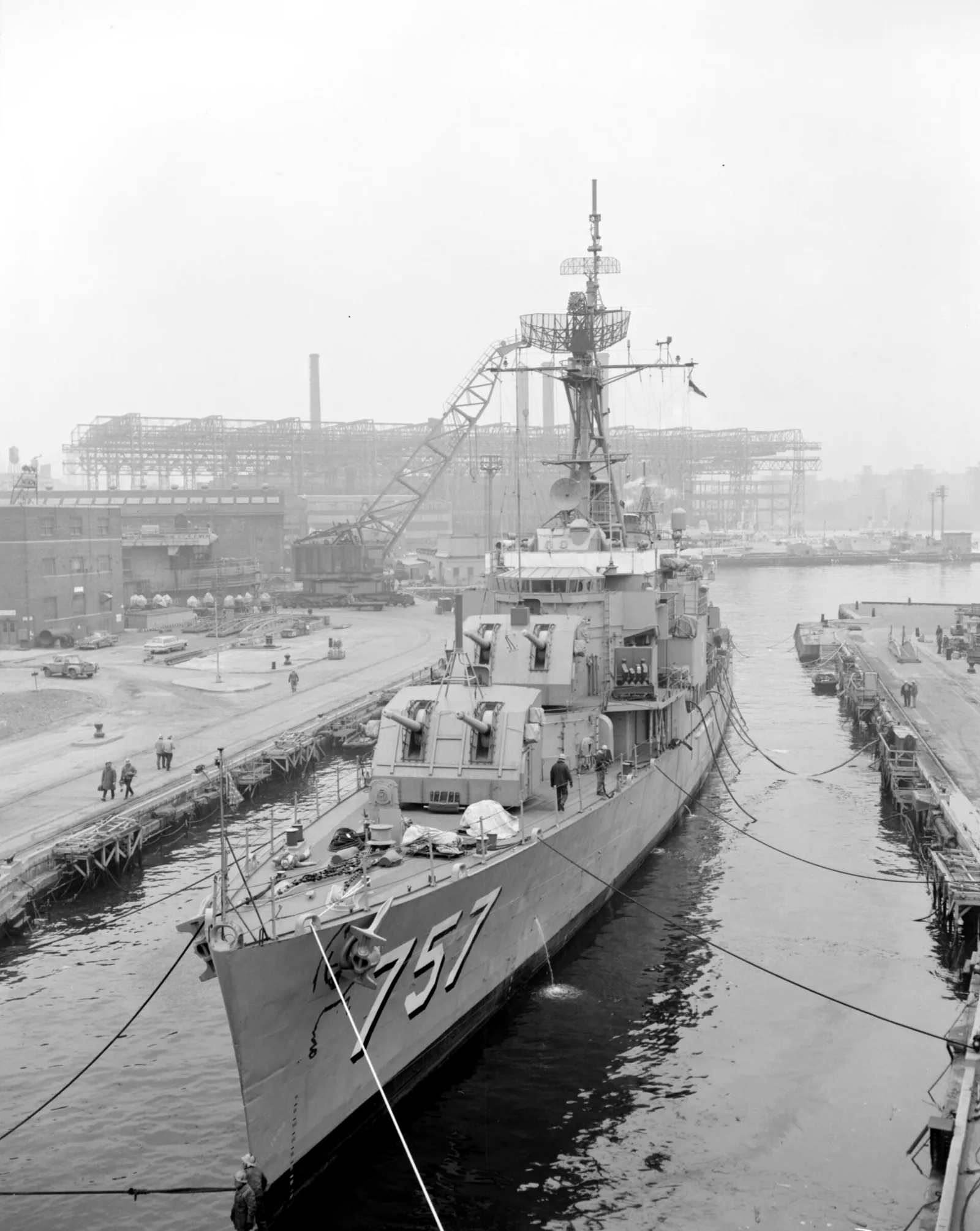
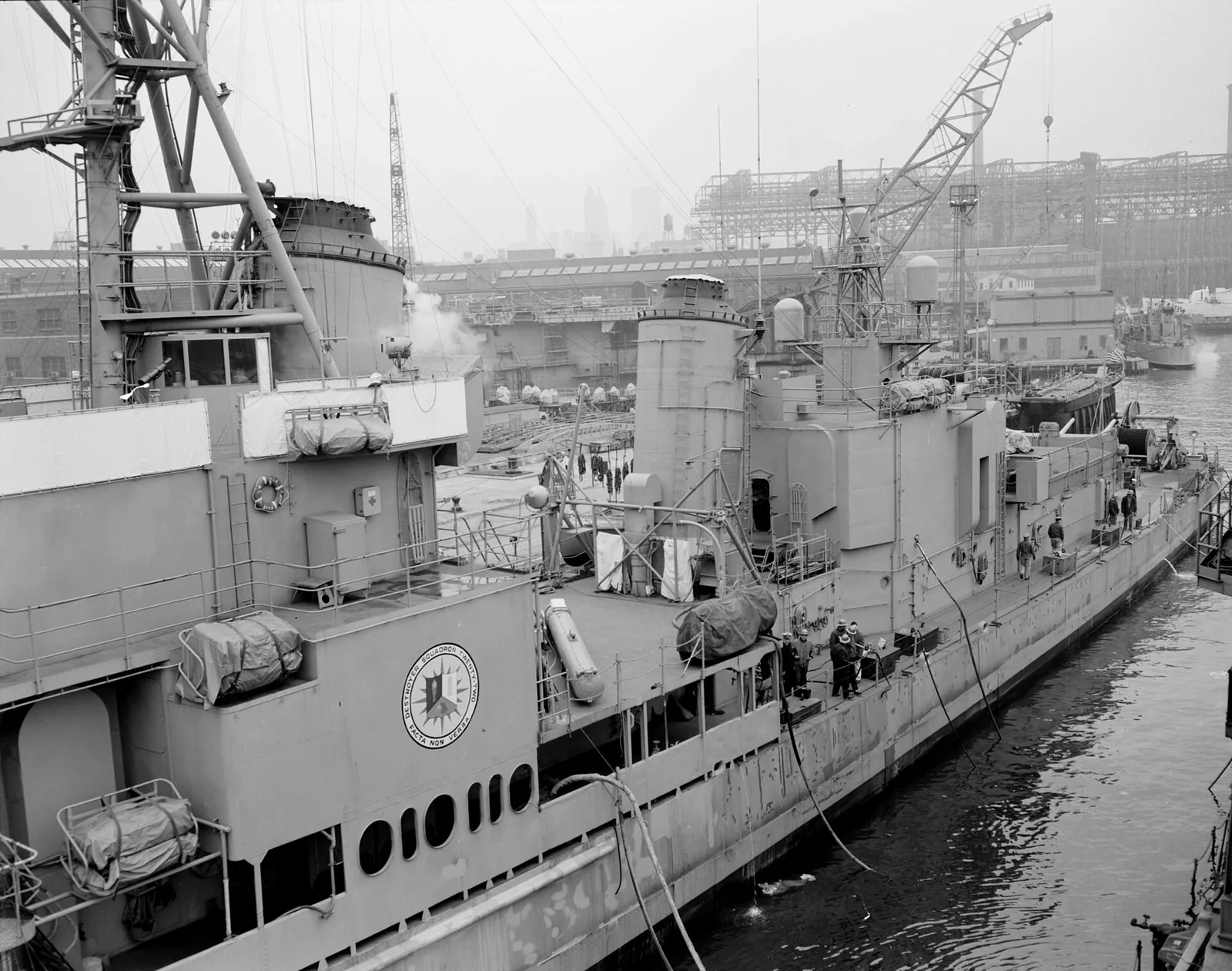
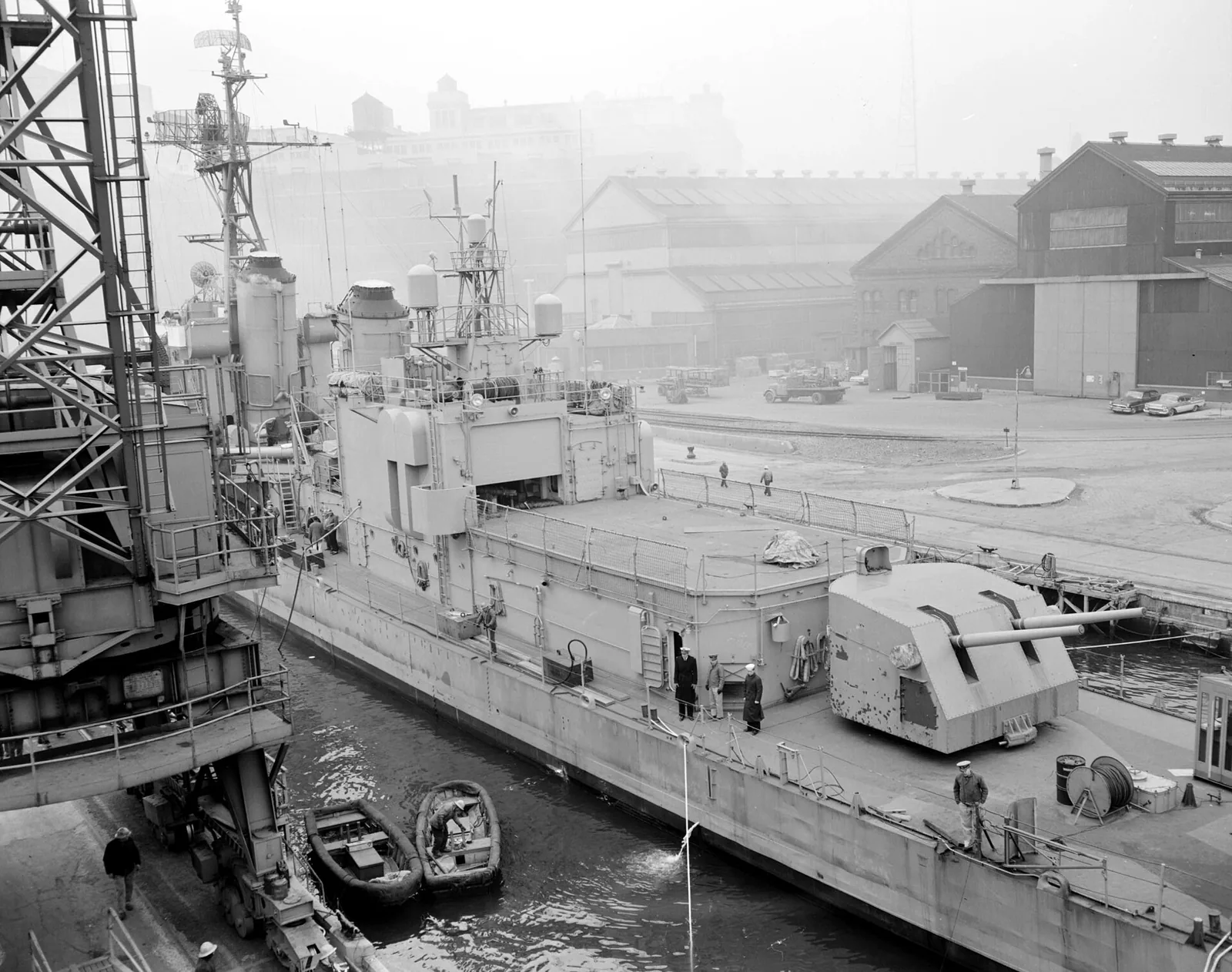
Summer 1959 found Putnam participating in the first operation "Inland Seas" during which she steamed in all five of the Great Lakes. Between 1960 and 1969 the destroyer made nine annual deployments to the Mediterranean, interspersed with northern European operations, coast-wise trips, and visits to the Caribbean. In June 1962 she entered the New York Naval Shipyard for a FRAM Mk. 11 conversion, which was completed in March 1963.
Into 1970 she continues active in the best traditions of the destroyer force providing an American presence during her deployments and always exercising and refining her multifaceted capabilities in ASW, AAW, surface gunnery, shore bombardment, and the multitudinous assignments that have traditionally been the lot of the all-purpose destroyer.
Other photographs
Held for this vessel, and not tied to any part of the account above.


References
Every work this entry draws on. There are no numbered markers in the text above: what we hold is the provenance of the page — this history, this article, these photographs.
- History Putnam II (DD-757) Dictionary of American Naval Fighting Ships, Naval History and Heritage Command. A work of the United States Government, in the public domain — the only text on this site reproduced verbatim.
- Facts USS Putnam (DD-757) Structured facts only — dates, dimensions, armament and fate. No wording is taken from it. Harvested 1 August 2026.
- Photograph USS Putnam (DD-757) off San Francisco, California (USA), on 29 December 1944 (19-N-76730) U.S. Navy Bureau of Ships — Official U.S. Navy Bureau of Ships photo 19-N-76730 available at Destroyerhistory.org — Public domain — Wikimedia Commons
- Photograph USS Putnam (DD-757) underway in the Atlantic Ocean on 12 October 1964 (NH 107151) AN Darrell L. Johnson, U.S. Navy — U.S. Navy photo NH 107151 — Public domain — Wikimedia Commons
- Photograph DD-757 Putnam - DPLA - b6c90521ca5454eeb0fd81c600631585 Department of Defense. Department of the Navy. Bureau of Ships. 9/18/1947-5/1/1966 — This file was contributed to Wikimedia Commons by National Archives and Records Administration as part of a cooperation project. The donation was facilitated by the Digital Public Library of America , via its partner Digital Public Library of America . Record in source catalog DPLA identifier: b6c90521ca5454eeb0fd81c600631585 National Archives Identifier: 24743647 — Public domain — Wikimedia Commons
- Photograph USS Putnam (DD-757) at the New York Naval Shipard, circa in March 1963 (24743647) U.S. Navy Bureau of Ships photo 19-NN - DD-757 Putnam - 394B-4 — Public domain — Wikimedia Commons
- Photograph USS Putnam (DD-757) at the New York Naval Shipard, circa in March 1963 (24743651) U.S. Navy Bureau of Ships photo 19-NN - DD-757 Putnam - 394B-6 — Public domain — Wikimedia Commons
- Photograph USS Putnam (DD-757) at the New York Naval Shipard, circa in March 1963 (24743653) U.S. Navy Bureau of Ships photo 19-NN - DD-757 Putnam - 394B-7 — Public domain — Wikimedia Commons
- Photograph USS Putnam (DD-757) docked at New York City on 24 March 1946 (NH 66346) Unknown author — U.S. Navy photo NH 66346 — Public domain — Wikimedia Commons
- Photograph USS Putnam (DD-757) insignia, in the 1950s (NH 65170-KN) U.S. Navy: post-work Cobatfor — U.S. Navy photo NH 65170-KN — Public domain — Wikimedia Commons
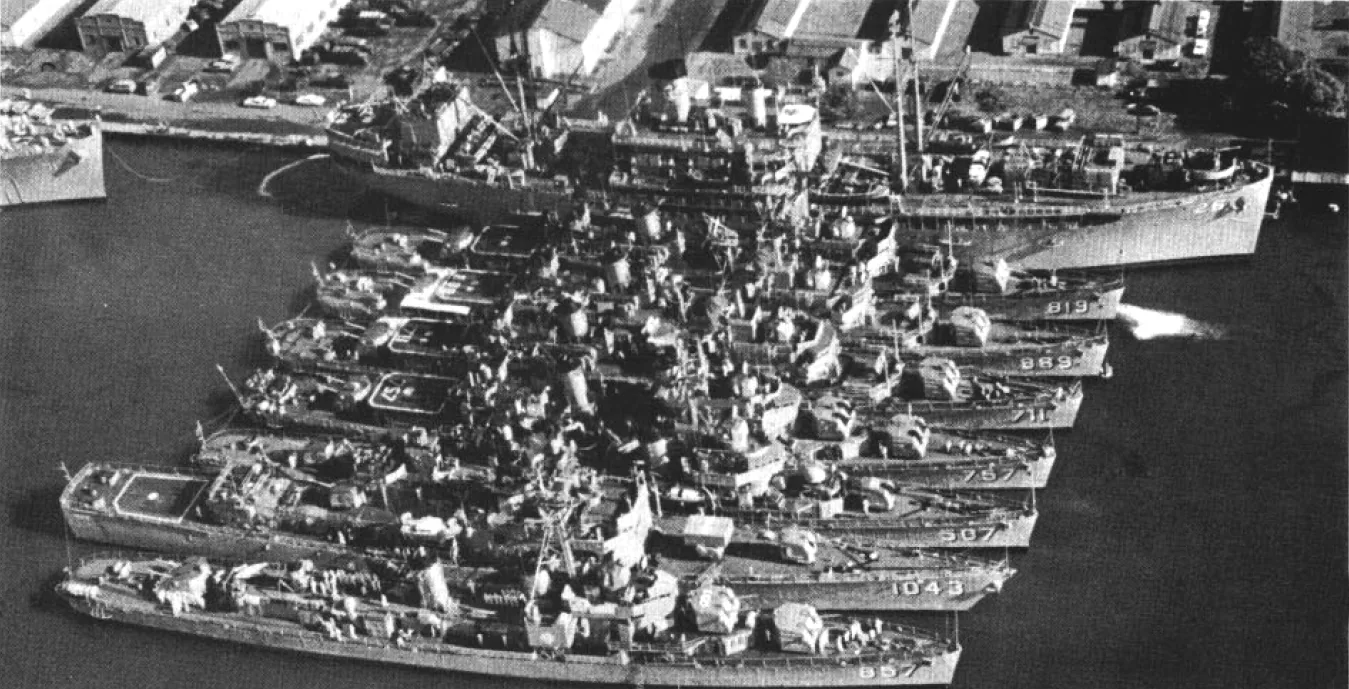
- Photograph USS Shenandoah (AD-26) with DesRon 32 at San Juan PR c1966 USN — U.S. Navy All Hands magazine July 1966 , p. 38 — Public domain — Wikimedia Commons