United States Navy — Destroyer escort
USS Raymond (DE-341) — service history
This is the full service history. For the vessel's particulars, photograph and specifications, see the entry.
In the words of the US Navy. The account below is reproduced verbatim from the Dictionary of American Naval Fighting Ships, compiled by the Naval History and Heritage Command — a work of the United States Government, in the public domain, and the only text on this site not written here.
Before commissioning
The second U.S. Navy ship named Raymond honored Reginald Marbury Raymond--born in Sewanee, Tenn., on 20 May 1912, to Reginald I. and Helen M. Butler--who entered the U.S. Naval Academy, Annapolis, Md., in 1929. Commissioned as an ensign on 1 June 1933, Raymond received his first assignment to heavy cruiser Chester (CA-27), serving on board until 10 June 1935. He then reported to the Submarine Base, New London, Conn., for instruction in submarines, completing the course in December 1935. Ordered to Submarine Squadron (SubRon) 5, he reported on board submarine tender Canopus (AS-9). Raymond remained in the Asiatic Station in S-38 (SS-143) until returning to the United States in August 1938.
Reporting in October 1938 to the New London Ship & Engine Co., Groton, Conn., Raymond performed duties in connection with fitting out Saury (SS-189) and served on board from her commissioning on 3 April 1939 until October 1941. Ordered to shore duty at the Office of the Chief of Naval Operations, he began working as Naval Observer at the American Legation, Cairo, Egypt, serving in that capacity from February–June 1942. While there, Raymond made several patrols on board British submarines, observing operations against Axis forces in the Mediterranean. Upon returning to the U.S., he assisted in fitting out Scorpion (SS-238) at the Portsmouth Navy Yard, Portsmouth, N.H., joining the new boat as her executive officer. He received his promotion to lieutenant commander on 1 October, the same day Scorpion was commissioned.
Second World War 1939–1945
1943
Scorpion , commanded by Lt. Cmdr. William N. Wylie, began her first [and most successful] war patrol in the sea-lanes off Tokyo on 9 April 1943. After attacking and sinking the 1,933 ton converted gunboat Meiji Maru, on 20 April, she added four Japanese sampans to her total only two days later. On 27 April, Scorpion attacked a convoy, striking and damaging a cargo vessel of some 7,500 tons. Sighted and depth-charged by an enemy destroyer for over half an hour, Scorpion next proceeded to torpedo and sink the 6,480 ton merchant ship Yuzan Maru after the destroyer surrendered the chase to render assistance to the cargo vessel. After receiving orders home on 28 April, Scorpion engaged and sank a 100-ton enemy patrol vessel.
At 0924 on 30 April 1943, the surfaced submarine sighted and engaged in a gun battle with the 600-ton Japanese patrol vessel Ebisu Maru . A bullet to the center of his forehead suddenly struck Lt. Cmdr. Raymond, firing a Browning automatic rifle from the bridge railing at the enemy ship, killing him instantly. At 0930, Scorpion fired a torpedo striking the enemy vessel and causing a massive explosion . After Ebisu Maru sank, Scorpion ’s crew secured from battle stations and prepared Lt. Cmdr. Raymond for a burial at sea. However, approaching enemy aircraft forced the submarine to dive, and Lt. Cmdr. Raymond’s body was swept from Scorpion ’s gun platform and lost at sea. The submarine and her victorious crew returned to Pearl Harbor, T.H., less her executive officer on 8 May.
Lt. Cmdr. Raymond, Scorpion ’s prospective commanding officer, posthumously received the Purple Heart and Silver Star medals for his “conspicuous gallantry and intrepidity as Executive Officer and Assistant Approach Officer” of Scorpion in operations off Honshu from 5–30 April 1943. In that time, Scorpion relentlessly attacked Japanese shipping, directly contributing to the sinking of eight hostile vessels, totaling 13,113 tons, and the damaging of a ninth vessel of 7,500 tons.
The second Raymond (DE-341) was laid down on 3 November 1943, at Orange, Texas, by Consolidated Steel Corp.; launched on 8 January 1944; and sponsored by Mrs. Helen Raymond, Lt. Cmdr. Raymond’s mother.
1944 Iwo Jima
Commissioned on 15 April 1944, Lt. Cmdr. Aaron F. Beyer, Jr., in command, Raymond conducted her shakedown in the waters off Bermuda from 10 May-5 June 1944, before proceeding to the Boston Navy Yard, Boston, Mass., for post-shakedown availability. She got underway for Norfolk, Va., on 18 June, and upon arrival the following day, received assignment as a training ship for the Norfolk Training Station.
After steaming through the Panama Canal on 1 July 1944 alongside amphibious force flagship Mount Olympus (AGC-8), Raymond arrived at Pearl Harbor on 23 July. The escort ship spent the next five days in yard availability, and on the 29th, commenced operational training lasting until 11 August.
Getting underway with Task Group (TG) 32.2 en route to Guadalcanal, Solomon Islands, on 12 August 1944, Raymond crossed the 180th Meridian on the 17th and the Equator on 22 August. After participating in the time-honored crossing the line ceremonies, she reached her destination on the 24th, and at 1920 the next day, steamed for Manus, Admiralty Islands, screening escort carrier Fanshaw Bay ( CVE-70) alongside escort ships Richard M. Rowell (DE-403) and John C. Butler (DE-339).
Arriving in Manus on 28 August 1944, Raymond conducted patrol duties and training exercises until getting underway with TG 77.1 on 10 September for Morotai. Acting as a screen for escort carriers whose air groups were attacking Japanese bases in the Dutch East Indies. On 25 September, Raymond received orders detaching her from the task group and proceeded back to Manus. On 12 October, she got underway with TU 77.4.3, also known as “Taffy 3.” Four days later, the group supported air operations against Leyte, Philippine Islands.
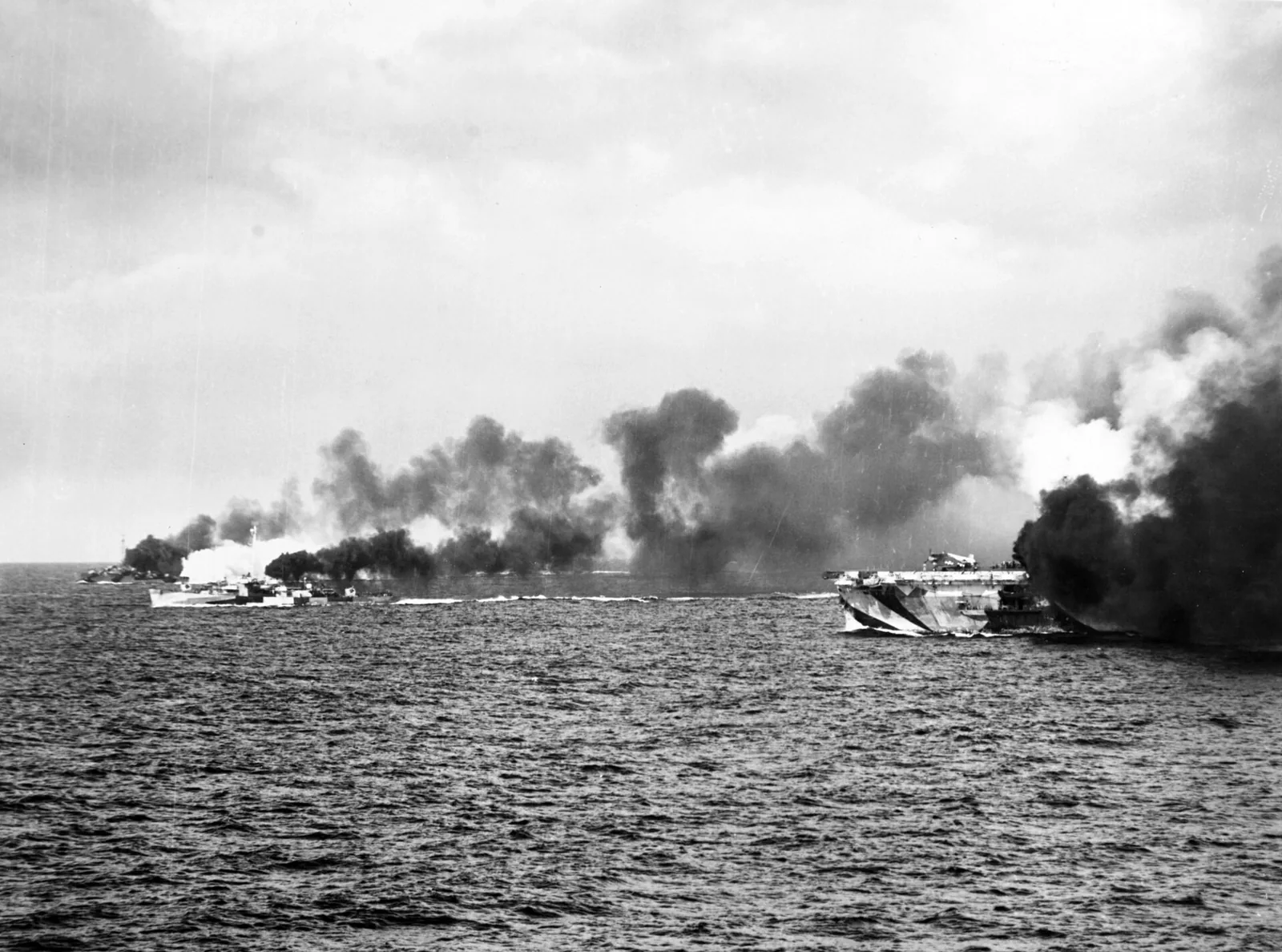
On 25 October 1944, Raymond participated in the Battle off Samar when Taffy 3 engaged the Japanese Center Force led by Vice Admiral Kurita Takeo. After laying a smoke screen to protect the task unit from the rapidly approaching enemy ships, Lt. Cmdr. Aaron F. Beyer, commanding officer, ordered Raymond to make a torpedo run on the closing enemy. Leaving the port side of the escort carrier formation, Raymond launched three torpedoes at heavy cruiser Haguro (Capt. Uozumi Jisaku, commanding). As the torpedoes missed, Haguro opened fire on Raymond with fifteen 8-inch salvos from only approximately 200 yards. Turning back to protect the Taffy 3 escort carriers already under attack, and miraculously escaping damage from Haguro ’s salvos, Raymond engaged heavy cruisers Chikuma and Tone with 5-inch gunfire at 0814. Although the damage to both enemy cruisers from Raymond ’s gunfire proved minimal, U.S. aircraft made several torpedo and bomb runs against Kurita’s force.
At 0840, Raymond joined Samuel B. Roberts (DE-413) in engaging the Japanese cruiser line from a distance of 5,900 yards. The two ships heavy rate of fire coupled with repeated attacks from U.S. aircraft convinced Adm. Kurita to retire the Center Force from the battle. Despite saving the landing force at Leyte, Taffy 3 suffered the losses of escort carrier Gambier Bay (CVE-73), escort ship Samuel B. Roberts, and the destroyers Hoel (DD-533) and Johnston (DD-557). Later in the day, kamikaze aircraft appeared overhead the American task force, one crashing and sinking escort carrier St. Lo (CVE-63) at 1125. Raymond acted as the primary vessel in rescuing 108 survivors from the stricken escort carrier.
After transferring 40 badly wounded St. Lo survivors to LST 464, a tank landing ship equipped to handle casualties, on 26 October 1944, Raymond departed for Manus. After an availability period there ended, she stood out to sea on 7 November, acting as a screen for escort carriers to Pearl. Arriving on 18 November, she got underway with TU 12.5.2 on 5 December. Problems with her port shaft forced her return to Oahu, where she underwent a drydocking for repairs until the day after Christmas.
Departing Hawaii on 29 December 1944 with TU 16.8.1, Raymond arrived at Eniwetok, Marshall Islands, on 7 January 1945. The next day, she steamed as escort with TU 96.3.15 for the Marianas Islands. After arriving at Saipan on 12 January, she got underway escorting vessels to Tinian. Raymond performed routine screening and escort duties through the remainder of January-early February 1945 with TU 94.7.2; TG 30.7; and on 9 February, got underway with TU 50.8.24 to refuel TF 58 in connection with Operation Detachment, the invasion of Iwo Jima.
Serving in the anti-submarine screen, Raymond participated in the Iwo Jima campaign until 3 March, when she arrived off Guam en route to Ulithi. On 21 March, she sortied with TU 50.18.34, to participate in Operation Iceberg, the invasion of Okinawa.
1945
During the Okinawa Gunto campaign (1 April–22 June 1945), Raymond performed escort and screening duties until mid-May for TU 50.8.7 oilers including Nantahala (AO-60), Tappahannock (AO-43), Sabine (AO-25), and Patuxent (AO-44). Several round-trips from Ulithi to Okinawa as an escort vessel filled the remainder of May. While underway on 5 June for Ulithi, Raymond steamed directly into the path of a typhoon, encountering very high seas. At 0600, she “passed into eye of storm encountering…very rough sea, no wind.” Twenty minutes later, winds increased to 100 knots. By 0945, the storm abated and Raymond continued underway for Ulithi, suffering no casualties. She arrived at her destination on 11 June.
Underway on 7 July 1945 as part of TG 30.8, Raymond escorted tankers and ammunition ships. Two days later, she acted as plane guard for Kitkun Bay (CVE-71). Rejoining TG 30.8, she steamed for Ulithi as escort for oilers Kankakee (AO-39), Neosho (AO-48), Escalante (AO-70), Cahaba (AO-82), Cossatot (AO-77), and Tappahannock . Arriving at Ulithi on 13 July, she next got underway with Ulithi-Okinawa Convoy number 40, alongside Presley (DE-371) and Silverstein (DE-534). Towards the end of the month, Raymond again steamed into a typhoon, this time catching the “outer limits” of the severe weather. However, at 0200 on 31 July, the convoy changed course as high seas and winds caused damage to deck cargoes. After riding out the rest of the storm, Raymond and the group arrived at Buckner Bay, Okinawa, at 1700 on 4 August 1945. Supporting TU 94.18.14 en route to Okinawa, the crew received word of the suspension of offensive operations due to the Japanese surrender. The war finally over, the escort ship’s crewmembers hoped to return home.
However, Raymond again set course for Okinawa on 20 August 1945, before ordered to escort TU 95.5.76, to Ulithi. Detached from the convoy on the 25th to escort transport ship General H. B. Freeman (AP-143) to Saipan, she then steamed on to Ulithi. After another underway period to Okinawa, Raymond moored at Ulithi on 9 September, before returning to the U.S.
From 1–3 November 1945, Raymond moored at Apra Harbor, Guam. At 1000 on 5 November, she got underway in company with Escort Division (CortDiv) 63 and Presley for Pearl Harbor. Arriving at Oahu on 14 November, she remained in Hawaii for the next three days, allowing several of her crew one last liberty in Honolulu before returning to the U.S. mainland. After receiving orders to report to San Pedro, Calif., Raymond got underway on 17 November, entering San Pedro Harbor and the Pacific Reserve Fleet six days later.
Post-war 1946–1949
1947
Decommissioned on 24 January 1947, Raymond remained moored at San Diego until recommissioned during the Korean War on 27 April 1951, Lt. Cmdr. Walter F. Toy, commanding. Receiving assignment to the Destroyer Force, U.S. Atlantic Fleet, and after transiting the Panama Canal, Raymond arrived at Newport, R.I., on 11 August 1951. The escort ship engaged in local operations out of Newport through December 1951, before proceeding to the Boston Navy Yard.
Korean War period 1950–1953
1952
After beginning the New Year undergoing a yard period, Raymond departed on 10 March 1952 for refresher training at Guantánamo Bay, Cuba, from 23 March–3 May. Arriving back in Newport on 9 May, she got underway for short periods in local operations until departing on 28 June for Key West, Florida. Attached to the Fleet Sonar School until 16 October, Raymond returned to Newport for upkeep, training, and a short yard period.
1953 Operation Springboard
During January 1953, the escort ship took part in fleet exercise Operation Springboard in the Caribbean Sea, with ports of call in St. Thomas, Virgin Islands, from 19–20 January; San Juan, Puerto Rico, from 21–23 January; and Bermuda, from 26–28 January. On 31 January, Raymond returned to Newport for a brief refit, remaining there until 23 March. Raymond engaged in a weeklong independent ship operation out of New Bedford, Mass., from 23–30 March, before steaming south to conduct exercises off Key West from 3 April–14 May, and St. Petersburg from 15–18 May. Returning to Key West for a month (19 May–19 June), Raymond steamed for Norfolk from 9–13 July to take on supplies before making way to New Bedford. On 30 March, the escort ship departed again for Key West with orders attaching her to the Fleet Sonar School until 20 June. After completing her assignment in Florida, she returned to Newport on 23 June.
On 5 July 1953, Lt. Cmdr. Lawrence D. Caney relieved Lt. Cmdr. Richard N. Moss as commanding officer. Later in the month, Raymond proceeded from Newport to Norfolk, departing the latter port on 14 July 1953 for a Midshipmen cruise to Bergen, Norway. After arriving in Copenhagen, Denmark, for a week’s liberty on 3 August, Raymond steamed to Guantánamo Bay, arriving on the 26th. The escort ship returned to Norfolk to bring on supplies from 1–3 September. Upon returning to Newport, she participated in local operations in the area from 3 October 1953–4 January 1954, entering the Philadelphia Naval Shipyard for a brief upkeep period from 6 January-8 April.
Cold War 1954–1963
1954
After completing upkeep, Raymond departed on 23 April 1954 for a month of refresher training at Guantánamo Bay. Returning to Newport on 9 June, she embarked on a Midshipmen cruise to Quebec, Canada, from 26–30 July; Havana, Cuba, from 14-18 August; and Guantánamo Bay, for four days of liberty on 20–24 August. Raymond steamed for the New York Naval Shipyard on 28 August before receiving orders in September to return to the Fleet Sonar School in Key West.
Steaming from Key West upon completion of her orders to the Fleet Sonar School, Raymond arrived at Newport on 18 December 1954. After a brief upkeep period, she spent January and February 1955 participating in short training periods before getting underway to the Caribbean on 24 February, making port visits at San Juan from 28 February–28 March. On 28 March, she steamed for Newport, conducting short underway periods in the area from 28 March–1 May. After another brief refit period taking almost an entire month (23 May–21 June), orders arrived for the destroyer to return to the Fleet Sonar School. On 24 June, Raymond got underway for Key West, steaming in the Caribbean until returning to Newport on 15 August.
1955
After her fourth stint at the Fleet Sonar School ended on 12 December 1955, Raymond returned to Newport on the 16th, spending New Year’s 1956 at her homeport until getting underway for a tender availability at Fall River, Mass., on 3 January. Steaming back to San Juan, Raymond spent the next few weeks conducting exercises in the area, before returning to Newport on 21 January. After a port call at Port Everglades, Florida, on 4 February, she returned to the Caribbean, visiting San Juan from 11–16 February; St. Thomas, from 16–21 February; and a return to San Juan from 21–24 February. After a brief visit to Little Creek Naval Base, Va., on 24 May, Raymond steamed to Newport from 25 May-12 June, for a brief refit. Returning to the Caribbean, Raymond visited Guantánamo Bay from 16 June-6 July; Santiago, P.R., from 7–8 July; returning to Guantánamo for the next six days, Raymond then proceeded to New Orleans for a visit (14–31 July).
1956
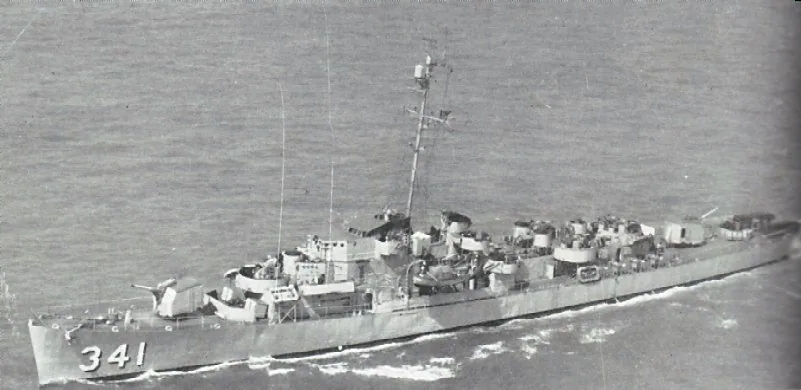
Returning to Newport from 3–12 August 1956, Raymond conducted operations off Key West from 28 September-12 October. Spending the next two days steaming off Havana, she made way to Key West, operating in the area until 2 November. From 6 November 1956–8 January 1957, Raymond moored at Newport. After a brief cruise to the Caribbean, the destroyer returned to Newport, remaining in the yard until 14 February. Receiving orders to steam for Key West, she arrived in the area on the 17th, remaining off the coast before making a port visit to Miami on 29 March. Returning to duty off Key West from 31 March–5 April, Raymond steamed for her homeport at Newport, mooring there from 8–29 April. For the remainder of May–July, she split her time between the New York Naval Shipyard (2–6 May); Boston (10–27 May); Newport (13–18 June); Annapolis (19 June); Newport (27 June–17 July), and Portland (18–22 July).
1957
From 22 July–14 September 1957, Raymond refitted at Newport. Returning to San Juan, she conducted training exercises in the Caribbean from 16 September–14 October. After making port calls to Savannah, Ga. (21–22 October); Vieques, P.R., (23–24 October); and Boston (24–26 October), she returned to her homeport before steaming back for Boston, conducting exercises in the area from 27 October–11 November. Making way for Fort Lauderdale, Fla., on 14 November, Raymond made port calls at Key West (17–19 November); New Orleans (22–25 November); and Savannah (29 November–2 December), before mooring at Newport for the remainder of the year.
1958
Raymond made way for Boston on 6 January 1958, remaining there until 2 April. Steaming to Newport, she spent the next 11 days moored there before making way for Guantánamo Bay. Conducting exercises in the Caribbean from 18 Apil–14 May, Raymond returned to Newport in late May. Turning her attention northwards, she steamed for New Bedford on 14 June before spending a month conducting exercises off Boston (18 June–19 July). After making a port call to Provincetown, Mass., (19–20 July), she got underway for Halifax, Nova Scotia, on 28 July. A port call to Nantucket, Mass., on 30 July, followed before Raymond steamed back to Boston, remaining there from 1-5 August. Raymond steamed back to Portland, conducting local operations in the area from 29 August–16 November. Getting underway for Boston, she spent the rest of the year refitting at the naval shipyard.
1959
On 25 February 1959, Raymond steamed again for the Caribbean, arriving at Guantánamo Bay two days later. She made a port visit to Kingston, Jamaica, from 28 February–1 March, before making way for Boston, mooring there from 8 March–18 April. After a brief cruise to Portland from 18-19 April, Raymond returned to Boston.
1960
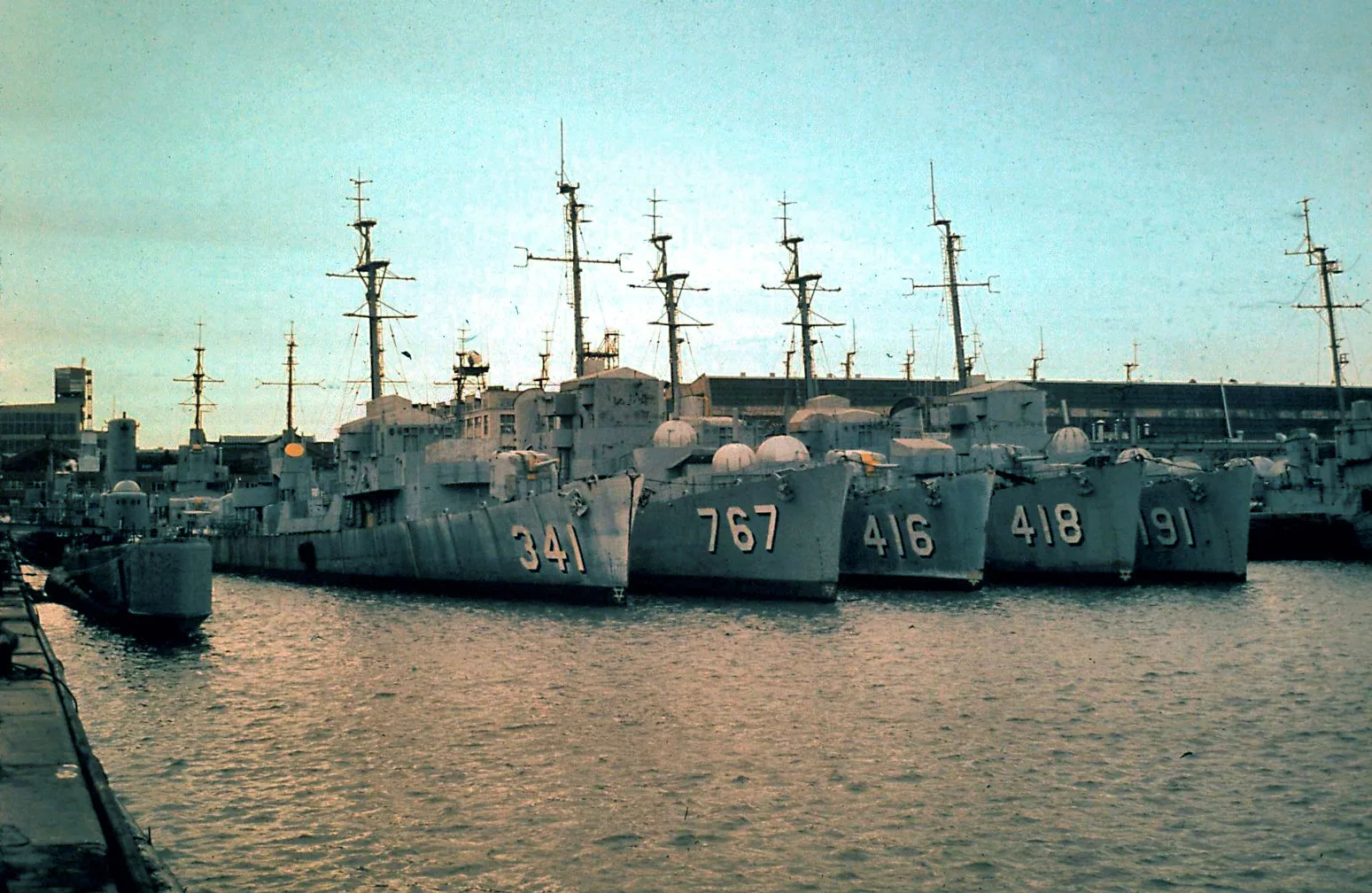
Decommissioned for the second time on 31 May 1960, Raymond was placed in inactive reserve with the Atlantic Fleet at the Philadelphia Naval Shipyard.
Vietnam War period 1964–1975
1972
Stricken from the Naval Vessel Register on 1 July 1972, and receiving assignment as a target vessel, ex- Raymond was sunk by aircraft from carrier Forrestal (CVA-59) off northeast Florida on 22 January 1974.
Raymond received the Presidential Unit Citation for her heroic part in the Battle off Samar, in addition to five battle stars for her World War II service.
Other photographs
Held for this vessel, and not tied to any part of the account above.
References
Every work this entry draws on. There are no numbered markers in the text above: what we hold is the provenance of the page — this history, this article, these photographs.
- History Raymond II (DE-341) Dictionary of American Naval Fighting Ships, Naval History and Heritage Command. A work of the United States Government, in the public domain — the only text on this site reproduced verbatim.
- Facts USS Raymond (DE-341) Structured facts only — dates, dimensions, armament and fate. No wording is taken from it. Harvested 1 August 2026.
- Photograph USS Raymond (DE-341) underway at sea, in the 1950s (L45-240.01.02) Unknown author — U.S. Navy photo L45-240.01.02 — Public domain — Wikimedia Commons
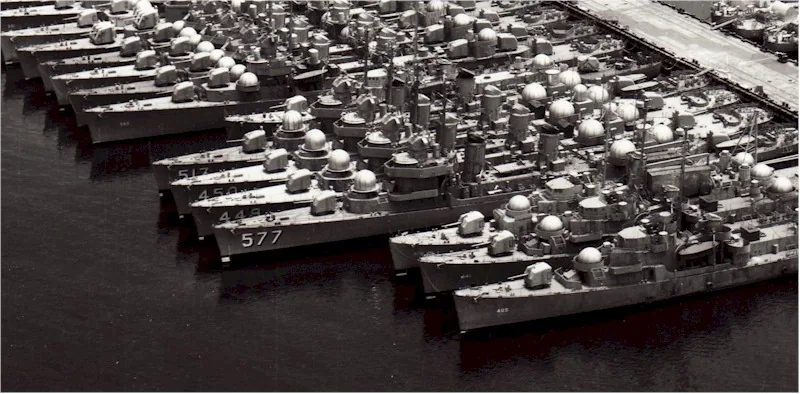
- Photograph U.S. Navy destroyers and destroyer escorts laid up at San Diego, California (USA), in June 1950 (80-G-428265) Rick E. Davis — Cropped from an U.S. Navy photo 80-G-428265 vailable at www.navsource.org — Public domain — Wikimedia Commons
- Photograph USS Gambier Bay (CVE-73) and escorts making smoke off Samar 1944 Unknown author — U.S. Navy photo 80-G-288144 — Public domain — Wikimedia Commons
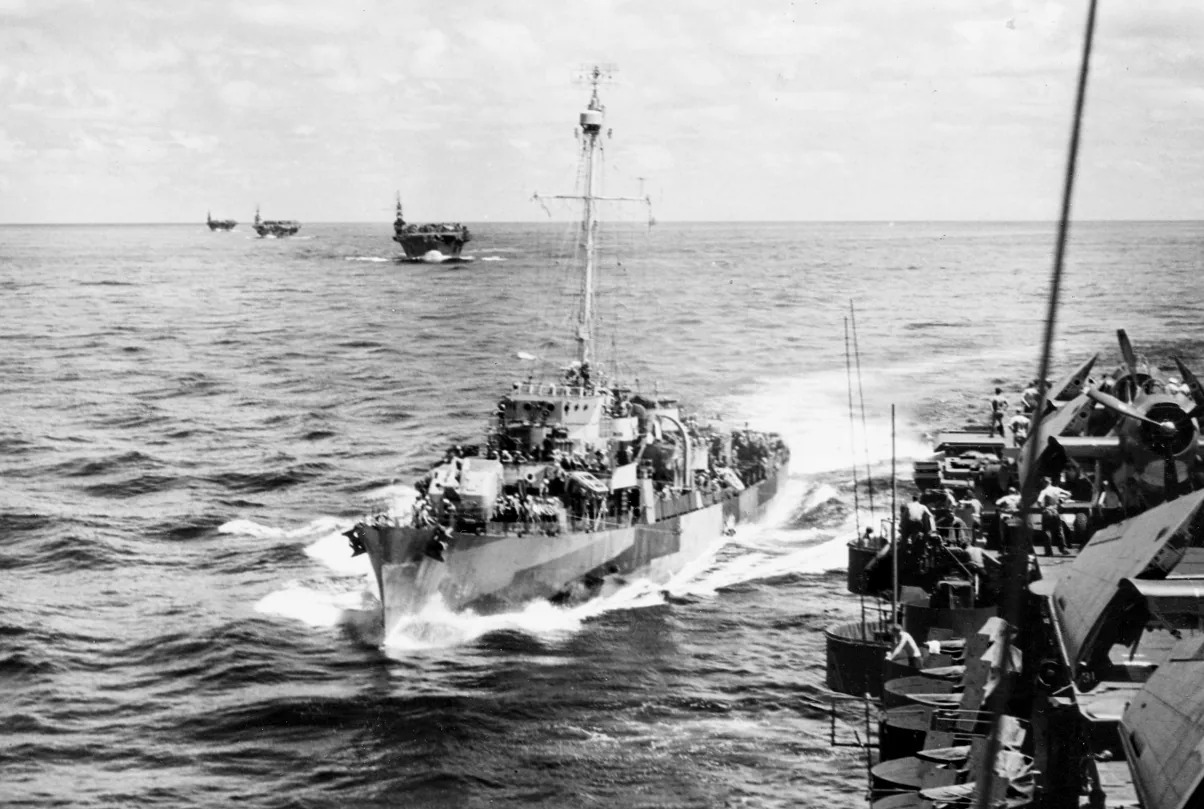
- Photograph USS Raymond (DE-341) approaching USS Sangamon (CVE-26) to refuel on 15 October 1944 (80-G-295001) U.S. Navy — U.S. Navy photo 80-G-295001 from usndazzle.com — Public domain — Wikimedia Commons
- Photograph USS Raymond (DE-341) underway, circa in 1956 U.S. Navy — Official U.S. Navy photo from "Jane's Fighting Ships, 1958-59" available at Navsource.org — Public domain — Wikimedia Commons
- Photograph USS Raymond (DE-341), USS Oswald (DE-767), USS Melvin R. Nawman (DE-416), USS Tabberer (DE-418) and USS Coffman (DE-191) laid up at the Philadelphia Naval Shipyard, Pennsylvania (USA), circa i U.S. Navy — U.S. Navy photo [1] from Navsource.org — Public domain — Wikimedia Commons