United States Navy — Destroyer escort
USS Reeves (DE-156) — service history
This is the full service history. For the vessel's particulars, photograph and specifications, see the entry.
In the words of the US Navy. The account below is reproduced verbatim from the Dictionary of American Naval Fighting Ships, compiled by the Naval History and Heritage Command — a work of the United States Government, in the public domain, and the only text on this site not written here.
Before commissioning

Thomas James Reeves, born in Thomaston, Conn., 9 December 1895, enlisted in the Naval Reserve as Electrician third class on 20 July 1917. Released from duty 21 July 1919, he was recalled to active duty and was transferred to the regular Navy 16 April 1920 and served until discharged 21 August 1921. On 12 October 1921 he re-enlisted in the Navy making it his career. Advanced through the rates to chief radioman, Reeves was serving in California (BB-44) when the Japanese attacked Pearl Harbor, 7 December 1941. During that attack the mechanized ammunition hoists in the battleship were put out of commission. Reeves "... on his own initiative, in a burning passageway, assisted in the maintenance of an ammunition supply by hand to the antiaircraft guns until he was overcome by smoke and fire which resulted in his death." For his distinguished conduct, RMC Reeves was posthumously awarded the Medal of Honor.
Second World War 1939–1945
1943
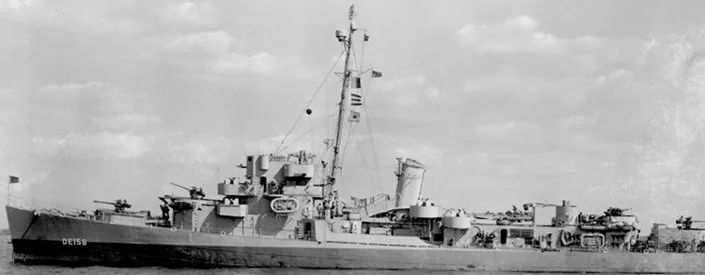
The first Reeves (DE-156) was laid down on 7 February 1943 at Portsmouth, Va., by the Norfolk Navy Yard; launched on 23 April 1943; sponsored by Miss Mary Anne Reeves, niece of the late Chief Radioman Thomas J. Reeves; and commissioned on 9 June 1943, Lt. Cmdr. Mathias S. Clark in command.
Following shakedown, Reeves returned to Norfolk and on 16 August 1943 got underwayu on transatlantic escort run, a slow convoy to Casablanca. Arriving at New York 6 weeks later, she underwent availability and further training, at Casco Bay, then returned to escort duty and for the next 12 months shepherded fast tanker convoys between New York and the United Kingdom. On 18 March 1944, after SS Seakay had been sunk, Reeves rescued 83 of the merchantman's 84 man crew. For heroism during that rescue, one of the escort's coxswain's, E. E. Angus, was awarded the Navy and Marine Corps Medal. The following day, Reeves took Donnell (DE-56) in tow after she had been torpedoed, stood by until relieved by tugs, then continued on carrying the damaged escort's more seriously wounded men.
Through D-day and the summer of 1944, Reeves continued to escort fast convoys. On 23 September she completed her last Atlantic escort mission and entered the Philadelphia Navy Yard for conversion to a high-speed transport.
1945 Ryukyus

Redesignated APD-52 on 25 September, Reeves emerged from the shipyard 23 December and after amphibious training, headed for the Panama Canal and duty in the Pacific. Arriving at Ulithi 26 February 1945, she continued on to the Philippines in early March to rehearse for Operation "Iceberg", the invasion of the Ryukyus.
On 26 March Reeves arrived off the Kerama Retto invasion area and, after initial duties as a standby ship for UDT operations, shifted to antisubmarine and antiaircraft screening duties. She served on that harrowing duty for 109 days interrupted only for a fast convoy to Ulithi and a brief availability in the Philippines. Detached 18 August, the APD delivered men, mail, and provisions to ships of the fleet, then sailed north to Japan. There, into October, she assisted in the repatriation of former POWs, then supported the U.S. Strategic Bombing Survey mission assigned to the Nagasaki area.
Post-war 1946–1949
1946
Reeves sailed for the United States 26 November and, after stops in the Volcano, Marshall, and Hawaiian islands, arrived at San Diego 23 December. Three days later she continued on; and, on 10 January 1946, she arrived at Boston to begin inactivation. Assigned to the Florida Group, Atlantic Reserve Fleet, she decommissioned 30 July at Green Cove Springs where she remained until struck from the Navy list 1 June 1960 and transferred to the Government of Ecuador for use as an electric generator plant.
Other photographs
Held for this vessel, and not tied to any part of the account above.
References
Every work this entry draws on. There are no numbered markers in the text above: what we hold is the provenance of the page — this history, this article, these photographs.
- History Reeves I (DE-156) Dictionary of American Naval Fighting Ships, Naval History and Heritage Command. A work of the United States Government, in the public domain — the only text on this site reproduced verbatim.
- Facts USS Reeves (DE-156) Structured facts only — dates, dimensions, armament and fate. No wording is taken from it. Harvested 1 August 2026.
- Photograph USS Reeves (APD-52) underway on 22 December 1944 (BS 79917) U.S. Navy — U.S. Navy Bureau of Ships photo BS 79917 available at usndazzle.com — Public domain — Wikimedia Commons
- Photograph Dungarees Reeves US Navy — National Archives — Public domain — Wikimedia Commons
- Photograph USS Reeves (DE-156) and USS Fechteler (DE-157) under construction at the Norfolk Naval Shipyard, Virginia (USA), in 1943 U.S. Navy — U.S. Navy Norfolk Naval Shipyard photo [1] from Navsource.org — Public domain — Wikimedia Commons
- Photograph USS Reeves (DE-156) at anchor, circa in 1944 U.S. Navy — U.S. Navy photo [1] from Navsource.org — Public domain — Wikimedia Commons