United States Navy — Light cruiser
USS Reno (CL-96) — service history
This is the full service history. For the vessel's particulars, photograph and specifications, see the entry.
In the words of the US Navy. The account below is reproduced verbatim from the Dictionary of American Naval Fighting Ships, compiled by the Naval History and Heritage Command — a work of the United States Government, in the public domain, and the only text on this site not written here.
Before commissioning
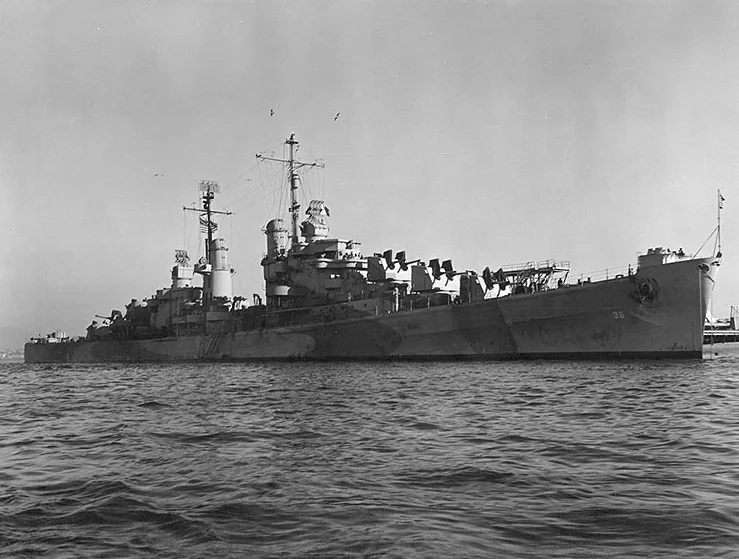
The second Reno (CL-96) was named for the city in the state of Nevada. The first Reno (DD-303) honored the late Lt. Cmdr. Walter E. Reno (1881-1917) (see Reno I (DD-303) for complete biography). II
Second World War 1939–1945
1941
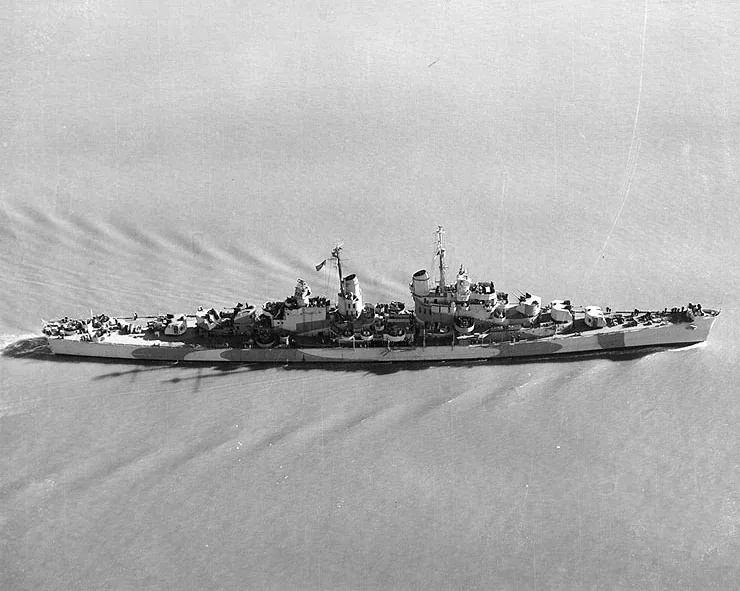
The second Reno (CL-96) was laid down on 1 August 1941 at San Francisco, Calif., by Bethlehem Steel Co.; launched on 3 December 1942; sponsored by Mrs. August C. Frohlich; and commissioned on 28 December 1943, Capt. Ralph C. Alexander in command.
1944 Philippine Sea
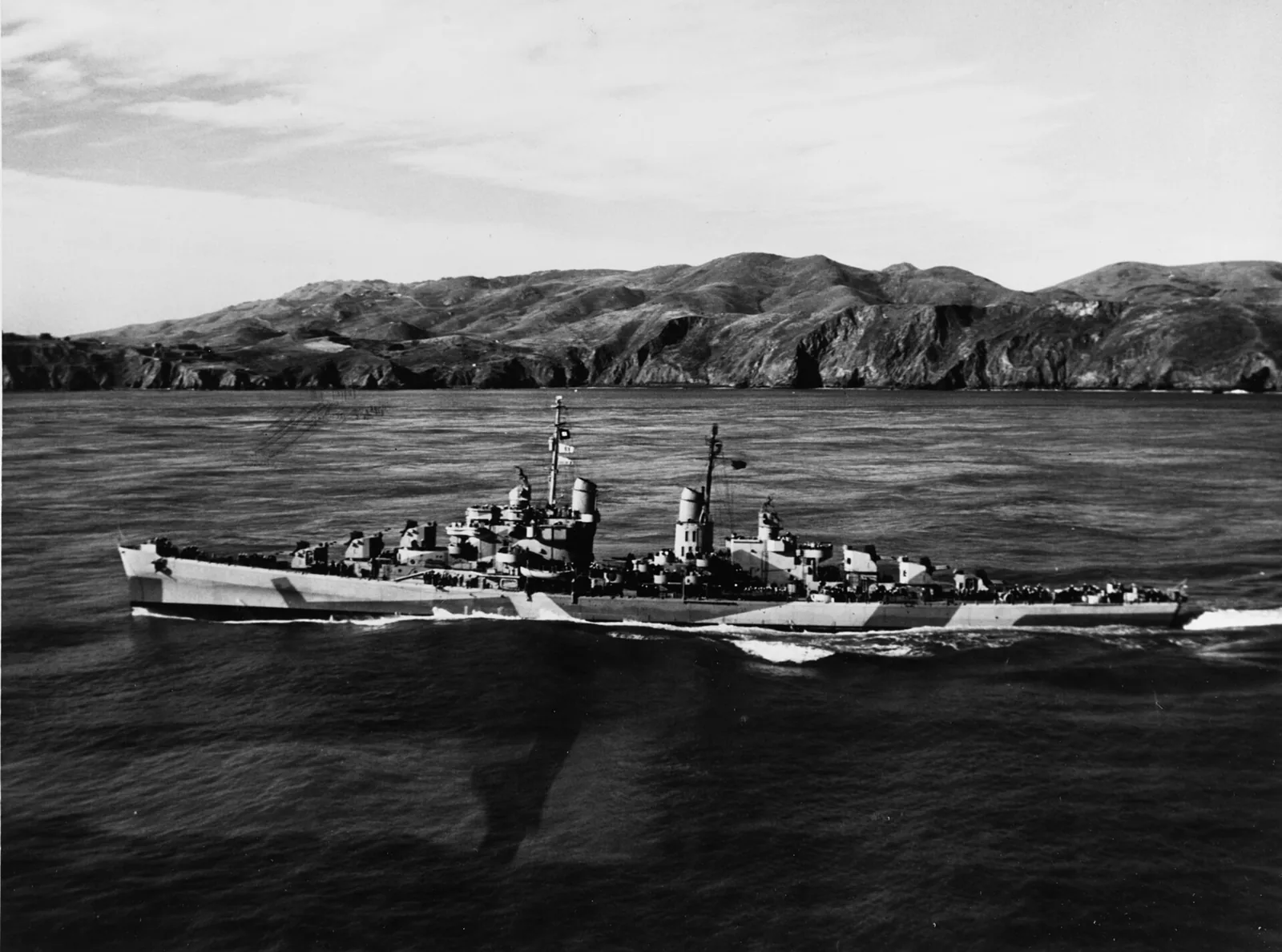
Following her shakedown off San Diego, Calif., Reno departed San Francisco on 14 April 1944 to join the Fifth Fleet. As an active unit in Vice Adm. Marc A. Mitscher’s Task Force (TF) 58, she first came in contact with the enemy by supporting air strikes against Marcus Island on 19-20 May. Three days later, she also supported strikes on Wake Island.
During the months of June and July 1944, Reno joined the fast carriers in surprise attacks against Saipan (11 June), Pagan Island (12-13 June), and against the Volcano and Bonin Islands (Iwo Jima, Haha Jima, and Chichi Jima) (15-16 June). Three days later, she assisted in repelling a large-scale Japanese carrier force attempt to defeat the Allied invasion of Saipan in the Battle of the Philippine Sea.
From 20 June to 8 July 1944, Reno joined in the operations covering the capture of Saipan, then covered landings on Guam from 17-24 July and two days later, took part in the strikes against the Palau Islands from the 26th to the 29th. Swinging north again, a final strike was made on the Bonin Islands 4-5 August and on 7 September the task group returned to the Palaus.
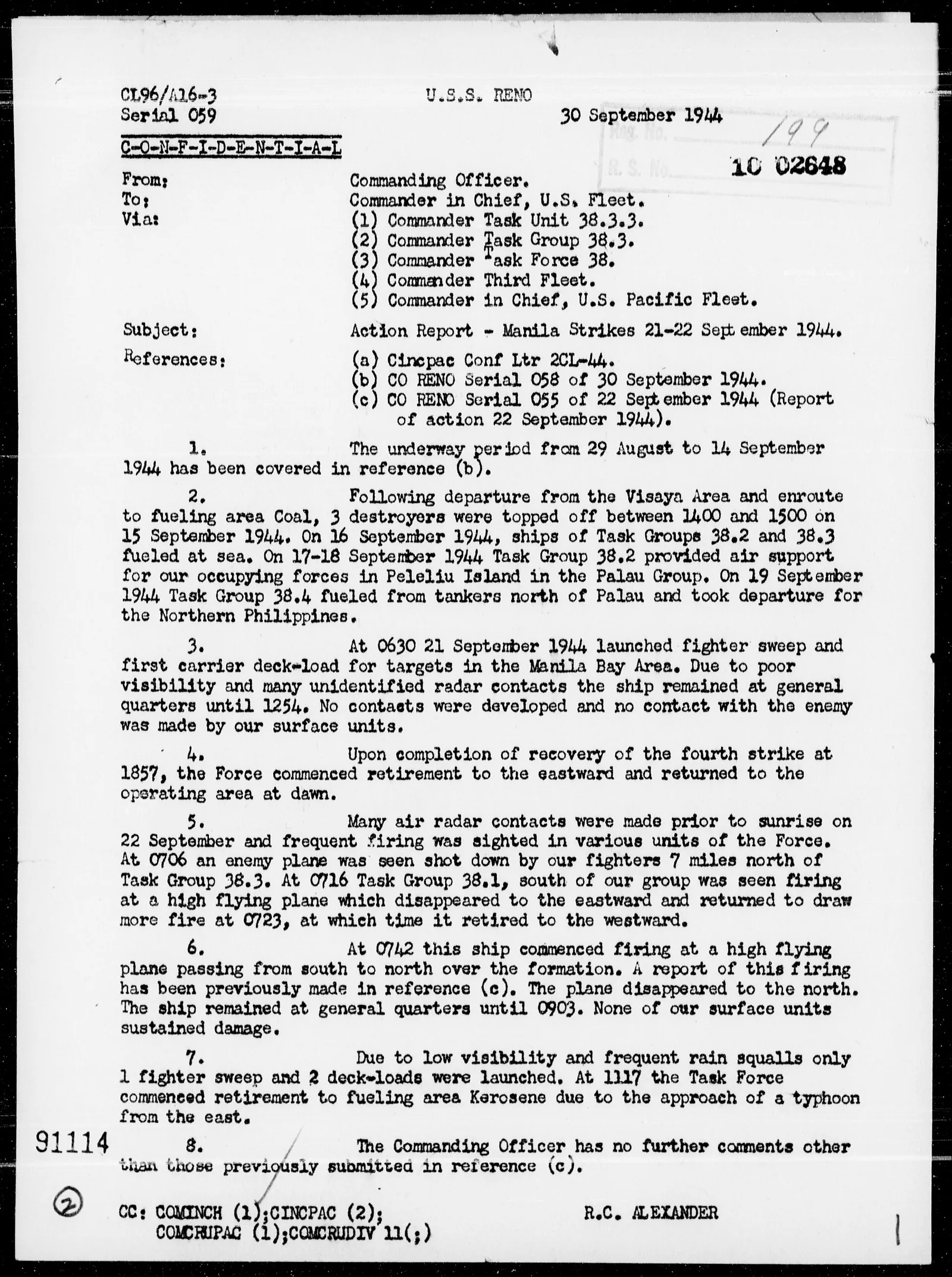
Continuing west, Reno participated in raids against Mindanao and adjacent Philippine Islands 9-13 September 1944, then supported the Palau invasion 15-20 September, and on the 21st and 22d, supported strikes against Manila and vicinity. Striking Nansei Shoto on 8 October, Reno , with TF 38, came nearer to the home islands of Japan than any other major unit of the U.S. Fleet had been.
During the three-day strike on Formosa (12-14 October 1944), Reno shot down six enemy planes. At the height of the battle, one torpedo plane crashed and exploded on the Reno ’s main deck aft. Though Mt. 56 was partially incapacitated by the explosion, the turret captain succeeded in maintaining his fire against the attacking planes and ships.
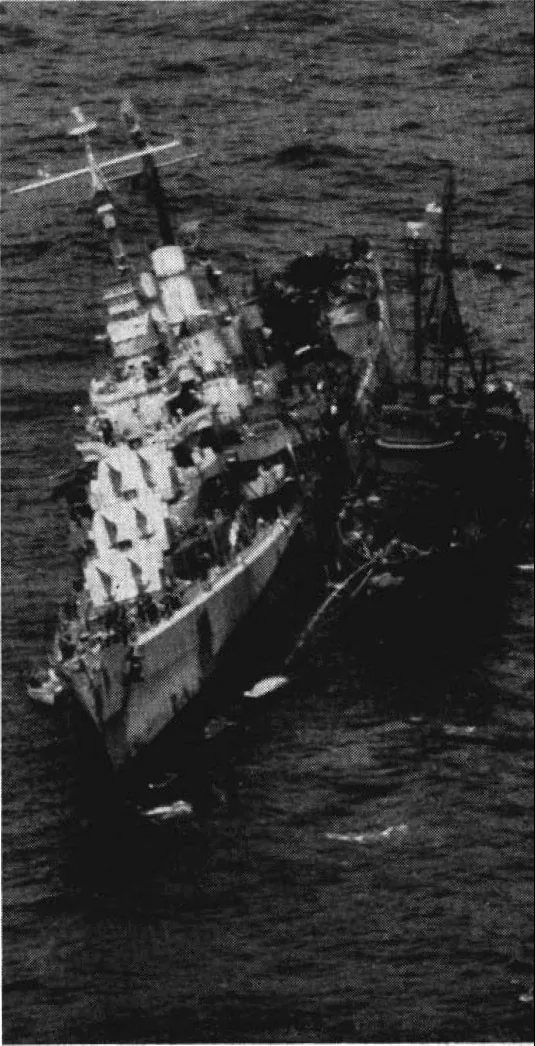
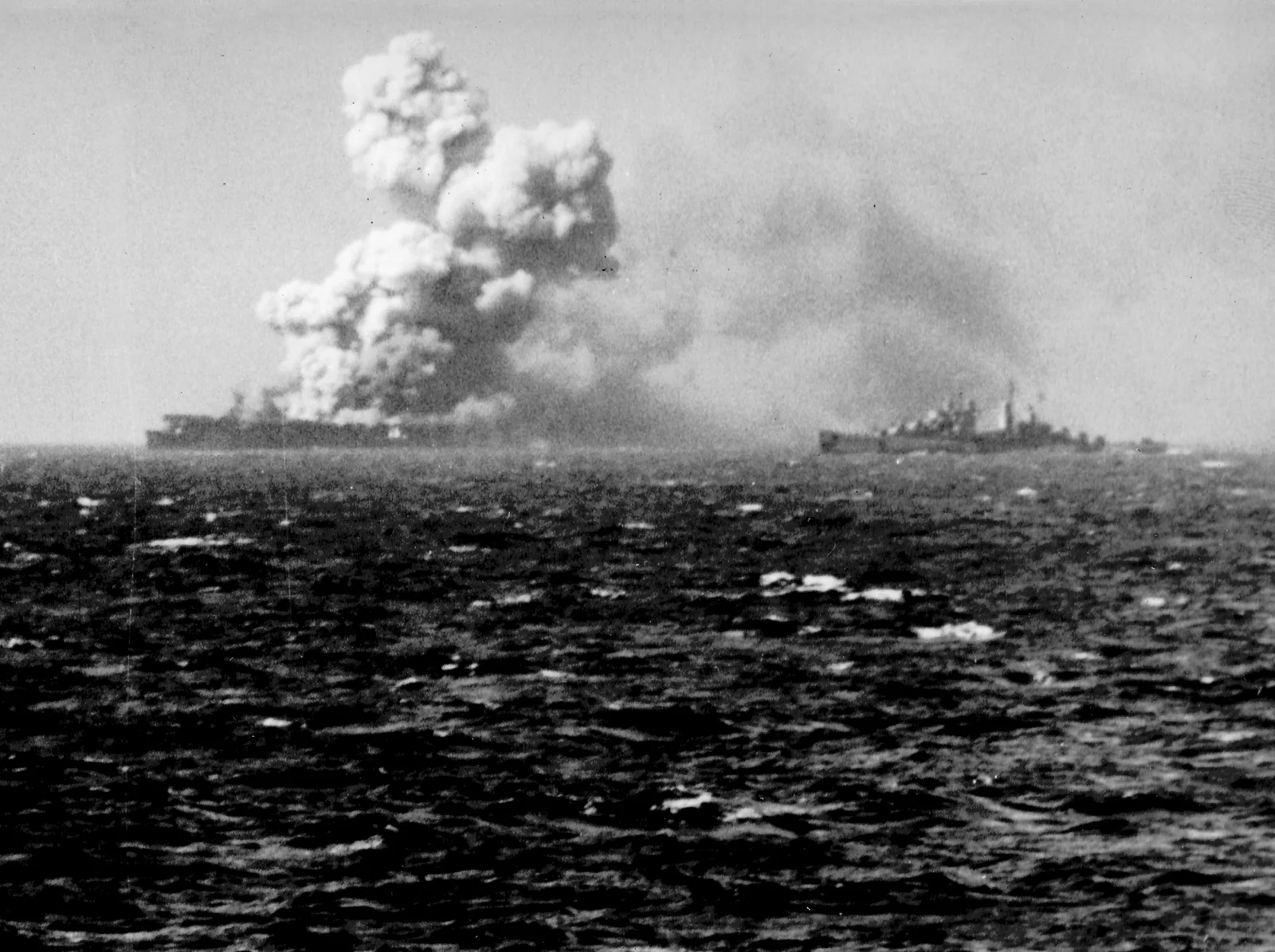
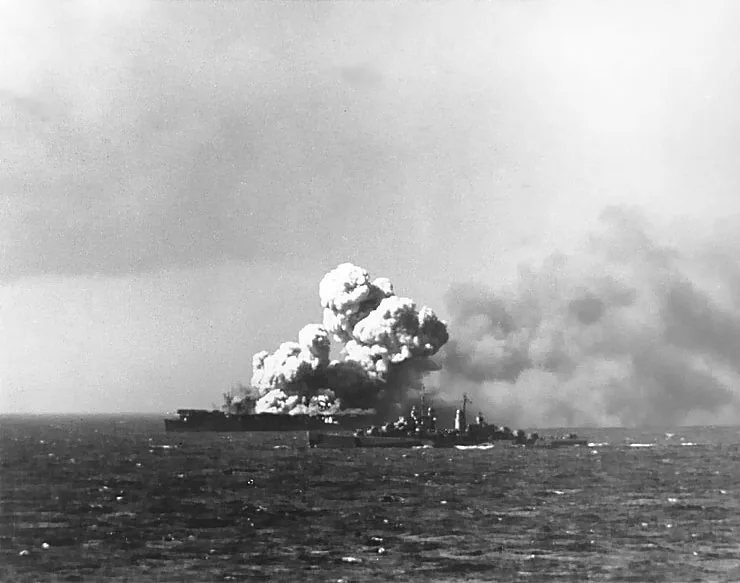
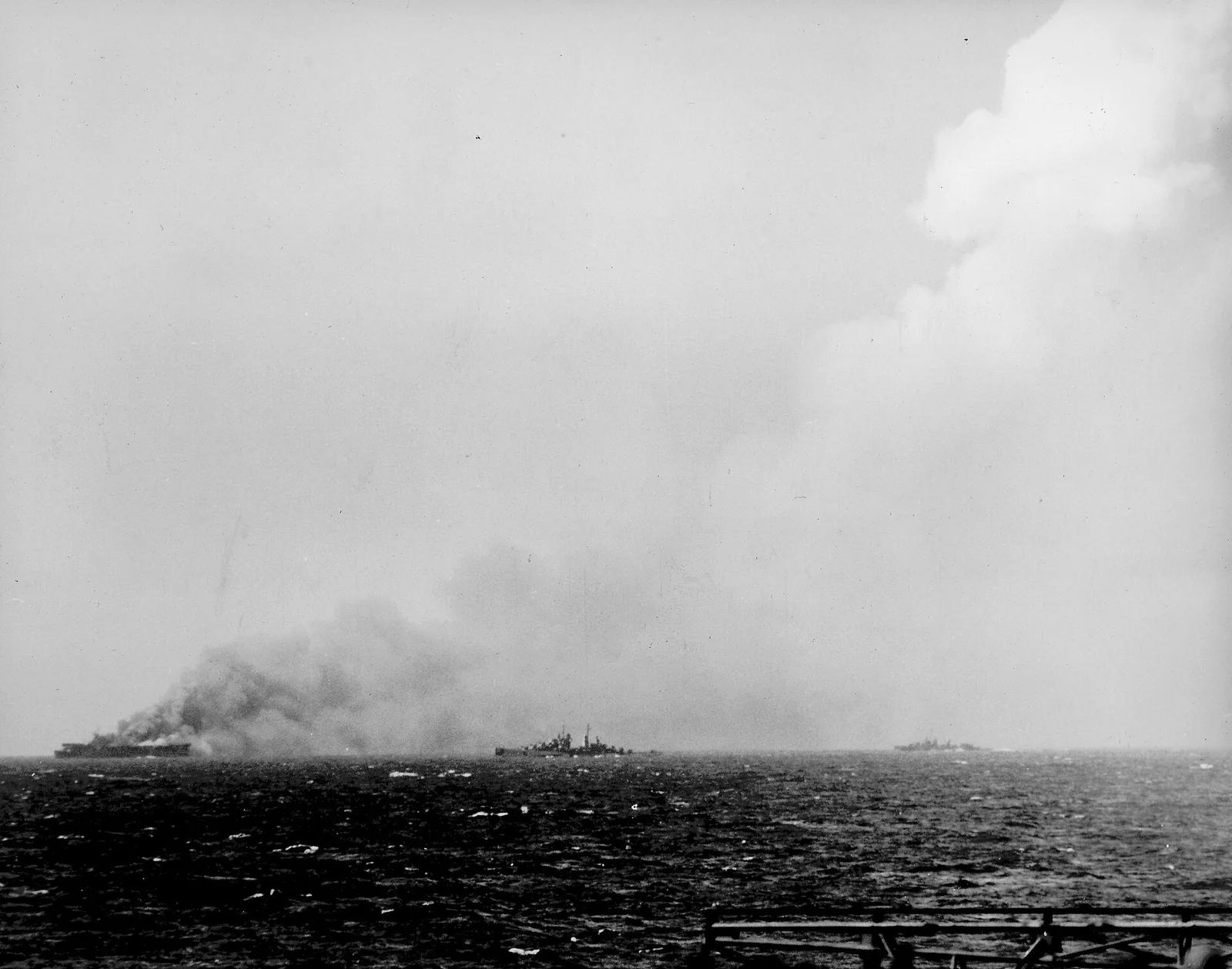
On 24 October 1944, four days after the initial Leyte invasion, while supporting air strikes against Luzon, TF 38 came under a large-scale air attack by Japanese planes from Clark Field, although the vigorous efforts of the force’s combat air patrol and the effective use of rain squalls as cover limited what damage the enemy inflicted. A Yokosuka D4Y1 carrier bomber [ Judy ], however, bombed the small carrier Princeton (CVL-23), forcing her to withdraw from the task group. Light cruiser Birmingham (CL-62), and destroyers Morrison (DD-560), Gatling (DD-671) and Irwin (DD-794) all suffered damage when they attempted to come alongside to aid the stricken carrier, with Birmingham particularly taking very heavy damage when a cataclysmic explosion, touched off by uncontrollable fires, occurred as she lay alongside.
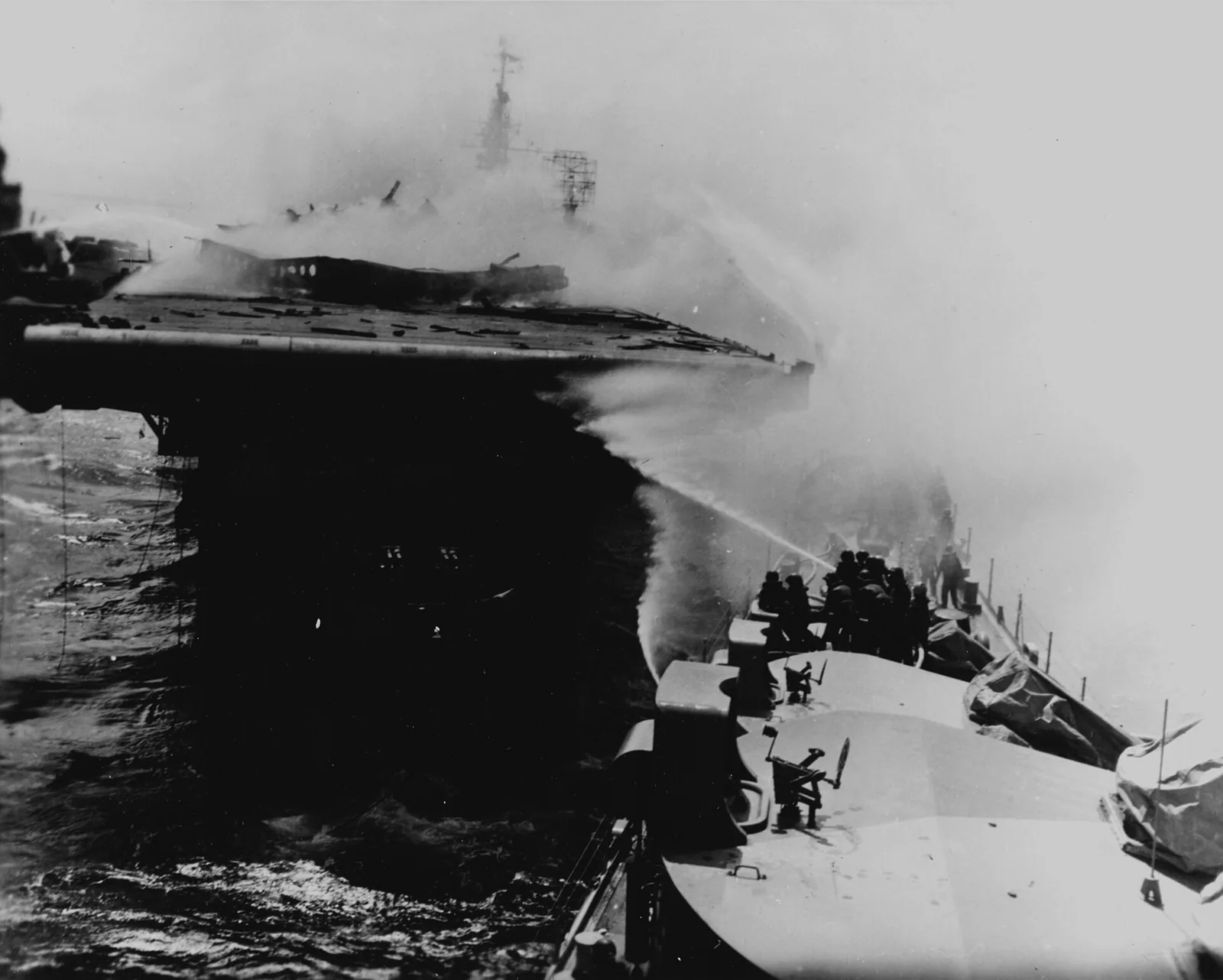
Reno came alongside five times but could not remain because of the intense heat and smoke. While Reno evacuated wounded men and tried to bring the fires under control, the listing flight deck of Princeton crushed one of Reno ’s 40 millimeter mounts. Efforts to save the carrier continued; but, after Princeton ’s torpedo warhead stowage area had exploded, Reno was ordered to scuttle her. Joined in the task by Irwin , Reno then sank the irreparably damaged carrier. On 25 October, having rejoined the task force, Reno proceeded north to engage the northern Japanese task force closing for the Battle of Cape Engano, the last engagement in the Battle for Leyte Gulf.
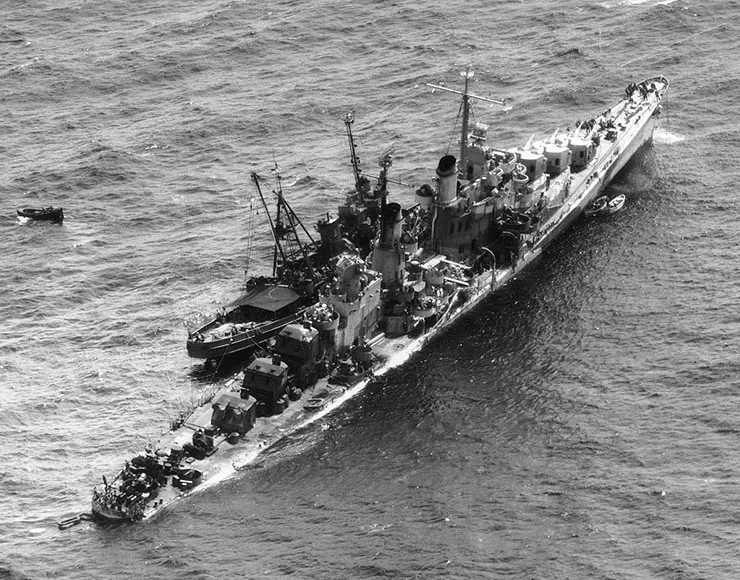
On the night of 3 November 1944, off San Bernardino Strait, the Japanese submarine I-41 (Lt. Cmdr. Kondo Fumitake) attacked the task group (TG 38.3) in which Reno was operating, loosing a spread of four Type 95 torpedoes, two of which struck Reno on her port side. One did not explode. The incident proved noteworthy, for not since 1942 had a Japanese submarine attacked a ship operating with a fast carrier task force. Heavy seas and high winds from a typhoon in proximity complicated the task of saving Reno , which quickly listed to 16 degrees, dead in the water, but an observer noted that “skillful seamanship, courage, and the unremitting effort of those remaining on board” [all hands not necessary for the intensive damage control efforts having been taken off] carried the day, allowing the ship to proceed, towed 1,500 miles to Ulithi by the fleet tug Zuni (ATF-95) for temporary repairs, arriving on 11 November. Lt. Cmdr. Kondo, meanwhile, claimed sinking an Essex (CV-9)-class carrier, receiving a special citation from Emperor Hirohito himself. Ironically, I-41 was last heard from on 12 November, the day after her victim arrived safely in the western Carolines.
1945
Reno then steamed under her own power to Charleston, S.C., where she entered the Navy Yard on 22 March 1945 for repairs. Emerging seven months later, with hostilities over, she steamed to Texas, then back to Charleston for the addition of bunk spaces. She reported for Magic Carpet duty and made two runs to Le Havre, France, and back with returning Army troops.
Post-war 1946–1949
1946
In early 1946, Reno steamed for Port Angeles, Wash., where she was decommissioned on 4 November 1946 and entered the Pacific Reserve Fleet, berthed at Bremerton, Washington. Reclassified as CLAA-96 on 18 March 1949, she remained at Bremerton until her name was stricken from the Navy Register on 1 March 1959 and her hulk was sold on 22 March 1962, to Coal Export Co., New York, N.Y., to be broken up for scrap.
Other photographs
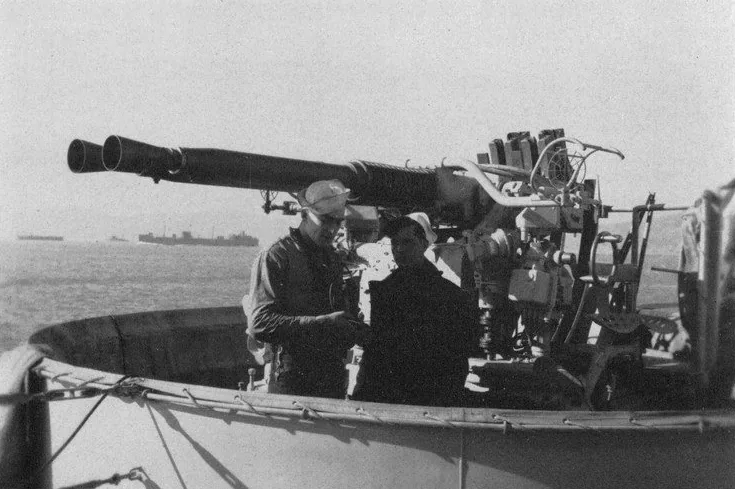
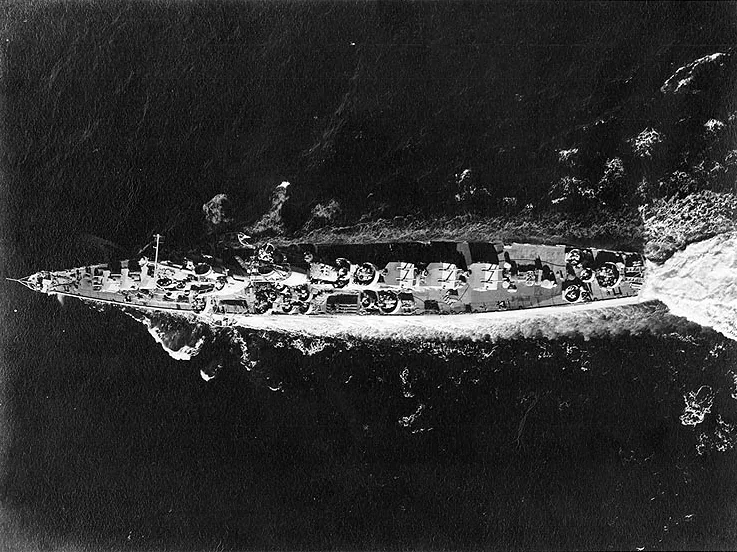
Held for this vessel, and not tied to any part of the account above.


References
Every work this entry draws on. There are no numbered markers in the text above: what we hold is the provenance of the page — this history, this article, these photographs.
- History Reno II (CL-96) Dictionary of American Naval Fighting Ships, Naval History and Heritage Command. A work of the United States Government, in the public domain — the only text on this site reproduced verbatim.
- Facts USS Reno (CL-96) Structured facts only — dates, dimensions, armament and fate. No wording is taken from it. Harvested 1 August 2026.
- Photograph USS Reno (CL-96) under salvage after being torpedoed off the Philippines, 5 November 1944 (NH 63431) Unknown author — U.S. Navy photo NH 63431 — Public domain — Wikimedia Commons
- Photograph USS Reno (CL-96) underway off California on 25 January 1944 (80-G-215947) Unknown author — U.S. Navy photo 80-G-215947 — Public domain — Wikimedia Commons
- Photograph USS Reno (CL-96) coming alongside of USS Princeton (CVL-23) on 24 October 1944 U.S. Navy — Official U.S. Navy photo 80-G-270430 from the U.S. Navy Naval History and Heritage Command — Public domain — Wikimedia Commons
- Photograph 40mm twin Bofors gun mount on USS Reno (CL-96) c1944 USN — U.S. Navy photo [1] from the USS Reno (CL-96) 1943-1944 cruise book available at Navysite.de — Public domain — Wikimedia Commons
- Photograph Overhead view of USS Reno (CL-96) c1943 U.S. Navy — Official U.S. Navy photo NH 98469 from the U.S. Navy Naval History and Heritage Command — Public domain — Wikimedia Commons
- Photograph Torpedoed cruiser USS Reno (CL-96) listing in November 1944 U.S. Navy — U.S. Navy All Hands magazine September 1955 , p. 13 — Public domain — Wikimedia Commons
- Photograph USS Princeton (CVL-23) 1944 10 24 1523explosion U.S. Navy (The image is part of an album of photographs collected by Captain Carlos W. Wieber during his command of the aircraft carrier USS Essex (CV-9) during 1944-1945.) — U.S. Navy National Museum of Naval Aviation photo No. 1983.046.010.039 — Public domain — Wikimedia Commons
- Photograph USS Princeton (CVL-23) afire USN, Post-Work: User:W.wolny — Official U.S. Navy photograph 80-G-287974 from the U.S. Navy Naval History and Heritage Command — Public domain — Wikimedia Commons
- Photograph USS Princeton (CVL-23) underway afire with USS Reno (CL-96) in October 1944 U.S. Navy (The image is part of an album of photographs collected by Captain Carlos W. Wieber during his command of the aircraft carrier USS Essex (CV-9) during 1944-1945.) — U.S. Navy National Museum of Naval Aviation photo No. 1983.046.010.038 — Public domain — Wikimedia Commons
- Photograph USS Reno (CL-96) and USS Morrison (DD-560) near the burning USS Princeton (CVL-23) in October 1944 U.S. Navy (The image is part of an album of photographs collected by Captain Carlos W. Wieber during his command of the aircraft carrier USS Essex (CV-9) during 1944-1945.) — U.S. Navy National Museum of Naval Aviation photo No. 1983.046.010.040 — Public domain — Wikimedia Commons
- Photograph USS Reno (CL-96) in San Francisco Bay in late 1943 U.S. Navy — Official U.S. Navy photo NH 98468 from the U.S. Navy Naval History and Heritage Command — Public domain — Wikimedia Commons
- Photograph USS Reno (CL-96) underway on 11 January 1944 (NH 98466) photographed by Naval Air Station Alameda, California (USA) — U.S. Navy photo NH 98466 — Public domain — Wikimedia Commons
- Photograph USS RENO - Rep of Ops During Carrier Air Strikes Against the Manila Bay Area, Philippines, 9-21-22-44 - DPLA - 1a57ffaf6dea29ab39733ec95999708c Department of the Navy. Office of the Chief of Naval Operations. Intelligence Division. Office of Naval Records and Library. (1922 - 10/10/1945) — This file was contributed to Wikimedia Commons by National Archives and Records Administration as part of a cooperation project. The donation was facilitated by the Digital Public Library of America , via its partner Digital Public Library of America . Record in source catalog DPLA identifier: 1a57ffaf6dea29ab39733ec95999708c National Archives Identifier: 139753533 — Public domain — Wikimedia Commons
- Photograph USS Reno CL-96 torpedoed Nov 1944 USN — Official U.S. Navy photograph NH 98473, from the collections of the Naval Historical Center from navsource.org [1] — Public domain — Wikimedia Commons
- Photograph USS Reno fighting fires on USS Princeton US Navy — Official U.S. Navy photo NH 63439 from the U.S. Navy Naval History and Heritage Command — Public domain — Wikimedia Commons