United States Navy — Destroyer
USS Ringgold (DD-500) — service history
This is the full service history. For the vessel's particulars, photograph and specifications, see the entry.
In the words of the US Navy. The account below is reproduced verbatim from the Dictionary of American Naval Fighting Ships, compiled by the Naval History and Heritage Command — a work of the United States Government, in the public domain, and the only text on this site not written here.
Before commissioning
Cadwallader Ringgold was born in Washington County, Md., on 20 August 1802, and entered the U.S. Navy in 1819. He commanded the schooner Weazel in action against West Indies pirates during the late 1820s and later served on board Vandalia in the Pacific and Adams in the Mediterranean. During 1838-42, he participated in the Wilkes Expedition in the Pacific, commanding Porpoise from 1840. Inactive in the later 1850s, he returned to the fleet during the Civil War . While in command of the frigate Sabine he effected the rescue of a battalion of marines whose transport steamer had gone inshore and also of the ship of the line Vermont which had lost her rudder in a storm. Promoted to commodore in 1862, he was placed on the rear admiral (retired) list in 1866. Rear Admiral Ringgold died at New York on 29 April 1867.
Second World War 1939–1945
1942
The second Ringgold (DD-500) was laid down on 25 June 1942 at Kearny, N.J., by the Federal Shipbuilding & Dry Dock Co.; launched on 11 November 1942; sponsored by Mrs. Arunah Sheperdson Abell, grand niece of Rear Adm. Cadwallader Ringgold; and commissioned at the New York Navy Yard, Brooklyn, N,.Y.,, on 24 December 1942, Cmdr. Thomas F. Conley in command.
1943 Tarawa
Shakedown, which took Ringgold from the New York Navy Yard to Guantanamo Bay, Cuba, and back, extended through 18 February 1943. Additional training maneuvers kept her operating in the vicinity of Trinidad until mid-July. Departing New York en route to the Pacific on 21 July, she transited the Panama Canal on the 27th and reported to Commander-in-Chief, Pacific Fleet, at Pearl Harbor, TYerritory of Hawaii, where she hoisted the pennant of Commander, Destroyer Division 50.
After several weeks of training, Ringgold joined a fast carrier task force built around the carriers Yorktown (CV-10) and Essex (CV-9), and the small carrier Independence (CVL-22). The force worked over Marcus Island on 1 September 1943 and then moved on to conduct a raid in the Gilberts. The carrier planes conducted seven strikes 18-19 September on Tarawa and Makin. A Japanese diarist recorded that Tarawa "is a sea of flames;" nine parked planes and five vessels were destroyed. Most importantly, Lexington's (CV-16) planes returned with a set of low oblique photos of the lagoon side of Betio, and these proved to be most useful in planning the assault on Tarawa .
On 5-6 October 1943, the largest fast carrier force organized to that time, comprising Essex , Yorktown , Lexington , Cowpens (CVL-25), Independence , and Belleau Wood (CVL-24), Rear Adm. Alfred E. Montgomery in command, struck at Wake Island. The target was also shelled by battleships, cruisers, and destroyers.
The next target was Tarawa, taken by the Southern Attack Force commanded by Rear Adm. Harry W. Hill in battleship Maryland (BB-46). His ships transported the tough Second Marine Division, all of whose components had fought on Guadalcanal . Destroyers Ringgold and Dashiell (DD-659) were scheduled for an early entrance into the lagoon on 20 November 1943. Just before sundown on the 19th, Ringgold thrust ahead of the main body of the attack force to secure a radar fix on a turning point just north of Mavana.
Charts of the area, however, were inaccurate. On several, Betio was oriented incorrectly. Fortunately, the submarine Nautilus (SS-168) had reconnoitered the area and had reported the error, and thus a new approach chart was improvised on board Maryland . Accurate radar fixes were thus possible.
Unfortunately, Nautilus' excellent reconnaissance work was ill-rewarded. At 2200, as Ringgold and Santa Fe (CL-60) pushed ahead of the attack force, they picked up a radar contact. Word had been passed to watch for the submarine, but it was believed that she had moved westward that afternoon to rescue a downed flier, and that she would submerge once she encountered friendly forces.
But Nautilus , being near a reef, did not submerge. Admiral Hill, anxious to avoid any encounters with possible Japanese patrols, gave the order to take the contact under fire. Ringgold's first salvo struck the base of the sub's conning tower. Although it ruptured her main induction valve, it did not explode. Nautilus submerged in "dire circumstances," but her damage control people worked both well and fast, so that she was able to make it to Abemama and complete her mission.
Shortly after 0500 counterbattery fire commenced, and at 0622 came the scheduled naval bombardment, which resulted in a systematic going-over for Betio. Minesweepers Pursuit (AM-108) and Requisite (AM-109), under cover of a smoke screen, swept a channel from the transport area into the lagoon during the bombardment, and they used their own guns to bark replies to Japanese shore batteries.
Then, while Pursuit placed marked buoys, Requisite led both Ringgold and Dashiell into the lagoon. A gallant sight they were as, shells falling all around them, they sped into the lagoon. Ringgold took two hits, both duds, although one managed to knock out her port engine. Lt. Cmdr. Wayne A. Parker, her chief engineer, is said to have imitated the legendary Dutch boy by plugging a hole with his body while emergency repairs were made.
Larger craft could not yet venture into the lagoon, and so this bold quartet provided all the frontal fire that the beach defenses received, firing in so lusty a fashion that additional ammunition had to be lightered in to them before the day ended. Of the 5,000 men ashore by the end of the-day, nearly 1,500 had been killed or wounded. What most helped these marines throughout that gruesome day was the presence of destroyers Ringgold and Dashiell , relieved by Frazier (DD-607) and Anderson (DD-411). They provided close on-call gunfire support, while carrier aircraft bombed and strafed Japanese positions almost continuously until sunset. But the "air support provided at Tarawa was slight in strength and elementary in technique compared with what was done 18 months later at Okinawa."
As the sun set, all combatants - except three destroyers - and transports withdrew to offshore areas for protection against air and submarine attack. The transports returned at 2140. Ringgold anchored inside the lagoon, Anderson cruised the southern shore, and Frazier was off the butt end of the island to provide call fire through the night.
The Americans might well have been swept into the sea that night, if the Japanese had been able to mount a vigorous counterattack. But Rear Adm. Shibasaki Keiji, the Atoll Commander, could not counterattack. Half of his 4,500 men were already dead, and his communications had been broken by naval gunfire. He lacked control over units outside his command post, and the only troops that could launch such an attack were on the so-called "musket barrel," which was under continued bombardment from the destroyers. By 27 November 1943, both Tarawa and Abemama were secured.
After completing repairs in December 1943, Ringgold took part in the assault and capture of Kwajalein and Eniwetok Atolls during January and February 1944, where she furnished close-in fire support for the landing forces. On 20 March she bombarded the shore installations at Kavieng, New Ireland, as a diversionary action for landings in the Northern Bismarck Archipelago. From 24 April until 1 May 1944, she took part in the assault and capture of Hollandia, Dutch New Guinea.
1944 Guam
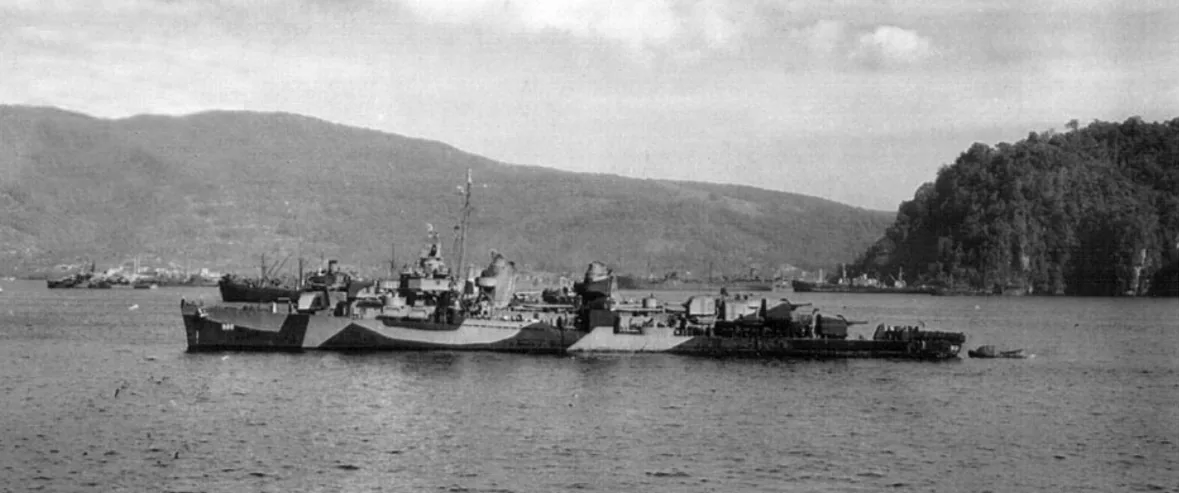
In June 1944 Ringgold took part in the Marianas operations. During the invasion of Guam she served as Landing Craft Control Vessel and provided gunfire support. During the initial landing, she dispatched 23 waves of landing craft to the beach. Next came the invasion of Morotai Island, the Northern Moluccas, where Ringgold again provided gunfire support.
On 20 October 1944 American forces returned to the Philippines , and Ringgold again furnished fire support, this time for the landings on Panaon Island off southern Leyte. Two days later, she was ordered to Mare Island, Calif., for overhaul.
1945
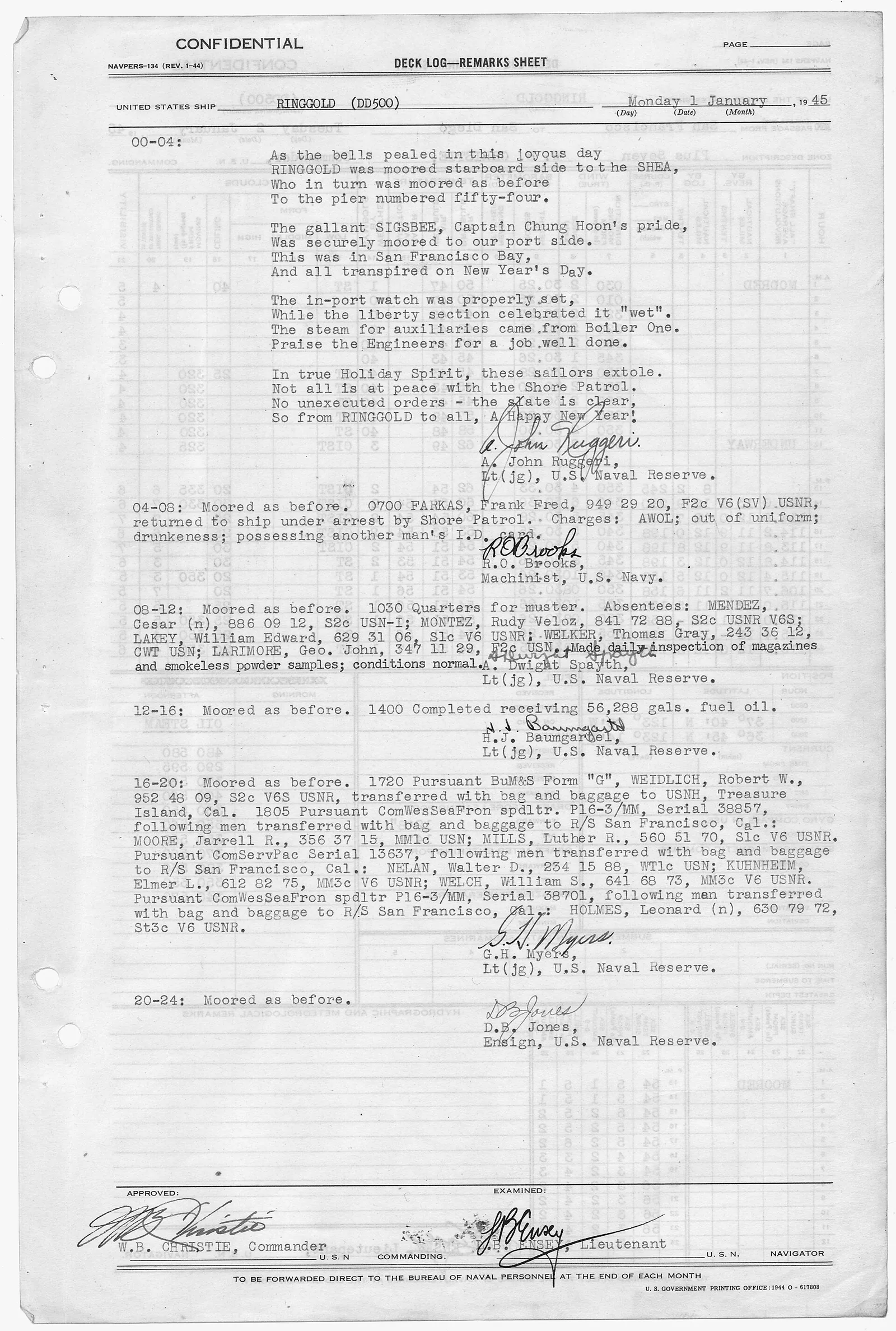
Early in February 1945, Ringgold joined Vice Admiral Marc A. Mitscher's famed Task Force 58 for the first carrier strikes against the Japanese mainland and Okinawa in support of the Iwo Jima operation . Under cover of a weather front, the force launched its air groups at dawn, 16 February, 120 miles from the target. Attacks against enemy air power were pressed into the heart of the Japanese homeland far into the next day. In the course of this two-day attack, the Japanese lost 416 planes in the air, 354 more on the ground and one escort carrier.
After repairs at Ulithi and Pearl Harbor, Ringgold rejoined the Fast Carrier Task Force in support of the Okinawa Operation , joining on 4 June 1945. Upon completion of this task, the force retired to San Pedro Bay, Leyte Gulf, the Philippines, arriving 13 June.
On 1 July 1945 the ship again put to sea, this time with Admiral William F. Halsey, Jr.'s Third Fleet Fast Carrier Task Force for strikes against the Japanese homeland. On the night of 15-16 July, with DesRon 25 and CruDiv 17, Ringgold participated in an antishipping sweep 6 miles off the northern coast of Honshu, Japan. Again, on the night of 30 July, she participated in an antishipping sweep in Suruga Wan and bombarded the town of Shimizu, Honshu, Japan.
Rejoining Task Force 38 the 31st of July 1945, Ringgold continued coastal operations with that force until the cease fire . Ordered to escort Antietam (CV-36) to Apra Harbor, Guam, on 22 August, she arrived there four days later and underwent repairs. Steaming to Okinawa 16 September, Ringgold embarked 83 passengers for Pearl Harbor, and then proceeded to the east coast of the United States.
Post-war 1946–1949
1946
Decommissioned on 23 March 1946, she was placed in the Atlantic Reserve Fleet at Charleston, S.C., where she remained into 1959. Designated for transfer to the Federal Republic of Germany under the military assistance program, she underwent modernization and outfitting at the Charleston, S.C., Naval Shipyard. Formally transferred to the German Navy 14 July 1959, she was redesignated Z-2 . Ringgold was stricken from the Naval Vessel Register on 1 October 1974.
Other photographs
Held for this vessel, and not tied to any part of the account above.



References
Every work this entry draws on. There are no numbered markers in the text above: what we hold is the provenance of the page — this history, this article, these photographs.
- History Ringgold II (DD-500) Dictionary of American Naval Fighting Ships, Naval History and Heritage Command. A work of the United States Government, in the public domain — the only text on this site reproduced verbatim.
- Facts USS Ringgold (DD-500) Structured facts only — dates, dimensions, armament and fate. No wording is taken from it. Harvested 1 August 2026.
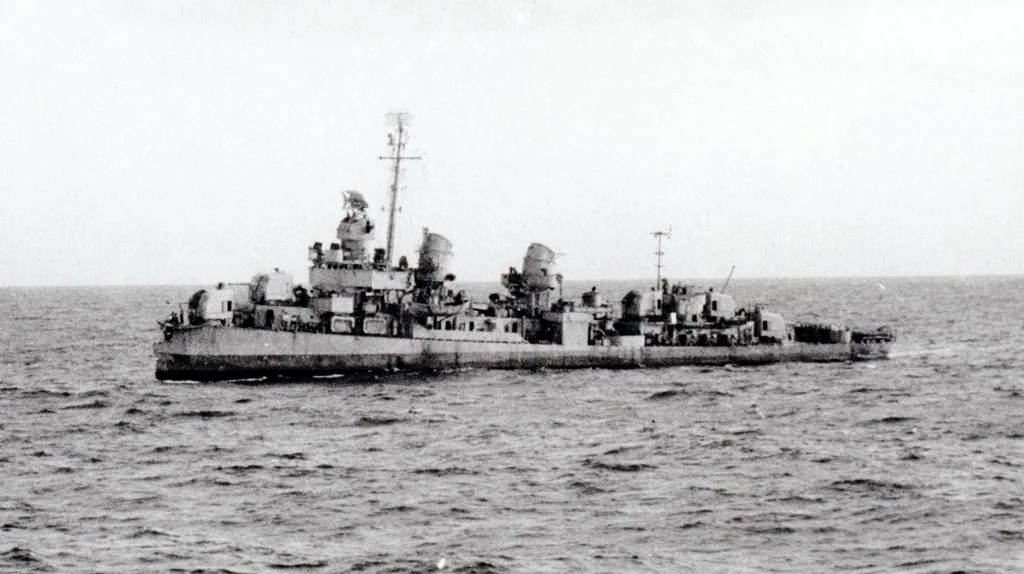
- Photograph USS Ringgold (DD-500) underway in the Atlantic Ocean, circa in May 1943 (19-N-44875) U.S. Navy — U.S. Navy Bureau of Ships photo 19-N-44875 from Navsource.org — Public domain — Wikimedia Commons
- Photograph West German destroyer Z 2 (D 171) during a towing exercise in the North Sea, in March 1971 Mehlauge — Own work — CC BY-SA 3.0 — Wikimedia Commons
- Photograph Deck Log, USS RINGGOLD (DD-500), January 1, 1945. - NARA - 305183 Unknown author or not provided — U.S. National Archives and Records Administration — Public domain — Wikimedia Commons
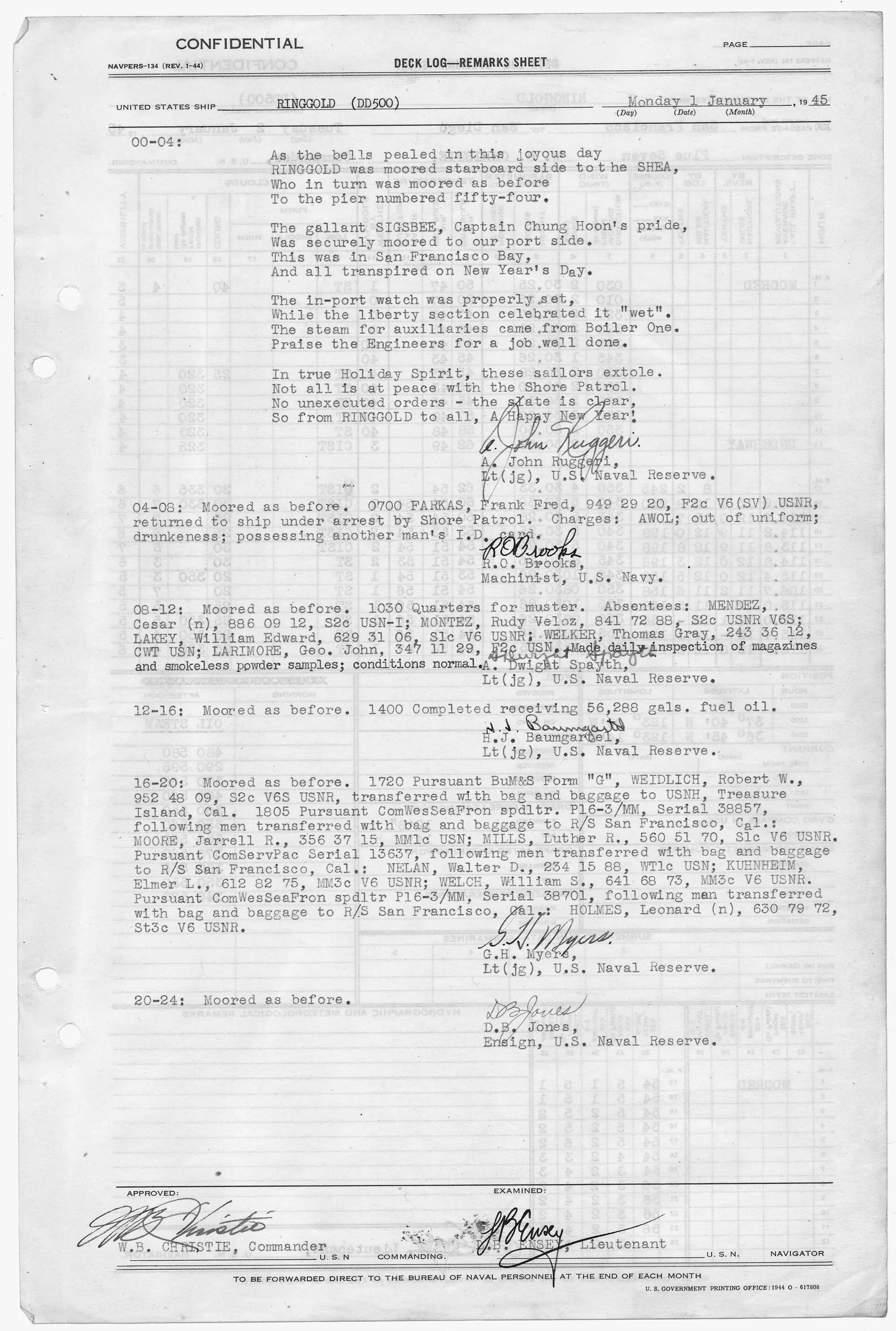
- Photograph Deck Log, USS RINGGOLD (DD-500), January 1, 1945. - NARA - 305183 Unknown author or not provided — U.S. National Archives and Records Administration — Public domain — Wikimedia Commons
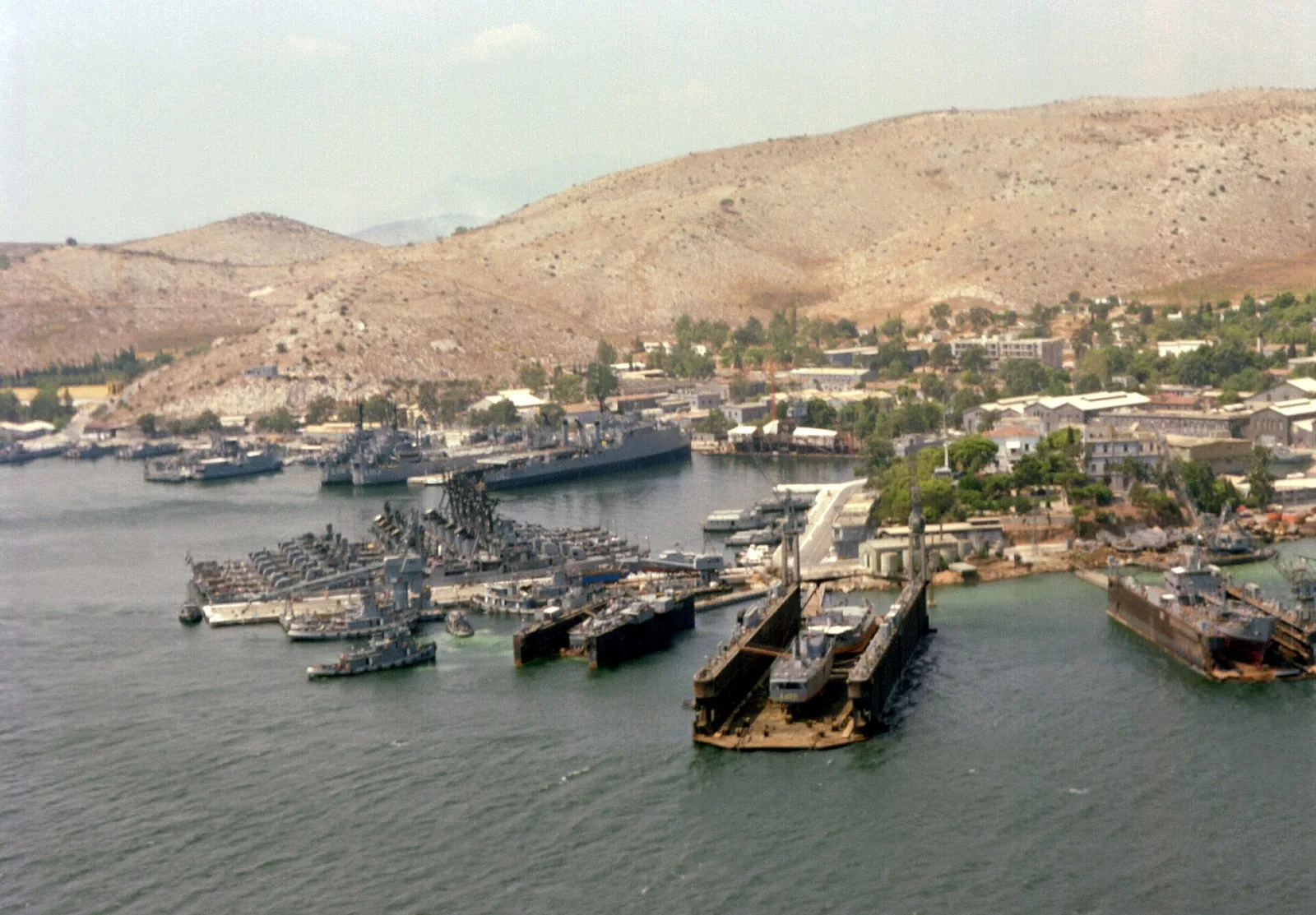
- Photograph Salamis Naval Base with Fletcher class destroyers 1979 PHC C. Pedrick, USN — Public domain — Wikimedia Commons
- Photograph USS Ringgold (DD-500) after losing her bow in a collision on 5 March 1945 Lt J.J. Heimark, U.S. Navy, aboard USS Schroeder (DD-501) — U.S. Navy photo [1] from Navsource.org — Public domain — Wikimedia Commons
- Photograph USS Ringgold (DD-500) in Humboldt Bay, New Guinea, on 13 October 1944 (SC 111-260537) U.S. Army — U.S. Army Signal Corps photo SC 111-260537 from usndazzle.com — Public domain — Wikimedia Commons
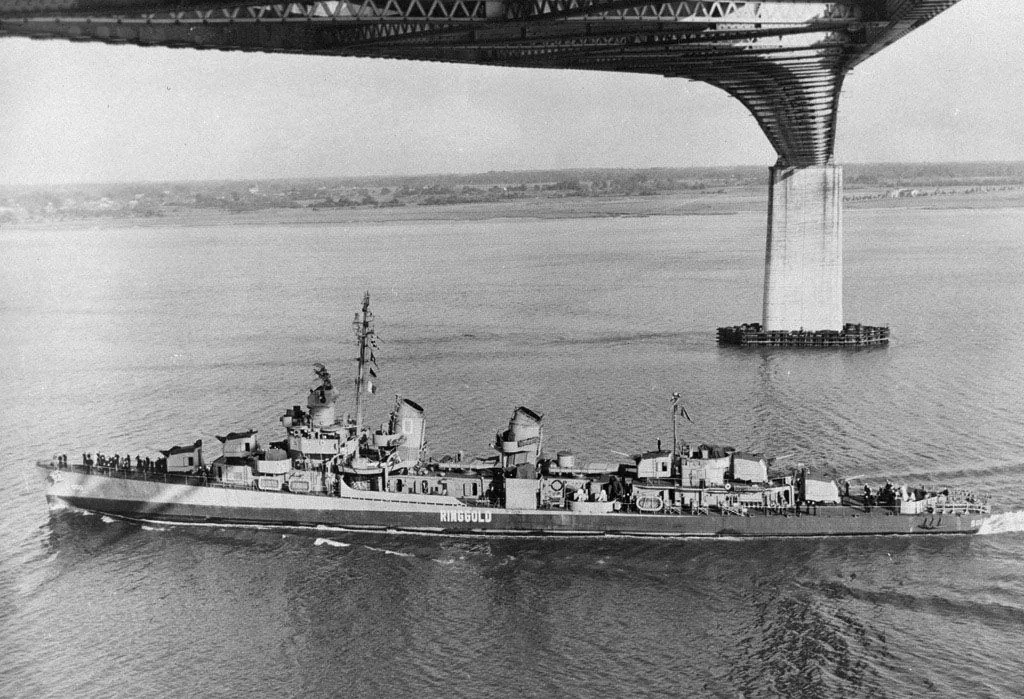
- Photograph USS Ringgold (DD-500) off Charleston, South Carolina (USA), in early November 1945 U.S. Navy — U.S. Navy photo [1] from Navsource.org — Public domain — Wikimedia Commons
- Photograph USS Ringgold (DD-500) underway in the Pacific Ocean on 16 June 1944 (80-G-321655) U.S. Navy — U.S. Navy Bureau of Ships photo 80-G-321655 from Navsource.org — Public domain — Wikimedia Commons
- Photograph USS Ringgold (DD-500) underway in the Pacific Ocean, circa in July 1945 U.S. Navy — U.S. Navy photo [1] from Navsource.org — Public domain — Wikimedia Commons