United States Navy — Destroyer
USS Rogers (DD-876) — service history
This is the full service history. For the vessel's particulars, photograph and specifications, see the entry.
In the words of the US Navy. The account below is reproduced verbatim from the Dictionary of American Naval Fighting Ships, compiled by the Naval History and Heritage Command — a work of the United States Government, in the public domain, and the only text on this site not written here.
Before commissioning

Three brothers, Jack Ellis, Jr., Charles Ethbert, and Edwin Keith Rogers were lost in action on 30 November 1942 when an enemy torpedo ripped away the bow of the heavy cruiser New Orleans (CA-32) during the Battle of Tassafaronga in the Solomon Islands.
Second World War 1939–1945
1944
Rogers (DD-876) was laid down 3 June 1944 by Consolidated Steel Co., Orange, Tex.; launched 20 November 1944; sponsored by Mrs. J. E. Rogers, Sr.; and commissioned 26 March 1945, Comdr. C. B. Smiley in command.
1945
Following shakedown off Guantanamo Bay, Rogers was converted to a picket ship at the Navy Yard, Portsmouth, Va. After further training in the Atlantic and Caribbean, Rogers transited the Panama Canal and touched at San Diego before reaching Pearl Harbor 4 August 1945.
With the termination of hostilities, Rogers departed Pearl Harbor 17 August for Tokyo Bay where she arrived 31 August via Eniwetok and Iwo Jima. On 1 September she stood out of Tokyo Bay to join a fast carrier task group and commence her routine duties as a member of the 7th Fleet. Through the decade she rotated to the Far East for duty with that fleet on a regular schedule, and in 1949 assisted in evacuating American nationals from China.
Post-war 1946–1949
1949
Rogers participated in the atomic bomb test in Eniwetok Atoll in 1948. On 18 March 1949, she was reclassified as a radar picket destroyer (DDR) after a height finder radar and more communication equipment had been added and her torpedo tubes had been removed.
During 1951 and 1952, Rogers served as a unit of Task Forces 77, 95, and 96 and participated in shore bombardment, blockading, and patrol missions in Korean waters. During this period Rogers also served as "lifeguard" destroyer for two Presidents: for President Truman's flight to Wake Island for his conference with Gen. Douglas MacArthur in 1950 and for President-elect Eisenhower on his return from the Far East in 1952.
After fighting stopped in Korea, Rogers alternated west coast tours with WestPac deployment. In 1954, she helped in the evacuation of the Tachen Islands.
Cold War 1954–1963
1962
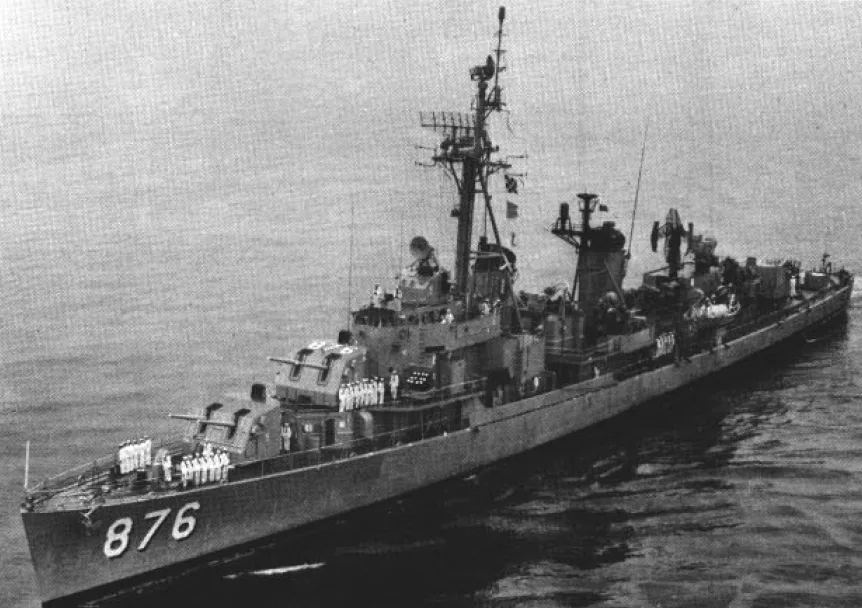
By 1960 Rogers had made over a dozen 6- to 9-month cruises to the Far East. After 1st Fleet operations off the west coast, Rogers again deployed in January 1962 to WestPac where she operated with carrier groups, on Formosa patrol, and participated in a major Allied amphibious exercise. Rogers returned to the 1st Fleet and on the evening of 12 November, successfully recovered one of Ticonderoga's (CVA-14) pilots who has ejected from his plane into a dense fog off the coast of southern California.
1963
In June 1963, after 18 years in the Pacific, Rogers departed San Diego for the east coast and FRAM I modernization at Charleston, S.C. On 30 July 1963 she was reclassified from DDR-876 to DD-876. In May 1964 she returned to the Pacific Fleet. Two years later she was operating off Vietnam. Returning to San Diego in August 1966, she operated with the 1st Fleet off the west coast of the United States until deploying again to the western Pacific in September 1967. In mid-November, she was operating in the Tonkin Gulf, and in April 1968 returned to Alameda, Calif.
Vietnam War period 1964–1975
1969
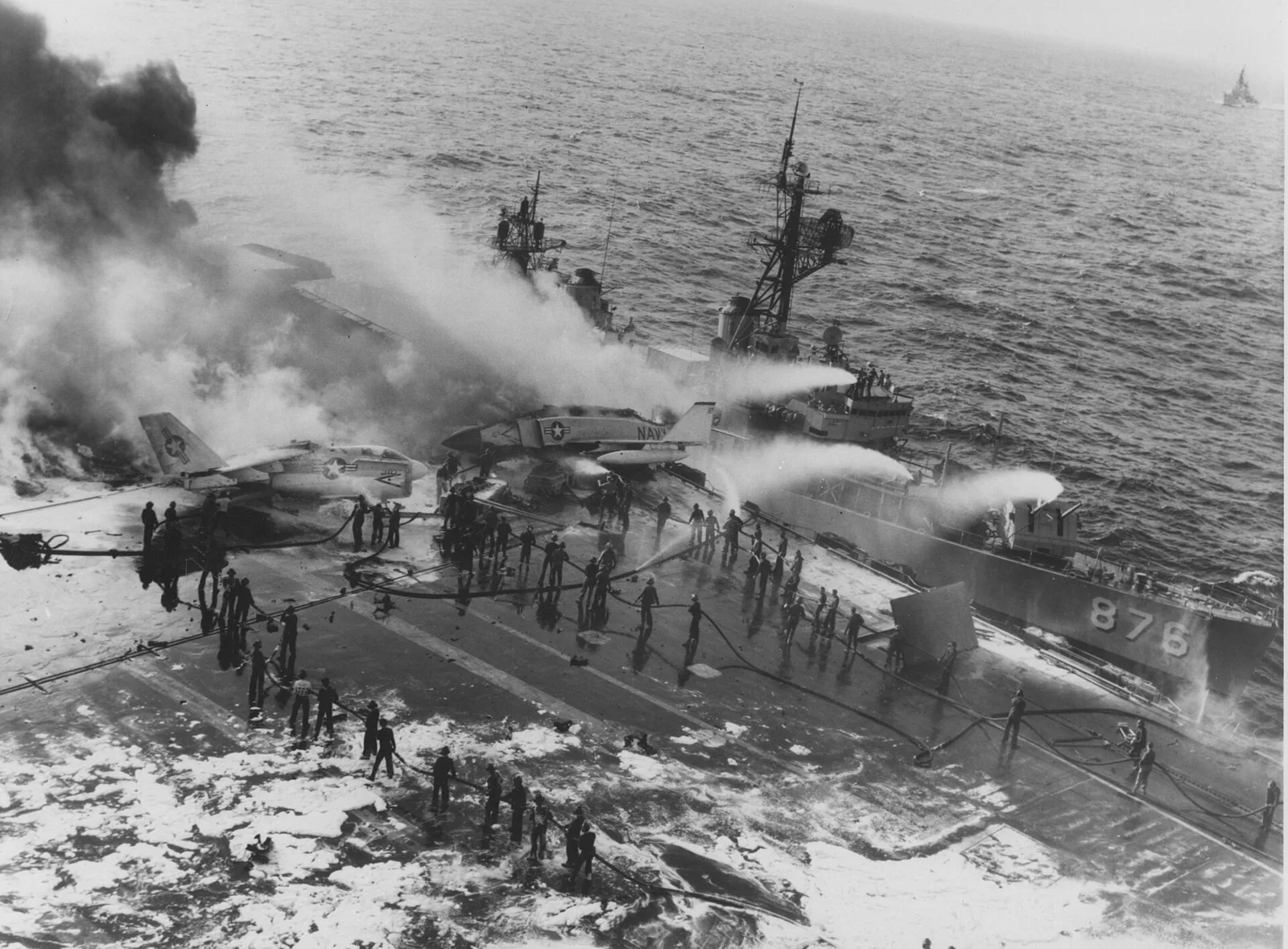
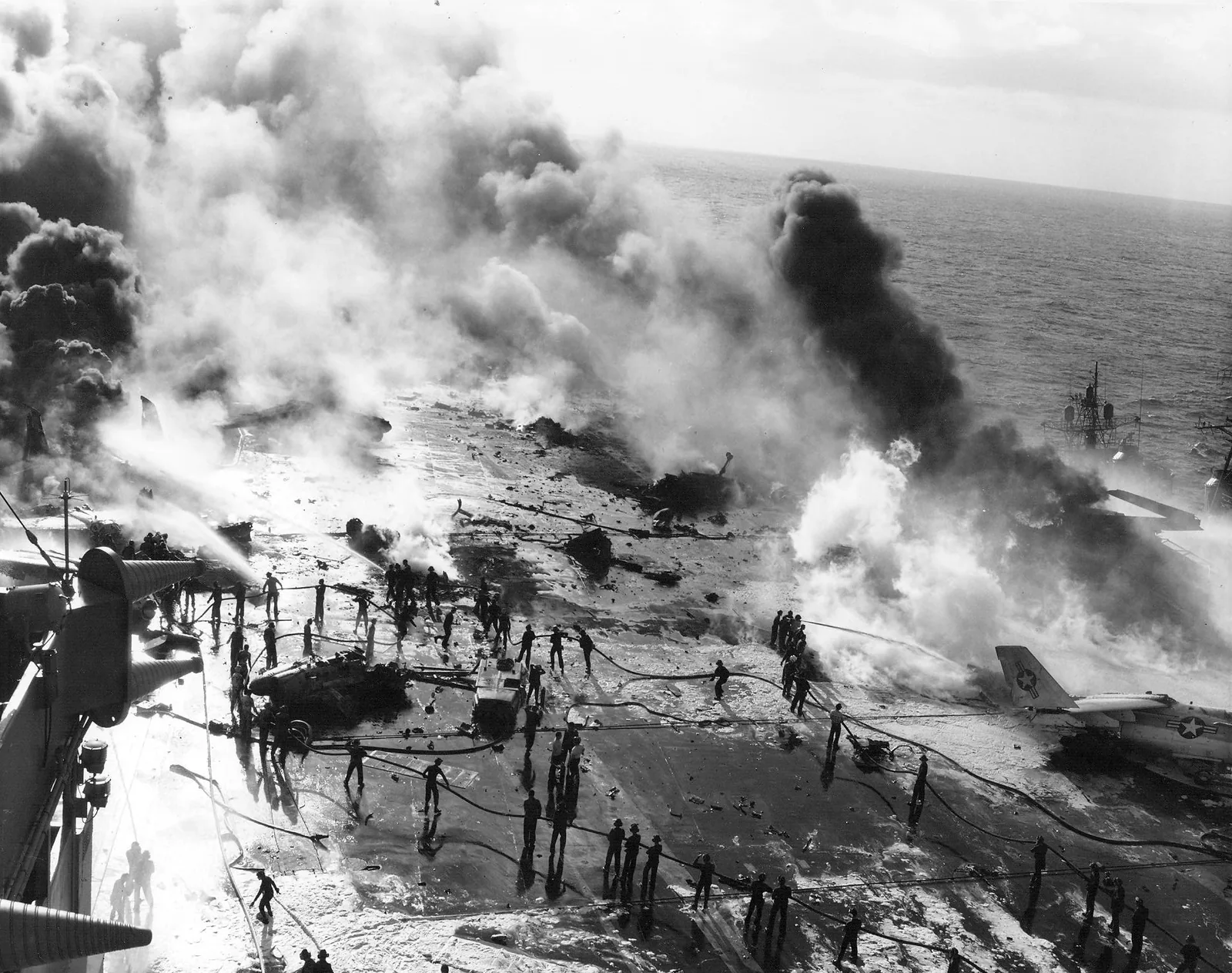
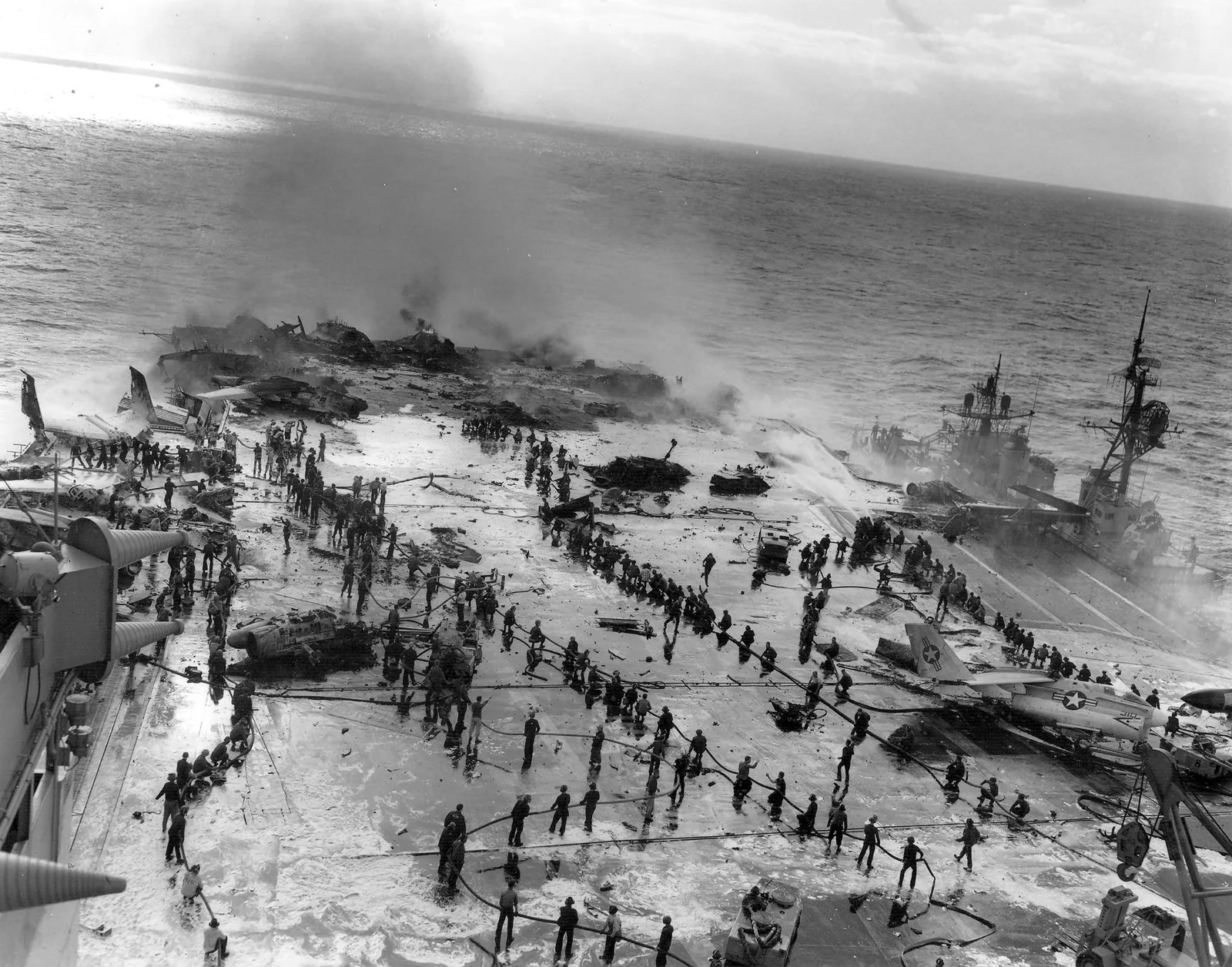
Again operating off the west coast of the United States for the balance of the year, Rogers deployed to the Far East in January 1969. En route she earned the Meritorious Unit Commendation for action in Hawaiian waters on 14 January coming alongside the port quarter of Enterprise (CVA(N)-65) with six fire hoses trained on the raging flight-deck fire while exposed to flying shrapnel from exploding bombs. After spending some of her time in the Far East off Vietnam, she returned to San Diego 6 July.
After a year of operations with the First Fleet, Rogers sailed from San Diego for another Far East cruise. Following five months of service in the western Pacific, she returned to San Diego 16 December.
1972
At the completion of another spring of west coast operations, Rogers headed back to WestPac, departing from San Diego 29 June 1972. She returned to San Diego 22 December and spent the next year on the Pacific coast of the United States engaged initially in normal operations. Later, in early April 1972, she entered Hunter's Point Naval Shipyard for regular overhaul. Overhaul was completed by 28 August and she left Hunter's Point for various trials and refresher training, which continued until mid-December. On the 18th, she sailed for Subic Bay, but had to return to San Diego three days later because of a medical emergency. She departed San Diego the same day, 21 December, and arrived in Subic Bay 29 January 1973. Returning to San Diego 12 June 1973, Rogers operated along the west coast into 1974.
Later service 1976 onwards
1981
Rogers decommissioned on 19 February 1981 and was struck from the navy list on 1 October 1980. Transferred to the Republic of Korea on 11 August 1981, the destroyer served as Jeong Ju (DD 925) until decommissioned 31 December 1999. The destroyer is reportedly now a museum ship at SapKoyohp National Sightseeing Resort, located at Dangjin-Gun, Chung Nam Province.
Other photographs
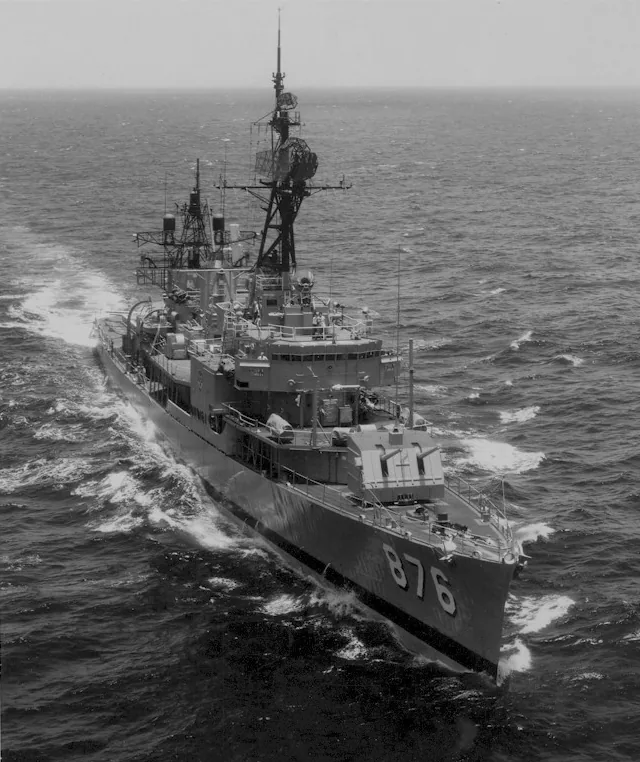
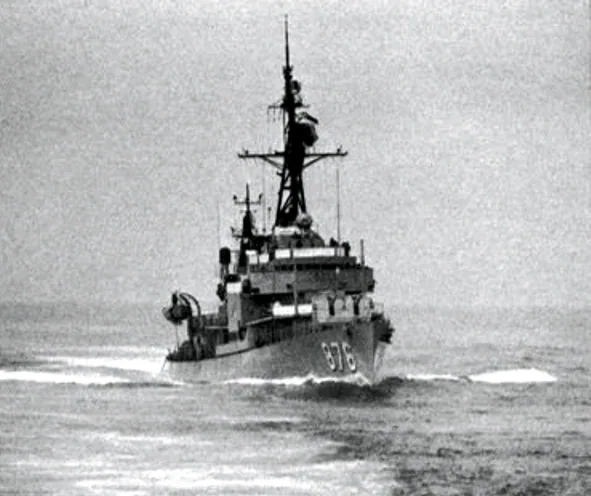
Held for this vessel, and not tied to any part of the account above.


References
Every work this entry draws on. There are no numbered markers in the text above: what we hold is the provenance of the page — this history, this article, these photographs.
- History Rogers (DD-876) Dictionary of American Naval Fighting Ships, Naval History and Heritage Command. A work of the United States Government, in the public domain — the only text on this site reproduced verbatim.
- Facts USS Rogers (DD-876) Structured facts only — dates, dimensions, armament and fate. No wording is taken from it. Harvested 1 August 2026.
- Photograph NH 107133 USS Rogers Unknown author — https://www.history.navy.mil/content/history/nhhc/our-collections/photography/numerical-list-of-images/nhhc-series/nh-series/NH-107000/NH-107133.html — Public domain — Wikimedia Commons
- Photograph USS Rogers (DD-876) alongside burning USS Enterprise (CVN-65) PH3 Lawrence T. Henderson, USN — US Navy Photo via NavSource.org https://www.navsource.net/archives/02/65.htm — Public domain — Wikimedia Commons
- Photograph Task Force 77 in South China Sea, 1965 USN — Official U.S. Navy photo USN 1109915 from the U.S. Navy Naval History and Heritage Command — Public domain — Wikimedia Commons
- Photograph USS Enterprise (CVAN-65) 1969 fire crew fire fighting U.S. Navy — U.S. Navy National Museum of Naval Aviation photo No. 1996.488.125.060 — Public domain — Wikimedia Commons
- Photograph USS Enterprise (CVAN-65) 1969 fire ending U.S. Navy — U.S. Navy National Museum of Naval Aviation photo No. 1996.488.125.062 — Public domain — Wikimedia Commons
- Photograph USS Kawishiwi (AO-146) refueling Ticonderoga (CVA-14) and Rogers (DD-876) in 1960 USN — Official U.S. Navy photo [1] from the USS Ticonderoga (CVA-14) 1960 cruise book available at Navsource.org — Public domain — Wikimedia Commons
- Photograph USS Rogers (DD-876) in the South China Sea in 1973 PH2 T.A. Daly, USN — Official U.S. Navy photo NPC 1156188 from the Navsource.org — Public domain — Wikimedia Commons
- Photograph USS Rogers (DD-876) Insignia Unknown author — U.S. Navy photo NH 68017-KN — Public domain — Wikimedia Commons
- Photograph USS Rogers (DD-876) underway in the Gulf of Tonkin, in 1966 U.S. Navy — U.S. Navy photo [1] from the USS Coontz (DLG-9) 1966 cruise book available at Navysite.de — Public domain — Wikimedia Commons
- Photograph USS Rogers (DDR-876) underway c1962 U.S. Department of Defense — U.S. Navy All Hands magazine October 1963 , p. 7 — Public domain — Wikimedia Commons