USS Sampson (DD-394)
Service
- 19 August 1938 — 1 November 19452,193 days of the war
- Name
- USS Sampson
- Pennant / hull number
- DD-394
- Namesake
- William Thomas Sampson
- Builder
- Bath Iron Works
- Laid down
- 8 April 1936
- Launched
- 16 April 1938
- Commissioned
- 19 August 1938
- Decommissioned
- 1 November 1945
- Struck
- 28 November 1945
- Fate
- Scrapped 29 March 1946 (1946)
- Status
- Scrapped
Specifications
- Displacement, standard
- 2,130 long tons (2,164 t)
- Length
- 116.13 m (381 ft)
- Beam
- 10.97 m (36 ft)
- Draught
- 3.05 m (10 ft)
- Complement
- 287
- Main gun
- 127 mm (5 in)
William Thomas Sampson, born on 9 February 1840 in Palmyra, N.Y., entered the United States Naval Academy on 24 September 1857. After graduating 1st in his class four years later, he served as an instructor at the Academy. In 1864, he became the executive officer of the monitor Patapsco of the South Atlantic Blockading Station and engaged in sweeping torpedoes off Charleston. He survived the loss of that ironclad on 15 January 1865, when she struck a torpedo, exploded, and sank with a loss of 75 lives. Following duty in the steam frigate, Colorado, on the European Station, another tour as instructor at the Naval Academy, and in the Bureau of Navigation of the Navy Department, he served in the screw sloop, Congress. He then commanded Alert, practice ship Mayflower, and Swatara while on duty at the Naval Academy. During the next years, he was Assistant to the Superintendent of the Naval Observatory, then Officer-in-Charge of the Naval Torpedo Station, Newport, R.I. On 9 September 1886, he became Superintendent of the Naval Academy. He was promoted to Captain on 9 April 1889, reported to the Mare Island Navy Yard to fit out San Francisco, and assumed command when that protected cruiser was commissioned on 15 November 1889. He was detached in June 1892 to serve as Inspector of Ordnance in the Washington Navy Yard and was appointed Chief of the Bureau of Ordnance on 28 January 1893. He assumed command of battleship, Iowa, on 15 June 1897. On 17 February 1898, he was made President of the Board of Inquiry to investigate the destruction of battleship, Maine. On 26 March 1898, he assumed command of the North Atlantic Station, with the temporary rank of Rear Admiral. The United States declared war against Spain on 21 April 1898; and, eight days later, Admiral Cervera's fleet sailed from the Cape Verde Islands for an uncertain destination. Admiral Sampson, in flagship New York, put to sea from Key West in search of the Spanish Fleet and established a close and efficient blockade on that fleet in the harbor of Santiago on 1 June 1898. On the morning of 3 July 1898, Cervera's fleet came out of the harbor and was completely destroyed in a running sea battle lasting five hours. The next day, Rear Admiral Sampson sent his famous message: "The Fleet under my command offers the nation as a Fourth of July present, the whole of Cervera's Fleet!" He was appointed Cuban Commissioner on 20 August 1898 but resumed command of the North Atlantic Fleet in December. He became Commandant of the Boston Navy Yard in October 1899 and transferred to the Retired List on 9 February 1902. Rear Admiral Sampson died in Washington, D.C., on 6 May 1902 and was buried in Arlington National Cemetery.
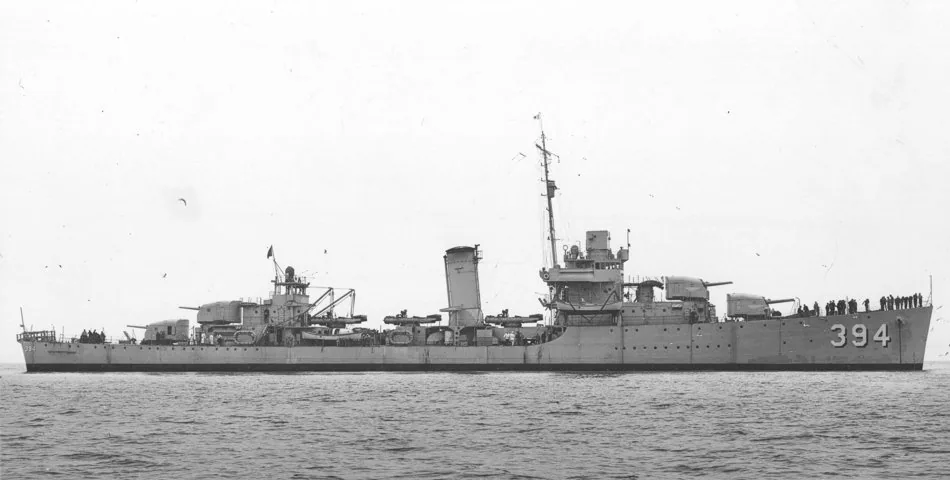
The second Sampson (DD-394) was laid down on 8 April 1936 by the Bath Iron Works Corp., Bath, Maine; launched on 16 April 1938; sponsored by Mrs. Louisa Smith Thayer; and commissioned at the Boston Navy Yard on 19 August 1938, Comdr. W. Granat in command.
Following shakedown in European waters in October and November, Sampson returned to Boston where she was assigned to the Battle Force of the United States Fleet.
Continue to the full service history About 1,799 words
From the Dictionary of American Naval Fighting Ships, compiled by the Naval History and Heritage Command (Sampson II (DD-394)). A work of the United States Government, in the public domain.
Armament and machinery
Armament and machinery
- Armament
- 4x2 5 in SP guns
- 3x4 21" torpedo tubes
Sister ships
Sources
- Facts harvested from USS Sampson (DD-394) on Wikipedia. Figures only — no wording is taken from it.
- Service history reproduced verbatim from Sampson II (DD-394) , Dictionary of American Naval Fighting Ships — public domain, a work of the United States Government.
- Photograph: Unknown author — http://www.destroyerhistory.org/goldplater/394sampson_01.html — Public domain — Wikimedia Commons