United States Navy — Aircraft carrier
USS San Jacinto (CVL-30) — service history
This is the full service history. For the vessel's particulars, photograph and specifications, see the entry.
In the words of the US Navy. The account below is reproduced verbatim from the Dictionary of American Naval Fighting Ships, compiled by the Naval History and Heritage Command — a work of the United States Government, in the public domain, and the only text on this site not written here.
Before commissioning
On 21 April 1836, General Sam Houston and his outnumbered troops won independence for Texas by decisively defeating a Mexican army at the San Jacinto River.
Second World War 1939–1945
1941
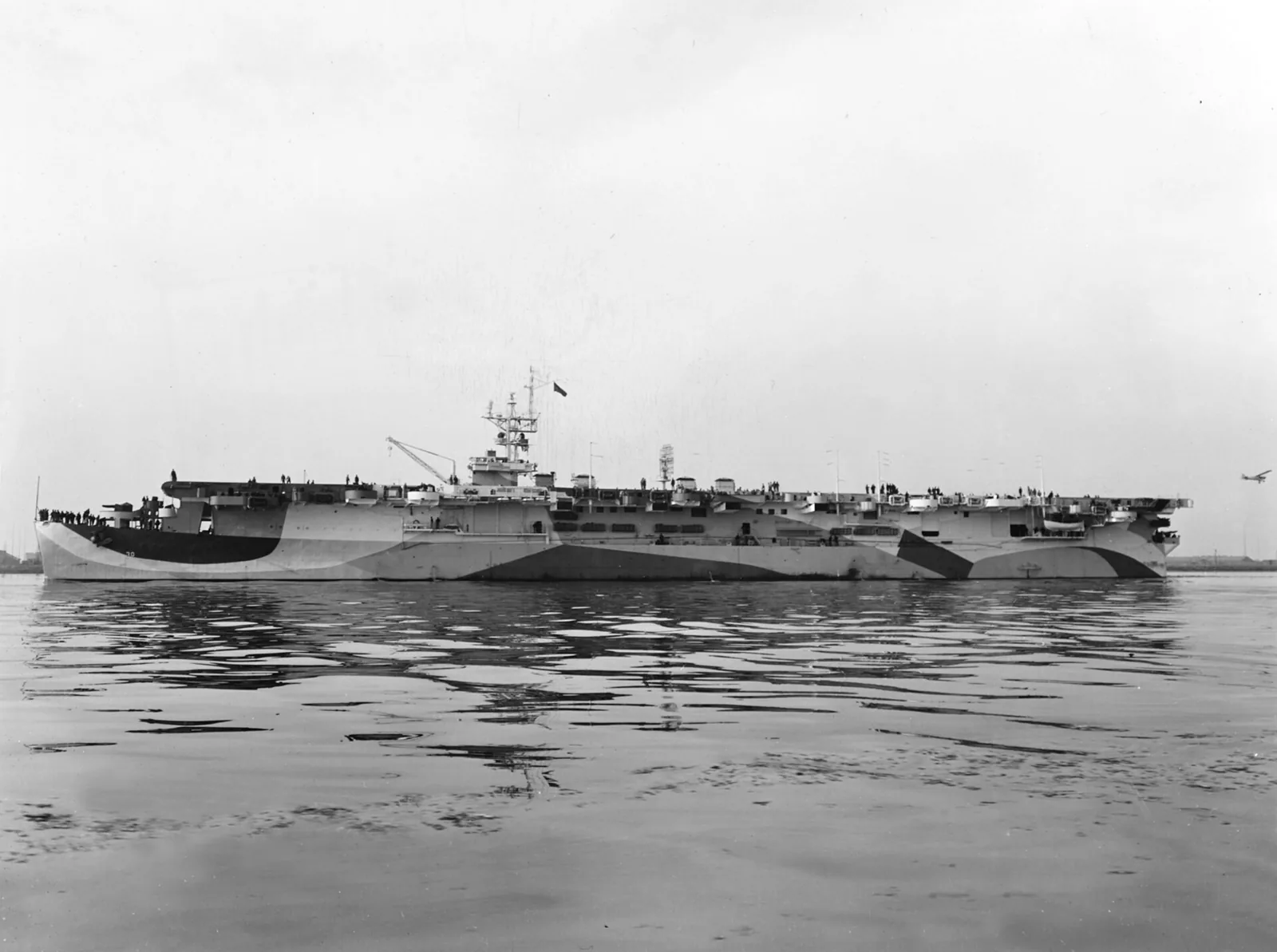
The name Newark was originally assigned to a projected light cruiser, CL-100, on 11 February 1941. The wartime need for aircraft carrier construction, however, resulted in the light cruiser being earmarked for conversion to an aircraft carrier and reclassification to CV-30. Renamed Reprisal on 2 June 1942, the ship was laid down on 26 October 1942 at Camden, N.J., by the New York Shipbuilding Co.; renamed San Jacinto circa 4 January 1943; reclassified as a small aircraft carrier, CVL-30, on 15 July 1943; launched on 26 September 1943; sponsored by Mrs. Jesse Jones, wife of the Secretary of Commerce; and commissioned on 15 November 1943, Capt. Harold M. Martin in command.
After shakedown in the Caribbean, San Jacinto sailed, via the Panama Canal, San Diego, and Pearl Harbor, for the Pacific war zone. Arriving at Majuro, Marshall Islands, she became part of the growing might of Vice Admiral Marc A. Mitscher's Task Force 58/38, the fast carrier striking force of the Pacific Fleet. There, San Jacinto embarked Air Group 51, whose fighters and torpedo planes would be the ship's chief weapons in battle.
1944 Luzon
After providing search patrols to protect other carriers striking at Wake and Marcus Islands, San Ja cinto, by 5 June 1944, was ready to participate in the largest fleet action since the battle of Midway, almost exactly two years before. On that day, Task Force 58 sortied from Majuro and headed toward the Marianas to conduct air strikes preparatory to American seizure of Saipan and to protect the invasion forces from enemy air and naval attack.
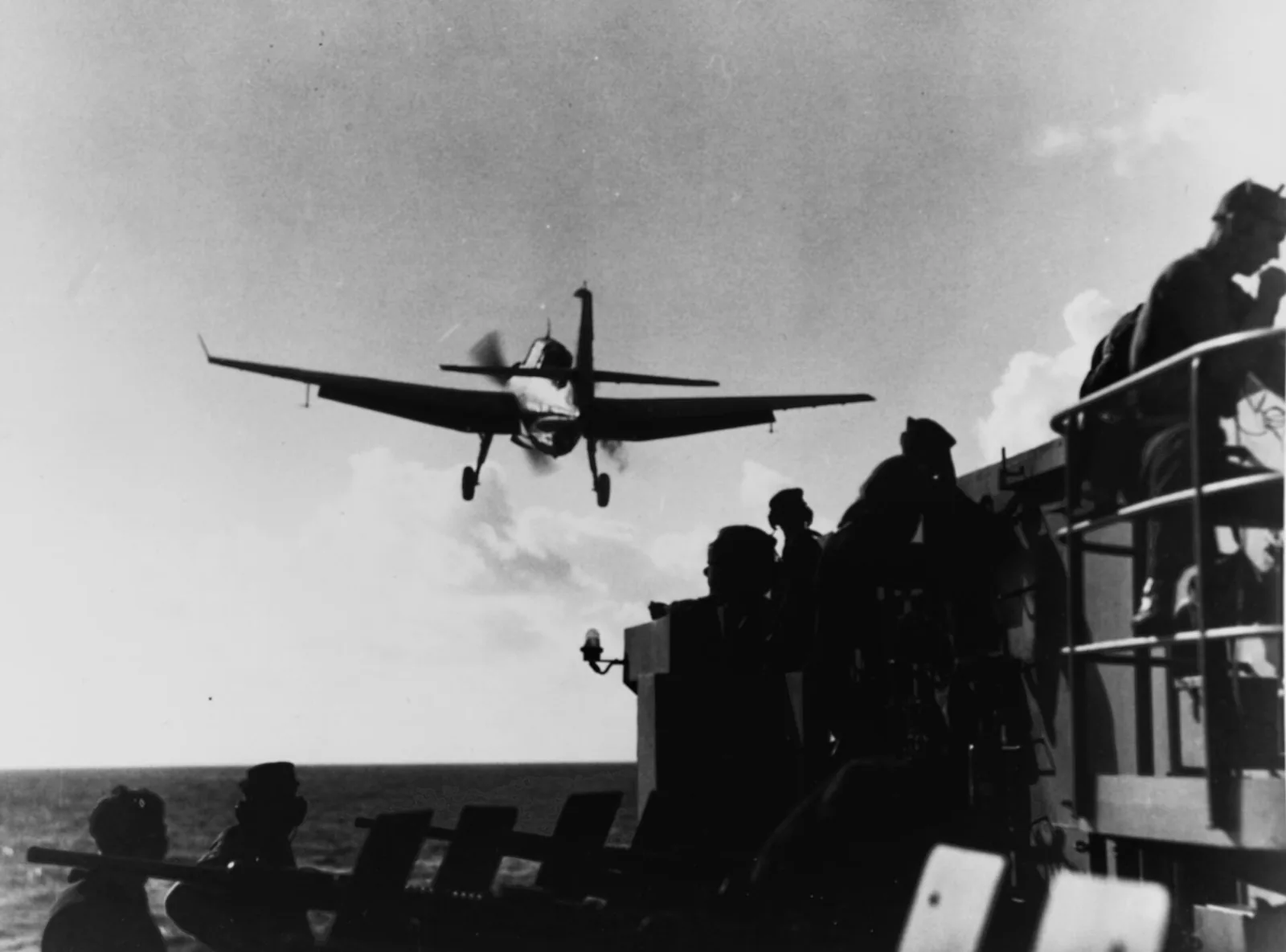
This American thrust triggered a strong Japanese reaction; on 19 June, the Japanese Fleet launched more than 400 planes against the invasion fleet and the covering carrier force. In the ensuing air battle, known to American pilots as the "Marianas Turkey Shoot," more than 300 enemy planes were shot down. While San Jacinto's planes were achieving their most one sided victory of the war, her gunners helped to down the few attackers able to get near the American ships. Then, at dusk, Admiral Mitscher dispatched an all-carrier attack after the retreating enemy fleet. The night recovery of the returning planes was accomplished amid considerable confusion. Reportedly, a Japanese carrier plane attempted a landing approach on San Jacinto, only to be waved off by the landing signal officer because its hook wasn't down.
San Jacinto then participated in strikes against Rota and Guam and furnished combat air patrol (CAP) and antisubmarine patrol (ASP) for her task group. During these raids, a San Jacinto fighter pilot was shot down over Guam and spent 17 days in a life raft trying to attract attention and 16 nights hiding on the island.
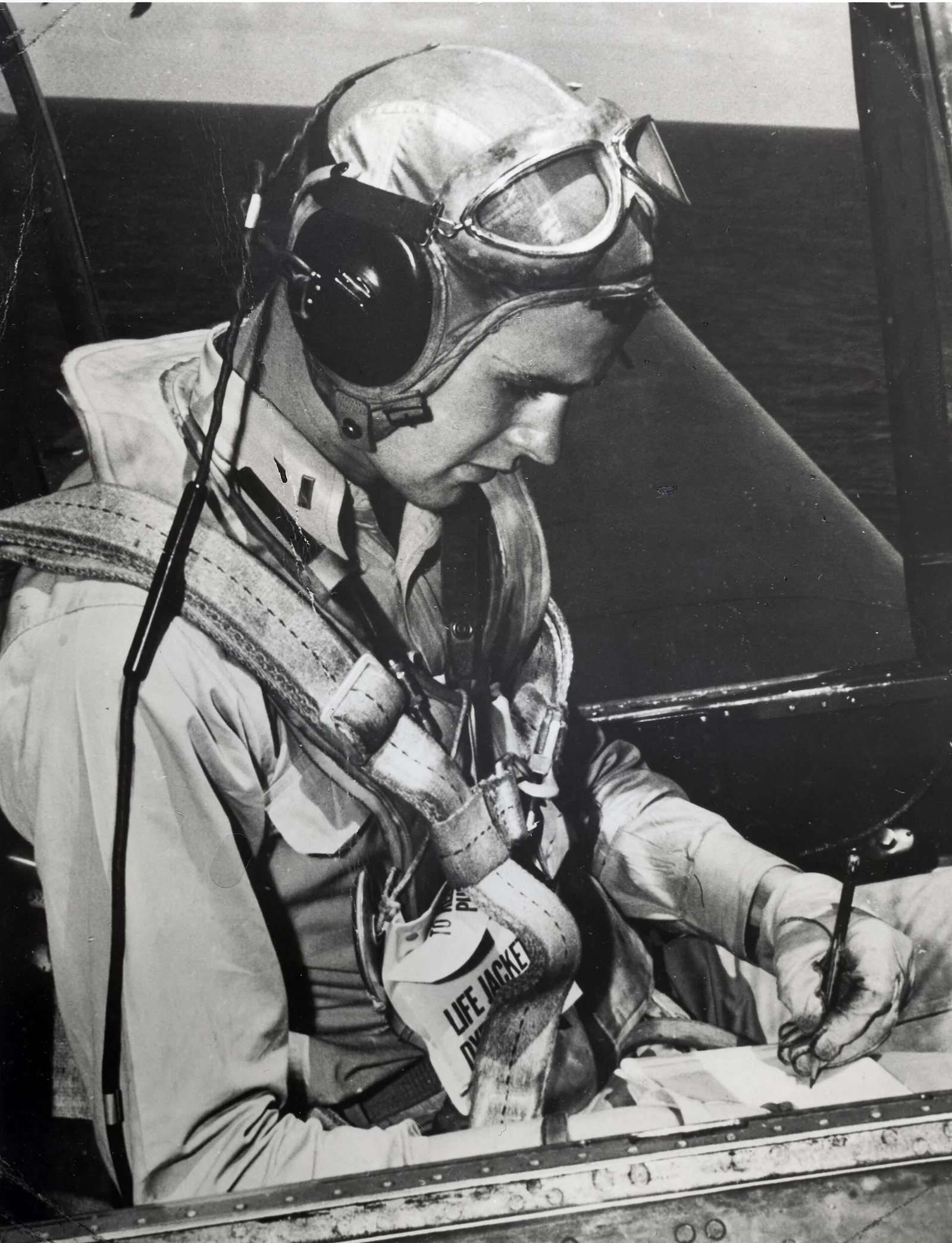
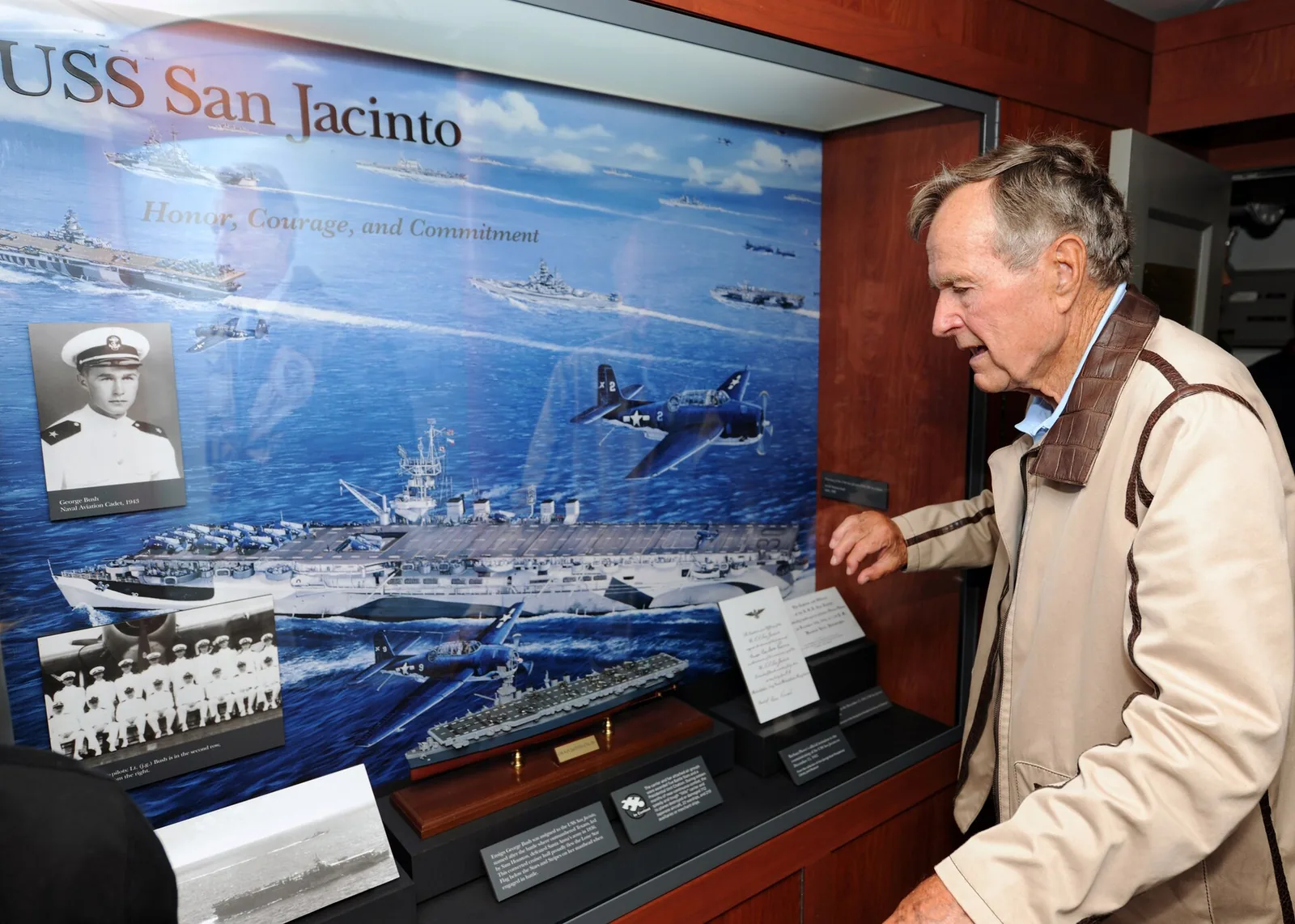
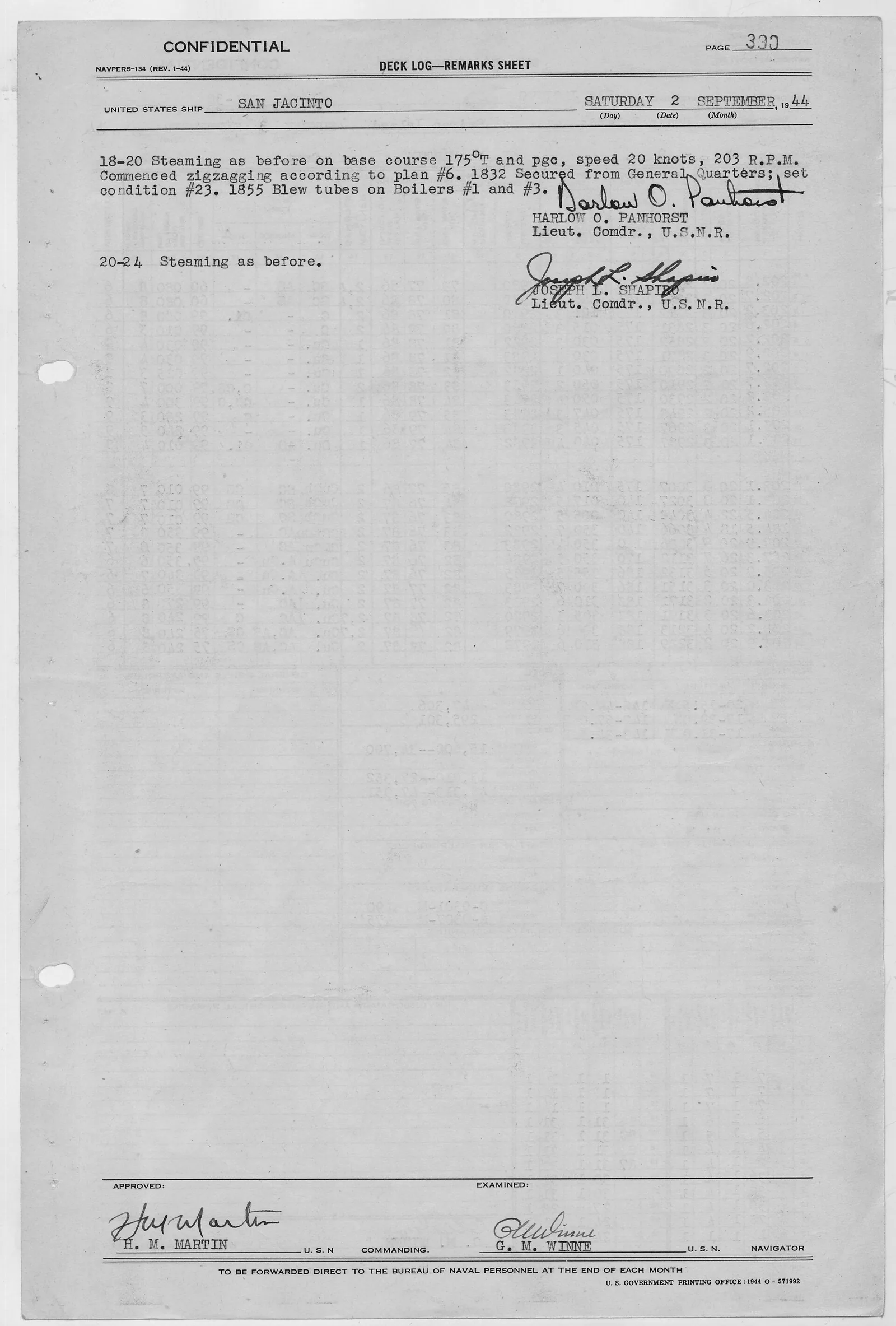
After a refueling and replenishment stop at Eniwetok Atoll, San Jacinto joined in carrier strikes against the Palaus on 15 July. On 5 August, her targets were Chichi, Haha, and Iwo Jima. A brief stop at Eniwetok preceded her return to the Bonins at the end of August. During strikes on Chichi Jima on 2 September, antiaircraft fire downed the General Motors TBM-3 Avenger flown by Lt.(j.g.) George H. W. Bush, USNR; although one of his two-man crew (either Lt. W. G. White or ARM2c J. I. Dela ney) bailed out, his chute failed to open and he plummeted to his death. The submarine Finback (SS-230), lifeguarding for the strike, rescued Lt. (j.g.) Bush, covered by fighters that sank two small craft that put out from the island in hopes of taking the downed pilot captive. The rescued Avenger pilot went on to become the 41st President of the United States.
As American troops landed on Leyte in the central Philippines on 20 October, San Jacinto provided close air support. On 24 October, this mission was interrupted by news of the tri-pronged approach of the Japanese fleet which precipitated the largest fleet battle in naval history.
San Jacinto sent planes against the central force in the Sibuyan Sea; then raced north to launch strikes against the northern force, resulting in heavy damage to the Japanese carriers and surface combatants off Cape Engano. On 30 October, her fighters furnished air protection over Leyte while her guns shot down two planes attempting suicide attacks on the ship. After a pause at Ulithi, the carrier joined in attacks on the Manila Bay area; then took a side trip to Guam to exchange air groups, receiving Air Group 45. She received slight damage during Typhoon Viper on 18 December 1944.
After completing repairs at Ulithi, San Jacinto and the rest of her fast carrier force entered the South China Sea and launched massive air attacks on the airfields of Formosa and against shipping at Cam Ranh Bay, French Indochina, and at Hong Kong. By refueling and replenishing at sea, Task Force 38 was able to continue its pressure on the enemy and strategic support for the American invasion of Luzon by strikes against the Ryukyu Islands.
1945 Iwo Jima
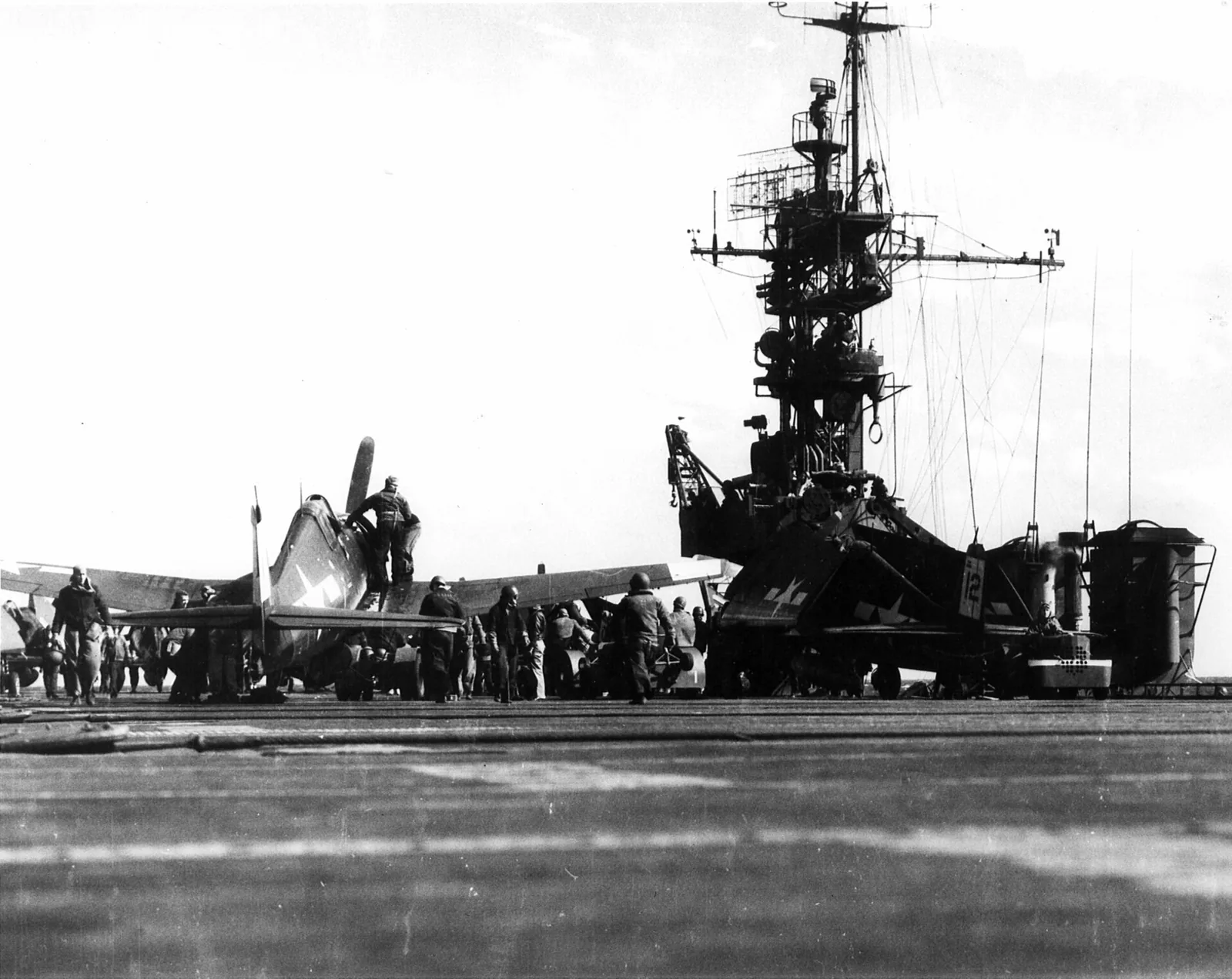
Next, San Jacinto joined in the first carrier strikes against the home islands of Japan. During the raids on 16 and 17 February 1945, carrier-based aircraft downed many enemy planes during fierce dogfights over airfields in the Tokyo area. These operations were designed to cover the imminent invasion of Iwo Jima. Next came air support for the landing Marines, followed by further strikes against Tokyo and Okinawa before San Jacinto returned to Ulithi.
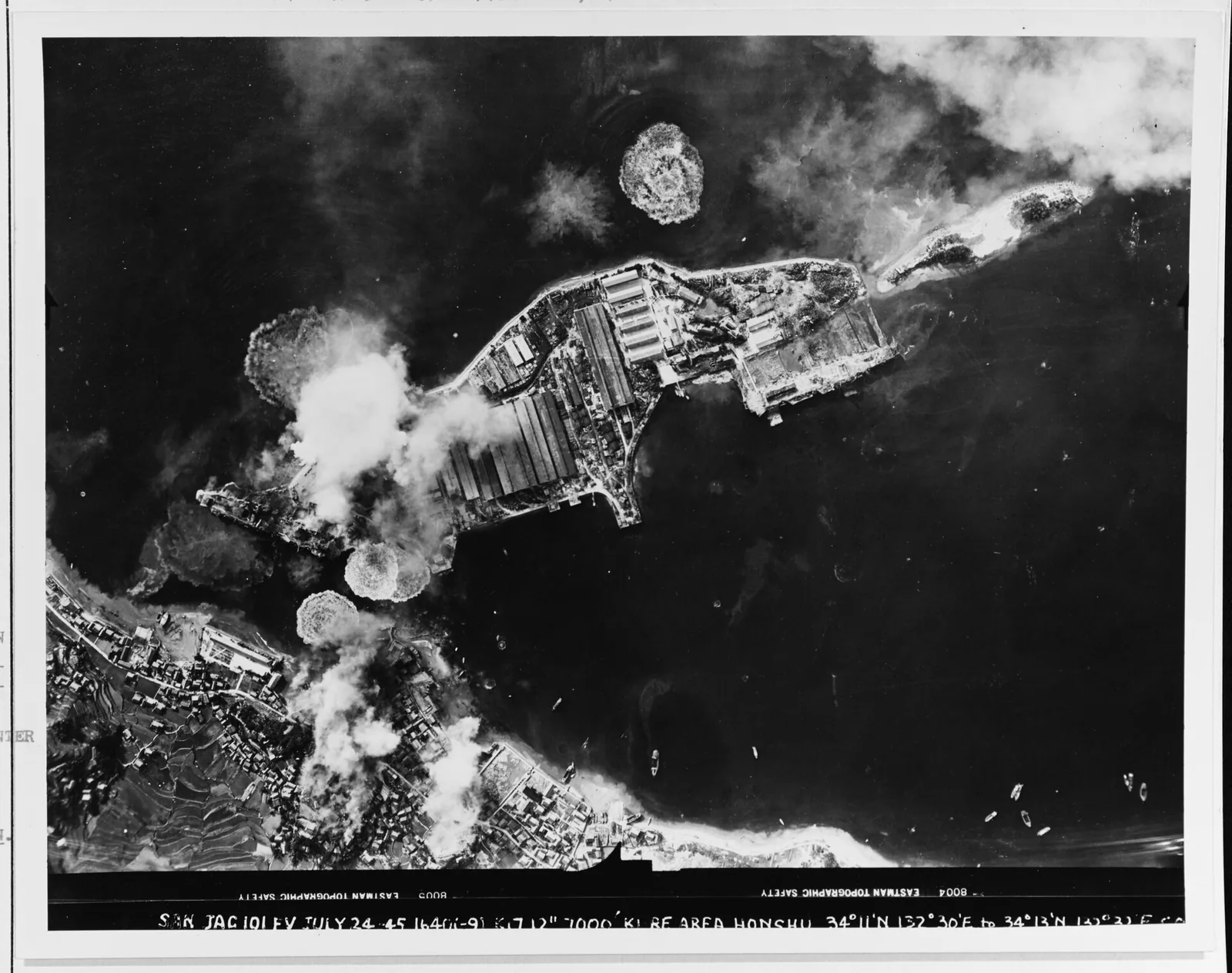
While conducting operations off Kyushu, Japan, she witnessed the conflagration on Franklin (CV-13); and, on 19 March 1945, narrowly escaped destruction herself when a kamikaze barely missed her. More massive enemy attacks came with Operation "Iceberg" as the carrier force furnished air support for the invasion of Okinawa. On 5 April, more than 500 planes, primarily kamikazes, attacked. Fighter planes and antiaircraft guns shot down about 300, but many got through. San Jacinto's gunners shot the wing off a would-be suicide plane, deflecting its dive, and splashed another only 50 feet off her port bow. Her mission of covering the Okinawa invasion entailed heavy air activity and kept the ship almost constantly at general quarters while supporting ground forces and repelling frequent attacks by suicide planes. On 7 April, San Jacinto's bombers torpedoed Japanese destroyer, Hamakaze, part of a naval suicide attack in which super battleship, Yamato, was also sunk. San Jacinto then returned to the dangerous job of defending against the suicide plane attacks, striking at the kamikaze airfields on Kyushu, and providing close air support for ground forces fighting on Okinawa. On 5 June, she successfully rode out another typhoon and, after replenishing at Leyte, sortied for her final raids as part of Task Force 58. Her aircraft struck at Hokkaido and Honshu, Japan, on 9 July and continued to operate off the coast of Japan until the end of hostilities on 15 August 1945. Her air missions over Japan then became mercy flights over Allied prisoner-of-war camps, dropping food and medicine until the men could be rescued. Her wartime mission completed, San Jacinto returned home and tied up at Alameda, Calif., on 14 September 1945.
Post-war 1946–1949
1947
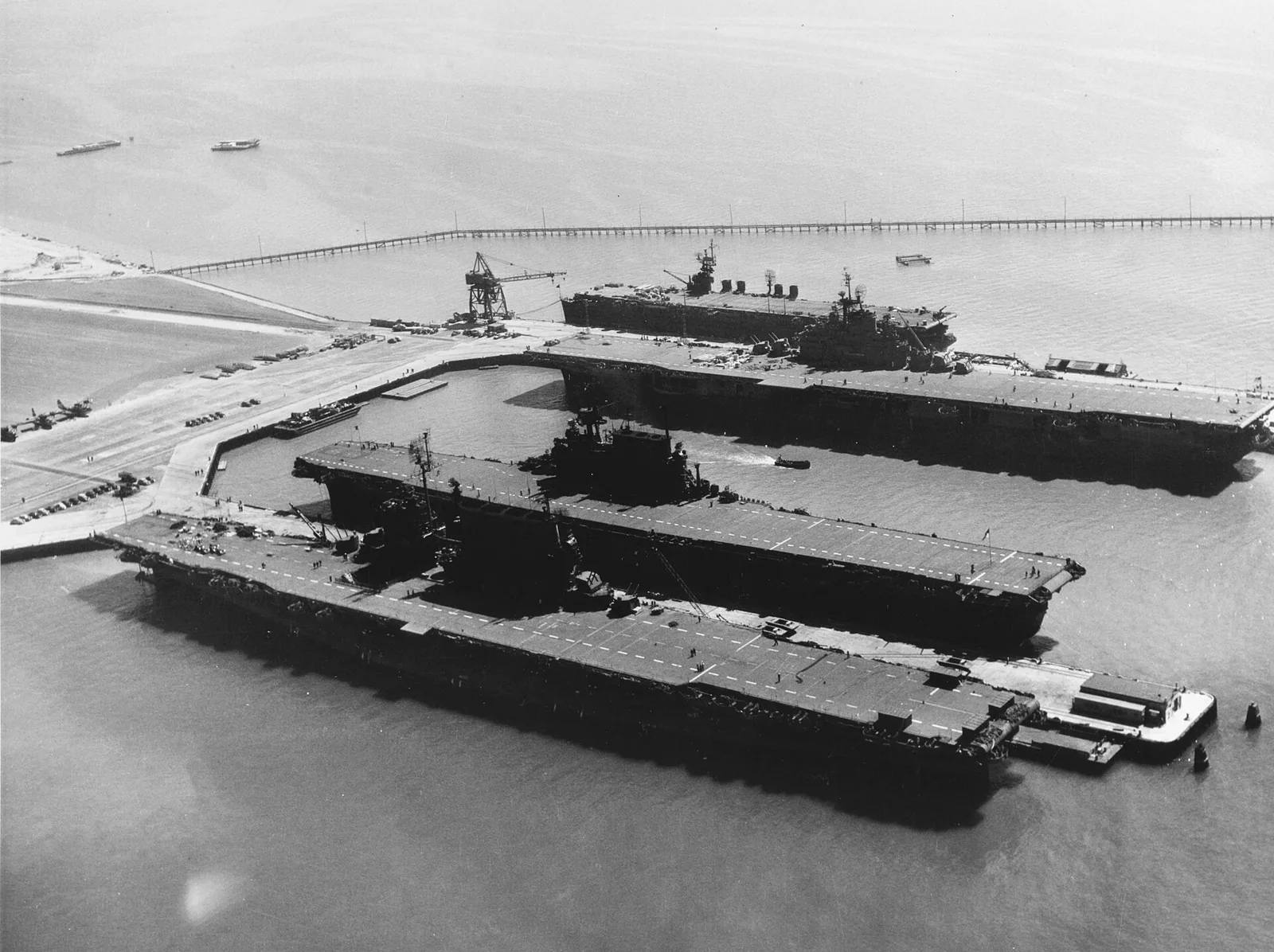
She was decommissioned on 1 March 1947 and joined the Pacific Reserve Fleet berthed at San Diego. Reclassified as an auxiliary aircraft transport (AVT-5) on 15 May 1959; she was struck from the Navy list on 1 June 1970.
Vietnam War period 1964–1975
1971
San Jacinto earned five battle stars and was awarded the Presidential Unit citation. Her hull was sold for scrapping on 15 December 1971 to National Metal and Steel Co., Terminal Island, Calif.
Other photographs
Held for this vessel, and not tied to any part of the account above.


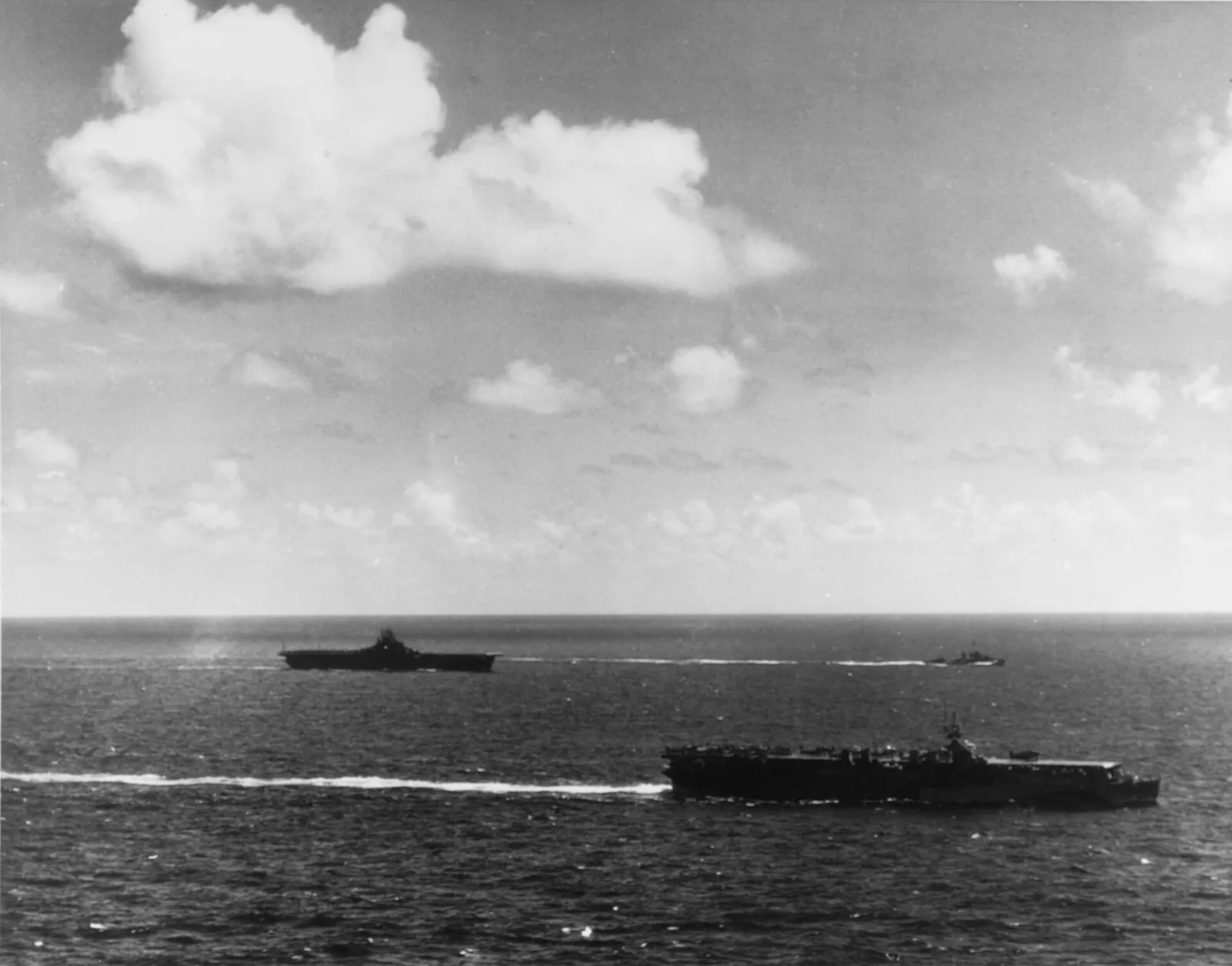
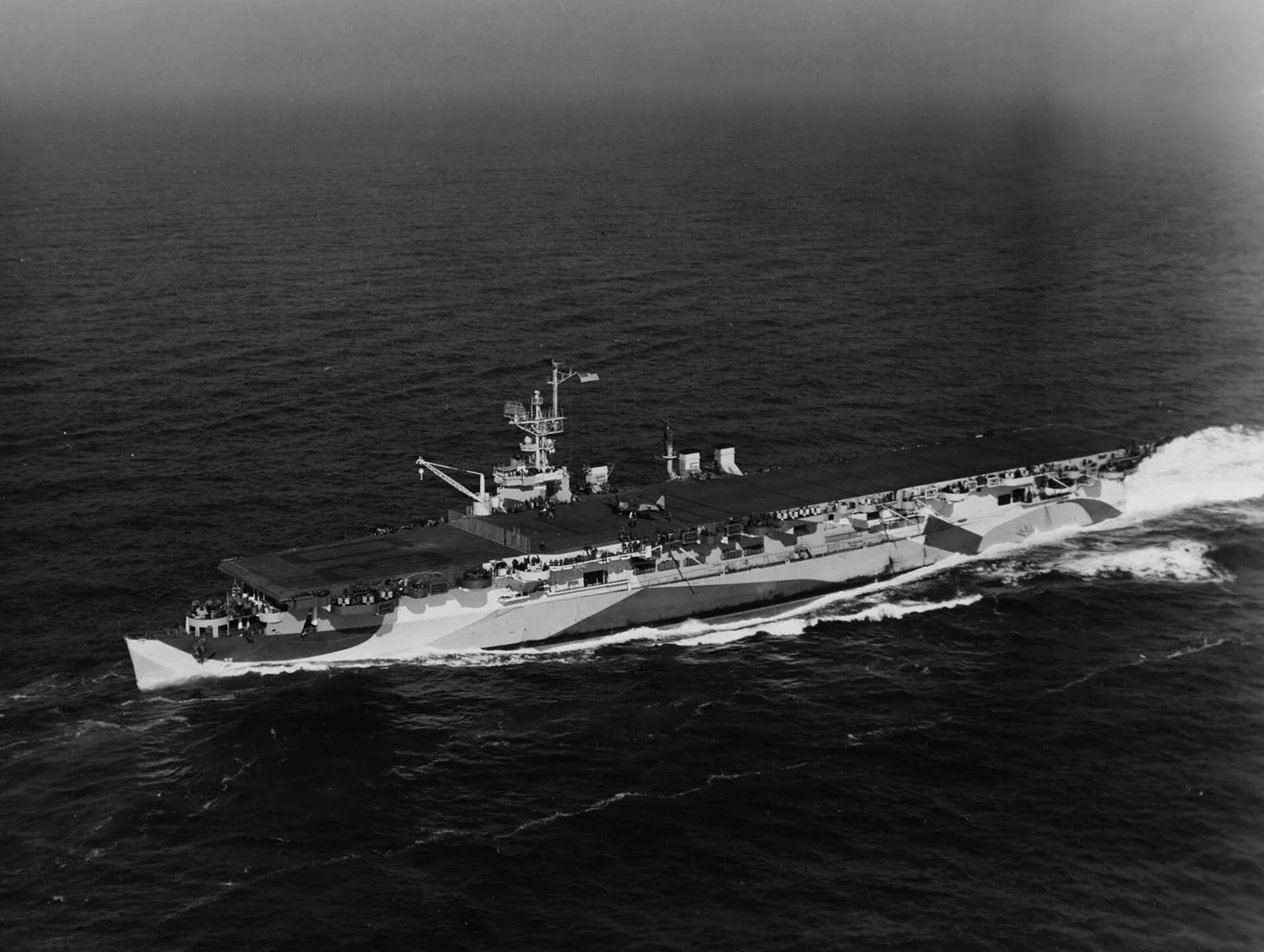
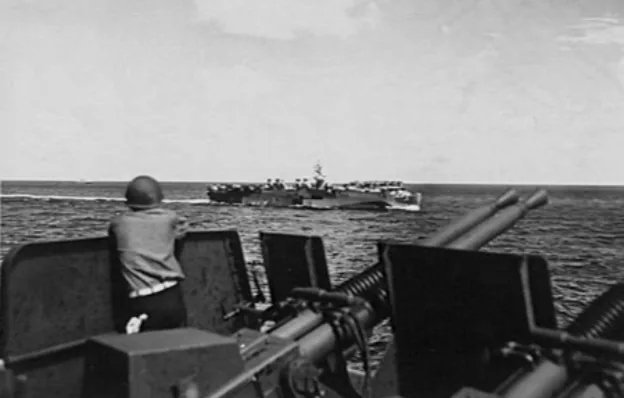
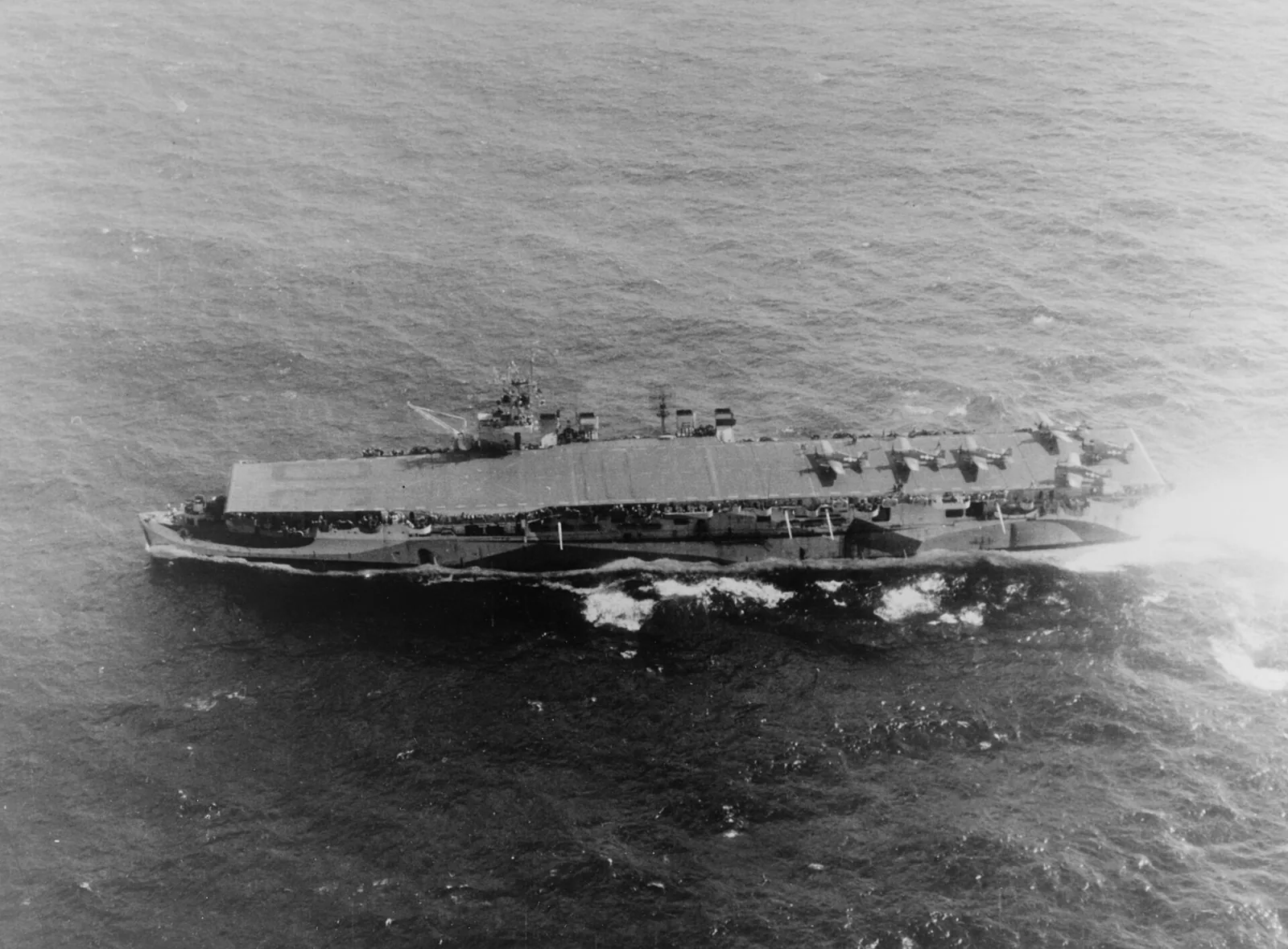
References
Every work this entry draws on. There are no numbered markers in the text above: what we hold is the provenance of the page — this history, this article, these photographs.
- History San Jacinto II (CVL-30) Dictionary of American Naval Fighting Ships, Naval History and Heritage Command. A work of the United States Government, in the public domain — the only text on this site reproduced verbatim.
- Facts USS San Jacinto (CVL-30) Structured facts only — dates, dimensions, armament and fate. No wording is taken from it. Harvested 1 August 2026.
- Photograph USS San Jacinto (CVL-30) underway at sea on 23 January 1944 (80-G-212799) Unknown author , photographed from a Squadron ZP-14 blimp. — U.S. Navy photo 80-G-212799 — Public domain — Wikimedia Commons
- Photograph George H.W. Bush seated in a Grumman TBM Avenger, circa 1944 (H069-13) Unknown author — U.S. Navy photo H069-13 — Public domain — Wikimedia Commons
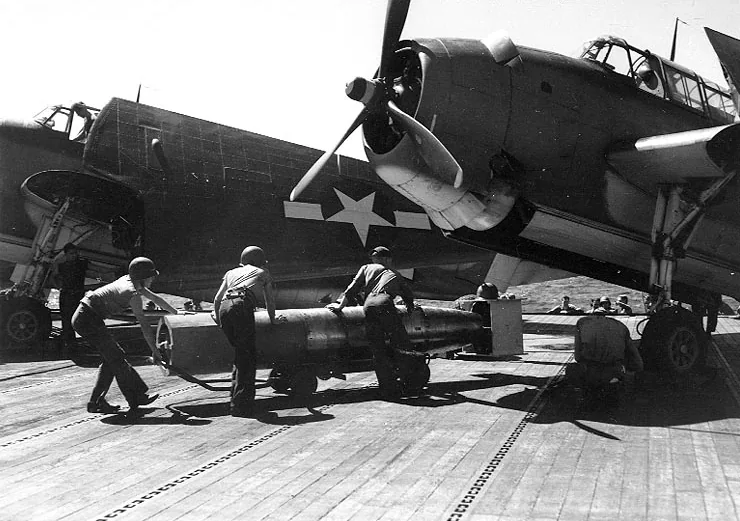
- Photograph Torpedo is loaded on TBM aboard USS San Jacinto (CVL-30) in October 1944 USN — Official U.S. Navy photo 80-G-284708 from the U.S. Navy Naval History and Heritage Command — Public domain — Wikimedia Commons
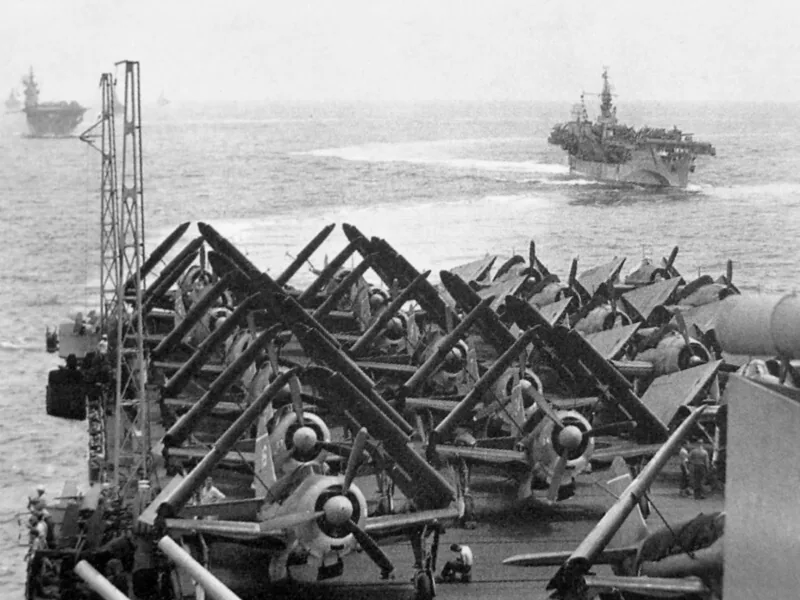
- Photograph F6Fs on USS San Jacinto CVL-30 1945 U.S. Navy — U.S. Navy National Museum of Naval Aviation photo No. 1996.253.7185.018 [1] — Public domain — Wikimedia Commons
- Photograph US Navy 100715-N-3885H-006 Former President George H.W. Bush looks at a display of his former ship, the aircraft carrier USS San Jacinto (CVL 30), in the tribute room of the aircraft carrier that bears his name, USS George H.W U.S. Navy photo by Mass Communication Specialist 3rd Class Nicholas Hall — This image was released by the United States Navy with the ID 100715-N-3885H-006 (next) — Public domain — Wikimedia Commons
- Photograph 80-G-490162 Raids on Japan, 1945 Unknown, presumed official US Naval photographer — https://www.history.navy.mil/content/history/nhhc/our-collections/photography/numerical-list-of-images/nhhc-series/nh-series/80-G-490000/80-G-490162.html — Public domain — Wikimedia Commons
- Photograph Deck Log of USS SAN JACINTO (CVL-30), September 2, 1944. - NARA - 305182, page 2 Unknown author or not provided — U.S. National Archives and Records Administration — Public domain — Wikimedia Commons
- Photograph Deck Log of USS SAN JACINTO (CVL-30), September 2, 1944. - NARA - 305182 Unknown author or not provided — U.S. National Archives and Records Administration — Public domain — Wikimedia Commons
- Photograph Essex,San Jacinto,Wasp before Marianas campaign,1944 05 27 Steve Whitby — https://www.navsource.net/archives/02/09.htm — Public domain — Wikimedia Commons
- Photograph General Motors TBM-1C Avenger of VT-51 takes off from USS San Jacinto (CVL-30) on 28 June 1944 (80-G-238783) Unknown author — U.S. Navy photo 80-G-238783 — Public domain — Wikimedia Commons
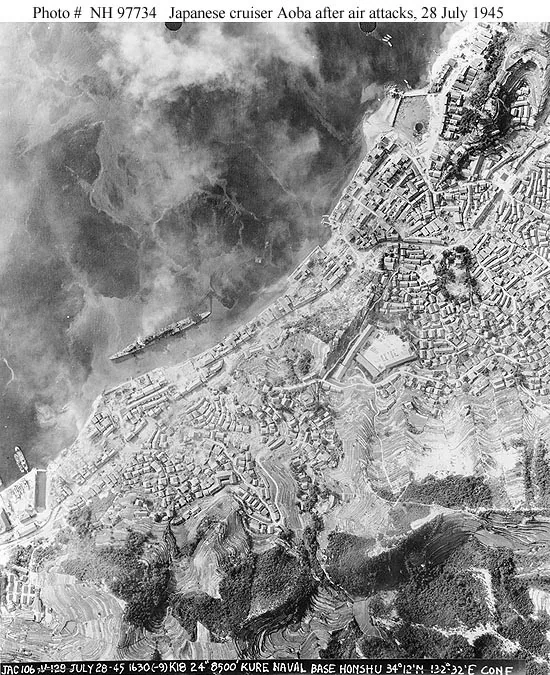
- Photograph NH 97734 Aoba Unknown, presumed US Navy official photographer — https://www.history.navy.mil/content/history/nhhc/our-collections/photography/numerical-list-of-images/nhhc-series/nh-series/NH-97000/NH-97734.html — Public domain — Wikimedia Commons
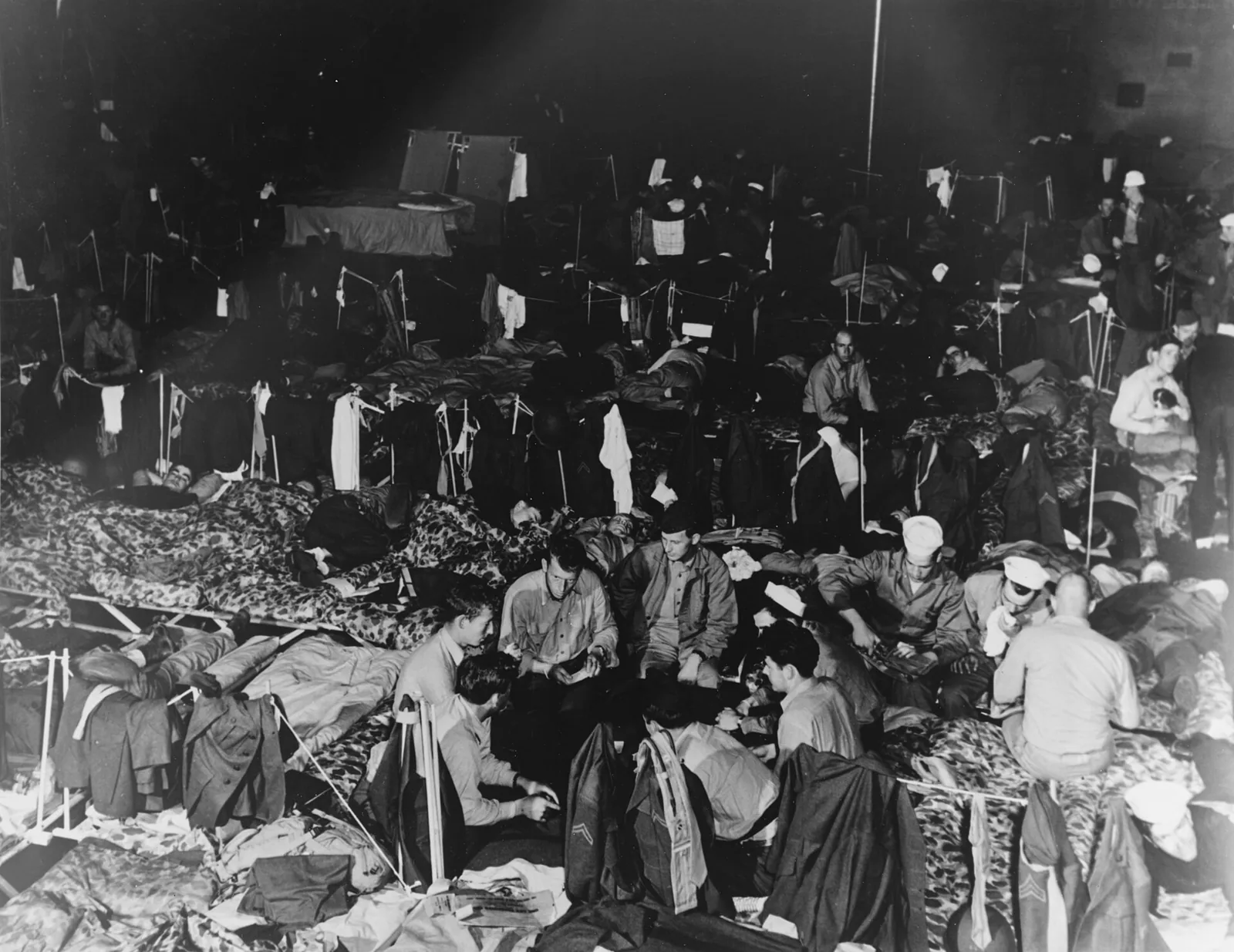
- Photograph Sailors in hangar of USS San Jacinto (CVL-30) in April 1944 U.S. Navy — Official U.S. Navy photo 80-G-265687 from the U.S. Navy Naval History and Heritage Command — Public domain — Wikimedia Commons
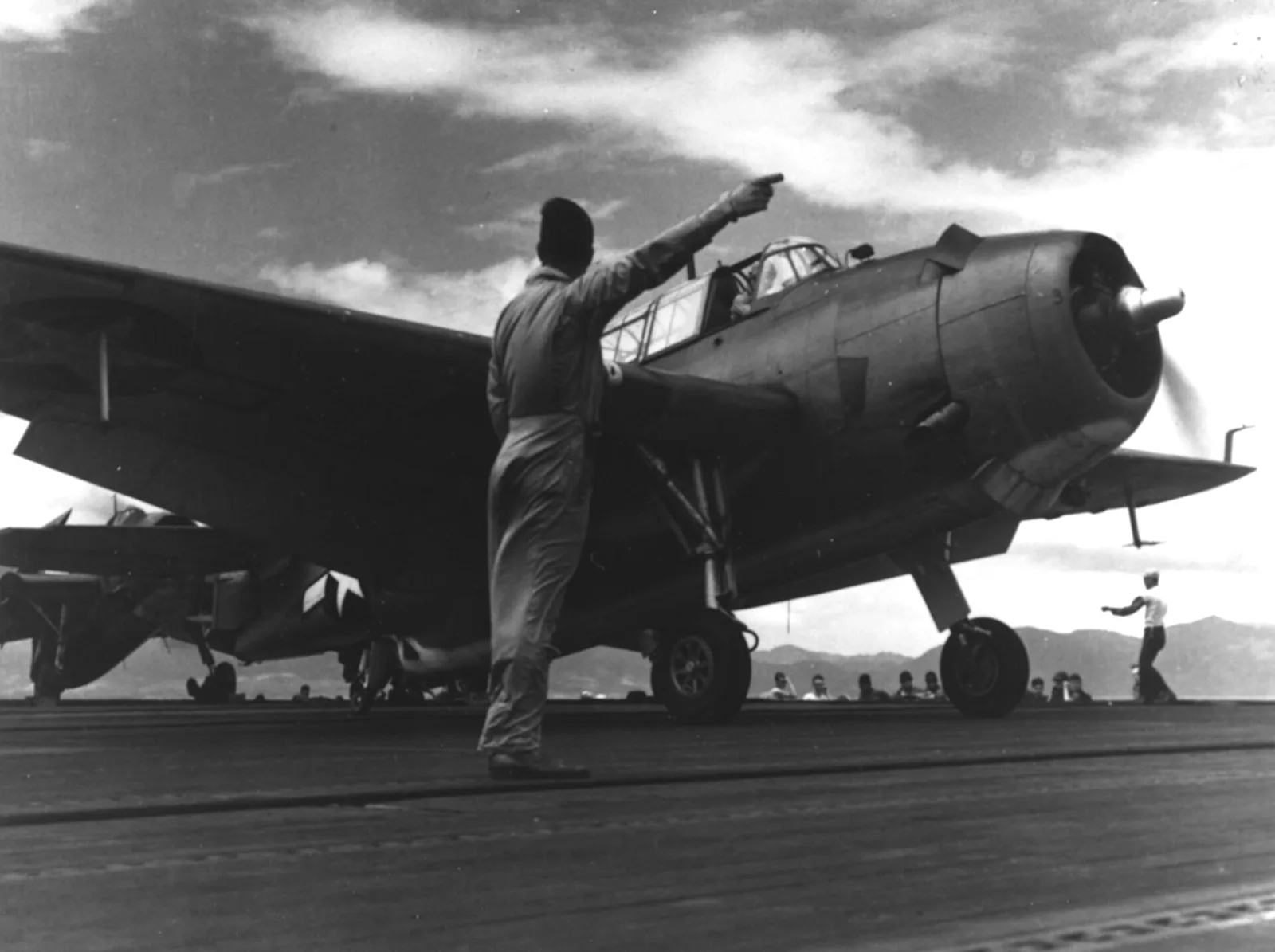
- Photograph TBM-1C of VT-51 launches from USS San Jacinto (CVL-30) in May 1944 U.S. Navy — Official U.S. Navy photo 80-G-238772 from the U.S. Navy Naval History and Heritage Command — Public domain — Wikimedia Commons
- Photograph USS Belleau Wood (CVL-24) underway with other ships, in 1945 U.S. Navy — U.S. Navy photo [1] from the USS Belleau Wood (CVL-24) 1943-1945 cruise book available at Navysite.de — Public domain — Wikimedia Commons
- Photograph USS San Jacinto (CVL-30) and USS Lexington (CV-16) underway in June 1944 U.S. Navy — Official U.S. Navy photo 80-G-238786 from the U.S. Navy Naval History and Heritage Command — Public domain — Wikimedia Commons
- Photograph USS San Jacinto (CVL-30) off the Philadelphia Naval Shipyard on 17 January 1944 (NH 43506) Unknown author — U.S. Navy photo NH 43506 — Public domain — Wikimedia Commons
- Photograph USS San Jacinto (CVL-30) underway at sea on 23 January 1944 (80-G-212798) Unknown author , photographed from a Squadron ZP-14 blimp. — U.S. Navy photo 80-G-212798 — Public domain — Wikimedia Commons
- Photograph USS San Jacinto (CVL-30) underway June 1945 Australian armed forces — Public domain — Wikimedia Commons
- Photograph USS San Jacinto (CVL-30) underway on 31 May 1944 U.S. Navy — Official U.S. Navy photo 80-G-265714 from the U.S. Navy Naval History and Heritage Command — Public domain — Wikimedia Commons
- Photograph USS Saratoga (CV-3), USS Enterprise (CV-6), USS Hornet (CV-12) and USS San Jacinto (CVL-30) docked at Alameda in September 1945 (80-G-701512) Unknown author — U.S. Navy photo 80-G-701512 — Public domain — Wikimedia Commons