United States Navy — Submarine
USS Seal (SS-183) — service history
This is the full service history. For the vessel's particulars, photograph and specifications, see the entry.
In the words of the US Navy. The account below is reproduced verbatim from the Dictionary of American Naval Fighting Ships, compiled by the Naval History and Heritage Command — a work of the United States Government, in the public domain, and the only text on this site not written here.
Before commissioning
Launched as Seal in February 1911, the first submarine built for the Navy by Simon Lake was renamed G-1 (q.v.) on 17 November 1911.
Interwar 1919–1938
1936
Seal (SS-183) was laid down on 25 May 1936 by the Electric Boat Company, Groton, Conn.; launched on 25 April 1937; sponsored by Mrs. John F. Greenslade; and commissioned on 30 April 1937, Lt. Karl G. Hensel in command.
Second World War 1939–1945
1939
Following an extended shakedown cruise in the Caribbean and a post-shakedown yard period, Seal departed New England in late November and proceeded to the Panama Canal Zone to commence operations out of her home port, Coco Solo. Arriving on 3 December, she conducted local operations off Balboa and off Coco Solo into January 1939; then proceeded to Haiti where she participated in type exercises prior to Fleet Problem XX. That exercise, to test the fleet's ability to control the approaches to Central and South America, was conducted during late February in the Lesser Antilles.
In March, Seal returned to the Haiti-Cuba area for exercises with Destroyer Division 4. In April, she proceeded to New London for overhaul which included modification of her main engines. In June, the submarine again sailed south, transited the Panama Canal, and continued on to San Diego and Pearl Harbor. In Hawaii from July to September, she took soundings for the Hydrographic Office and participated in variouslocal exercises. At the end of the latter month, she returned to San Diego, her home port into 1941.
During the next two years, she conducted exercises and provided services to surface ships and to Naval and Army air units along the west coast and in the Hawaiian area. In the fall of 1941, her division (SubDiv 21) was transferred to the Asiatic Fleet. Departing Pearl Harbor on 24 October, she reached Manila on 10 November; and, 34 days later, cleared that bay to commence her first war patrol. She headed north to intercept Japanese forces moving into northern Luzon to reinforce those already landed at Vigan and Aparri.
1941
Initially off Cape Bojeador, she shifted south to the Vigan area on the 20th and, on the 23d, torpedoed and sank Hayataka Maru, the last Japanese ship sunk by American torpedoes in December 1941.
1942
From the Vigan area, the submarine moved into the approaches to Lingayen Gulf; and, in January 1942, she again turned north to patrol the entrance to Lamon Bay. She rounded Cape Bojeador on the 9th and Cape Engano on the 10th; and, on the 11th-as the Japanese invaded the Netherlands East Indies at Tarakan, Borneo, and Minahasa, Celebes-she headed south for the Molucca Passage. By the 20th, she was patrolling east of the Celebes to intercept enemy traffic into Kema. On the 27th, she was ordered to patrol off Kendari, which had been attacked on the 24th and then to proceed to the Royal Netherlands Naval Base at Soerabaja, then still under Allied control.
Seal arrived at Soerabaja on 5 February. Daily air raids necessitated diving during the day and precluded repairs to her engines, which smoked excessively, and to the broken prism control mechanism in her high periscope. On the 11th, she departed for Tjilatjap on the south coast of Java; and there, on the 14th, she went alongside the tender Holland. That same day, the Japanese moved into southern Sumatra; and, on the 19th, they invaded Bali. Allied forces counterattacked; and, as air and surface forces hit the Japanese fleet, Seal departed Tjilatjap and transited Lombok Strait to patrol north of Java. On the 24th, she attacked two convoys but was able to damage only one freighter. The next day, she unsuccessfully attacked an enemy warship formation. On 1 March, as the Japanese moved against Soerabaja, she was similarly disappointed. On the 14th, she headed east to patrol the southern approaches to Makassar City; and, for the next week, with her forward air conditioning unit broken down and her refrigerating plant inoperable, she patrolled between that city and De Bril Bank. On the 21st, she headed for Fremantle, Western Australia, the Netherlands East Indies had fallen.
Arriving on 9 April, Seal departed again on 12 May and worked her way through the Malay Archipelago, the Celebes Sea, and the Sulu Sea to her patrol area off the Indochina coast. During the early morning hours of the 28th, she entered the South China Sea: and, that night, she fired on and sank the 1,946-ton Tatsufuku Maru. On 7 June, while off Cam Ranh Bay, she attacked an eight-ship convoy and underwent a seven-hour depth charging by surface ships and aircraft. From the 15th to the evening of the 17th, heavy seas and high winds hampered hunting; and, on the 18th, "a healthy stream of air bubbles" was discovered "issuing from the starboard side . . ." On the 19th, she left the area and headed for Balabac Strait. On the 23d, she moved into Makassar Strait; and, on the 4th of July, she reached Fremantle.
On her fourth war patrol, 10 August to 2 October 1942, Seal returned to the Indochina coast and patrolled north from Cape Padaran. Despite 11 sightings, she was plagued by uncertain torpedo performance against shallow draft vessels; by premature explosions; and by leaky exhaust valves and holes in the fuel compensating line which resulted in air and oil leaks to the surface. She was able to damage only one cargo ship, on 3 September.
Twelve days later, Seal was en route back to Fre-mantle. She arrived on 2 October and departed again on the 24th to patrol in the shipping lanes in the Palau area. On 16 November, she intercepted a convoy of five cargomen in two columns with a destroyer escort and conducted a submerged attack on the leader of the near column as the formation zigzagged toward the submarine. Less than a minute after firing, Seal collided with, or was rammed by, another enemy ship. The periscope went black and vibrated severely. The submarine rose to 55 feet; hung there nearly a minute; then started down. A few minutes later, depth charging began and Seal leveled off at 250 feet. Breaking up noises were heard. Pour hours later, the area was clear and Seal surfaced. The high periscope had been bent horizontally, and the housing on the low periscope had been sprung preventing its operation. The radar antenna had been broken off the radio mast. Quantities of uncooked rice and beans, unlike those used on the submarine, were found between the wooden deck pieces of the cigarette deck, on the bridge, and caught in the bathythermograph. The periscope shears yielded "a good sample of Japanese bottom paint."
Captured Japanese documents later confirmed the sinking of the 3,500-ton freighter Boston Maru by an American submarine on that date in that location. Whether that ship was Seal's target or the colliding ship is not known, but it is possible that the freighter's hull had been badly punctured by the submarine's periscope shears.
1943
On the 17th, Seal was ordered to start for Pearl Harbor. She arrived on the 30th; and, after temporary repairs, continued on to the Mare Island Navy Yard for permanent repairs. On 2 April 1943, she returned to Hawaii; and, 12 days later, she departed on her sixth war partol. On the 18th, she topped off at Midway; and, by 1 May, she was patrolling off the Palaus. On the 2d, she attacked a freighter; missed; and subsequently came under an aerial bombing attack. On the 4th, she sank a tanker, San Clemente Maru; but, for the remainder of the patrol, was unable to close any targets.
Seal returned to Midway on 3 June. Refit took two weeks; training, a third. On 24 June, she was ready for sea. On 2 July, she entered her area off Todo Saki on the northeastern Honshu coast; and, on the 8th, she underwent a severe, ten-hour, depth charging which resulted in persistent air and oil leaks and forced her to turn back for repairs.
She arrived at Pearl Harbor on the 24th. Her repairs were quickly completed; and, in mid-August, she sailed west again. On the 27th, she entered the southern Kurils. On the 31st, while the submarine was diving, the conning tower hatch failed to latch; and the hatch flew open. The pumproom was flooded before the boat could be surfaced. Substantial damage to her electrical circuits resulted, and Seal retired eastward to make temporary repairs. The work continued for a week; and, on the 8th, as the air compressors were being jury-rigged to provide sufficient air pressure to launch torpedoes, she returned to the Kurils and crossed into the Sea of Okhotsk. On the 17th, she attacked two freighters with no success. On the 25th, she cleared the area; and, on 4 October, she returned to Pearl Harbor.
During her next two war patrols, Seal provided lifeguard services and conducted reconnaissance missions-at Kwajalein on the ninth (7 November to 19 December 1943) and at Ponape on the tenth (17 January to 6 March 1944). She then proceeded to Mare Island; and, after reengining and overhaul, returned to the northern Hokkaido-Kurils area for her eleventh war patrol, 8 August to 17 September 1944.
With 14 to 15 hours of daylight, she hunted in the coastal and interisland shipping lanes to Muroran, Matsuwa, and Paramushiro. On the 24th, she attacked and sank Tosei Maru off Erimo Saki. On 5 September, after a six-hour chase, she fired four torpedoes at a maru with one escort; but all missed. On the night of the 8th, she contacted a two-column, six-ship convoy with an escort on each wing and close in to the leading ship. Shortly after 2045, she fired four torpedoes at overlapping targets; then opened to the eastward as the torpedoes started hitting. Just before midnight, she again attacked the convoy, now comprised of only four ships. One freighter took two hits. A second maru turned to chase Seal. Seal retired briefly; and, just before 0300 on the 9th, hit the remainder of the convoy. Daylight brought antisubmarine aircraft to the scene, and Seal fishtailed at deep submergence until 1700. At 2026, having sunk the Shonan Maru and damaged three or four other ships, she headed for Midway, arriving on 17 September.
1944
On her twelfth and final war patrol, 10 October to 29 November 1944, Seal again hunted in the Kurils. Her 30 days in the area, however, yielded only two contacts worthy of torpedo fire. On 25 October, she caught and sank the three-island freighter Hakuyo Maru as it ran down the convoy lanes away from Paramushiro. Three weeks later, she attacked and damaged another maru off Etorofu (now Iturup). During the last days of the patrol, she ranged off the coast of Sakhalin, scoreless. On the 17th, she cleared the area.
1945
Seal arrived at Pearl Harbor on 29 November and, after refit, assumed training duties in the Hawaiian area. In June 1945, she returned to New London where she continued her training duties through the end of World War II. After the war, she was ordered inactivated and disposed of. In early November, she proceeded to Boston where she was decommissioned on 15 November; and, after a change in her orders, was retained in the Reserve Fleet. On 19 June 1947, she was placed in service and assigned to Boston as a Naval Reserve training ship; and, in March 1949, she was transferred to Portsmouth, N.H., where she continued to serve the Naval Reserve until placed out of service and struck from the Navy list on 1 May 1956. Six days later, she was removed from the Portsmouth Naval Shipyard for scrapping.
Other photographs
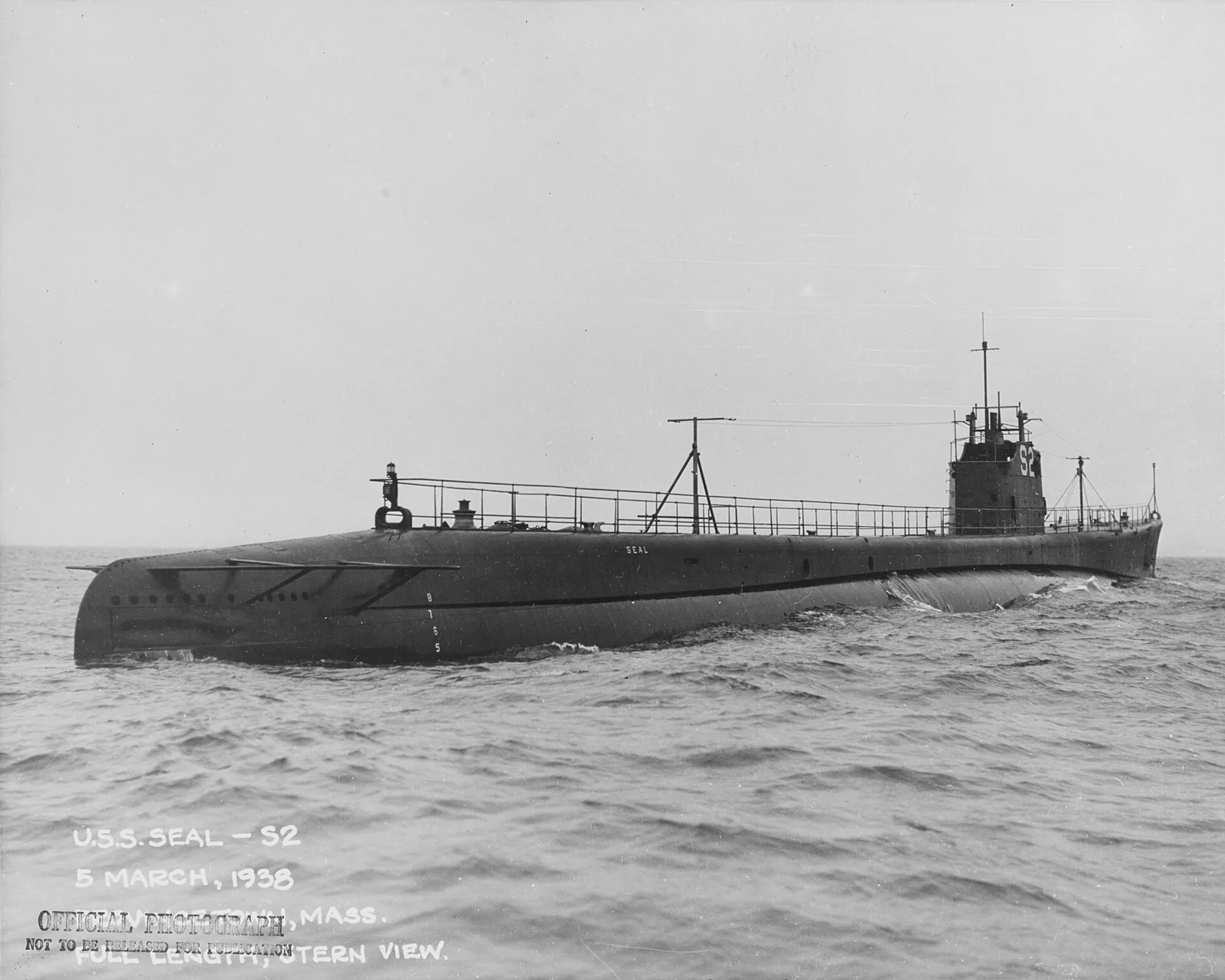
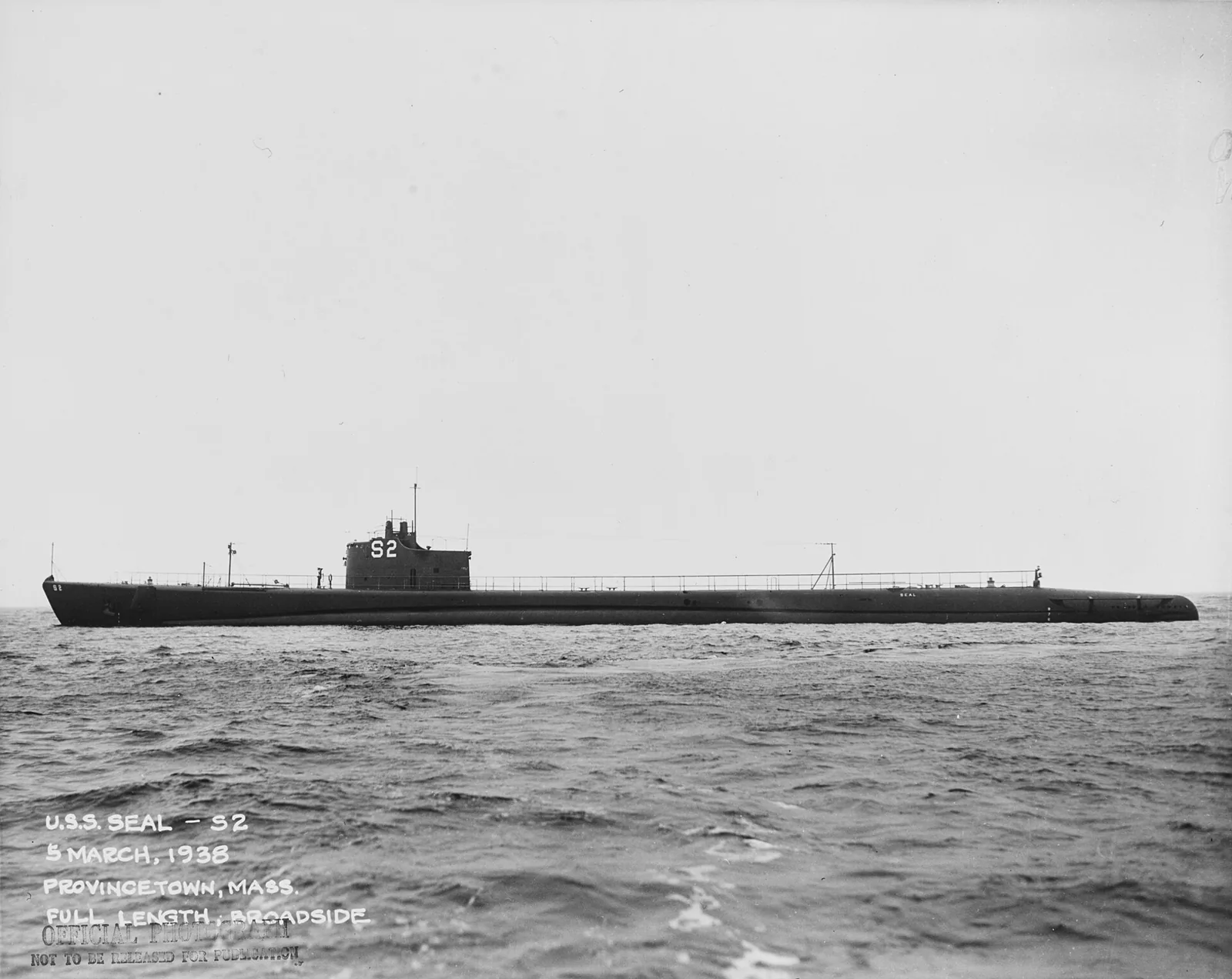
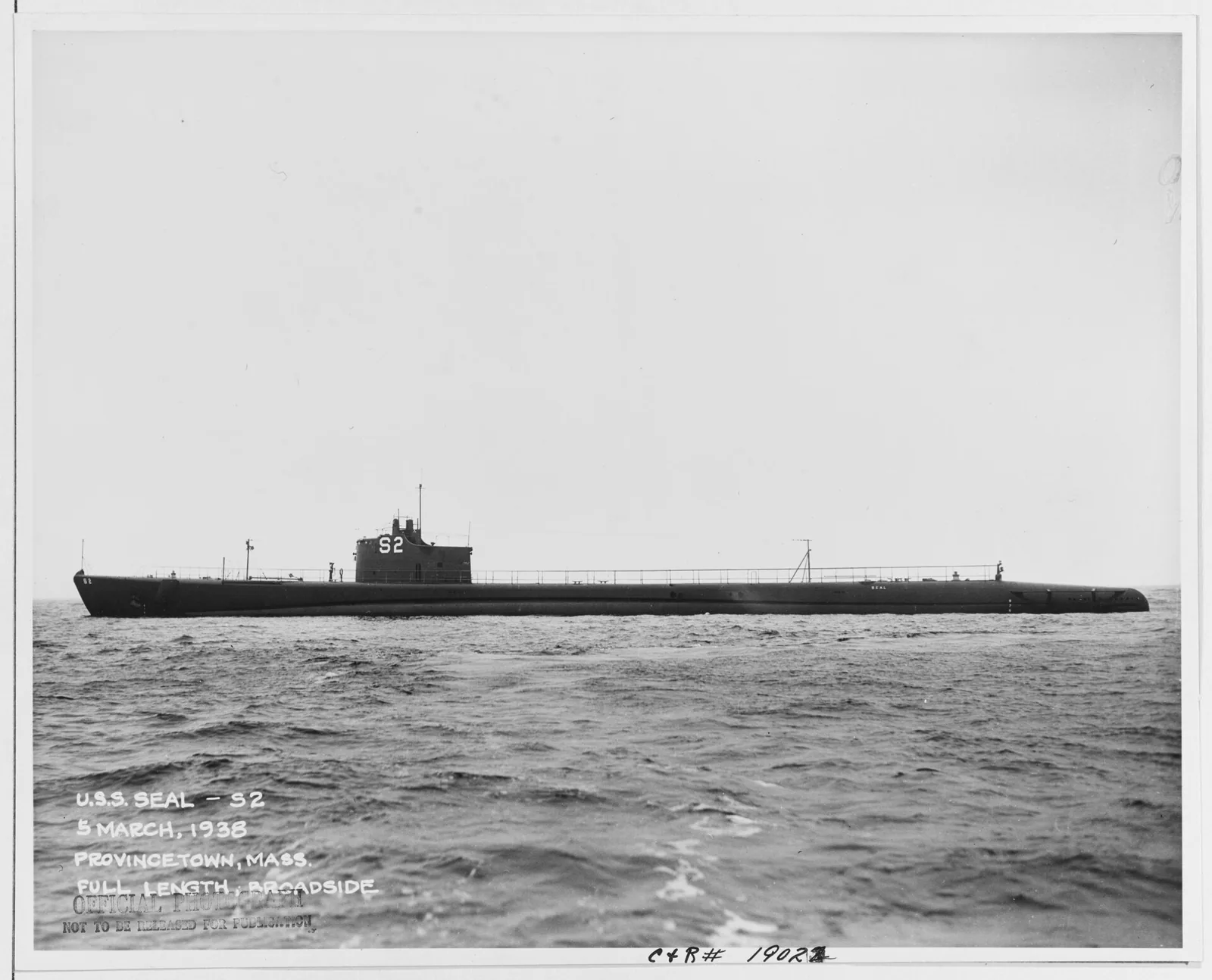
Held for this vessel, and not tied to any part of the account above.

References
Every work this entry draws on. There are no numbered markers in the text above: what we hold is the provenance of the page — this history, this article, these photographs.
- History Seal (SS-183) Dictionary of American Naval Fighting Ships, Naval History and Heritage Command. A work of the United States Government, in the public domain — the only text on this site reproduced verbatim.
- Facts USS Seal (SS-183) Structured facts only — dates, dimensions, armament and fate. No wording is taken from it. Harvested 1 August 2026.
- Photograph USS Seal (SS-183) U.S.Navy — http://www.history.navy.mil/photos/images/h91000/h91833c.htm http://www.history.navy.mil/photos/images/h91000/h91833.jpg — Public domain — Wikimedia Commons
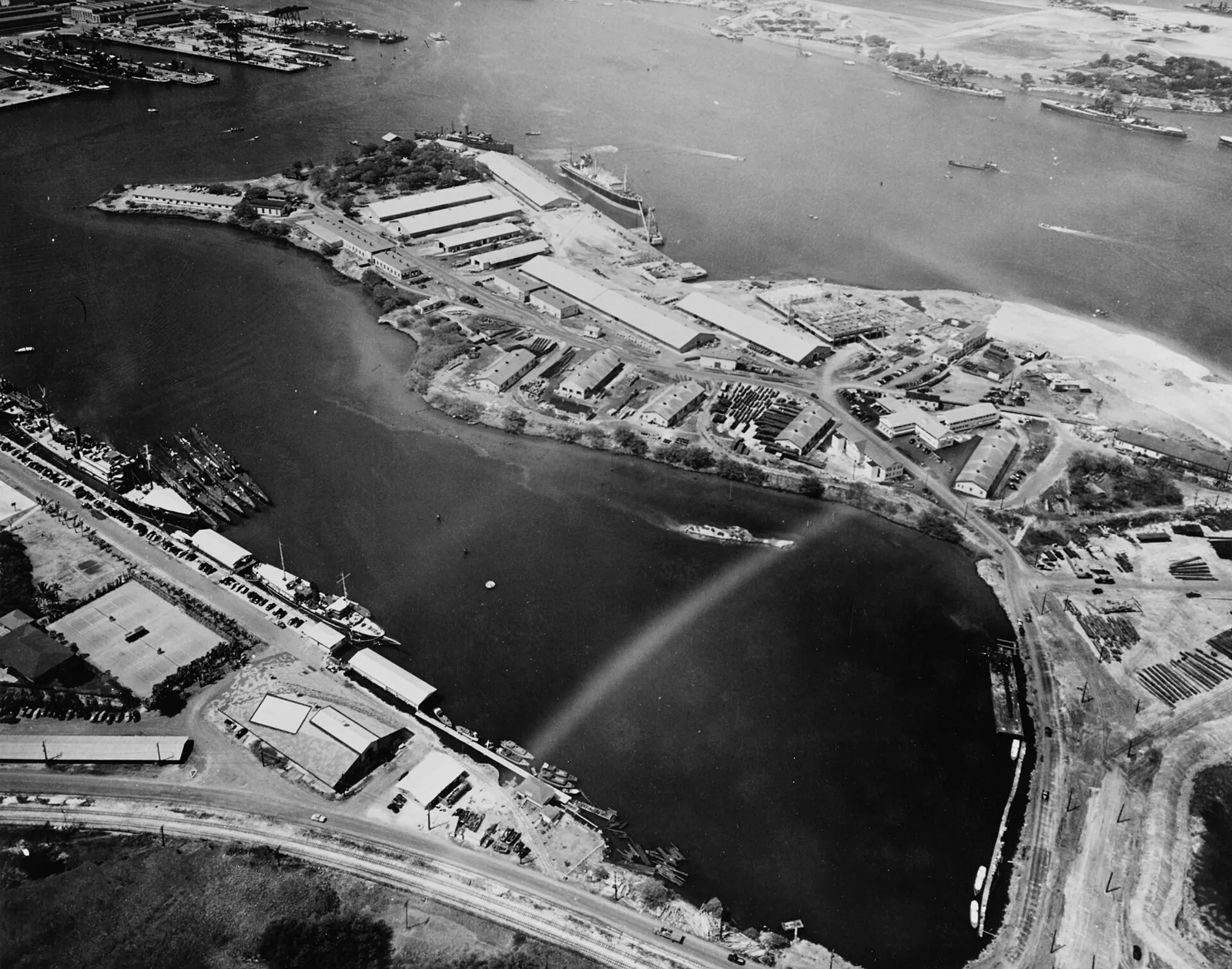
- Photograph Aerial view of Pearl Harbor Naval Base, looking west, with the supply depot in upper center, 13 October 1941 (80-G-451131) U.S. Navy — Official U.S. Navy photograph 80-G-451131 from the U.S. Navy Naval History and Heritage Command — Public domain — Wikimedia Commons
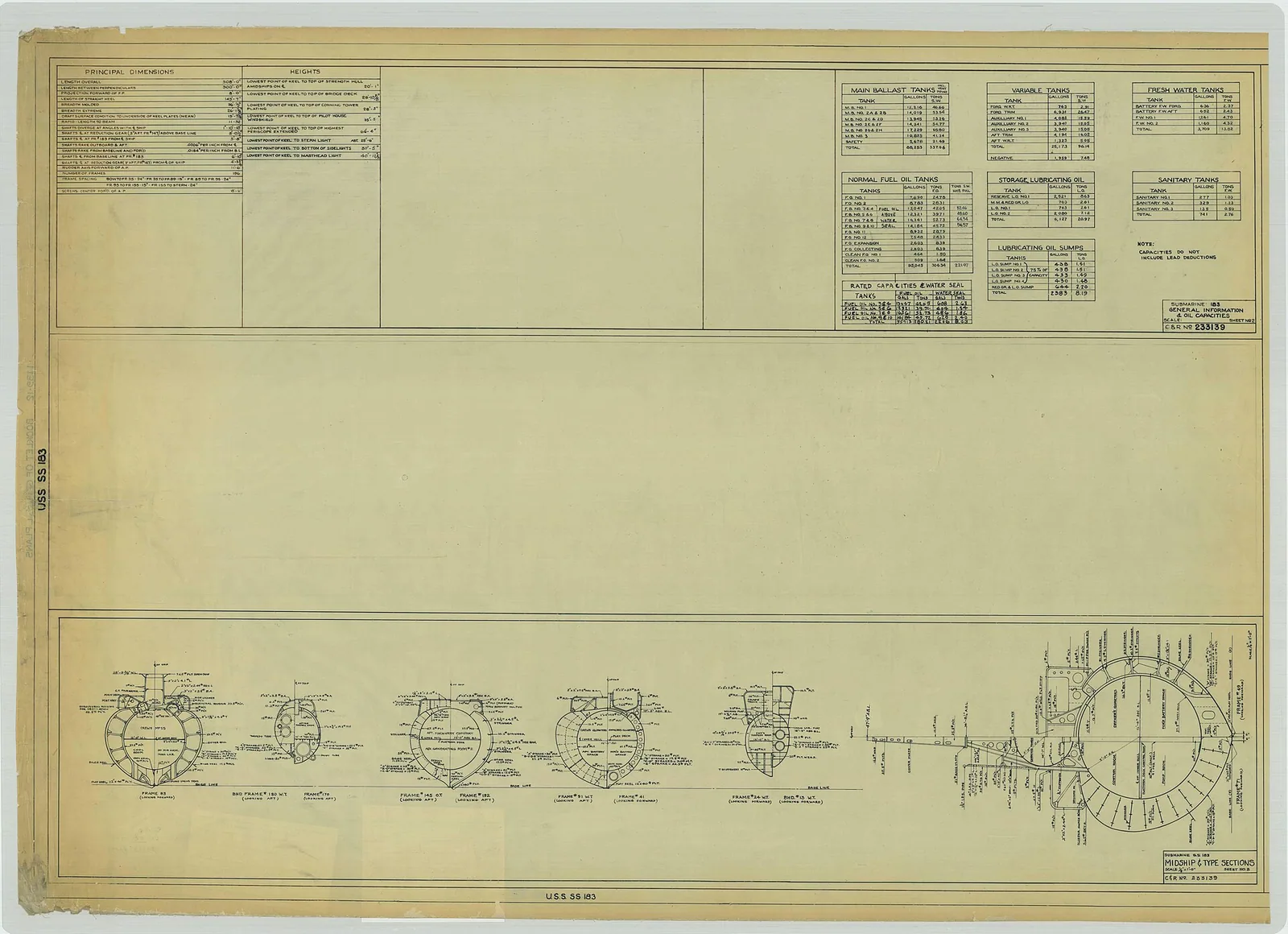
- Photograph USS Seal (SS-183)- Booklet of General Plans - General Information & Oil Capacities - Midship & Type Sections - NARA - 120547066 Unknown author or not provided — U.S. National Archives and Records Administration — Public domain — Wikimedia Commons
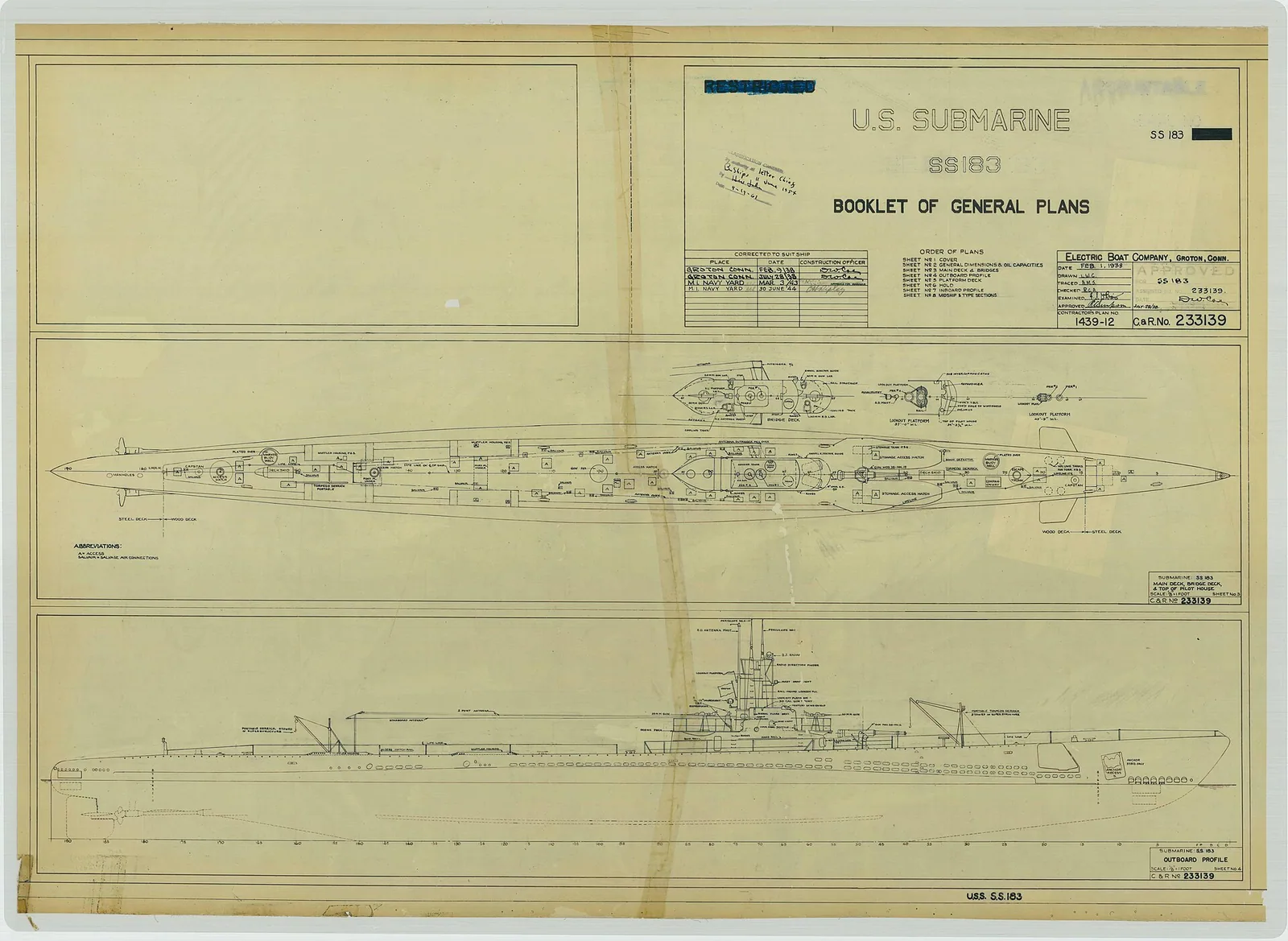
- Photograph USS Seal (SS-183)- Booklet of General Plans - Main Deck, Bridge Deck, & Top of Pilot House - Outboard Profile - NARA - 120547062 Unknown author or not provided — U.S. National Archives and Records Administration — Public domain — Wikimedia Commons
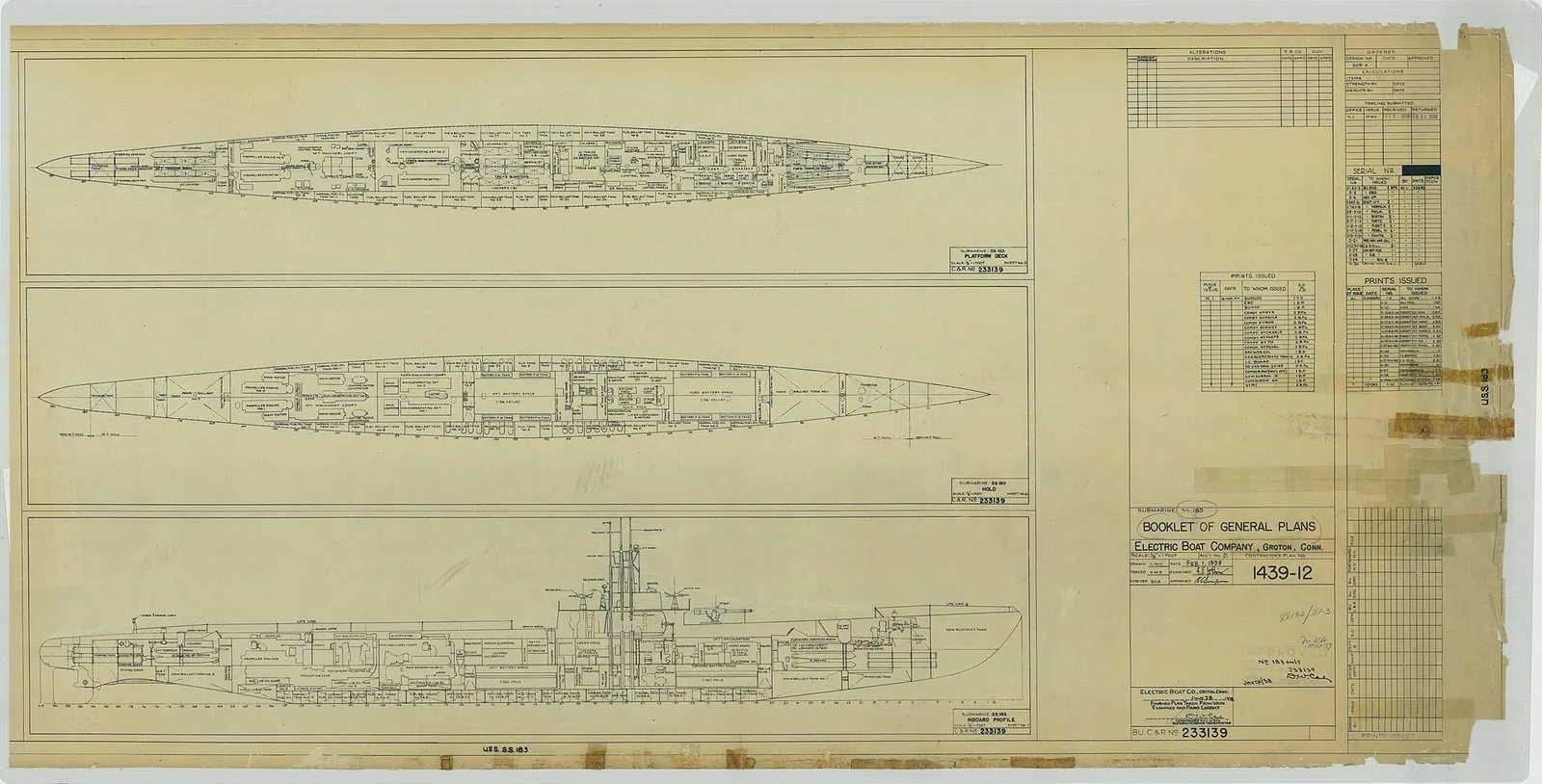
- Photograph USS Seal (SS-183)- Booklet of General Plans - Platform Deck - Hold - Inboard Profile - NARA - 120547064 Unknown author or not provided — U.S. National Archives and Records Administration — Public domain — Wikimedia Commons
- Photograph USS Seal - 19-N-19021 Unknown author — This image has been extracted from another file — Public domain — Wikimedia Commons
- Photograph USS Seal - 19-N-19021 Unknown author — 19-N-19021 — Public domain — Wikimedia Commons
- Photograph USS Seal - 19-N-19022 Unknown author — This image has been extracted from another file — Public domain — Wikimedia Commons
- Photograph USS Seal - 19-N-19022 Unknown author — 19-N-19022 — Public domain — Wikimedia Commons